singletracks is mountain biking
Sign In | Create Your Account | Site Map | Help  


Two MTB Trails, One Day: Enjoying my Fall Break

Tuesday, October 25th, 2011

My college gives us one day off for “Fall Break.” I’m not sure how a 3-day weekend qualifies for a vacation, but apparently it does! I decided to make the most of this precious time, so I hit the road and drove over to Ellijay, Georgia to investigate a couple of trails I’d never ridden before.

Ridgeway

First on my list was the Ridgeway Loop. I had heard that the hills were short, very steep and anaerobic, and that the trail didn’t receive much traffic… these reviews were dead on.

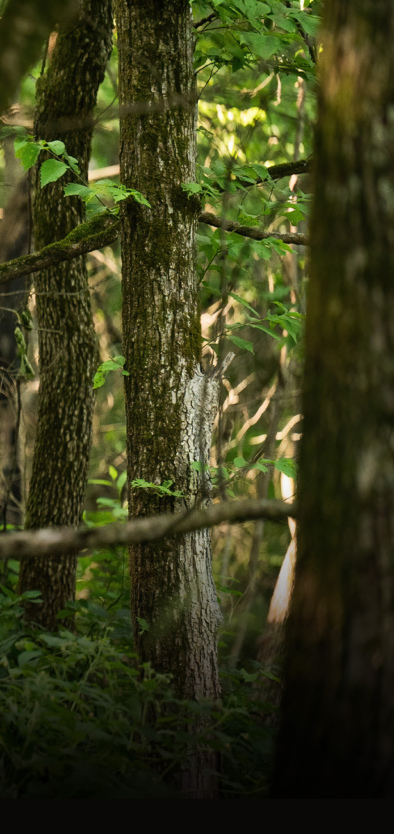
This photo is very characteristic of the entire trail.

This is definitely an old-school trail design that sends the singletrack straight up and straight down all the hills. Still, in spite of the design flaws, most of the climbs are manageable due to their short overall length; going anaerobic can be tough, but it can be done for a short time.

As for the condition of the singletrack itself, the trail doesn’t seem to receive much traffic at all. There were sticks, branches, and leaf litter on the main tread for miles. It was hard to tell, but it looked like the brush on the sides of the trail had recently been mowed down by a brush hog, and some of that debris fell on the singletrack as well. As a result, it might possibly receive more traffic than it appears to, but from one ride it was very difficult to tell.

Of course, the entire trail wasn’t actual singletrack… some rather lengthy sections were old doubletrack forest roads, and one section ran through what looked and felt like a tilled-up field, but there were a couple of singletrack jewels thrown in, too.

Hands down, the best section of trail was the last mile that drops down from the paved road junction before the turn off to the mountain bike parking and runs directly to the parking lot. This mile featured a modern trail design, and it looked like it had been cut more recently than the rest of the trail. However, it didn’t ride with the feel of a brand-new trail, so it’s difficult to say when they put this section in. Hopefully there is more of this in store for the rest of the trail!

When I dropped out into the parking lot after finishing with this swoopy delight, I had to ride back up the pavement and drop in again!

Taken on the best section of singletrack.

Downhill Trail

I had heard rumors of a downhill trail here at Ridgeway, so I packed my downhill rig, just in case. As my downhill bike isn’t in the best condition at the moment, I didn’t spend a lot of time trying to find the downhill course. I figured that if I saw the trail on my cross-country ride, then I’d go and check it out. Well, I didn’t see it, but when I got home and looked at the reviews, I realized that I should have read GoldenGoose’s review before I left, as the downhill trail apparently doesn’t actually touch any of the cross-country trails, but is very close to the parking lot.

Perhaps that’s another reason to go back and visit, but I do need to do some maintenance on my DH sled before I return!

Woodring Branch: Amadahy Trail

After spending too much time riding and hiking around in circles at Ridgeway, I finally made it to Woodring Branch to check out the Amadahy Trail.

Both of these trails are on the shores of Carter’s Lake, but they couldn’t be more different! While Ridgeway was steep, old-school, and anaerobic, Amadahy was very flat, easy, and flowed like a water slide!

The singletrack featured a beautiful bench-cut design that circles a large knob right on the shore of Carter’s Lake. The tread was mostly smooth with a light gravelly feel and is very fast, but there were a couple of entertaining sections of rocks and roots to break up the action.

While Ridgeway only provided views of Carter’s Lake, if you took a detour off the main trail, Amadahy follows the shore of the lake for about two thirds of its length. There are stunning views of the blue waters around every turn, with many opportunities for gorgeous photos.

At only 3.5 miles long, I just had to do two laps on this trail. Even then, 7 miles didn’t feel like enough. This is a wonderful little gold nugget of a trail, but it certainly isn’t a gold mine. If you live relatively close and want to check this place out, I highly recommend it, but there’s just not enough trail to make me drive an hour each way to get here again.

Your Turn: Have you ridden a new trail recently? Which one was it?

Dakine Syncline MTB Short Review

Thursday, October 6th, 2011

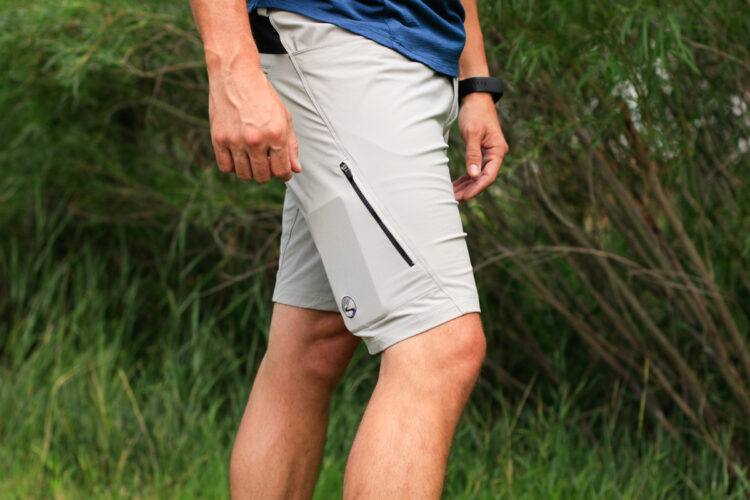
The Dakine Syncline features an “all-mountain fit” with a 14.5″ inseam. It has a conveniently removable Italian-made Comp chamois, ventilated mesh lining, zippered hand pockets and leg vents, a heavyweight rib knit back stretch panel, side waist tab adjustments, polyester birdseye waistband, and a crotch gusset for an increased range of motion.

But what does all of that even mean? Nothing if it doesn’t translate into a comfortable ride out on the trail.

Out on the Trail in the Syncline

I first tested the Syncline shorts during a long day of shredding the Evolution Bike Park at Crested Butte Mountain Resort. The baggy fit easily accommodated some beefy knee pads without any catching or binding. Thanks to the removable chamois, I think you could easily wear a hip and tail bone protector under these shorts and still feel very comfortable (although I haven’t tried them with one yet). The exterior of the Syncline short is much heavier and tougher than a cross-country short (as you’d expect) since it’s built to survive a few tumbles off the bike now and again without getting shredded to pieces. I’ll admit I took a couple of spills, and the Syncline shorts thought nothing of them.

When is a pair of downhill shorts just another pair of shorts… and when is it something more?

Obviously, the Syncline is designed for the downhill aficionado, and with all of these DH-specific features and its durable build, it excels in this category.

I was surprised to discover that the Syncline performs well in a number of other applications, too.

Cross-country

Despite the fact that these shorts hit below the knee, they ride very well even on cross country rides. I guess the “all-mountain fit” lives up to its name, by keeping them from catching on the knee or saddle. There were several chilly, early-morning rides in Crested Butte when I threw the Syncline on for a little extra warmth, and they were both comfortable and toasty! Obviously, because of the heavy, durable exterior they wouldn’t be ideal for hot summertime rides, but as the temps continue to cool here in North Georgia I am looking forward to many fall rides in the Synclines,

Commuting

The cooler fall temperatures have also convinced me to start commuting to school again. As a result, my Syncline shorts have been seeing significant use as a pair of commuter shorts. They’re the perfect mix between bicycle comfort and classroom style. I don’t have to  destroy my taint on the uphill slog to campus, and I don’t have to pack an extra pair of shorts to change into before class. Dakine’s Phantom pattern (tested) is low-key enough to not draw any weird stares from my fellow English students. Want to sport a different style? The Synclines are available in 5 different colors.

Bottom Line

From the big hit bike to the carbon hardtail to the commuter, the Syncline shorts provide stellar performance and classy style!

MSRP: $135.

Many thanks to Dakine for providing the Syncline shorts for review.

Specialized Camber Pro 29er Mountain Bike Review

Wednesday, September 14th, 2011

The Specialized Camber Pro 29er is more mountain bike than most riders deserve – and yet it’s not even top of the Specialized line. With decades of experience designing and building mountain bikes, Specialized has applied that knowledge to the Camber Pro, resulting in a high performance FS 29er that’s built for going fast and winning races.

Like the Tallboy from Santa Cruz, I went into my demo ride assuming the Camber Pro would feel a bit sluggish and unnecessarily heavy. Of course once again I was completely wrong. The Camber Pro is probably the most responsive FS 29er I tested and it was ultra-snappy on the climbs. At medium speed over rocks the bike felt a little twitchy and stiff but once I opened things up the suspension felt plush. Of course it’s always hard to pinpoint exactly what’s affecting the feel of a bike – everything from tire pressure to shock settings to frame materials plays a role.  Still, I can say the Camber Pro has a racy feel that seems to be part of its DNA.

Unlike the top of the line S-works Stumpjumper 29er, the Camber Pro is not a full carbon bike – the rear triangle is alloy. Still, the bike is very light and felt just as stiff (or even more stiff) than other full carbon bikes I tested. With 120mm of travel this bike dips its toe into Trail bike waters but to me it’s a pretty solidly XC bike. Still, some of the features – like wider handlebars and a Specialized dropper seatpost – lean toward Trail bike territory.

Specialized has a reputation for producing dialed-in racing machines and the Camber Pro is no exception. It’s a sexy looking bike that’s efficient at getting its job done, all in a neat, FS 29er package. Want to win full-on singletrack century bike races? The Camber Pro might just be your ticket.

Santa Cruz Tallboy Carbon 29er Mountain Bike Review

Tuesday, September 13th, 2011

I came into my demo of the Santa Cruz Tallboy assuming I wouldn’t enjoy it. Don’t get me wrong, Santa Cruz makes amazing XC bikes and I’m a died-in-the-wool 29er rider, but before saddling up on the Tallboy, I had never ridden a full suspension (FS) 29er I really loved. Even just a year ago the FS 29ers on the market were mostly heavy, awkward, and usually suffered from serious pedal bob on the climbs. Luckily the Tallboy, with 100mm (about 4 inches) of front and rear travel, has none of those problems.

Santa Cruz makes two versions of the Tallboy – a full carbon beauty (the one I demoed) and an aluminum one for those looking to save a little coin. The full carbon frame weighs in at just about 5 pounds with shock and the fairly standard build I rode at Bootleg Canyon was even lighter than it looked. This bike felt fast – both on the climbs and the descents.

On the trail the Tallboy didn’t ride like a 29er to me (which is really a compliment). Maybe it’s because I’ve been riding my own 29er hardtail for a few years now but to me the Tallboy just felt like a really fun XC mountain bike. I honestly forgot it was a 29er or that it was even a FS bike – it was me and the trail and that was it. In fact I think this was my favorite of all the great FS 29ers I rode all day. The suspension let me sail over rocks, rail bermed turns, and descend faster than on my hardtail 29er at home.

One of the reasons I’ve stuck with my hardtail all these years is that I have zero patience for pedal bob. If I’m climbing, I want every bit of my energy going toward getting me to the top so I can bomb down the other side. In my experience, 29ers in particular suffer from even worse pedal bob than their 26-inch cousins, perhaps due to the increased leverage ratios. Needless to say, Santa Cruz has the Tallboy dialed in and once again, I found myself forgetting to think about the bike – pure bliss.

Clearly the Valencia orange paint job isn’t for everyone, especially given the current black and white obsession sweeping the MTB industry. The component mix is solid, and there are several options to choose from. My demo was set up with Fox suspension, a Rock Shox dropper seatpost, Mavic wheels, and Maxxis Crossmark tires (one of my favorites). The full carbon frame retails for around $2,600 and the Tallboy is currently Santa Cruz’s best selling mountain bike (even better than the Blur!). Check one of these out if you get the chance – it’ll change the way you think about FS 29ers.

Giro Xar MTB Helmet Review

Thursday, June 9th, 2011

Behold the Xar! I bet right now you’re imagining some big burly guy with tons of power and wealth overseeing his Slavic minions. Actually that would be a Czar. Even so, when you strap on Giro’s Xar I guarantee you’ll feel like an Emperor.

A while back I wrote about the release of Giro’s new Roc Loc 5 fit system which is featured in the Xar helmet. After testing the Roc Loc5 on my own noggin I’m ready to give you my thoughts on how I think the Xar fits and feels.

The Xar is the next generation premium all-mountain (AM) helmet from Giro. Taking some of the styling cues from the hugely popular Xen helmet, Giro set off to take this helmet in a slightly different direction. Sporting a bit more of an angular shape, Giro applied all their technical know-how to build the Xar for the more aggressive rider. A lot of time went into making this helmet comfortable, and comfortable it is.

The Roc Loc 5 system as I mentioned in previous articles takes up less space (making more room for eye-wear) while firmly holding the helmet in place. To me, a secure fit is the most important factor in making a helmet feel comfortable. The micro dial adjuster operates easily with one hand and is great for making sure the two rear pads position themselves evenly on the back side of your head just below the occipital lobe (back side of the brain just where the skull rounds itself towards the spine).

The pads are also adjustable up and down to ensure maximum comfort and fit (something that many lower-end models do not have and are not required by the CPSC ). The last thing mountain bikers want is a helmet that bobbles around while sailing over roots and rocks. What you don’t see in this helmet is the Dupont Nylon reinforcements molded right into the EPS (Expanded Polystyrene) liner for added protection without added bulk. So basically you won’t look like the Toad character from Mario Bro’s video games, unlike some other economy helmets out there. With the Xar you get a low-lined helmet that adds a measure of protection to the sides and lower half of your cranium. At a cost of $130 MSRP, the Xar is the top lid in the AM price range because you’re paying for the fit, finish, and technology in it.

Fitting the Xar took just a few minutes, dialing the Roc Loc 5 system and chin strap to the way I like it. Once adjusted it was a very nice fit. The sides of the Xar helmet are set in a bit so that the space is more ovalized than round (for those of you who have a very round head, try before you buy) but this suits me just fine.

Riding on the trails I found it an enjoyable experience knowing the helmet is there but not feeling uncomfortable or overly hot. I guess the time spent making sure that this helmet keeps you cool paid off. For an added measure I noticed the full width brow pad absorbed any excess sweat and moved it to the sides.

When you have a chance take a look at Giro and check out the Xar and the other helmets in the line up. They have something for everyone!

I’d like to thank the folks at Giro for providing the Xar for review.

Race Report & What I Learned at My First XC Mountain Bike Race

Monday, June 6th, 2011

I did my first ever cross country (XC) mountain bike race recently.  I’ve done a bunch of longer distance endurance races (6hr, 50 mile, 100k’s, etc) and a few short time trials, but this was my first mass-start, short distance, high intensity race.  It was crazy!  It was both frustrating and fun at the same time, and I can see how people get addicted to it.  I learned a lot that day, so read on to hear how my race went and to see if XC racing is something you might enjoy yourself.


The SS class seemed to be the most eager to start.  432 even false started!

The Race and Course

The race was put on by Gone Riding and was a dual-series race for the South East Regional Championship and the Georgia State Championship.  The course was a flatish rooty and rocky 10.5 mile loop at Dauset Nature Trails in Jackson, GA.  There was only about 900ft of climbing per lap, but there were tons of roots and way more rocks than you would expect to find in middle Georgia.  It was a rough course, but the conditions were hard packed and fast.  There were 3 classes:  Base (XC3) Sport (XC2) and Expert/Pro (XC1).  Base did one lap, Sport did 2, and Expert did 3.  Everything I read suggested first timers race in the Base class, so that’s exactly what I did, in the 19-29 age category.

I knew the pace would be fast the whole time, so for about 15 minutes before we started I rode up and down a long mellow gravel road climb.  I pedaled an easy high cadence at first, then did some sprinting to send my heart rate up to redline a few times.  I arrived at the start line, heart rate up and already sweating, just minutes before we went off.  There were 8 of us in my class, and no one looked slow.

On Your Mark, Get Set, GO!!

No really – GO!!!  As soon as they said “go” it was a full out 100% effort sprint.  We had about a quarter of a mile on a gravel road before we entered the singletrack.  Almost immediately two guys somehow got tangled up and crashed hard at what had to be close to 20mph.  I entered the singletrack at the back of the now 6 person pack.  The pace never slowed down – it was fast, aggressive riding the entire race.  Balls to the wall, hard as you can go.  If you don’t feel like you might puke, you’re not trying hard enough.  After a mile or so I made a pass and moved up to 5th, and kept pushing myself.


Me booking it through the woods.  Be mindful of the trees!  Photo: Mark D.

Around the 4 mile mark I had almost reeled in the two riders ahead of me – I was close enough they weren’t getting out of sight anymore.  Then on a rough climb I downshifted without easing up on the pedals.  This is when I learned my upper limit screw on the rear derailleur was out of adjustment – the chain jumped past the big cog and got jammed between the spokes and cassette.  I had to stop.  The guys in front of me quickly disappeared, and the 3 behind me flew past.  Before I could get the chain free some of the racers in the wave that started after my class had also caught and passed me, including my friend Chris.


One of the Pro classes tearing out of the start line.

Once I got the chain free I took off in earnest, trying as hard as I could to catch back up.  At a switchback there was another crash and I caught my friend Chris and a few other guys.  Chris isn’t slow, so I tried to stay on his wheel.  A short while later I passed Chris when he was in the wrong gear on a rocky climb.  He caught back up to me pretty quickly, but didn’t try to pass.  Knowing he was behind me made me push even harder.  Around 7.5 miles into the lap we catch a group of four racers, then my chain gets stuck between the cassette and spokes again.

This time it’s really stuck good, and I end up literally sitting on the ground next to the trail pulling and tugging on the chain trying to get it free.  A ton of people pass me.  There’s no way I can catch anyone in my class at this point: my race is over.  After what feels like an eternity a course volunteer/photographer comes down the hill and helps me get the chain free.  I finished the lap at a decent pace, but not nearly as hard as I was riding before.  No point in killing myself now.  A few minutes after I finish I hit the stop button on my heart rate monitor.  One hour and nine minutes on the clock, average heartrate of 181 bpm and a max of 206 bpm.  I told you it was full out!


Post-race watermelon really hits the spot on a 90 degree day.

Lessons Learned

The biggest lesson I took away from the race is that perfect bike set up is critical.  I had nearly 200 miles on that bike since building it up with no issues, but the race was the first time I rode it that hard – basically with reckless abandon.  Shifting while cranking as hard as possible on the pedals will show any imperfections in your set up!

Some other advice for those of you interested in trying an XC race:

  • Warm up is crucial!  The pace is fast the entire ride so starting cold will suck.
  • The ‘beginner’ class isn’t just for beginner riders – the leaders are very fast.  The winners in pretty much every class all averaged over 13mph (on a very rough course) - the sport and expert riders just did it for more laps.
  • Have realistic expectations.  Your only goal for your first race should be to finish without getting hurt.  The chance of you winning is very small.
  • Keep your head up.  Everything happens fast.  Crashes, people stalling, unexpected roots or rocks – you gotta see them in time to react.


The kids race was awesome!  Photo: Mark D.

All in All…

…it was a fun day, even though I was dead last in my class.  The atmosphere was much more laid back and relaxed than I expected.  Everyone was friendly and there to have fun.  I also thought the kids race was cool – get ‘em hooked young!  The only thing I didn’t like was the drive-time to race-time ratio – I spent about 5hrs in the car and only about 50minutes riding.  I probably wont do another one until I can combine it with a trip to visit friends or family.  I can’t wait to try another XC race though!

How To Make Great MTB Trail Videos: Camera Mounting Options

Friday, May 27th, 2011

With the advent of the many affordable HD helmet camera options on the market (especially the GoPro), the number of point of view (POV) mountain bike videos on the internet has exploded! To be brutally honest, the vast majority of the POV videos uploaded every day aren’t worth the time that it takes to watch them.

There are 2 main reasons for this poor video quality, despite the access to excellent equipment:

1) The camera angle never changes, many shots are shaky, and/or the only perspective used is boring.

2) Poor editing.

In the first half of this two part series, I will analyze a number of popular camera mounting options for mountain biking. Hopefully this will help you add a little extra zest to your next trail video.

Helmet: Top, Facing Forward

Photo Credit: Contour.com

The default camera mounting option for most people seems to be on the top of the helmet, facing forward. This is expected, as these types of point of view cameras are commonly referred to collectively as “helmet cams.”

Unfortunately, this perspective can sometimes be the absolute worst choice for an interesting video. If you are riding solo, this shot tends to create a flag pole-type perspective with nothing in the frame to add depth to the picture. It’s almost impossible to tell how steep the trail actually is or how large the obstacles are as there is nothing else to compare them to. Also, the bike is not in the picture at all, so the viewer has no idea how exactly the rider is handling his bike.

However, if you are filming a chase scene with another rider in front of you, this angle does an excellent job of capturing what the other rider is doing on the trail. This is the only instance when I’d personally recommend this mount.

Helmet: Top, Facing Backward

Again, this angle is really only useful if you are shooting a chase scene. Obviously, it would capture the performance of the rider behind you.

Full Face Helmet:  Side Mount, Facing Forward

This is a pretty popular mount with gravity riders wearing full face helmets. The angle inevitably captures part of the helmet in the picture, and that little section of helmet is usually enough to lend a little bit of perspective to the image. Also, you can usually see the bike a little bit in the bottom of the frame, which is especially cool on jump lines.

Here’s an actual video to give you an idea of what this perspective looks like:

Handle Bars

Photo Credit: GoPro.com

After the forward helmet mount, this is probably the second most common mounting option… unfortunately. Because of the fact that the camera is mounted directly to the bars, it is constantly being jolted and shaken by the smallest bumps in the trail. When I watch videos shot from this perspective I can rarely make out what is going on, and most of the time my head starts hurting and I turn it off. It’s also impossible to see how the rider is working the bike.

The one thing that a bar mount does well is provide a good view of the trail surface, if it is relatively smooth.

Seat Post: Rear View

Photo Credit: GoPro.com

While at first glance you might think that the camera would suffer a lot of shaking mounted in this position, the truth is that this is actually a very stable mount, especially on a full suspension bike. This is a very unique perspective that I find is a lot of fun to watch. When you are riding a bike, you never get to see the trail disappearing behind your tires. But with your camera mounted like this, you can when you get home to your computer!

Also, the rear wheel provides a focal point for viewers to keep things interesting and to provide a little bit of depth to the picture. I also find it fun to watch how the suspension responds to changes in the terrain.

Chest Mount

When I’m riding solo, the chest mount is hands-down my favorite choice! Mounting the camera on your chest avoids the flag pole effect by providing close-up objects in the frame (arms and handlebars) that create perspective.

But the number one reason I enjoy this perspective so much is that the viewer can see exactly what the rider is doing, and how he manipulates the bike.  Everything from shifting to braking to steering is visible to the viewer, making for a much more interesting video, especially if there are no other riders present.

One word of caution: make sure that your camera is aimed high enough to catch the trail out in front, because we don’t want to be staring at the top tube of your bike the entire time!

Get Creative

From ground placements for ride-by shots to having a camera spin around your head, your creativity is really the only limit when it comes to creating a unique perspective for your next trail video!

Coming Up

In the next installment, I’ll cover a few tips to help you edit your videos so they don’t end up in the expansive vault of neglected YouTube videos.

Based on the videos that you’ve watched or created, what is your favorite video camera mounting option?

Hangin’ with RaceFace at Interbike

Friday, October 8th, 2010

If you were to walk around Interbike last month you might have wondered where the RaceFace booth was set up. Six floors above the noisy convention center inside the Venetian hotel, RaceFace set up a swanky suite to show off their latest gear to a mostly invitation-only crowd. Fortunately trek7k and I were on the list and we got a chance to sit down with John Pentecost to chat about the 2011 line.

We started off talking about the newest and most anticipated items, the Next SL and SixC cranks. Both of these cranks are made of carbon using a process that’s super cool and super secret. Suffice it to say it’s manufactured using aviation-grade technology. The Next SL cranks weigh in at a feather-light 675 grams, lighter than top-of-the-line SRAM and Shimano cranks.

The 2011 Deus and Next cranks feature some impressive features like newly redesigned chainrings called Turbine rings. Two years of engineering and testing went into the all new Turbine rings which have unparalleled performance.  As with the previous Team and Race rings, the Turbine rings are made in Canada from 7075 aluminum so they’re built to last.

What really piqued my interest was the SixC cranks (the “C” is silent), manufactured at the RaceFace British Columbia (Canada) facility. The crankset is completely hollow and the composite arms have no internal aluminum spine. Taking a look at the cutaway confirmed that claim, though the actual manufacturing process is a closely guarded secret (as it should be). With 3mm of chainline adjustability, this ensures the ability to achieve perfect drivetrain alignment even with difficult suspension frame designs and it’s ideal for fine-tuning shifting chainguide set-ups.

The pedal and spindle inserts on the SixC cranks are co-molded and mechanically locked into place to guarantee that they’ll never loosen or creak. The SixC can be purchased in either a triple ring set-up or double ring with a lightweight 7075 alloy bashguard. All-alloy Torx 30 hardware keeps weight down and looks sweet.

For 2011, RaceFace is all about color. Like the Atlas line, the Deus handlebars also come in several color choices, just in case you were planning on blinging out your ride. The 680mm wide Deus bar comes with a 3/4″ inch rise while the 785mm AtlasFR bar features a 1/2″ inch rise. But if color isn’t your thing, you can always go for the stealth look.

That’s right, RaceFace had stealth looking bars stems and matching cranks on display at the show. This stuff looked really cool but was hard to shoot with the cameras (I guess the stealth really works). Of course RaceFace isn’t limited to what we were able to photograph here. Rest assured that the product line-up is huge with a multitude of bars, stems, cranks, seatposts, rings, and headsets. And don’t forget they also have a huge clothing and protection line designed with feedback from great riders like Brett Tippie and Wade Simmons.

Now you gotta check out the RaceFace website to see all the cool gear and threads. I’ve been a believer in RaceFace products since as long as I owned a MTB – I had one of the original turbine cranks from way back – so I know the new stuff is going to be dialed on the trail. Put on your RaceFace for 2011!

Flow Country Trails

Friday, May 7th, 2010

hans_rey

photo courtesy hansrey.com.

This morning at the IMBA Summit, Mr. No Way himself, Hans Rey, gave a great talk about where he’s been and what he’s been up to lately. Hans brought some amazing photos to share including shots from many first rides and first descents around the world from Egypt to Machu Pichu to China and beyond. In the mountaineering and climbing worlds, first descents are a hot topic and it was cool to imagine taking a mountain bike to places that have never seen knobby tires. Of course IMBA’s official stance is that unless bikes are expressly allowed in an area, the area should be considered off limits to biking which sorta puts a harsh on first descent bagging.

Hans also talked about a new trail designation he’s pushing for adoption in the MTB world: Flow Country trails. If you’re a mountain biker you already know what flow is and the “country” part is a nod to cross-country riding. Anyway, the idea is to certify “flow country” trails that are appropriate for all skill levels and even all riding styles (FR, DH, XC, etc.). Hans showed a video of the first flow country trail in Livigno, Italy and it’s best described as flowing and fast, with bermed turns and small jumps for getting air. Here’s the official flow country description from Hans Rey’s website:

Flow Country trails are flowy, purpose-built singletrails for mountain bikers of any skill level or for any kind of mountain bike, no matter whether beginner or expert or on a hardtail XC or downhill bike; and especially for the ever growing section of All Mountain/ Enduro riders. This mountain bike specific trail will provide a common playground for both worlds of riders, the endurance driven riders and the Freeriders. The tracks shall neither be extreme, nor too steep or dangerous, small berms and rollers shall provide the addicting rollercoaster feeling and sensation.

Although we didn’t get all the details this morning, I’d venture to say some of the loops at FATS here in Augusta might qualify (we’ll see what Hans has to say after he rides there this afternoon). I got a chance to sample the Big Rock loop there yesterday afternoon and flow country seems to be a pretty good way to describe it.

We’re stoked to see the movement toward uniting all types of mountain bikers with a single trail type that everyone can enjoy instead of fragmenting the sport further. As IMBA gets behind the flow country idea, look for designated trails around the US and the world.

Kona Hei Hei 2-9 Mountain Bike Review

Wednesday, April 28th, 2010

hei-hei-full

The 29er mountain bike platform has proven itself in the world of cross-country mountain bike racing and these days the bigger wheels are slowly making their way deeper into all-mountain territory. The Kona Hei Hei 2-9 (pronounced “hey hey”) is the company’s first and only full suspension 29er that’s dripping with XC race cred while dipping its big fat toe into AM waters.

Frame & Geometry

First introduced in 2008, the Hei Hei 2-9 features hydroformed Scandium tubing for a strong, lightweight, and durable frame that looks like a work of art. Scandium tubing is made from an aluminum alloy that’s had its grains aligned by adding scandium to the mix (so no, bike frames aren’t made from elemental scandium – not even close). The upshot is increased strength which allows Kona’s designers to use less material (read: lighter frame) than if they were using regular old 7005 aluminum. All built up my XL test bike weighs in just under 29 lbs. with pedals – not bad for a 22″ frame with big wheels and 4-inches of travel!

The Hei Hei 2-9 frame tubes are hydroformed, a process in which the tubes are precision shaped by blasting hot metal with liquid. This allows the designers to create the beautifully sloped top-tube you see without introducing points of weakness since the metal grains remain seamlessly aligned. At points where the tubes are welded, hydroforming is used to create stronger surfaces for the connections. The 2010 Hei Hei 2-9 also sports a tapered headtube which increases strength and durability of both the frame and headset bearings.

hei-hei-rockers

Since 1996, Kona has been honing their 4-bar linkage suspension design and the 2010 Hei Hei 2-9 takes full advantage of this versatile rear suspension set-up. Magnesium rocker plates keep the whole assembly lightweight and extremely stiff with zero noticeable side-to-side movement. On the trail this kept the rear end laser focused on bouncy descents and quick to accelerate coming out of sharp turns.

On trails with short and fast elevation changes (think gully dips) the 4-bar linkage allows the bike to respond quickly, going from full compression back to efficient climbing in the blink of an eye. Of course much of the credit goes to the properly tuned Fox Float RP23 which comes standard on every Hei Hei 2-9 but I gotta say the match between shock and frame is impressive.

While the Hei Hei 2-9 isn’t a true all-mountain bike, it offers just the right amount of suspension to take the edge off all-day epic rides and to smooth out the rough spots on fast courses. I personally like to pedal hard and ride fast and the Hei Hei 2-9 let me do that without needing to slow down for short rock gardens or sharp, rooty patches. As a full-time hardtail rider I have to admit I noticed a bit of pedal bob on the climbs but when I remembered to engage pro-pedal most of the bounce disappeared.

hei-hei-front

The Kona Hei Hei 2-9 features fairly aggressive head and seat tube angles that are just right for XC racing, yet slack enough to enjoy the flow going downhill. As a point of reference, the Hei Hei 2-9 angles are just slightly more slack than the regular Hei Hei (26-inch wheels) but not nearly as laid back as the Kona Dawg. This turns out to be a nice compromise between climbing efficiency with sharp handling (high angles) and high speed, downhill crushing (lower angles).

Speaking of sharp handling, I was blown away by just how well the Hei Hei 2-9 handled on tight, sinuous singletrack. The wide, 710mm handlebars took some getting used to at first but I soon found the responsiveness of the bike allowed me to quickly juggle the bars through tight spaces without losing the back end. Accelerating out of tight spaces was also a treat thanks to the stiff rear end.

(more…)

UCI XC World Cup Event Ditches Medals – Winners Take Home Wood Instead

Thursday, April 22nd, 2010

mtb_trophy

photo courtesy The Northern Echo.

Winners at this year’s UCI Cross Country World Cup in Dalby Forest, UK will be taking home hand-crafted wood trophies instead of the traditional medals. Master woodworker Philip Greenwood was commissioned to create the unique trophies and he used three different woods (Beech, Ash, and Oak) to represent gold, silver, and bronze.

Mountain biking is all about the great outdoors and it’s cool to see the symbolism in these awards. In fact, all of the wood has been sourced locally which means winners will be taking a bit of North Yorkshire home with them.

mtb_hall_of_fame_awards

Even the Mountain Bike Hall of Fame induction awards have gone arty and we’re especially fond of the unique, steampunk-esque trophy style used (above). Art and mountain biking seem to go together nicely and our members have put together a collection of some other cool MTB art photos here. Also check out the archives (one & two) for more stories about unique mountain bike art.

Dirty Century Proposed for Bailey, CO as Warm-up for Leadville

Tuesday, March 16th, 2010

buffalo_creek_trail

Politicians in Colorado know a good thing when they see it. Now that the Leadville 100 is a nationally recognized event that routinely sells out, state Senators are looking to add another large-scale 100-mile MTB race to help boost local economies.

While it sounds like the discussions are very early stage at best, the idea is to create a race that starts in Bailey, CO and winds through much of the singletrack network known as the Buffalo Creek area. Right now the Senators are looking for local businesses to help raise money for the race which they predict could bring 3-5,000 racers and spectators to the area each June.

Of course racing at Leadville and Buffalo Creek are two entirely different things. For starters, Buffalo Creek sits at an average elevation of about 8,000 feet – not 10,000+ like Leadville. The climbs around Buffalo Creek are mild in comparison which could help draw more “recreational riders” than Leadville. Bailey is only about 30 minutes outside Denver which is another advantage, though without Lance Armstrong or a movie about the race, it may be hard to attract large crowds initially.

I personally love the trails in and around Bailey and for strictly cross-country stuff it’s hard to find a better singletrack network in Colorado (or the US for that matter). Sign me up for 2011!


Site Map | Advertise | Partners | Contact Us | Terms | Privacy
Campground Reviews | Hiking Trails | Trail Running | Skiing / Snow Sports | Mountain Biking
Copyright 2012 Blue Spruce Ventures LLC | Atlanta, GA
singletracks.com is yet another slick Review App