Latest mountain bike news

A green vintage bike with wide tires and a unique curved frame is positioned on a wooden surface. The bike features a distinctive handlebar design, a spring seat, and is set against a backdrop of wooden panels and a closed door.
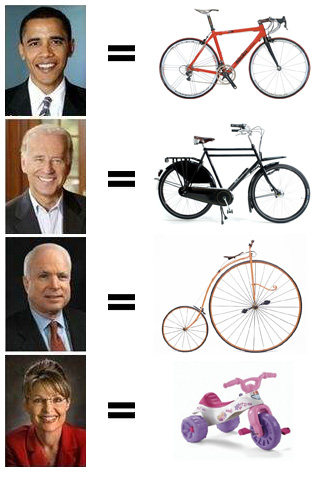
A humorous illustration comparing four political figures to different types of bicycles, with each figure accompanied by a bike that symbolically represents them. The top features one figure pairing with a red road bike, the second with a black commuter bike, the third with a vintage penny-farthing, and the fourth with a children's tricycle.
Aerial view of a tranquil lake surrounded by lush green forests, with a sandy beach and boats along the shore. The scene captures the clear blue water transitioning to lighter shades near the shoreline, framed by rocky outcrops in the foreground.
  1
Two mountain bikers navigate a dirt track during a competitive race. One rider, wearing a blue helmet and black and yellow gear, leans into a turn, kicking up dust, while the other biker, dressed in black and white, closely trails behind. Spectators can be seen in the background, enjoying the event under a clear blue sky.
A sleek, minimalist bicycle with a shiny gold frame, featuring a brown leather saddle and handlebars. The wheels have striking gold accents, set against a dark background that highlights the bicycle's design and elegant curves.
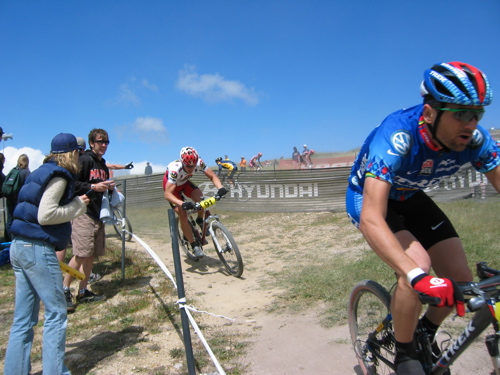
A mountain bike race scene featuring two cyclists navigating a turn. One cyclist in a blue jersey and helmet is leading, while another in a red and white jersey trails closely behind. Spectators are on the sidelines, including a woman taking a photo. The background shows a blue sky and a fence with a Hyundai advertisement.
  1
For some time now, I've been converting a <a href="http://www.nirve.com/largeimage.asp?id=1437">Nirve Fifty-Three</a> cruiser into a "Klunker". <a href="http://s2.photobucket.com/albums/y7/orderodonata/bike/?action=view&amp;current=Nirve_Side2.jpg">This is the result.</a>

<img id="image1345" src="https://images.singletracks.com/blog/wp-content/uploads/2008/10/nirve_side2.jpg" alt="nirve_side2.jpg" width="550" height="410" />

Our entire sport was founded upon the Klunkers, which were fashioned from scrounged bits from other bicycles, motorcycles &amp; ice-cream carts. The founders of mountain biking's scavenging provided fat knobby tires, brakes, handlebars, and most importantly, derailleurs. With their Klunkers thus fitted, Gary Fisher, Charlie Kelly, Russ Mahon and their friends took to the fireroads of Marin County &amp; Crested Butte. While at first it wasn't quite what would normally be considered a sport, it didn't take long for mountain biking's pioneers to create impromptu races which were anything but organized. But within a short time the Repack Downhill race was brought into being, and modern mountain bike racing was born.

High-technology &amp; mass-production was still years away, and in the beginning each mountain bike in existance was a unique example of mechanical art. Mountain bikes weren't made to be as light as possible with exotic materials &amp; complex suspension mechanisms, they were made to maximize the fun-potential and to be able to climb steep hills.... which is why I decided to create my own Klunker.

From the first moment I discovered mountain biking, I was a complete technology fiend. This tendency carried over from my previous hobby of upgrading Jeeps &amp; V-8 engines to offroad in rocky, muddy terrain. So with mountain bikes, I wanted suspension.... and lots of it. I wanted speed; I wanted survivability; I wanted stopping power, and because of those desires, I absolutely had to have the latest &amp; greatest components to hit the market.

But there came a time when I realized that even by having a +$5000 bike loaded with high-zoot parts &amp; a high-tech suspension design, there was something lacking in my riding experience. Sure, I could bomb downhills, plow through rockgardens, and loft sizable jumps &amp; drops with ease, but it was almost too easy.... too narrow-minded.

At some point I started researching the history of mountainbiking, the original bikes, and the men who made them. Additionally I became interested in the handmade bikes by Coconino, Ahearne, Hunter, Retrotec, and others. I realized that to have fun mountain biking, it didn't require six-inches of suspension, hydraulic brakes, carbon-fiber components &amp; frames, and all the other things that I was so fixated on. I could've gone singlespeed, but that was just a bit too "hardcore" for me; I could've forgone suspension entirely, but that would've been too painful. So I decided that in the future I would obtain a dedicated cross-country hardtail, which I could use as a more all-purpose bike and still have fun with on the trails.

But once again, my Wife interveined. She had introduced mountainbiking to me, as she had done with Jeeps &amp; offroading. And this time, she decided to start riding a cruiser bicycle. As she was searching for the right bike, I started noticing how <strong>cool</strong> some of those cruisers were.... and I wanted one too. Some of my decision to get a cruiser was nostalgia, as I remembered riding an old "fuddy-duddy" bike during summer vacations when I was 10-12yrs old. More of it was because I simply wanted to have a comfortable, easy bike to ride while accompanying my Wife along the smooth riverside bike-paths. But lastly, I remembered the Klunkers.

It was uncomfortable to start tearing apart a nice high-end cruiser, even though I was saving the bits removed to return the bike to it's previous state. But as the project moved along, and I obtained the parts to make the cruiser more capable offroad, I started to truly feel the spirit &amp; motivation which was behind the very first mountainbikes. And I felt like a bit of a rebel by choosing a steel frame instead of aluminum, foregoing hydraulic brakes for a front drum &amp; rear coaster brake, giving up a plush suspension for a pogo-like springer fork, and sacrificing multiple gears for just three in a geared hub.

But for as primitive as my updated Klunker may seem, it has revealed itself as having a ride &amp; handling ability which results in a huge grin-factor. The bike has a long wheelbase and a slack headtube angle for easy, slow steering while cruising through town. This lends to a stable, secure ride while moving fast downhill. The coaster brake can lock up the rear wheel with very little effort, which works with the long wheelbase &amp; reclined rider position for nice, controllable skids. And the front drum brake helps keep the front wheel tracking during those skids, while the springer fork does an excellent job of mitigating a fireroad's rough surface.

Then there's the method to riding a Klunker..... I call it the "Tripod". Instead of raising up off the saddle &amp; moving my weight back over the rear wheel, I instead lightly stand on the pedals while hanging on the wide, sweeping handlebars. "Tripod" comes from when entering a fast curve; the coaster brake starts a skid, and one leg goes out to the side to maintain balance &amp; control. In this fashion I can keep the Nirve drifting around a corner for as long as I've got the momentum. But riding a coaster &amp; drum brake is a lot different than the disc brakes which are de'rigueur in modern mountainbiking. It's easy to overheat coaster &amp; drum brakes, which makes for some interesting moments at times, and requires knowing how &amp; when to brake while at speed. Just learning how to keep a long skid going is contrary to the way a mountainbike is normally ridden; yet is essential to riding a long-wheelbase, coaster-brake'd Klunker fast on fireroads.

I heartily recommend that any mountainbiking enthusiast take the opportunity to experience the ride that our sport's founders discovered. The ride doesn't have to be on a converted high-end cruiser like my Nirve; instead it can be on an old Schwinn, just as was done by Gary himself. Speeding downhill on a disused fireroad, coaster brake smoking, legs extended, hanging on the handlebars, and leaving a plume of dust from drifting around curves is quite a sensation.... easily rivaling the ride found on the best singletrack. Going back to the roots of mountainbiking has a thrill all of it's own; and with modern mountain bikes having more in common now with aircraft &amp; moto-bikes than bicycles, riding an original mountain bike feels more soulful &amp; natural than any $4k FS rig ever could.
  1
A sleek, modern mountain bike featuring a black and red frame, front suspension, and advanced gear components. The bike is positioned against a plain white background, highlighting its design and features.
Image alt tag: A promotional poster for the Pixie Cross World Championship featuring two cyclists racing on 16-inch bicycles in a colorful, lively environment. The poster includes event details such as the date (Saturday, July 12th), location (Downtown Downieville, next to the fire station), and a description of the open class event. Graphics include the WTB logo and striking typography.
  2
A cyclist sitting on a folding chair in a natural outdoor setting, with a mountain bike leaning against the chair. The cyclist, wearing a colorful biking outfit, appears contemplative as the sun sets in the background, illuminating the surrounding landscape.
  2
A group of four mountain bikers wearing helmets and numbered jerseys ride along a dirt trail through a grassy field, with spectators in the background. The scene captures a competitive cycling event, showcasing the riders focused on their performance.
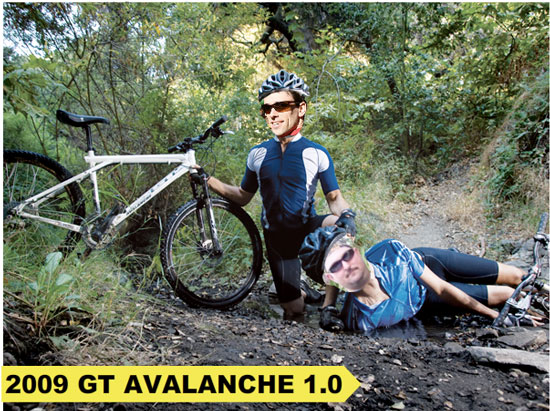
A mountain biker in a blue and black outfit stands next to a white 2009 GT Avalanche 1.0 bike, while another cyclist in an athletic outfit sits on the ground in a wooded area. The scene depicts a trail with greenery surrounding them.
  1
A mountain biker in a red and white jersey rides through a rocky terrain at night, illuminated by bike lights. The image features the text "24 Hours of Moab" and mentions the race's significant cash prizes, celebrating its 13th year.
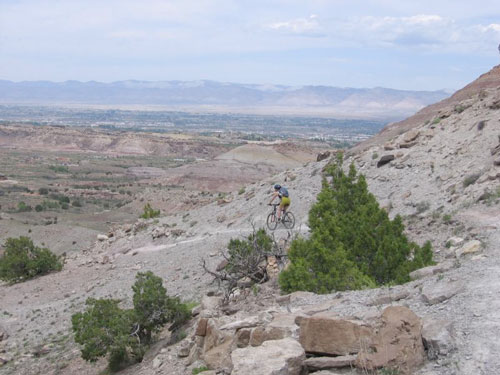
A cyclist riding a mountain bike along a rocky trail, with a scenic view of a valley and distant mountains in the background. The landscape features sparse vegetation and is characterized by earthy tones and rocky terrain under a partly cloudy sky.
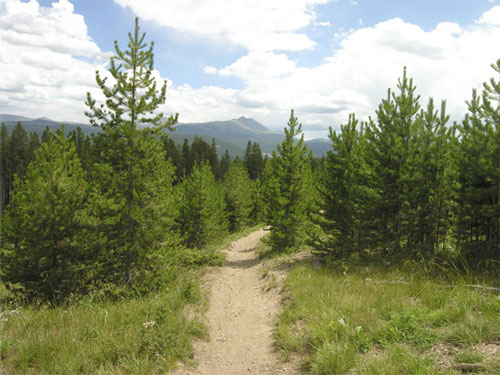
A dirt path winding through a lush forest of evergreen trees, with rolling hills and a cloudy blue sky in the background.
A businessman in a suit and tie poses confidently while sitting on a bicycle, with his arms crossed. The background is plain white, highlighting his professional attire contrasted with the casual nature of the bike.
A person wearing a red helmet and a pink tank top stands next to a mountain bike in a rocky, desert landscape. The background features dry shrubs and hills under a clear blue sky.
  2
For some time now, I've been converting a <a href="http://www.nirve.com/largeimage.asp?id=1437">Nirve Fifty-Three</a> cruiser into a "Klunker". <a href="http://s2.photobucket.com/albums/y7/orderodonata/bike/?action=view&amp;current=Nirve_Side2.jpg">This is the result.</a>

<img id="image1345" src="https://images.singletracks.com/blog/wp-content/uploads/2008/10/nirve_side2.jpg" alt="nirve_side2.jpg" width="550" height="410" />

Our entire sport was founded upon the Klunkers, which were fashioned from scrounged bits from other bicycles, motorcycles &amp; ice-cream carts. The founders of mountain biking's scavenging provided fat knobby tires, brakes, handlebars, and most importantly, derailleurs. With their Klunkers thus fitted, Gary Fisher, Charlie Kelly, Russ Mahon and their friends took to the fireroads of Marin County &amp; Crested Butte. While at first it wasn't quite what would normally be considered a sport, it didn't take long for mountain biking's pioneers to create impromptu races which were anything but organized. But within a short time the Repack Downhill race was brought into being, and modern mountain bike racing was born.

High-technology &amp; mass-production was still years away, and in the beginning each mountain bike in existance was a unique example of mechanical art. Mountain bikes weren't made to be as light as possible with exotic materials &amp; complex suspension mechanisms, they were made to maximize the fun-potential and to be able to climb steep hills.... which is why I decided to create my own Klunker.

From the first moment I discovered mountain biking, I was a complete technology fiend. This tendency carried over from my previous hobby of upgrading Jeeps &amp; V-8 engines to offroad in rocky, muddy terrain. So with mountain bikes, I wanted suspension.... and lots of it. I wanted speed; I wanted survivability; I wanted stopping power, and because of those desires, I absolutely had to have the latest &amp; greatest components to hit the market.

But there came a time when I realized that even by having a +$5000 bike loaded with high-zoot parts &amp; a high-tech suspension design, there was something lacking in my riding experience. Sure, I could bomb downhills, plow through rockgardens, and loft sizable jumps &amp; drops with ease, but it was almost too easy.... too narrow-minded.

At some point I started researching the history of mountainbiking, the original bikes, and the men who made them. Additionally I became interested in the handmade bikes by Coconino, Ahearne, Hunter, Retrotec, and others. I realized that to have fun mountain biking, it didn't require six-inches of suspension, hydraulic brakes, carbon-fiber components &amp; frames, and all the other things that I was so fixated on. I could've gone singlespeed, but that was just a bit too "hardcore" for me; I could've forgone suspension entirely, but that would've been too painful. So I decided that in the future I would obtain a dedicated cross-country hardtail, which I could use as a more all-purpose bike and still have fun with on the trails.

But once again, my Wife interveined. She had introduced mountainbiking to me, as she had done with Jeeps &amp; offroading. And this time, she decided to start riding a cruiser bicycle. As she was searching for the right bike, I started noticing how <strong>cool</strong> some of those cruisers were.... and I wanted one too. Some of my decision to get a cruiser was nostalgia, as I remembered riding an old "fuddy-duddy" bike during summer vacations when I was 10-12yrs old. More of it was because I simply wanted to have a comfortable, easy bike to ride while accompanying my Wife along the smooth riverside bike-paths. But lastly, I remembered the Klunkers.

It was uncomfortable to start tearing apart a nice high-end cruiser, even though I was saving the bits removed to return the bike to it's previous state. But as the project moved along, and I obtained the parts to make the cruiser more capable offroad, I started to truly feel the spirit &amp; motivation which was behind the very first mountainbikes. And I felt like a bit of a rebel by choosing a steel frame instead of aluminum, foregoing hydraulic brakes for a front drum &amp; rear coaster brake, giving up a plush suspension for a pogo-like springer fork, and sacrificing multiple gears for just three in a geared hub.

But for as primitive as my updated Klunker may seem, it has revealed itself as having a ride &amp; handling ability which results in a huge grin-factor. The bike has a long wheelbase and a slack headtube angle for easy, slow steering while cruising through town. This lends to a stable, secure ride while moving fast downhill. The coaster brake can lock up the rear wheel with very little effort, which works with the long wheelbase &amp; reclined rider position for nice, controllable skids. And the front drum brake helps keep the front wheel tracking during those skids, while the springer fork does an excellent job of mitigating a fireroad's rough surface.

Then there's the method to riding a Klunker..... I call it the "Tripod". Instead of raising up off the saddle &amp; moving my weight back over the rear wheel, I instead lightly stand on the pedals while hanging on the wide, sweeping handlebars. "Tripod" comes from when entering a fast curve; the coaster brake starts a skid, and one leg goes out to the side to maintain balance &amp; control. In this fashion I can keep the Nirve drifting around a corner for as long as I've got the momentum. But riding a coaster &amp; drum brake is a lot different than the disc brakes which are de'rigueur in modern mountainbiking. It's easy to overheat coaster &amp; drum brakes, which makes for some interesting moments at times, and requires knowing how &amp; when to brake while at speed. Just learning how to keep a long skid going is contrary to the way a mountainbike is normally ridden; yet is essential to riding a long-wheelbase, coaster-brake'd Klunker fast on fireroads.

I heartily recommend that any mountainbiking enthusiast take the opportunity to experience the ride that our sport's founders discovered. The ride doesn't have to be on a converted high-end cruiser like my Nirve; instead it can be on an old Schwinn, just as was done by Gary himself. Speeding downhill on a disused fireroad, coaster brake smoking, legs extended, hanging on the handlebars, and leaving a plume of dust from drifting around curves is quite a sensation.... easily rivaling the ride found on the best singletrack. Going back to the roots of mountainbiking has a thrill all of it's own; and with modern mountain bikes having more in common now with aircraft &amp; moto-bikes than bicycles, riding an original mountain bike feels more soulful &amp; natural than any $4k FS rig ever could.
  2
A red helicopter flying above a rocky cliff, with a group of people gathered near a Red Bull-flavored archway at the top. The sky is clear blue, and the scene appears to be part of an event or competition, showcasing the excitement of outdoor sports.
A split image featuring two scenes from a mountain biking event. The top section shows several riders in action on a rugged trail, with trees and shrubs in the background. The bottom section displays a close-up view of a group of cyclists racing side by side on a dirt path, each wearing colorful jerseys and racing numbers.
A purple bicycle with cream-colored tires, featuring a camera mounted on the handlebars and solar panels alongside a control panel on the rear. The bike is positioned against a light-colored wall.
A man with short hair, wearing a black athletic shirt, looks over his shoulder with his tongue slightly visible between his lips. A second man stands nearby, partially in the background, with a neutral expression. The setting features a light-colored wall with a floral pattern.
Two mountain bikers riding on a forest trail, wearing helmets and focused on their path. The image includes a logo for SORBA (Southern Off-Road Bicycling Association) in the corner.
Close-up of a bicycle's drive train, showing a chain, derailleur, and part of the frame. A section of the chainstay is visible, with protective tubing on it. The background appears to be a concrete surface.
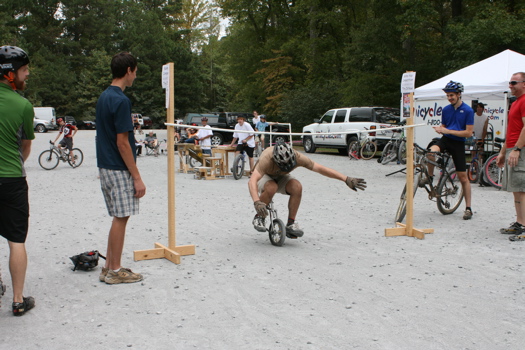
A group of people watching a bicycle competition in a gravel area, where a cyclist is attempting to ride under a low bar while balancing on a small bike. Some participants are cheering, and there's a tent in the background with bicycles and equipment.
Alt text: Promotional poster for the 3rd Annual Triangle Fat Tire Festival, scheduled for October 4, 2008, from 9 AM to 9 PM at Lake Crabtree County Park in Morrisville, NC. The poster features a bicycle graphic and details about events including "Take a Kid Mountain Biking Day," bike demos, and an endurance race titled "Curse at the Crab."
A tangled pile of black rubber hoses resting on a dry, reddish-brown surface.
A mountain bike displayed on a stand at a trade show, with a digital screen in the background showing a similar bike. The bike features a sleek black frame with red accents, distinct tires, and a modern design.
  1
Close-up view of a bicycle's drivetrain, showcasing a titanium frame, a red rear hub, a black chainring, and a blue belt drive. The intricate details of the components, including the cranks and gears, are visible against a dark background.
  5
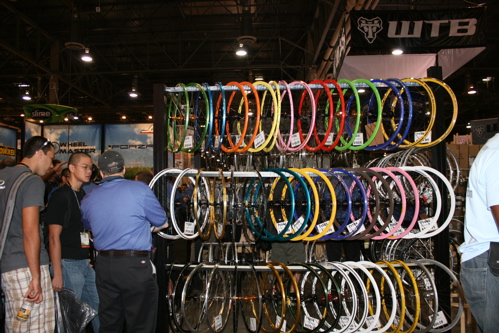
A display of colorful bicycle rims at a trade show, with several people examining the display in the foreground. The rims are arranged in rows, showcasing a variety of colors, including red, blue, green, and yellow, among others. Various banners and signage can be seen in the background.
Mountain bike on display at an exhibition, featuring a green and black frame, prominent suspension, and sleek tires. The background includes blurred figures and other bicycles.
A white Giro Athlon mountain bike helmet displayed on a rack, accompanied by a product information card. The card features specifications, and highlights that the helmet is new for 2006.
An image of a bicycle's handlebars and seat post, showing a release lever and a seat post with stop holes. The bike is displayed on a table, and the background consists of a dark curtain, suggesting it’s at an exhibition or trade show.
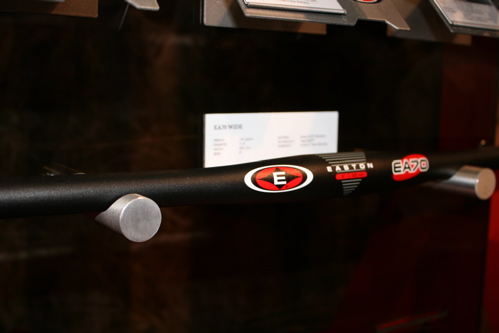
Black handlebar with branding stickers displayed in a showcase, partially obscured by a white information card. The handlebar has a sleek design, featuring a circular end cap and logos from EAXON and EA70.
A panel discussion featuring three speakers at a table in front of an audience. Two speakers are seated at the center, one wearing a black shirt and the other in a white shirt, while an older man in a blazer sits to the left. The audience is partially visible, focusing on the speakers.
A speaker at a podium wearing a gray cap, glasses, and a dark jacket, presenting to an audience.
A close-up view of a bronze mountain bike wheel displayed on a wall. The wheel features thin spokes and a hub at the center, with a sign above it labeled "Iodine / all mountain."
  1
A hand holding a compact, white Blackburn air pump, showcasing the product's design and branding.
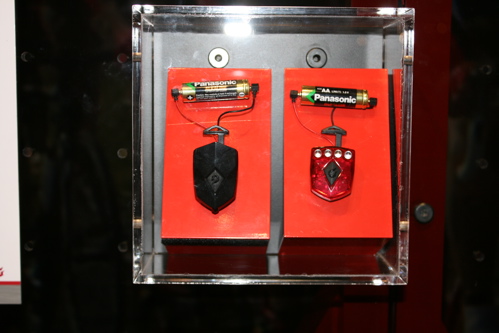
A display case featuring two vintage electronic devices mounted on red backgrounds. The left device is a black remote control shaped like a shield, connected to two AA batteries. The right device is a red remote control with buttons, also displayed with two AA batteries attached.
Alt text: Award certificate for the "2008 Best Mountain Bike Light System" featuring the name "Light &amp; Motion ARC" and a quote praising it as the best overall HID system. The certificate includes five stars and is branded with the logo of Singletracks.
  1
A person holds a Garmin GPS device in their hand, displaying a map interface with Lake Mead and nearby locations shown on the screen. The device is orange and features various buttons including a reset and lap option.
A person wearing a green t-shirt and a helmet stands next to a mountain bike on a dirt field. In the background, there are vehicles and tents, suggesting an outdoor event or competition. A yellow banner is visible behind them, with text that is partially obscured.
A person standing next to an orange mountain bike on a rocky trail in a desert landscape, with mountains in the background. The individual is wearing a green t-shirt and a helmet, looking relaxed and ready for a ride. The sky is clear and blue, indicating a sunny day.
  3
A mountain biker riding on a rocky trail with a panoramic view of mountains and cloudy skies in the background.
  1
For some time now, I've been converting a <a href="http://www.nirve.com/largeimage.asp?id=1437">Nirve Fifty-Three</a> cruiser into a "Klunker". <a href="http://s2.photobucket.com/albums/y7/orderodonata/bike/?action=view&amp;current=Nirve_Side2.jpg">This is the result.</a>

<img id="image1345" src="https://images.singletracks.com/blog/wp-content/uploads/2008/10/nirve_side2.jpg" alt="nirve_side2.jpg" width="550" height="410" />

Our entire sport was founded upon the Klunkers, which were fashioned from scrounged bits from other bicycles, motorcycles &amp; ice-cream carts. The founders of mountain biking's scavenging provided fat knobby tires, brakes, handlebars, and most importantly, derailleurs. With their Klunkers thus fitted, Gary Fisher, Charlie Kelly, Russ Mahon and their friends took to the fireroads of Marin County &amp; Crested Butte. While at first it wasn't quite what would normally be considered a sport, it didn't take long for mountain biking's pioneers to create impromptu races which were anything but organized. But within a short time the Repack Downhill race was brought into being, and modern mountain bike racing was born.

High-technology &amp; mass-production was still years away, and in the beginning each mountain bike in existance was a unique example of mechanical art. Mountain bikes weren't made to be as light as possible with exotic materials &amp; complex suspension mechanisms, they were made to maximize the fun-potential and to be able to climb steep hills.... which is why I decided to create my own Klunker.

From the first moment I discovered mountain biking, I was a complete technology fiend. This tendency carried over from my previous hobby of upgrading Jeeps &amp; V-8 engines to offroad in rocky, muddy terrain. So with mountain bikes, I wanted suspension.... and lots of it. I wanted speed; I wanted survivability; I wanted stopping power, and because of those desires, I absolutely had to have the latest &amp; greatest components to hit the market.

But there came a time when I realized that even by having a +$5000 bike loaded with high-zoot parts &amp; a high-tech suspension design, there was something lacking in my riding experience. Sure, I could bomb downhills, plow through rockgardens, and loft sizable jumps &amp; drops with ease, but it was almost too easy.... too narrow-minded.

At some point I started researching the history of mountainbiking, the original bikes, and the men who made them. Additionally I became interested in the handmade bikes by Coconino, Ahearne, Hunter, Retrotec, and others. I realized that to have fun mountain biking, it didn't require six-inches of suspension, hydraulic brakes, carbon-fiber components &amp; frames, and all the other things that I was so fixated on. I could've gone singlespeed, but that was just a bit too "hardcore" for me; I could've forgone suspension entirely, but that would've been too painful. So I decided that in the future I would obtain a dedicated cross-country hardtail, which I could use as a more all-purpose bike and still have fun with on the trails.

But once again, my Wife interveined. She had introduced mountainbiking to me, as she had done with Jeeps &amp; offroading. And this time, she decided to start riding a cruiser bicycle. As she was searching for the right bike, I started noticing how <strong>cool</strong> some of those cruisers were.... and I wanted one too. Some of my decision to get a cruiser was nostalgia, as I remembered riding an old "fuddy-duddy" bike during summer vacations when I was 10-12yrs old. More of it was because I simply wanted to have a comfortable, easy bike to ride while accompanying my Wife along the smooth riverside bike-paths. But lastly, I remembered the Klunkers.

It was uncomfortable to start tearing apart a nice high-end cruiser, even though I was saving the bits removed to return the bike to it's previous state. But as the project moved along, and I obtained the parts to make the cruiser more capable offroad, I started to truly feel the spirit &amp; motivation which was behind the very first mountainbikes. And I felt like a bit of a rebel by choosing a steel frame instead of aluminum, foregoing hydraulic brakes for a front drum &amp; rear coaster brake, giving up a plush suspension for a pogo-like springer fork, and sacrificing multiple gears for just three in a geared hub.

But for as primitive as my updated Klunker may seem, it has revealed itself as having a ride &amp; handling ability which results in a huge grin-factor. The bike has a long wheelbase and a slack headtube angle for easy, slow steering while cruising through town. This lends to a stable, secure ride while moving fast downhill. The coaster brake can lock up the rear wheel with very little effort, which works with the long wheelbase &amp; reclined rider position for nice, controllable skids. And the front drum brake helps keep the front wheel tracking during those skids, while the springer fork does an excellent job of mitigating a fireroad's rough surface.

Then there's the method to riding a Klunker..... I call it the "Tripod". Instead of raising up off the saddle &amp; moving my weight back over the rear wheel, I instead lightly stand on the pedals while hanging on the wide, sweeping handlebars. "Tripod" comes from when entering a fast curve; the coaster brake starts a skid, and one leg goes out to the side to maintain balance &amp; control. In this fashion I can keep the Nirve drifting around a corner for as long as I've got the momentum. But riding a coaster &amp; drum brake is a lot different than the disc brakes which are de'rigueur in modern mountainbiking. It's easy to overheat coaster &amp; drum brakes, which makes for some interesting moments at times, and requires knowing how &amp; when to brake while at speed. Just learning how to keep a long skid going is contrary to the way a mountainbike is normally ridden; yet is essential to riding a long-wheelbase, coaster-brake'd Klunker fast on fireroads.

I heartily recommend that any mountainbiking enthusiast take the opportunity to experience the ride that our sport's founders discovered. The ride doesn't have to be on a converted high-end cruiser like my Nirve; instead it can be on an old Schwinn, just as was done by Gary himself. Speeding downhill on a disused fireroad, coaster brake smoking, legs extended, hanging on the handlebars, and leaving a plume of dust from drifting around curves is quite a sensation.... easily rivaling the ride found on the best singletrack. Going back to the roots of mountainbiking has a thrill all of it's own; and with modern mountain bikes having more in common now with aircraft &amp; moto-bikes than bicycles, riding an original mountain bike feels more soulful &amp; natural than any $4k FS rig ever could.
  1
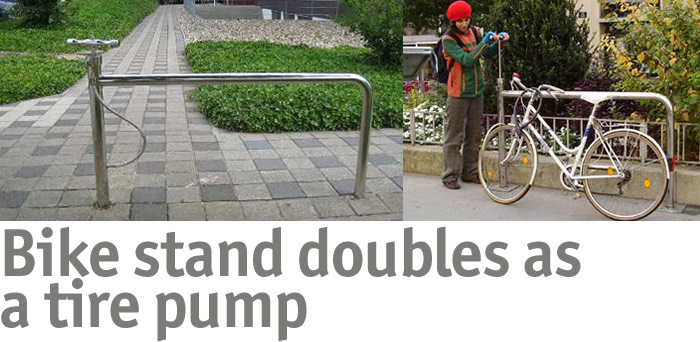
Image showing a unique bike stand that also functions as a tire pump. On the left, the bike stand is anchored in the ground, while on the right, a person in a red hat is using the stand to inflate a bicycle tire. The background features greenery and a pedestrian walkway.
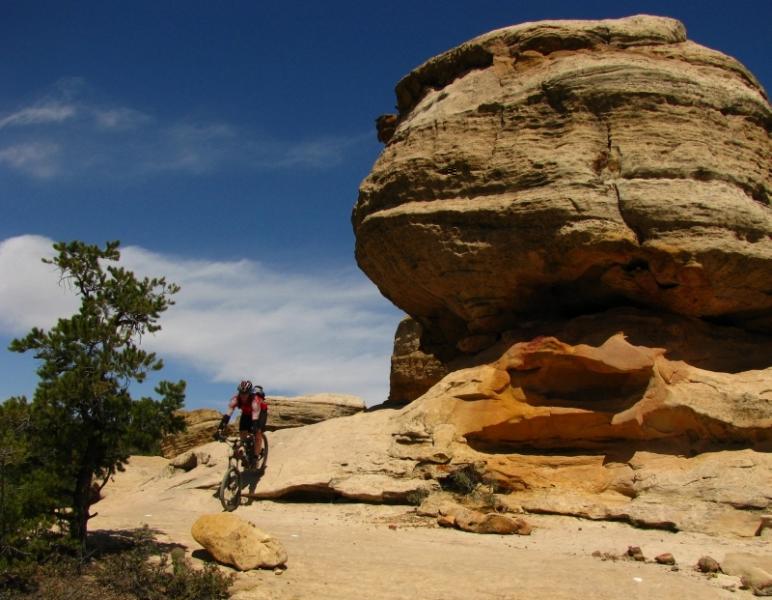
A mountain biker ascends a rocky trail beside a large, weathered rock formation, with blue skies and scattered clouds in the background. Sagebrush and small trees are visible on the side of the path, enhancing the rugged outdoor scenery.