Sign In | Create Your Account | Site Map  

Hayes Brakes Are At Their Prime!

Saturday, February 20th, 2010

prime_mc1prime_caliper2

prime_rotor2

It’s that time of year when I get to call up my good friends in the industry and see what’s up and coming and possibly squeeze out some interesting tidbits about new products. I recently got a chance to talk with with Joel Richardson, Production Manager at Hayes Disc Brakes, which is always super fun and exciting. I enjoy talking with Joel because we speak the same language - “Techish” - and he’s a person who is super stoked to talk about new products in development.

Joel managed a bike shop in Wisconsin from 1994-1998 and as things go in this kind of business he ended helping Len Cabaltera (the original Hayes guy) with development of the Hayes Mag brake back in 1996.

“Len would come into my shop and ask for design and feature feedback on the prototypes.  We had no idea what it would lead to. He hired me straight out of College in 1998 and I started in tech, hand bleeding brakes and answering phones.”

Joel moved around the company a few times before landing in his current position as the brake Product Manager.

Our conversation started out with a bit of small talk, chatting about the usual challenges riders have with disc brakes and set-up. It’s during conversations like these that new ideas are introduced and Joel and I actually came up with a few good ones - perhaps you may even see one or two in the near future, you never know. Anyhow getting into it, we talked a bit about technology and key product characteristics Hayes will carry forward and improve upon and even touched on some of the new stuff under development.

bling-rotor

Above: a Hayes design that never went into production but got some serious consideration. Back in 2002 Hayes came up with a two piece rotor for Shimano’s centerlock hub design.

One of the most exciting new products at Hayes this year is the Prime braking system. Prime is the name of the eventual replacement for the Stroker brake line-up and the Prime Pro and Expert take all that is great about the Stroker - forged calipers, compact master cylinder design, and tool free reach adjustment - and make it even better. Prime brakes feature a new caliper design that can withstand a set of bigger pistons and allow you to change up the pads without removing the caliper thanks to a top-loading design. The new brakes also throw in a floating two-piece rotor for the icing on the cake.

The new Prime master cylinder design was put under heavy scrutiny during the design phase. Keeping the basic Stroker design, Hayes tilted the cylinder 10 degrees to maximize finger positioning and changed up the master cylinder internals to allow for easy position adjustments and pad placement. As if that weren’t enough, Prime brakes features a new hose design that minimizes expansion and improves feel while sporting a plethora of exotic materials to reduce weight - now that’s Prime!

hayes-factory-004

A good bit of motorsports technology was put into the Prime brake design. These brakes will outperform all of the present systems that Hayes produces thanks in part to the largest pistons they have ever produced @ 26mm. Many hundreds of hours were needed to develop a brake that would feel consistent under the tremendous forces generated in the caliper. Early in the product development Hayes decided that the calipers needed to be forged to achieve performance expectations (just like the previous model Strokers).

hayes-factory-009

Hayes takes product testing very seriously and one of the tools they use is a Dynamometer capable of testing real world situations such as high speed/high input and wet conditions, shock, and vibration, while monitoring hydraulic pressure, force, speed, torque and temperature. After the dyno test, Hayes slaps the brakes on real bikes rigged with data capturing tools for actual testing on the dirt.

Here’s more from my conversation with Joel.

So when can we expect the Prime for sale to the public?
Everything is pointing to a June 2010 release date.

How powerful is the Prime and where does it fit in the line-up?
It surpasses the power of the Stroker Ace 4 piston brake by 23% on average.

There are two versions here, are we going to see another model or two in the future?
You bet, we are investigating the possibilities for a carbon version.

Are you planning on matching the finish on the brakes to other components produced by Hayes group of companies?
Maybe you can find the ANSWER.

I noticed there are no weights listed yet, any clue as to how light these units will be?
You’re looking at about 385 grams for the Pro and approximately 415 grams for the Expert, give or take a few grams.

On the new Prime brakes I noticed Hayes is going with a two-piece rotor. How long has that been in the making? I recall there were rumors that you were thinking about that…
Back in 2002 there was consideration and work on a two-piece rotor but for various reasons it never made production.

Along with Prime, what other things are changed up for 2010?
The Stroker Gram now comes in all white with a white brake hose. The Stroker Ace has a revision on the friction material making it easier to burnish the brake pads while the caliper and brake lever now come in black. We also started selling the Stroker Ace tool kit as well as the Feel’r gauge to set up your brakes. In 2010 the familiar HAYES logo is back on our brakes as well.

Well folks, stay tuned for a product review or two of the new 2010 Hayes brake offerings. I’m not sure about you but I’m stoked to give the new Prime brakes a run for their money!

Hayes Company History

1972 –  Schwinn 200E Series bicycle disc brake
1993 –  Production of DiaCompe Speed Check Disk Brake
1997 –  HFX Mag
1999 -  Cable Actuated Hydraulic
2000 -  Redesigned flip-flop Mag MC 2 piece clamp, G1 Caliper 74mm post mount
2001 -  HMX-1 Mechanical
2002 -  HFX-Comp, HML Mechanical Levers
2003 -  HFX Mag Plus, HFX Nine MC, G2 Caliper
2004 -  HFX Nine Carbon, MX-1 Mechanical, MX-2 Mechanical, Wave Rotors
2005 -  El Camino, Sole, , BFL Levers, V-Series 6 & 8″ Rotors
2006 -  MX 3, V7(180mm) Rotor, SRL Lever
2007 - Stroker Trail / Ryde, Stroker Carbon/ V9 (224mm) rotor
2008 - Stroker Ace / Stroker Gram/ V5 (140mm) rotor
2010 - Now the PRIME

Hayes firsts

Flip/Flop universal lever design with 2-piece clamp master cylinder body

Three layer hose construction

Tool-free brake pad change

Magnesium master cylinder bodies

Bladder/cartridge master cylinder design

Ball socket caliper pistons

Flip/Flop radial master cylinder

Hayes industry standards

74 mm post mount calipers with slotted mount feet

203 mm rotor size

10 mm quick release hub rotor offset

15 mm 20mm thru and rear hub rotor offset

.070” thick rotors

Forward arcing rotor splines for thermal capabilities and strength

T25 low profile disc screws

Blue Ryno Carbon Mountain Bike Test Ride

Thursday, August 27th, 2009

blue-ryno-side

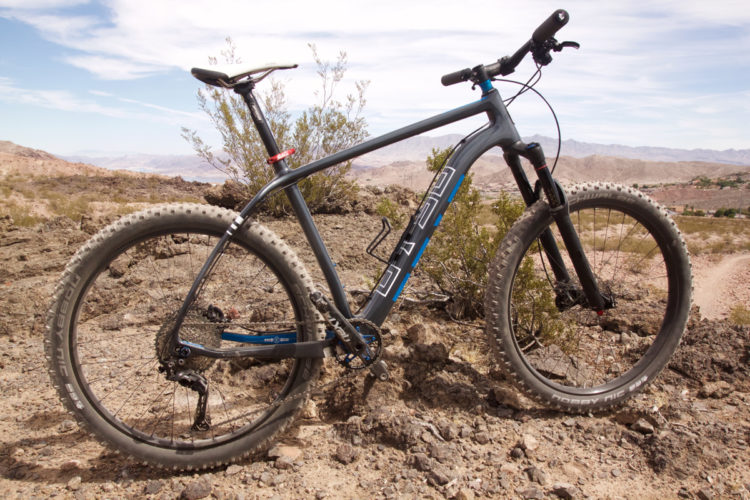
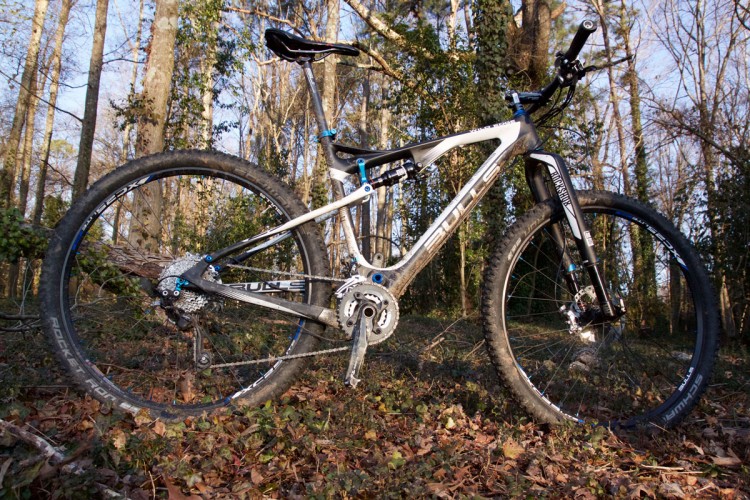
Don’t let the name fool you: the Blue Ryno Carbon mountain bike isn’t heavy or clumsy on the trail. In fact, like an actual rhino, this bike is fast, tough, and enjoys playing in the mud every now and then. Named after Blue’s marketing manager Ryan “Ryno” Barnett, a Cat 1 racer who was severely injured after being hit by a car on a training ride, this FS carbon bike is any serious XC rider’s dream come true.

So what makes this bike so fast? For starters the Ryno Carbon is lightweight - a medium-size frame weighs well under 5 pounds with the rear shock. I actually got to hold a bare XL-size frame (2474 grams) and it was shocking just how light the thing felt, almost like plastic. On the trail that light weight translated into  an extra 4-6 inches of air off whoops and joyous, nearly effortless climbs.

rear-shock

Serious XC riders may still worry about pedal bob on FS mountain bikes but as a longtime hardtail rider I have to say the Ryno climbs like a champ. In fact, on a recent test ride at the IMBA Epic Bull Mountain trail system I easily cleaned the entire rooty, eroded climb on the Ryno, something I had never done on either of my hardtails. With 3″ of rear travel the Ryno kept my tires in constant contact with the trail even on nasty short and chunky climbs. The Ryno also includes a front-suspension lockout on the standard built to improve climbing efficiency even further.

Riding the Ryno Carbon fast over rooty, rocky trails was a blast. On the descents at Bull Mountain I barely had to pick my lines and the Ryno suspension kept my wheels glued to the trail. Landing medium height jumps off whoop-te-doos was a cinch and the bike recovered almost instantly each time to keep the flow. The geometry on the XL model I’ve been riding features an extra long cockpit which kept me low and comfortable mile after mile.

The Ryno Carbon features asymmetrical carbon chainstays which may look a little odd at first glance but are actually born out of high tech design. The upshot? Improved rear triangle stiffness and lower weight overall. The stiff rear triangle transfers pedal power more efficiently and helps reduce side-to-side wheel torsion for even more precise cornering.

asymmetrical-chainstay

Like the XC Carbon, the Ryno frame is optimized for vertical compliance and lateral stiffness. This means even without the rear shock you won’t feel every bump in the trail and cornering remains crisp and tight every time. The carbon fibers in this monocoque frame are manually layered which produces a high strength, accurate build every time.

Complete Ryno bikes feature SRAM X.9 components which I found to be smooth as butter throughout testing. The Elixir brakes and suspension set-up produced few stutters or shakes on quick stops while the X9 Trigger shifters were consistently accurate, even in muddy conditions. Mavic Cross Trail wheels, Rock Shox Reba Race 100mm fork, Rock Shox Monarch 4.2 rear shock, FSA V-Drive crank, and Aerus carbon bars round out the component mix.

headtube

The X9 build offered by Blue certainly isn’t the lightest possible but it offers a great mix of reliable, quality components. The only choice that seems a little odd is the tire selection: Hutchinson Piranha 2.0s. These skinny tires certainly offer lower rolling resistance than say a more popular 2.2 or 2.3 tire but in this day and age they feel a little undersized. Then again, you can’t argue with fast!

The Blue Ryno Carbon is one of those mountain bikes that’s so light and responsive you can ride it for days without getting tired or beat up. And if think a full carbon, dual suspension mountain bike is out of your price range, think again - the complete Ryno Carbon retails for just over $3,500 (bare frame is $1,500). Blue quickly sold out of the 2009 bikes earlier this year and it’s no surprise - this is an ultra-fast bike at a great value. XC racers, ultra marathon riders, and 24-hour zombies take note: this is the bike for you!


Site Map | Advertise | Partners | Contact Us | Terms | Privacy
Camping | Hiking | Trail Running | Mapping | Mountain Biking
Copyright 2010 Blue Spruce Ventures LLC | Atlanta, GA
singletracks.com is yet another slick Review App