singletracks is mountain biking
Sign In | Create Your Account | Site Map | Help  


Twenty6 Gear for 2012: Pedals, Stems, and More

Wednesday, November 2nd, 2011

Who is Twenty6? I met with owner Tyler Jarosz at Interbike and, judging by our conversation, he is highly passionate about riding and his products definitely reflect that. The company is based in Bozeman, Montana, surrounded by some of the best biking in the country which clearly influences Twenty6 designs.

From pedals to brake levers, everything from Twenty6 has design appeal as well as function. After picking up my pimped-out package of the new Predator pedals, F1 stem, and Dualie levers, I was stoked to get back home and install these parts. Looking at the gear from Tyler, you can truly see the level of his CNC skills.

Predator Pedals

The Predator pedals have seen significant changes over the previous model (the Prerunner). For one thing, the body has been increased in size, with a bit more meat towards the outboard of the pedal. Not only did the body size get larger, but the pedal’s profile has actually changed with a more pronounced concave shape that provides better pin placement and traction. Speaking of the pins, Tyler explained to me the importance of his pins: these are not run-of-the-mill hex pins… they are engineered to have a break-away point to prevent damage or pull through.

The axle features an Enduro bearing near the axle root and a turcite bushing at the other end. Making sure everything stays mostly clean and running smooth, a Quad O-ring is designed to keep the crap out and provides a measure of pedal resistance (i.e. you can control the spin of the pedal). To keep the weight down, you have the option of either a titanium axle or a chromoly one. At a weight of 320 grams (ti axle) or 390 grams (chromoly), both options are very light for their size.

F1 Stem

The F1 Stem has been revised for this year with a one-piece mount to the upper crown while still keeping the same front cap. The added support stiffens the stem, preventing possible bending when you do case it, and it gives the rider more feedback. The stem is offered in two lengths with a choice of 40/45mm or 50/55mm and weighs ±150 grams, slightly heavier than the previous model as a result of the stiffer design. The F1 has a clamp diameter of 31.8 only, so installing your older 25.4 bar won’t work here. It mounts easily to any 4 bolt direct mount fork.

Dualie Levers

Small parts like a brake lever can easily be missed and taken for granted, but Tyler went to the trouble of coming up with some great levers for many a brake, including the Avid Codes that I reviewed earlier this year. The Dualie levers are machined from billet 6061 T6 aluminum and weigh about 50 grams (depending on the model). The attention to detail that went into the two finger design is impressive, with the machining both reducing weight and enhancing grip.

Installation

I had an easy time installing the new gear on my bike. The most work went into installing the levers on the Codes because you have to make sure that you engage the spring and carefully swap out the reach adjuster. A tip here would be to apply a bit of grease to the small hole where the spring and detent ball is installed then carefully slide the adjuster nut sideways, ensuring the detent ball stays put (use a toothpick or a slender tool to hold in the ball). The pedals and stem installations were no-brainers. The stem is a plug and play affair with a very straightforward install – just remember to torque everything down evenly (6Nm).

Predator Test

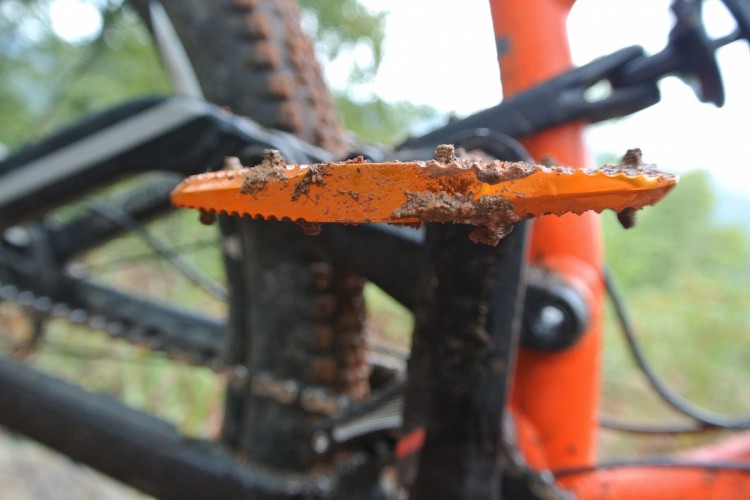
I used both the Predators and F1 stem on my Opus Nelson and the Dualie levers on my Banshee Legend, and they work great! The pedals had excellent grip, with no issues. My foot felt firm and balanced on the pedal and the large platform worked well even when it got really messy. The pin pattern on the Predator worked great at holding the shoe yet allowing me to rotate my foot without too much resistance when I needed to use some body English. You would think that the large pedal would strike every rock in sight (and I thought that too), but that was not the case. I make it a point to keep my feet at the 3 and 9 o’clock position when traveling through rock gardens and rock drops (places that will destroy most pedals if you’re not paying attention). Even so, I still thought that these would strike. They didn’t though… as long as I was upright. Even in the berms I was paying attention to see if I was close to striking, but I had no issues. The very thin profile of the pedal keeps it away from most everything, though I did strike a few times on an exceptionally large boulder section aptly named “The Coffin” at Blue Mountain.

To keep the pedals fresh, Tyler has an extensive choice of replacement pins, and he even has a repair kit available.

F1 Stem Test

The F1 stem worked well, holding the bar firmly in place without even a hint of creaking. Even after going down hard on a few occasions, I was impressed to see that the bar and stem remained perfectly aligned without a hint of movement or bending.

Dualie Test

I instantly loved how the Dualie levers felt over the stock Code levers. They provide a definite improvement in feel without any hint of slipping: I never had to use a second finger to stop the bike. Speaking of feel, the machining on the levers grab the finger nicely, even with wet gloves on. All this equates to a better, more confident braking experience with the Dualie levers. If you are looking for a major upgrade on your levers, look no further.

Bottom Line

All in all, Tyler’s Twenty6 products are definitely worth checking out. They easily offer the most color choices around! So what will all these cost? For the Predator Ti pedal you’re looking at $269 – $289 (white). The F1 stem comes in at $129 – $139 (white) and the levers are priced at $74 – $79 (white). Some of these parts may be a bit on the pricy side of things, but these are not your run-of-the-mill components!

I would like to thank Twenty6 for sending the gear down for review.

Spank Spike Pedals: Reviewed

Wednesday, October 26th, 2011

I did a bit of an introduction to Spank’s Spike pedal a while back and since then I’ve been rocking the Spike pedal on my Banshee DH bike. Today I’m finally ready to share my analysis of these pedals.

Technical Specs

The Spike pedal, unlike many other pedals on the market, is made of cold-forged aluminum, which offers increased strength and durability. This special construction also allows these pedals to be über-thin at just 12 mm (not including the pins). Within this thin profile you get an IGUS outboard bushing and an over-sized full-complement inboard bearing. The IGUS bushing is made from reinforced fibers and solid lubricants. This technique makes for a bushing with predictable characteristics such as high compressive strength and good corrosion resistance and can be run lubrication-free. The steel axle is hollowed out and is alloyed with scandium for increased strength.

The elongated hexagon-shaped pedal is made with chamfered edges (a wedge design, as compared to square edges) to increase pedal clearances. This is important for cornering – the pedal can glance off things if there is a pedal strike, thus reducing the impact force on the bike. The elongated design is also meant to prevent pedal flip. The 90+ cm² area and 20-pin design makes for a very sure-footed feel.  Pins are inserted from the opposite side of the pedal with a hex key and locked in place as if they were cap screws, unlike hex pins that rely on the use of thread lock to stop them from spinning. Finally, the seals serve dual duty, providing both protection from the elements while also acting as an anti-spin control.

Installation

Installation of the pedals requires a 10mm hex key – there are no pedal wrench options here due to the proximity of the inboard bearing. The use of thread lube is important to prevent seizure of the axle to the crank arm. If you have a crank that requires washers, don’t forget to install them. With this pedal design, the inboard pedal body runs very close to the crank arm (± 1mm) so the lack of a washer could cause it to rub.

Real-World Testing

I took my trusty DH rig to the slopes to see if these pedals really worked as advertised. Bottom line: they definitely do!

Surprisingly enough, the Spike pedals offered excellent traction. It took a while to get used to the tight proximity of the platform to the crank arms, but after a bit of fumbling around, things were good. I had no real need to play with the pins–the 10 pins per side were adequate and well-placed, giving my feet great traction while still allowing them to roll when necessary. The pins are not the most aggressive on the market, but they can still take a chunk out of your legs if you’re not careful. Wearing shin protection would be a good idea, just in case you lose a foot while getting bucked off your bike.

What I loved most about the Spike pedal was the very solid feel underfoot. The large platform allowed me to move my feet fore and aft just a touch when desired.  I really found these pedals advantageous in the corners and tight spots too. We have a run called the Coffin Drop at Blue Mountain which is pretty tricky. If you hit it wrong, it will smash up your pedals and possibly toss you off the trail into the rhubarb. The low profile and chamfered edges shine here, keeping both feet and the pedals away from the rocks.

After two weeks of riding, I did have to adjust the pedal a bit, adding a bit more anti-spin, but that was the only thing that needed adjustment. Running my DH bike through Ontario’s bad weather at Blue (cold, rainy, muddy), the pedals didn’t clog up or exhibit degraded performance in any way. They still feel as smooth as the day they were installed.

A bit of a side note: the funny thing about the Spike pedals is how very quickly you will learn how many people are checking out the gear on your bike. While waiting in line for the lift, I had many people comment on the Spikes.

The Spank Spike pedals come in five colors: orange, blue, black, ti-grey, and red (tested), which will compliment a wide range of colors on your bike. At $125 MSRP, these are available at a good price point. They aren’t crazy expensive, and they offer decent value for the money. These rank in the top three in my favorite pedals book, primarily for their excellent performance-oriented design!

Many thanks to Spank for sending the Spike pedals over for review.

New 2012 gear from Interbike

Monday, October 17th, 2011

Interbike is a fascinating place, and if you ever get the chance to stroll through the booths you will find tons of fascinating products. Jeff and I were both really impressed with some of the things we saw, and at other times we were thoroughly unimpressed by some of the downright-ridiculous designs. We made sure to swing by most of our usual stops to chat with folks such as e*thirteen, Fox, iXS, Spank, SRAM, Shimano, Intense, Santa Cruz, Osprey, THE, and Easton. Interbike is seriously the greatest when it comes to getting a sneak peak at the latest gear and talking with your favorite riders.

e*thirteen

One of my first stops was at the e*thirteen booth. It’s hard to believe you can improve on such a great crank, but e*thirteen managed to squeeze 60 grams out of last year’s design by using an alloy axle and machining a little bit off the spider here and there. Not only did the crank just go through a weight reduction, but they also managed to change up the bottom bracket, making it more durable and easier to install.

Along with the cranks, there are two clever new pedals from e*thirteen: the LG1+ and LG1R. The pedals feature an alloy body, plates that attach to the pedal, and user-selectable 4mm or 7mm pins. The LG1R has titanium spindles and pins while the LG1+ features chromoly. The difference in weight between the two pedals is 88 grams (380g and 468g, respectively).

Race Face

Hard Goods

Race Face was at the show, but you had to look really hard to find their booth. :) Essentially the hard goods line-up has changed ever so slightly with the introduction of the Chester cranks. The Chester is basically Race Face’s entry-level DH crank, the Respond is their mid-level, and the Atlas is their top-tier DH crank.

Race Face is also getting ready to launch the SIXC, which is a new DH crank modified with a longer-than-average axle. The SIXC cranks will be lighter than the new XO DH coming out from SRAM and the rubber boots are a nice addition meant to save the crank ends from damage.

Soft Goods

I spent some time talking with Wendy from Race Face and she was proud to show off some of the clothing and protection that will be offered for next year. It looks like the trend is toward simple colors with large contrasting logos and neat argyle prints (kind of like the Singletracks jersey). Needless to say, Wendy (who also does the design work) has done a great job at making gear that will look cool for both men and women.

The new trend in MTB armor is softer, more flexible pieces and Race Face is on the ball with their Flank line-up. This soft wrap-around leg armor features a ton of excellent elements such as D3O on the impact points of the knee and shin and a Terry Cloth liner.

Stay tuned for more from RaceFace in the near future.

Niterider

A brilliant example of lighting at Interbike was Niterider. With all their lights out on display, this booth really was a beacon in a sea of bike gear. Niterider’s best and brightest, the Pro 3000 LED, uses 6 large Cree LEDs and a massive Li-Ion battery; the whole package retails for less than $700. Along with the top model, Niterider has a light for just about every budget, including both rechargeable and non-rechargeable units. I had a chance to talk with Tom, the founder of Niterider, and it seemed that we both shared the same passion for good lighting systems and the conviction that there really weren’t any good bike lights available when Niterider started out.

FSA

FSA was displaying all of their 2012 gear nearby and the smell of high quality, nicely-finished carbon saturated the booth. The K-Force and SL-K gear for the XC-Trail rider may be a good idea for those looking to save some weight. I really appreciated the extensive use of uni-directional carbon in the products that were on display. The cranks feature a spine of aluminum to keep things stiff along with the monocoque structure that you see. With other carbon goodies in the form of bars, seat posts and stems, FSA was out to impress.

Ritchey 29er

Despite not being a big 29er fan, I just had to stop and stare a while at this beautiful 29er by Ritchey. For one thing, I owned one way back in the day that was made by Tom Ritchey himself, and my bike had the same “America F*$@ ya” paint job. I kinda miss that bike, and this beautiful ride, although very modern, still has that classic look to it. I found myself wishing I had the cash to pick one up.

From the integrated seat post clamp, to the adjustable rear dropouts that allow you to go either singlespeed or geared, to the highly-polished look, this bike really is a stunner. It’s a steel frame and has a projected cost of $999 (frame only). Depending how you build it up, you can get weights down to 21lbs for a single or 23lbs if you’re going with gears.

THE

THE was showing off their new colors for this year’s T2, along with some cool armor and gear. There’s a decent mix of mild to wild color schemes for you.

Loaded Precision

Loaded Precision was showing off a few new components for this year with their signature series wheels and pedals. For those of you who are interested, they will have a 150mm rear axle available soon in addition to all the present wheel configurations… and in a variety of colors to really pimp your bike out. Anthony from Loaded also mentioned the growing number of products in their XC line-up, including some fire-red 29er wheels!

Topeak

Topeak was there showing off their vast array of pumps and gear. Some interesting additions included a new chain tool called the Link Meister which is geared toward serious users and shops. The head on the Link Meister adjusts so that you can get the pins out perfectly straight without messing things up, thanks to an adjustable shoulder which cradles the chain in the link separator. A really robust set of mud guards for suspension bikes caught Jeff’s eye as well as mine. It may have been sheer fascination about the whole idea, but I have to say they looked pretty sweet. I was thinking about tossing a pair on my DH bike…

For the Apple fanboys and fangirls out there, Topeak showed an iPhone 4 (and now iPhone 4S) compatible stem mount. Unlike the other iPhone handlebar mounts we’ve seen and used, this one put the phone front and center and leaves a cut-out for the phone’s camera. Not only can you use your iPhone as a GPS/cycling computer, now you can use it as a POV camera. Brilliant!

Randomness

When you go to Interbike, you will inevitably come across some oddities along with all the cool ideas. Below is one such product in the making (which type is it? that’s up to you). Still a prototype, this 4-wheeled pedal bike features full independent suspension using Rock Shox Monarchs. As Jeff and I chatted with the owners, we did see many places were weight could be removed. Presently this bike is pushing over 50lbs.

Azonic

Azonic proudly displayed the Outlaw wheels, which have been their staple product for many years and are now available in a 29er version and in an expanded color line. Along with that were bars and stems in the same color patterns for that perfect match.

Azonic has partnered up with O’neal to produce some cool looking threads and skid lids. Their focus seems to be all about color and a mix of retro patterns with modern graphics.

Twenty6

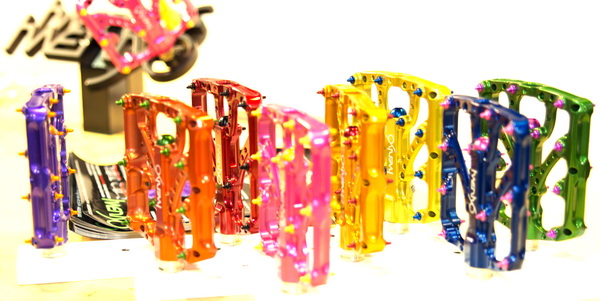
Before the show started, I got an invitation to visit Twenty6. Twenty6 is a small, high tech company that machines kick ass gear. Not only is the gear super slick, but they also have some rich color choices.

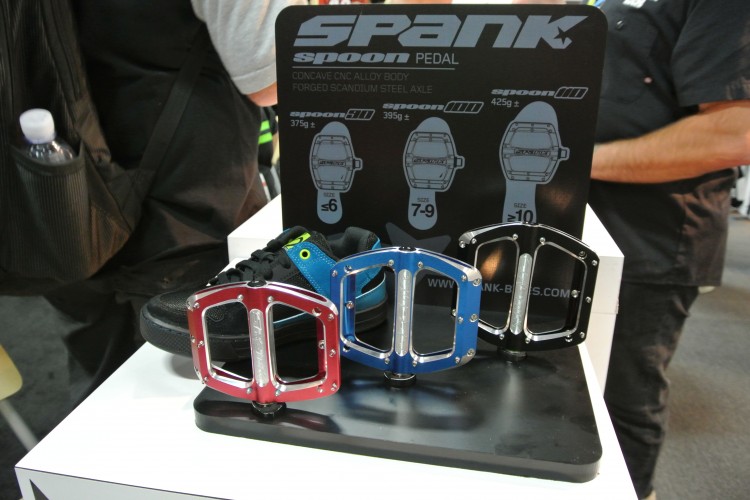
Below is just a sample of different color options. I’ll have a review written up soon on the Predator pedals, so stay tuned!

Pro Riders

Remember when I mentioned that Interbike offers access to celebrity riders? Well, great riders like Matt Hunter and Darren Berrecloth were at the iXS booth for a while signing posters and chatting it up.

I even got to spend a little while chatting with Matt. Having limited time, I just had to ask him how he did a particular jump in Seasons where he boosted off a kicker into a loose wall of dirt… it looked absolutely crazy! I got him to talk about how he felt going into it for the first time. It turns out a mix of confidence and fear with a bunch of adrenaline thrown in motivated him. I was really impressed to hear that he is human like the rest of us. Just in case you’re wondering, you can meet Matt in Whistler yourself during the summer months at the Summer Gravity Camp.

iXS

Speaking of iXS, they had a great line up of new 2012 gear on display. With a huge range of colors and improvements, I can’t wait to see when they will all be available. The new METIS shown below looks even better up close. The additional pad in back provides a perfect mating to a Leatt brace, and it provides excellent ventilation.

Not only does iXS make cool helmets, but they also produce a bunch of hemispherical goggles that really rock. They offer a dozen graphic styles to match or clash your helmets. iXS’s gloves and clothing are definitely something to behold. This is one website you must visit.

Spank

Spank had a bunch of shiny, new parts on display as well. They had a prototype stem that I thought looked absolutely amazing! The stem was beautifully CNC-machined, but I was told by Gavin Vos, the co-owner of Spank, that it is just a sample and that the final forged unit will be even stronger. The introduction of complete wheels from Spank also really peaked my interest. Even though I have no issues lacing up my own wheels, a complete solution with both hubs and rims is something I personally like.

The new Spike bar with another Spike stem prototype on display.

Speaking of Spike, stay tuned for a review of the new Spike pedals which, based on my initial rides, are excellent. These beasts have forged bodies with 20 pins on a true flat / thin body. How thin? 12mm to be exact. Not the thinnest, but in practical terms you can’t get much thinner without sacrificing strength.

In a previous post we talked a bit about wheels. Well, Spank has a few wheel sets bound to suit your riding style. The Spike and Spoon wheels look excellent with a bunch of innovative features like the BeadNip profile, the OhhBah inner wall, and zero eyelet construction. Again, Gavin explained why they decided to go without eyelets. They thought, “Why drill an extra large hole and add an eyelet, when precision drilling the holes with the correct angle will make a better interface and stronger wheel?”

Kore

Kore had a bunch of glossy parts out on display as well as a neat prototype of a new 35mm-diameter bar. They aren’t trying to set another standard just for the heck of it, but they reason that with bigger hit bikes, there is a real need for stronger gear that is more resistant to fatigue.

SRAM

One of my last Interbike stops was with SRAM. I talked with Tyler Morland for a while, and he showed off all the goodies to me. SRAM knows how to deliver! For one thing they had celebrities there with their bikes. Can you name the rider pictured below?

You know you done good when you have a tire named after you, like Danny Hart. Danny was around with his Giant showing off all the SRAM gear.

SRAM had all their components on display with new colors like the XO Silver, and there were other new additions to the line up like the XO DH chainring and bashguard.

Jeff and I both agree that the new X5 Group could be a game-changer next year. It looks like X9 but at a much lower price point. Tyler pointed out that essentially these two groups are the same and that the reduced pricing is a result of changes in materials. You will probably start seeing these on bikes in the $800 range – nice gear at a cheaper price point.

Shifting looks very X9ish as well.

The biggest story with SRAM is that you will have two more choices on gear for a total of 4 gear ranges for the chainrings: the original 42-28, 39-26, and now a lower 38-24 and an even lower 36-22. Another important set of products that SRAM will be releasing are easy-to-get repair kits for all your forks, shocks, and other gear.

Santa Cruz

The final stop that I had to make was Santa Cruz bikes. Like SRAM, you couldn’t miss this gorgeous booth with wall-to-wall wood and bike porn. Not to mention that Greg Minnar, Steve Peat, and Josh Bryceland were on hand as well.

Below are three of my favorite Santa Cruz bikes from the show:

The new carbon Nomad. This bike already was made even stronger than the aluminum version of the V10.

The new Carbon V10.

I got all goose-bumpy when I saw this rig! And to think that you can literally jump an entire highway with this bike and it’s still lighter than some XC bikes. What a testament to the strength found in newer carbon structures.

Santa Cruz Tallboy.

I have a lot of respect for this bike; the Tallboy is the bike that really turned me onto 29ers. A few people I know have this bike and they work magic on it–it climbs like a billy goat!

Well folks stay tuned for more – I hope to get a few more Interbike pics posted of even more sweet mountain bikes!

Time X-ROC S MTB Pedal Review

Tuesday, August 30th, 2011

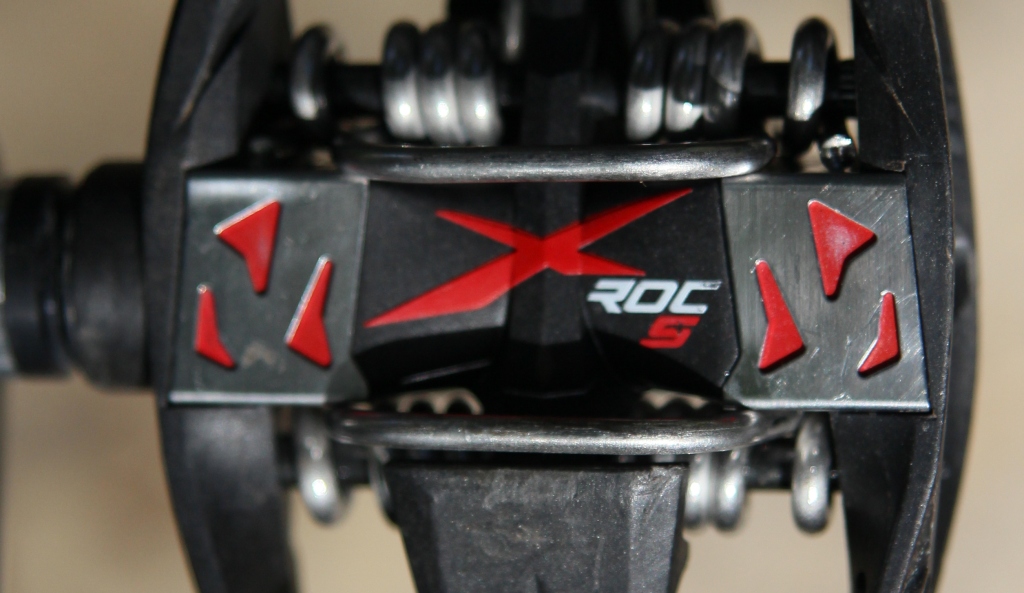
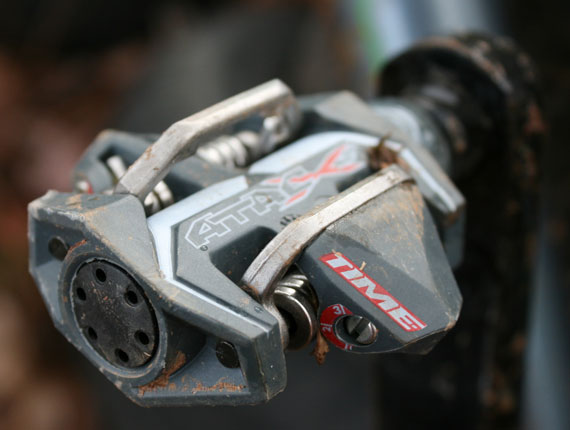
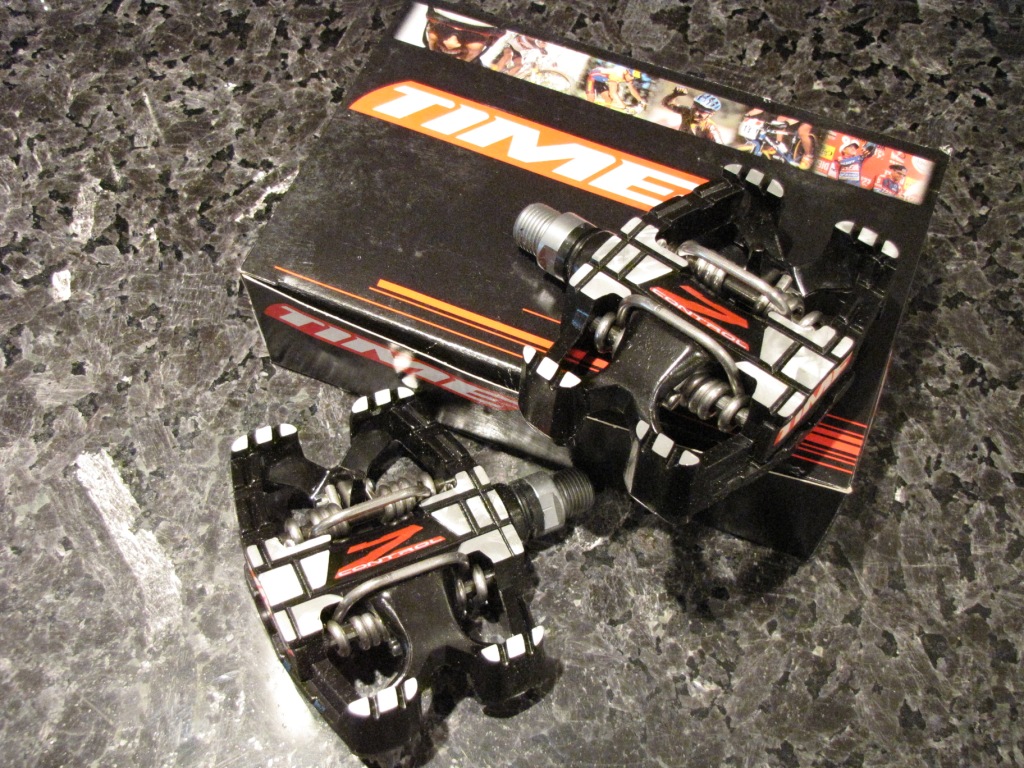
Time has come out with a new set of mountain bike pedals for 2011, the X-Roc S, with a stable platform for aggressive riders. The X-Roc is slightly smaller that the Z-Control pedals I tested a couple years ago but that’s not to say they’re any less capable.

Unlike the Z-Control pedals, the X-Rocs feature a composite body designed with stainless steel plates to protect the important bits and to provide an area to limit wear. The body is also designed with integrated teeth to better grip the pedals when you’re un-clipped. And when the weather takes a turn for the worse, ample ports in the pedal allow crud to flow out, reducing the chances of clogging the cleat area and possibly preventing you from clipping in.

When you’re clipped in you have about 6mm of lateral float and ±5° degrees of adjustable angular float. Depending on how you set the cleats you could have either a 13° degree or 18° degree release angle. A total weight of 422 grams is reasonable for a pedal that comes with a full length chromed steel axle, composite body, and the clipless mechanism.

Installing the X-Rocs on my AM / trail bike I found that these pedals offer a real improvement over the Z-Control pedals. The X-Roc pedals feature the same reliable clip in feeling as the ATAC XS but it was much easier to find the pedal with my foot after popping out. Adjusting the tension is easy with a standard screwdriver through a port on the side of the pedal. There are a few tension settings to allow you to tune the tension for your particular style of riding. I tend to run mine second from soft.

I ran the X-Roc pedals on my DH bike to see how they felt with the Mavic Alpine XL shoes and I gotta say they worked well and held on tight. I was afraid some of the larger rock gardens would wreak havoc on the composite pedal body but after more than a few hits, everything still works just fine.

For about $135 you get everything in a neat package with cleats and pedals. The instructions are easy enough to follow and will take about 20 minutes to get them on your bike and cleats on your shoes. If you are replacing existing cleats, do yourself a favor and clean the old screw holes very well and use some penetrating oil to loosen up the old hardware. You may want to even consider leaving the penetrating oil overnight.

I would like to thank the folks at Time for sending down the X-ROC S pedals for review.

How to Switch to Clipless Mountain Bike Pedals

Tuesday, February 15th, 2011

Now that you know why you should switch to clipless pedals, all you need now are the right pedals and shoes plus a little bit of practice.

Clipless Pedals and Shoes

First, you need to buy the right gear: a pair of clipless pedals and a pair of shoes. As you can see from the photo above, the number of pedal options can be pretty intimidating. Two of the most popular types are Crankbrothers’ Eggbeater pedals and Shimano’s SPD pedals but be sure to check out the MTB pedal buyers’ guide to understand all your options.

Naturally, there seem to be even more mountain bike shoe options than there are pedal options! Whichever pair of shoes you buy, make sure they have a place to attach the “cleat” for your pedals. The cleat is the metal piece that actually clips in to your pedal, and a pair of those should come with whichever pedals you choose to buy.

I personally wear a pair of Specialized shoes on the trail. Some mountain bike shoes feature a flat bottom skate-style sole with a cleat option thrown in for good measure. Others sport a more relaxed, casual design that would look pretty normal off the trail.

While they may look geekier, I recommend going all-out and buying a pair of legitimate cross-country style mountain bike shoes. Going with a cross-country oriented shoe provides you with the benefits of a snug fit for power on the upstrokes and a hard sole for even force distribution on the downstroke.

In short, XC shoes ensure the best pedaling performance possible.

Skill #1: Clipping In and Out

If you have never ridden with clipless pedals before, the thought of being mechanically attached to your bicycle may seem scary… until you realize how easy it is to get in and out of the pedals. Here’s how to get comfortable with clipping in and out.

  1. Find a big, grassy field to practice in. That way you won’t have to worry about navigating, and if you take a fall or two the consequences won’t be nearly as bad as on pavement or rocky trail.
  2. Place the front of the metal cleat into the pedal. It may take a little while to get the feel of where exactly the cleat is at, but it should be positioned right under the ball of your foot.
  3. Press down so that the back part of the cleat clicks into place. Your foot is now connected to the pedal.
  4. To get out, simply press down with your big toe and turn your heel outwards, as if you are squashing a bug.
  5. Make sure that you do not pull straight back when you try to disengage the pedal. One of the main goals of clipless pedals is to increase pedaling efficiency. They will not disengage unless you turn your heel outward.
  6. Practice this motion over and over with both feet until the motion feels completely natural.

Over time, these steps will truly become second nature. You will undoubtedly fall a few times as a result of not being used to the new gear, but don’t worry – you’ll catch on quickly! The video below demonstrates the basic clip in/clip out motion. (Don’t worry – the third clip in the video is demonstrating pedal “float” – this is not the result of a stuck cleat.)

Skill #2: Pedaling in Circles

I will be the first person to admit that I’m not good at pedaling in circles. I tend to just mash the pedals and go. Personally, I need to get a road bike and spend about 6 months focusing on spinning efficiently. While I’m not the most efficient pedaler myself, I at least understand the basic concept.

As the subtitle says, it is important to think about pedaling in circles. As I mentioned previously, one benefit to clipless pedals is the increased speed and power generated by using the entire pedal stroke instead of just the downstroke.

While you’re pedaling, consciously consider these steps:

  1. Push down like an average pedal stroke.
  2. Pull your foot across the bottom of the stroke as if you are trying to wipe poop off of the bottom of your shoe.
  3. Pull your foot up and thrust your knee hard toward your handlebar.
  4. Push down… and repeat smoothly.

As with any other mountain biking skill, perfecting the art of the pedal stroke takes time and practice. As you begin to master the art, try unclipping one foot and pedaling with just the other. Doing this will help you realize how beneficial a smooth cadence can be.

Your Turn: Over the past two posts on this topic we have covered a lot of ground: the benefits of clipless pedals, when to switch, what gear to buy, and two crucial skills for using clipless pedals. What other questions do beginners have about making the big switch?

Making the Switch to Clipless MTB Pedals

Thursday, February 10th, 2011

For those of you new to the sport of mountain biking, seeing other people ride around with their funky looking shoes clipped in to their odd-shaped pedals may look A) weird or B) like a death wish! Actually, there are a number of very good reasons to use these special shoes and pedals… which is why almost everybody who’s serious about riding singletrack does.

What are the benefits to using clipless pedals?

Clipless pedals were originally developed primarily to increase pedaling efficiency in order to help riders go faster. With a standard set of flat pedals, you are only able to put power into your drivetrain on each downstroke of the pedals. But when your feet are clipped in, you’re able to provide constant power with both legs by utilizing the upstroke as well.

Of course it’s not physically possible to generate as much power on the upstroke as on the down, but being able to add power to the system constantly does make you a significantly more efficient machine. As an added bonus, this constant power (as compared to the surges of power that come from just mashing the pedals) helps you to maintain better traction on loose, steep climbs.

While all of these things are very true, none of them are my personal favorite reason for using a clipless system. For me, the advantage of being “locked” into my bike made me fall in love with clipless pedals. When you’re clipped in, your feet will never slip off of the pedals, even when the going gets rough! I’ve met hardcore downhillers who claim that if you’ve got the right pair of flat pedals and shoes, your feet will be as rock solid as if you were riding clipless. Maybe that’s true – but the downhill skier in me doubts that even a pair of DH flats can beat the feeling of being mechanically connected to your bike.

Not only do clipless pedals increase your efficiency and keep your feet from slipping off, but they offer increased control as well. It is much easier to put “body English” on the bike when you’re be in a sticky technical situation, easier to jump your bike and control it in the air, easier to ratchet the pedals and provide partial strokes when needed, and clipless pedals force you to try harder to stay upright because you don’t want to constantly be clipping in and out.

When should I switch over to clipless pedals?

The simple fact that you’re reading this article is a good indicator that you should try a pair of clipless pedals. You’re obviously interested enough in mountain biking that you are spending time researching it on the internet. If this isn’t just a passing fling for you, not just a sport that you’re going to participate in every once in a while, I’d recommend going clipless.

Sure, go ahead and learn the basic skills with flat pedals. They offer less commitment to technical moves, and not having to buy specific shoes or another pair of pedals is definitely cheaper. But once you’ve been riding for several months and are getting out on the singletrack at least a couple of times every week, it’s time to get serious and take advantage of all the benefits I’ve detailed above.

It’s time to take the plunge and buy some clipless pedals!

Coming Soon: What gear you need to buy, and how to use it once you’ve bought it.

Your Turn: If you’re an experienced rider, do you have any points you’d like to add on the benefits of clipless pedals?

Xpedo Hurtle 12 Pedal and MXS Mountain Bike Shoe

Thursday, November 4th, 2010

Over the last few months I have been rocking a few different sets of flat pedals on my mountain bike but here’s one that sets itself apart: the Xpedo XMX12AC Hurtle (for simplicity I’ll call it the Hurtle 12). This Hurtle 12 is similar in construction to the Face Off 17 pedal that I reviewed a few months back and shares the same chromoly axle with a single DU bushing and bearing. Constructed out of 6061 AL, the Hurtle 12 weighs in at 370 grams, 10 grams less than the Face Off 17. Unlike other pedals, the Hurtle 12 has its spindle completely protected in the middle which helps with sealing and durability.

The Hurtle is pretty thin at 13mm (not including the pin height) which is just enough spindle diameter to keep the grease inside. The actual body is an extrusion which is then machined to its final shape. Look carefully and you will see the slight concave shape which is designed to match the shape of a typical flat shoe.

Out of the box you also get replacement pins and a wrench that allows you to easily replace broken pins. The Hurtle pedals comes in black, grey, red, pink, green, and gold – pretty much all the colors you’d need to match any bike.

On the trail the Hurtle 12s offer the largest and most solid platform of all the Xpedo pedals I’ve tried. Placing my foot down on the pedal feels about as secure as locking in with a pair of SPD clips. Yep, that secure. The square platform has 8 pins placed strategically so that my forefoot gripped extremely well with just enough grip at the back of the pedal to allow a bit of foot roll for times when I pitched the bike sideways.

Having these on my FR bike for the test and riding through all kinds of terrain I had no issues with rocks or contamination. The pedals still spin great with zero signs of grittiness or play. I did manage to scrape them up a bit, but other than that, they stayed straight. I would even recommend the Hurtle 12 pedals for AM / DH use; I found they boosted my confidence level a bit, knowing that if a foot came off I would find that pedal quickly enough.

Xpedo MXS Shoe

The MXS is the only flat sole mountain bike shoe that Xpedo sells and I’m happy to report they work well enough and felt fairly comfortable. I have a wide foot so the roomy toe box on the MXS was a welcome feature. The MXS shoes grip will on most pedals, offer decent heel and ankle support, and feature a foot bed with a bit of flex.

Overall the MXS shoes tend to work better as a dirt jump (DJ) shoe than a more aggressive DH shoe. I noticed the low rise cut on the outside of the shoe allowed my ankles to roll at times which isn’t ideal for DH riding. On the other hand, the ability to roll to the outside of the shoe worked well for the bike park. The inside ankle cut is best described as a mid-rise and it covers the ankle for both protection and support.

The uppers on the MXS shoe are synthetic leather and mesh for a good balance between durability and breathe-ability.

Taking the shoes out on my FR rig at the slopes I didn’t feel as confident as I would have liked. I found when the shoes got a little dirty on the soles they started to slip a bit too much. The lack of outer ankle support also contributed to some issues when sailing through rock gardens.

For DJ riding I can definitely recommend the MXS shoe – it’s stiffer and more durable than your Nikes. However, for DH mountain biking I would say go for something else – though let’s see what the future brings for this shoe.

In case you’re wondering, the Xpedo Hurtle 12 pedals retail for $75 and the MXS shoes will set you back around $55. Check out the Xpedo website for these and other great products.

I would like to thank Xpedo for providing the Hurtle XMX12AC pedals and the MXS shoe for review.

Spank Tools for Superheros

Thursday, September 23rd, 2010

Hi everyone. Well one of the first stops for me this year at Interbike was a visit with a friend of mine Lance Tueller, the Importer of Spank / iXS / and Morewood bikes. This year Spank went and spent a ton of time developing and improving an already impressive line-up of components. Basically the message that I got was lighter, stronger, and bling. Everything from the Subrosa line of bars, rims, and saddles to the über-tough Stiffy line of products got a once-over from the folks down at Spank. The new rims have two unique features that no other brand that I can think of has yet: the “Ooh-Bah” profile and bead nip technology. The Ooh-Bah profile is being carried to nearly all the rims in their line-up. Speaking of the line-up, Spank rims start from 23mm outside rim width all the way to a massive 40mm. I’m talking crazy Rampage dimensions!

Now another new item that is just awesome is the Spike pedal and honestly the pictures just don’t give these jewels justice. For one thing the super low profile and the chamfered ends are simply amazing, especially for a pedal that boasts a generous platform with 9 pins on each surface and coming in at about 400 grams. Watch out for these pedals, I’m sure you’re going to see many of these on some up and coming bikes because of the great design. The inner bearing is placed as close as possible to the crank while the pedal body is tapered at the crank end to naturally move your foot onto the platform.

The Spike range has a nice bar coming in at 777mm wide and three rises (1, 2, and 3 inches) making this one very friendly to the gravity crowd. To top it off, the stunning anodizing and graphics makes this a bar to grab hold of. There’s also a re-engineered stem for the Boxxer / Fox crowd plus a price reduction which makes the stem even more attractive.

Check out all this and more at Spank Bike’s website.

Syncros Crux Platform Pedal Review

Thursday, June 3rd, 2010

The Syncros Crux pedals are intended for downhill, freeride, 4x, trials, BMX racing, and dirt jump applications. If you’re into any of that stuff and are looking for a pedal with unparalleled grip, look no further.

004

Syncros uses a high quality, 6061 aluminum alloy for the pedal body. The result is a pedal that’s lightweight and stronger than it needs to be. Because this pedal is competition oriented, it is lighter than Syncros steel pedals but does not come with the same lifetime warranty. The concave shape produces maximum foot/pedal contact and the specially designed replaceable pins provide more grip than any other pedal I’ve tested.

The Crux pedals feature an axle made of SNCM CroMoly, the hardest axle material available. Four bearings per pedal will keep it spinning smooth and free of play for a long time. And if the bearings ever do wear out, you can easily rebuild the pedal with parts available at your local shop. At $183.95 MSRP, these pedals costs $40+ more than the competition but at just 428 grams they’re 90-110 grams lighter than similarly priced pedals. Oh yeah and the graphics look great, especially when paired with the matching FR 31 bars. The Crux pedal is available in black & grey grunge, white & grey grunge, and white & purple grunge.

The Ride

Initially I was a bit skeptical about the size of these pedals since I’m used to riding a bigger platform. But after just a few minutes my concerns disappeared. The slightly smaller platform means all the pins dig into your shoes, minimizing slippage.

003

Whether you ride with a skate shoe or 5.10’s, these pedals offer plenty of grip. The unique pin design bites into your shoes so once your foot is on the pedal it won’t slip off. These pins will take a chunk out of your shin if you do slip a pedal so Syncros highly recommends wearing leg armor while using the Crux. When paired with 5.10’s, the Crux provides so much grip it feels like you’re clipped in. This makes the Crux pedal ideal for terrain where your foot would normally slip around such as technical DH, Freeride, dirt jumps, and skatepark riding.

All this extra grip gives you instant confidence. Within minutes I was jumping higher, riding faster and pulling better moto whips than usual. This confidence extends into all riding situations be it rock gardens, corners, jumps, steeps or skinnies. The Crux pedals don’t spin during foot tricks like no footers thanks to the tight bearing tolerances – a nice touch for sure. I even got some props from other riders at Joyride 150, my local bike park, on the look of these pedals and how well they matched the FR 31 bars.

012

The Verdict

After over a month of pounding these pedals hard they are still good as new. The Syncros Crux pedals should continue to perform flawlessly for months to come, given the impressive materials Syncros builds these pedals with. These are the best pedals I have used to date and I highly recommend them for their intended use.

Similar Products Tested

- 1664 Beaver Traps
- Axiom Roadgap
- Easton Flatboy DH
- GT Flats
- Mosh Flats
- Truvative Holtzfeller
- Truvative Hussefelt
- Wellego Flats

Thanks to Syncros for supplying the Crux pedals for testing.

About Syncros

Syncros started operating out of a Vancouver bike shop in the 1980’s, producing parts that could withstand the pounding dished out by riders on the nearby North Shore Mountains. Syncros was bought by Ritchey in 2003 and today produces high-end components built tough enough to withstand the most difficult trails while maintaining competitive weights and prices.

Syncros FR 31 Handlebar Review

Friday, May 28th, 2010

bars1

Today’s fastest MTB racers are choosing increasingly wider handlebars in an effort to improve leverage and control. Gravity racers are also demanding low rise or flat bars which allow the rider to get into a low, powerful position. Syncros understands this and offers the FR 31 bar for extreme riders looking for maximum width and minimum rise.

If you look around the pits at a DH race, you’ll find that most racers run bars 710-785mm wide with 0-1” of rise. These days most DH race bikes are equipped with either the Chromag Fubar OSX, Raceface Atlas, Sunline V1 or Truvative BooBar handlebars bolted to the front end. Syncros aims take some market share from these 4 companies with the FR 31 handlebar. At 315 grams these bars are around 10% heavier than the competition but at just $66.95 MSRP, the FR 31 is $20-50 less expensive than the others.

lava_bars

Looking at the bars, the first thing that strikes you is the width. At 790mm (31 inches), this is the widest bar on the market which translates into unparalleled leverage and control. Every rider I talk to who has switched to wide bars likes the extra control and refuses to go back to narrower bars. Of course if you just can’t get used to that much leverage or if you regularly ride trails with really closely spaced trees, you can always cut the bars to size.

The Ride

There’s a reason why all the top racers are running wide bars like these. It took me about an hour of ride time to get used to the FR 31 bars but after that I was launching jumps higher, pinning corners faster, pumping rollers better, pedaling harder, and rolling through rough terrain more easily.

No matter the terrain, your bike will feel more stable with these ultra wide bars. The width, rise, and sweep combine to put your hands in an ideal riding position which allows you to exert more power on the bars. In particular, the low rise puts you into a streamlined, race-ready position. I tested in black/grunge black bar, which drew some compliments, especially when paired with the matching Crux pedals.

The Verdict

The Syncros FR 31 bars are a perfect choice if you are a new school rider looking for more control overall and I wholeheartedly recommend them.

Similar Products Tested:

- Sunline V1
- Truvative Team DH/XC
- Truvative Holzfeller
- Truvative Hussefelt
- 2007 Raceface DH

Thanks to Syncros for supplying the FR 31 bar for testing

About Syncros

Syncros started operating out of a Vancouver bike shop in the 1980’s, producing parts that could withstand the pounding dished out by riders on the nearby North Shore Mountains. Syncros was bought by Ritchey in 2003 and today produces high end components built tough enough to withstand the most difficult trails while maintaining competitive weights and prices.

How to Choose the Best Mountain Bike Pedals

Thursday, April 22nd, 2010

best_mtb_pedals

For our second mountain bike buyers guide, we’re gonna fill you in on some tips for choosing the best mountain bike pedals. Whether you’re a mountain bike beginner looking to upgrade your entry-level bike or an old pro looking for the best pedals for the money, we’ve got a recommendation for you.

Platform vs. Clipless Pedals

When choosing a mountain bike pedal, the first thing you’ll want to decide is if you want platform or clipless pedals (or a combo – more on that later). Most entry level mountain bikes come equipped with platform pedals made from either plastic or some type of metal. The main advantages of platform pedals are:

  1. You don’t need special shoes to use them. Any sturdy pair of shoes with a flat bottom will work.
  2. It’s easy to bail off the bike if necessary (great for beginners but also downhill/dirt jump/freeriders too).
  3. Entry level platform pedals are less expensive than entry level clipless pedals.

platform_pedal

Some platform pedals may also include straps for keeping your feet attached, though if you really want a solid foot-pedal connection you’ll want to investigate clipless pedals.

Clipless mountain bike pedal systems feature a special cleat that is attached to a mountain bike-specific shoe to give the rider a solid connection between foot and pedal. The rider clips into the pedal by stepping down and releases by twisting his heel to the side. It can take beginners a bit of practice to get used to clipless mountain bike pedals but the advantages are pretty clear:

  1. Improved pedal efficiency as energy is transferred throughout the pedal stroke.
  2. Improved handling on technical rides. Clipless pedals keep your feet attached to the bike on bumpy descents and make things like bunny hopping much easier.
  3. Decreased weight. Clipless pedals generally cut a much smaller footprint than platform pedals and can weigh half as much as a similar quality platform pedal.

atac_pedal

There are several competing standards in the clipless pedal market and cleats may not be compatible from one standard to another. Major clipless pedal standards include SPD, Time, and CrankBrothers, among others. At the moment SPD is the most widely used standard across many brands but unless you plan to share bikes or need to outfit multiple rigs, this may not be a very important consideration.

Combination mountain bike pedals combine the advantages of both pedal types: a wide platform plus a clipping mechanism. The main tradeoff in choosing a combo pedal is there is often a large weight penalty and the clips may be a bit more difficult to engage than on a clipless-only pedal. Still, for many riders the combo pedal is a great choice.

Other Pedal Factors to Consider

We’ve touched on many of these items already but no matter which type of pedal you’re looking for, you may want to consider these additional items.

  • Pedal weight. Manufacturers typically quote the weight for the pair of pedals and in most cases, lighter is better.
  • Mud shedding abilities. Look for open spaces in the pedals where mud can be pushed out when you place your feet on the pedals.
  • Adjustability. This is mostly important when looking at clipless pedals where you’ll want to consider things like pedal tension settings (the amount of force it takes to clip and unclip) and float (the degree to which you can rotate your foot when clipped in). Platform pedals may allow you to replace spike pins or even change up the colors on the pedal body. More adjustability is better.
  • Durability. It’s a good idea to choose a solid pedal with smooth bearings that won’t require a ton of maintenance. Great mountain bike pedals will stand up to the abuse of multiple rock strikes and scratches year after year.

MTB Pedal Recommendations

With all that in mind, here are the best mountain bike pedals as rated by singletracks members and our editors. We’ll update this list periodically to reflect the latest and greatest.

PLATFORM PEDALS

CLIPLESS PEDALS

  • CrankBrothers Eggbeater sl: Super lightweight and great mud shedding. Unfortunately these pedals are not adjustable.
  • Time ATAC Alium: Buttery smooth clip and release plus a highly durable pedal body.
  • Shimano M520: This pedal has been around forever, and for good reason. Great value.
  • Xpedo MF-6: Lightweight with a decent size pedal body and the smoothest bearings we’ve seen. Detailed review here.

COMBO PEDALS

  • Shimano M424: The top rated combo pedal according to singletracks members.
  • CrankBrothers Mallet m: Durable platform pedals with the ability to clip in when necessary. Only 464 grams/pair.
  • Time ATAC Z: These pedals can take a serious beating yet they’re buttery smooth clipping in and out.

Choosing the best mountain bike pedals isn’t rocket surgery, it just takes a little research. To view all the pedals singletracks members have rated, head over to the MTB pedal review pages where you can read detailed reviews, view pics, and even videos.

Xpedo MF-6 Mountain Bike Pedal Review

Wednesday, April 14th, 2010

img_5327

Back in February element22 reviewed two sets of platform pedals from Xpedo and now it’s my turn to fill you in on the company’s cross-country offerings. I’ve been riding the Xpedo MF-6 Ti/Al mountain bike pedal which is a lightweight, highly adjustable pedal with smooth-as-silk bearings and a great choice for anyone who likes to ride fast and light.

The Xpedo MF-6 Ti/Al pedal features a titanium spindle that spins so freely Xpedo could probably apply for a perpetual motion patent on the thing. From my testing I knew the pedal was smooth but I didn’t realize just how smooth it was until I (unscientifically) compared it to several other pedals I had laying around. Whereas my other pedals would spin freely 2-3 times on a single push, the MF-6 easily got 10-12 spins with roughly the same force. On the trail that lower resistance translated into less energy lost when I was pedaling hard.

xpedo-mf6-profile

This smooth pedal spin is all thanks to the 3 cartridge bearings inside every MF-6 pedal (other pedals typically include just a single cartridge bearing). The titanium spindle isn’t rated for riders weighing over 187 pounds but in my testing I noticed virtually zero spindle flex (I weigh about a buck sixty five). A stiff spindle transfers more energy to your pedal stroke and produces even more speed on the trail.

All MF-6 pedals from Xpedo are SPD-compatible which makes it easy to add them to the mix if you have multiple bikes with SPD pedals. These pedals offer 12 points of tension adjustment via adjustment bolts on either side of the pedal (make sure you set both sides to the same tension). In my tests I found the tiny adjustment screws did tend to get packed with grit in muddy conditions but fortunately I didn’t find myself needing to adjust the release tension much beyond my initial set-up. For me, a toothpick did the job of clearing the bolt heads after a particularly nasty ride. I also added a little lube to the cleat hinges after washing the pedals to keep the hinges working smoothly.

Speaking of mud, the MF-6 pedals do a decent job of clearing mud – about what you’d expect for an SPD pedal. The pedal itself doesn’t really seem to hold onto mud but if you put your foot down in the tacky stuff you’ll have a hard time re-engaging. On the trail you can clean out your cleats roughly with a stick before stepping back in and the MF-6 will do the rest.

xpedo-mf6-angle

Beyond tension release adjustment, the Xpedo MF-6 also offers 3 engagement settings: open, set, and a mix of the two. The open setting allows you to clip into the pedals by stepping vertically while the set setting is for toe-in engagement. The last setting gives you a hybrid vertical or toe-in engagement and it’s the setting you’ll find when you take the pedals out of the box. I personally prefer the set setting to avoid accidental clip-ins but others may prefer the speed and flexibility of the other settings.

xpedo_artThe MF-6 Ti/Al pedals are very lightweight for such an adjustable pedal. At less than 300g per pair they’re lighter than all the pedals I own except my Eggbeater sl pedals (which aren’t adjustable and offer zero platform beyond the clips). The aluminum body on the MF-6 offers a medium-size platform that makes it easy to find the pedal with your foot without looking down. I found the MF-6 pedals to be super comfortable on the trail thanks to a generous 6° of float and a fairly standard 15±2° pedal release angle.

These pedals don’t include wrench flats on the spindle so you’ll need an 8mm allen wrench to install them properly. Add a little grease to the spindle threads and don’t overtighten (Xpedo recommends 25 ft-lbs of torque). Also add some blue Locktite Threadlocker to the cleat bolts before you install to keep the bolts from backing out, even on washboard trails (thanks for the tip ckdake!).

The Xpedo MF-6 is easily the best SPD-compatible pedal I’ve ridden and for cross-country riders this pedal is an excellent choice. With aviation grade spindle bearings, multiple adjustment options, and well thought-out design in a lightweight package, the Xpedo MF-6 Ti/Al is a tough pedal to beat!

Thanks to the riders at Xpedo for providing the MF-6 pedals for review.


Site Map | Advertise | Partners | Contact Us | Terms | Privacy
Campground Reviews | Hiking Trails | Trail Running | Skiing / Snow Sports | Mountain Biking
Copyright 2012 Blue Spruce Ventures LLC | Atlanta, GA
singletracks.com is yet another slick Review App