singletracks is mountain biking
Sign In | Create Your Account | Site Map | Help  


Archive for the 'Hors Categorie' Category

Happy Birthday Mountain Biking!

Friday, October 21st, 2011

George Newman on Repack, 1976. Photo courtesy Charlie Kelly’s website.

Ok, so the sport of mountain biking doesn’t really have a birthday but if it did, October 21, 1976 would be a pretty good date to start with. That’s the date of the first “Repack” race where Charlie Kelly, Fred Wolf, Bob Burrowes, a just a few others gathered to race their Klunkers down Mt. Tamalpais. At that point the bikes weren’t even called mountain bikes yet but the seeds of the sport as we know it were sown there in Marin County, CA. A few folks still go up to Mt. Tam to celebrate the anniversary of that first Repack race (though ironically mountain biking is off limits there today).

Riding bikes off road has been around pretty much since the bike was invented (there weren’t that many roads back then anyway). Even cyclo-cross, which seems to be gaining more momentum lately, was around well before that Repack race in 1976. But the idea of racing a bicycle downhill in the dirt was an entirely new concept and something that we all enjoy today thanks to those early pioneers.

So happy birthday mountain biking – here’s to another 35 years of adrenaline!

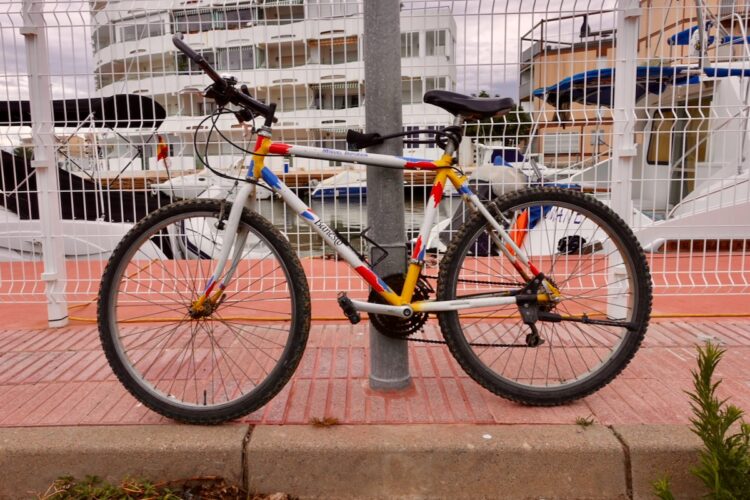
Old Hardtail to New Commuter: How to Convert Your Rig for the Daily Grind

Wednesday, October 19th, 2011

After upgrading to that shiny new full suspension, disc brake equipped, 25 pound trail slayer, your trusty old hardtail got relegated to the back of the garage. You look at it from time to time and remember the good times you had on it: your first crash, your first all day epic, that trip to Moab where you carried it down Portal Trail

You think about riding it, but the new bike gets all the trail time and it makes you a little sad inside.

Photo courtesy of eliwestfall

Okay, so that’s a bit over-dramatized, but what if you could re-purpose that old hardtail and get regular saddle time on it again? One option is to convert it to a singlespeed; another is to turn it into a dedicated commuter bike, which are not mutually exclusive options, by the way.

When I started bike commuting about 5 years ago I thought I needed/wanted a road or ‘cross bike. I even started shopping around for one, but I soon realized that another bike was not in my budget at the time. I took a hard look at my Specialized Rockhopper and realized several things about it:

  • The frame is very well built.
  • It has excellent geometry.
  • I knew for a fact that I could ride it long distances comfortably.
  • It has pannier rack mounts.
  • It has bosses for two water bottle cages.
  • It can easily handle a load consisting of me, a laptop, clothes, etc.
  • It can drop off curbs, hit cracks, and even survive detours into the dirt when the bike path is under construction.
  • I paid $150 for it, so if it ever gets stolen, it’s not the end of the world.

The perfect commuter bike was sitting right there, ready to go!

At that time it was still my mountain bike, so I swapped tires twice weekly and removed the rack for trail use. This article, however, will cover what I learned when I did get that shiny new trail bike and turned the Rockhopper into my full time Curbhopper.

First you will need to assess your bike’s current condition, any parts that need upgrading or replacing, and any options you might already have installed.

Maintenance

  • Replace the chain and cassette.
  • Get the wheels trued.
  • Check the headset, bottom bracket and hubs for proper adjustment. Re-lube if necessary.
  • Replace the brake and shifter cables.
  • Replace the brake shoes.
  • Check all bolts and fasteners for tightness, rust, etc.
When commuting, you will likely be riding in traffic, dodging cars, and powering through intersections. That is not the time to miss a shift or snap a chain! Make sure the bike is in perfect mechanical condition. At some point you will thank yourself.

Upgrades

Knobby tires and front suspension are great on the trail, but on pavement…not so much. In order to make a truly dedicated commuter bike, these need to go.


There are a number of rigid steel forks on the market. These are sized to allow for the travel your bike used to have, and can come with V-brake or disc brake tabs.

Here are some decent models to consider:

eBikeStop carries Dimension steel forks in both V-brake and disc brake configurations. They range in price from $35 – $55.

When I converted, I spent $45 on a Tange steel fork, with V-brake tabs, but these seem to be getting a little scarce.

Surly makes a great steel fork for $100 with both V-brake and Disc tabs.

Whatever fork you choose, just be sure to match the brake mounting tabs to your intended brake type, and pay attention to 1 1/8th inch threadless vs 1 inch threaded steerers.
For tires, the issue is not so much the tread or the width, but more importantly the maximum air pressure. On pavement, a firmer tire rolls easier and you want as many psi as possible. I have 1.5″ wide Bontrager Hardcase Comfort tires that will take 85psi. Loaded with me and work stuff, these hold up great and roll fast. Here are some tire choices that are currently available:

Kenda Kwest (100psi 26×1.5 model) $20.50

Schwalbe Marathon $41.95

WTB Slick (with Flatguard) $19.99

Bontrager H2, H4 or H5 $20.99 – $46.99

Racks and Bags

With the fork and tires sorted, the next step is to give your newly created urban assault bike the ability to carry stuff. A luggage, or pannier rack is the first item to decide on. Most older mountain bikes have pre-drilled and tapped mount points for just this purpose. Topeak is the leader in this segment and their rear racks integrate seamlessly with their own line of bags while also supporting bags from other brands. The center of the rack acts as a de facto fender, and they have a built-in tab for mounting a tail light. One model is even disc brake compatible.

If you don’t have rack mounting tabs, you will need to use a seatpost rack. These don’t support as much weight as the frame mounted type, but they are suitable if it’s your only option.

Next you will need to choose a bag for transporting your stuff. If you do not need to transport a laptop, there is a huge selection of bags available. Make sure to allow room for a change of clothes, lunch, and personal items. Better quality models have compression straps, bungee cords and built-in rain covers. If you also need to transport a laptop, not to worry: there are bags designed specifically for this purpose. The Delta Metro Elite is an affordable choice that can hold a 17″ laptop with plenty of room left over for clothes and files, and it has an integrated rain cover. I have this model and it works ok, but the mounting system is a little weak. The mounting hook broke after about a month of use, but Delta replaced it for me without a hassle.

If you’re serious about bike commuting, the primo line of bags to check out comes from Arkel. These high quality bags are pricey, but they are very well made and can hold up over years of commuting. The Bug model is fairly compact and can hold a small to midsize laptop via an optional padded sleeve. Off the bike, it quickly converts to a backpack. The aptly named Commuter is the workhorse of the line-up. It swallows larger laptops and a ton of stuff and includes the  laptop sleeve.

Lights

Whether your whole commute is in daylight hours, or if you stretch into dusk in the spring and fall, a good set of lights can be a valuable purchase, and they may even be required by law in some places. A good quality ‘blinky’ tail light is a good idea regardless, as it helps motorists see you, even in bright sunlight. Here are several good models:

Planet Bike BRT-3 Can be direct-mounted on the Delta rack above. This is the light I use. $9.99

Niterider TL-5.0 Convenient seat post mount. $6.98

Blackburn Flea Small, light-weight, rechargeable and insanely bright. This is a popular model among full time bike commuters. $29.99

As for a headlight, there are a number of decent models in the $30 to $50 range from the above vendors, but if you already have one for nighttime mountain biking, you can just use that. If you don’t have a light, I would still recommend a mountain biking light such as the MagicShine MJ-808 P7 for $89.99, the CygoLite Pace 350 for $149.99 or the Light & Motion Stella 400 for $269.99. Any of these lights will work well for commuting, as they all have Hi, Medium and Flash modes for night time illumination or daytime visibility, as needed. I have the MagicShine and I love it.

This how-to is intentionally comprehensive and results in a well appointed, full-time commuter bike. You can start with the basic maintenance, street tires, and a backpack and make the rest of the modifications as time and money permit. Hopefully this helps you get that great old hardtail out of mothballs and back into circulation!

If you already have a converted commuter bike, go ahead and drop a link to a photo of it into the comments.

Life Cycles Mountain Bike Video

Wednesday, October 5th, 2011

There has never really been a mountain bike movie like this before. And it may be a long time before anyone else can capture a wisp of the feeling Life Cycles has captured. Derek Frankowski and Ryan Gibb, the creators of this masterpiece, have my respect.

Life Cycles exhibits a paradigm shift in the way mountain bike movies are made. Every scene offers an explosion of color, a lack of color, a thought provoking idea, and then it’s visually stunning again. The cinematography is truly awesome.

But that’s not all that Life Cycles is about. Depending upon your stage in life and what experiences you have had, you relate to the movie in different ways. Growing up around bikes my entire life, I totally get the story–almost as if the movie was playing what someone had read in my mind.

After watching it, all of a sudden a few doors in my mind opened up. Things from the past that were buried under cobwebs and day-to-day life started to emerge again–a purer way of thinking. Getting back to the day when things were simpler, less tech-oriented. As of late, people (myself included) are/were all about the latest and greatest, all about what’s new, what new technology we’re exploiting. It gets to the point where you’re not satisfied unless you have the latest and greatest between your legs when you’re riding… like the lack of a boostvalve or tapered bore piston is going to diminish your ride for whatever reason.

Well, Life Cycles brings you back. Remember that time when you first learned to jump as a kid? That moment when your bike left the earth behind for the first time, that first fleeting second off that rickety soap-box-and-plank jump? Remember that? How about those tracks you left behind in the black earth of the berm you just railed. Other words like “ebb” and “flow” come to mind as well.

Life Cycles provides new ways of looking at that trail: who created it and what they were thinking when they cut the path. Look at the care that was taken to not disturb most of the landscape so that they and you could enjoy the countryside. Appreciate the immensity of the outdoors and some of the epic visages that await you.

All this lies in store for you when you watch Life Cycles. The list of featured riders is impressive as well. Icons in their own niches of riding styles are here: riders like Hunter, McCaul, and Semenuk, to name just a few, will blow you away. Just seeing how big they are and at the same time how small we all are as we ride along the landscape before us is almost indescribable.

Check out Life Cycles: get yourself a copy. It sells for about $35.50 for your Blu-ray player, or you can download it on iTunes for less than $10. Either way, you’re getting something special.

Official Trailer

(here’s the link for those who can’t see the embedded video above)

If you have already watched Life Cycles, what are your thoughts?

Leave No Trace Mountain Biking

Wednesday, September 28th, 2011

“What does mountain biking mean to you?”

This question is posed all the time in forums, blogs, videos, and magazines. It can be a tough question to answer because there are so many things that make mountain biking such a rewarding lifestyle. I know that for me, and for many of you, one of the most rewarding aspects of mountain biking is getting to enjoy some of the wilder, more unsullied places on the planet. There is something peaceful and pure in nature that speaks to us, that calms the spirit.

That blissful escape from the urban world is destroyed when you reach a scenic overlook only to find someone’s garbage lying on the ground.

Sometimes I hate people. This trail-side trash heap totally ruins the scenic beauty of this spot. Green Mountain, Blue Ridge, Georgia.

For me, this picture represents the beauty and grandeur of nature that I head out on the trail to find. Trail 401, Crested Butte, Colorado.

We can all help protect the majestic beauty of the mountains, forests, meadows, and deserts that we ride in by choosing to Leave No Trace.

LNT Mountain Biking

There are seven main principles of Leave No Trace outdoor ethics. In addition to just listing the main principles, I’ll add some of my thoughts on how it can be specifically applied to mountain biking:

1. “Plan Ahead and Prepare”

This is a good rule for any trip into the forest. Know where you’re going, what the area will be like, and pack everything you think you’ll need.

2. “Travel and Camp on Durable Surfaces”

This is very important for mountain bikers! Ever heard the saying: “Keep singletrack single”? The trail is meant to be followed. If you don’t have the skills to ride a particular section of trail, don’t blaze your own trail around it. If you do it, someone else will follow your tire marks. Riding off the established trail accelerates erosion and degrades the purity of the singletrack experience.

Please, if you can’t handle the difficulty of a specific section of trail, just get off and walk.

3. “Dispose of Waste Properly”

Pack it in, pack it out. One of the things that inspired me to write this post in the first place was finding trash all over my local trail system after a recent race. Does it really take you that long to put your half-eaten gel packet back in your pocket? And if you can pack in an extra tube for when you get a flat tire, why can’t you pack your flat tube back out with you?

I picked up all of this trash in less than a quarter of a mile. Perhaps the water bottle was more “lost” instead of “tossed,” but the tube and sweat rag are unacceptable.

For other sorts of waste in the backcountry, I refer you to these directives from LNT.org:

  • “Deposit solid human waste in catholes dug 6 to 8 inches deep at least 200 feet from water, camp, and trails. Cover and disguise the cathole when finished.”
  • “Pack out toilet paper and hygiene products.”
  • “To wash yourself or your dishes, carry water 200 feet away from streams or lakes and use small amounts of biodegradable soap. Scatter strained dishwater.”

4. “Leave What You Find”

If you want to take something from a natural environment, please just take a picture. Leave whatever you’re photographing there for everyone else to enjoy too!

5. “Minimize Campfire Impacts”

This really only applies to mountain bikers who are bikepacking, but please try to use preexisting fire rings.

6. “Respect Wildlife”

These ideas really apply to everyone at all times, including mountain bikers.

7. “Be Considerate of Other Visitors”

This is especially important for the mountain biking community. Learning to yield the trail properly to other users goes a long way towards amiable interactions with other user groups and trail access in the future. In case you aren’t aware, the technical rules of yielding are as follows:

  • Hikers yield to horses.
  • Mountain bikers yield to horses.
  • Mountain bikers yield to hikers.
  • The downhill rider yields to the uphill rider.

As we’ve discussed in a recent forum thread, this last one doesn’t always make the most sense. But when in doubt, stick to these guidelines, and it can help alleviate stress for everyone.

It Only Takes One

It only takes one person to ruin the purity of nature for everyone else by leaving trash on the ground, carving their initials in a tree, or spreading dirty toilet paper across the forest floor.

On the other hand, sometimes it only takes one person to pick that piece of trash up to restore the woods to its former natural glory.

Don’t be the first person… be the second.

What are your thoughts on Leave No Trace MTB ethics?

Android App + Trail Progress Bars

Friday, September 2nd, 2011

Ok Android users, this one is for you: the singletracks Android app was officially published yesterday afternoon! Download it for free to find nearby trails, read and post reviews, and read the singletracks blog, just like the iPhone version.

We also quietly added trail progress bars to everyone’s “My Account” page earlier this week as a fun way to track how many great trails you’ve ridden. The first bar shows the percentage of trails in your state you’ve ridden; the next shows the percentage of IMBA Epics; and the third shows the percentage of the singletracks top 100 mountain bike trails. We’ve also updated the top 100 trails page to show you which trails you’ve ridden at a glance (your trails are shaded green on the list).

Feel free to post your stats here in the comments or in this forum thread we just started. Who is the king of the IMBA Epics? The most well-traveled mountain biker in your state? Let the smack talk begin.

Thanks to singletracks member ckdake for the progress bar feature suggestion!

Singletracks iPhone App Update

Friday, August 26th, 2011

Just a quick note to everyone that we updated the singletracks iPhone app this week and the new version should be showing up in iTunes today. This is officially version 1.0 (the first one was 0.9) and we’re really stoked about it. The updated app features a more native look and feel and should be more responsive as well. Here are the highlights:

  • Create or log in to your singletracks account within the app. Once you’re logged in you can update trail statuses, add trail and gear reviews, add trails to your wishlist, and check-in whenever you hit the trail.
  • View up to 18 photos of each trail in the new photo gallery.
  • New search and filter functions make it easy to zero-in on the trail and gear reviews you want to find.
  • Improved blog integration with thumbnails and enhanced readability.

Of course you can still find the closest trails based on your current location and get turn-by-turn directions to the trailhead. There are some other nice little surprises included as well that you can only access when you’re logged into your singletracks account. The app should also work well on iPad for those of you who roll that way.

For those who aren’t on an iPhone, you can access the mobile site through any web browser right here. And for those with an Android phone, good news: the new app should be super easy to port which means we hope to have an Android version available in the next few weeks.

We’ve already got a big list of new features for version 1.x and even 2.0 so stay tuned!

Spoiler Alert: Why I’m Not a Fan of Calling Out Obstacles on the Trail

Monday, August 22nd, 2011

Rocks!

Tell me if this has ever happened to you during a group ride. You’re cruising along and the guy in front of you yells out “low branch!” every time there’s something you need to duck for along the trail. Or he yells out “bridge!” to tell you there’s a 3-foot-wide wooden structure spanning a dry creek bed 18-inches below grade. On a recent ride I even heard someone yell out “log!” which caused me to grind my teeth in frustration – what’s up with all the spoilers?

Yes, calling out obstacles on the mountain bike trail can be both courteous and helpful. For example, there may be unexpected problems ahead (say a newly fallen tree) or even a rider who is stopping abruptly (stopping!). Sometimes it’s a good idea to call out directions at a fork in the trail to keep the group together (right!).

Log!

Still, the whole idea of calling out warnings on the trail seems like a road biking thing to me, like when guys silently point at loose man hole covers or crumbling asphalt for others to avoid. The difference is, we’re mountain bikers – we expect – nay, enjoy – the bumps in the road! Here are three reasons I can do without trail spoilers.

1. I don’t want to know what’s coming up. For me, mountain biking is all about encountering the unexpected and when there are no more surprises left on the trail that usually means it’s time for me to find new dirt. I love the adrenaline rush I get from reacting quickly and making split-second decision making so when I know what’s coming up, that takes some of the fun out of biking for me.

2. Trail warnings break your concentration. I typically focus on picking lines 10-yards ahead of my wheel so to take a mental break to think about what’s coming up beyond that can be dangerous. Ok, so it’s not really that dangerous but it definitely harshes the flow. Do not harsh the flow.

3. Conditions change and everyone is ultimately responsible for themselves. On a recent night ride our group was turning left off a curvy, paved road and after looking both ways I called out “clear” and leaned into the turn. Just as I crossed the yellow line I saw headlights coming around the bend and while I had plenty of time, I realized the guys behind me wouldn’t make it. If they had simply listened to me without looking they would have been hit, long before I could follow up with a “car up.” The point is, even if someone calls out an obstacle, it’s still up to the individual rider to evaluate the situation and make the right decision.

I get that we’re “trying to have a a society here” and I understand that the riders who call stuff out are really trying to be helpful. Just next time – call out “spoiler alert!” before you tell me what’s coming so I can at least cover my ears.

USAPCC Stages 5&6: Steamboat Springs, Breck, Golden, & Denver

Friday, August 19th, 2011

The Stage 6 route circles North Table Mountain.

Steamboat Springs is the only city fortunate enough to host both a race start and finish during the 2011 USA Pro Cycling Challenge (USAPCC) which makes this a prime location to watch the race. Racers will start the big climb up to Rabbit Ears Pass within the first 5 miles of Stage 5 and from there it’s a long, fast descent to the first sprint line of the day in Kremmling. There’s another sprint line in Dillon and a KOM line at Swan Mountain before the race finishes in downtown Breckenridge. Total distance: 105 miles.

Stage 6 is the final stage of the USAPCC and it starts in Golden just west of Denver. Racers will ride a figure-8 circuit north and south of Golden before heading west toward downtown Denver for the finish. With a Sunday finish in the largest city in Colorado, I’m sure this stage will see the largest crowds of the race. Even though Golden is just 12 miles from Denver as the crow flies, this stage manages to stretch 72+ miles with just over 3,000 feet of climbing.

Mountain Biking

Breckenridge is a mountain biking town, though despite operating a summer lift many riders choose to ride both down and uphill. The area hosts well known summer races like the Breck Epic and Firecracker 50 and mountain bikers can access hundreds of miles of backcountry trails nearby. The Colorado Trail passes close to town and one popular mountain biking route takes riders along the trail from Kenosha Pass to Breckenridge.

Over on the Front Range side, the Stage 6 course will literally circle North Table Mountain, a relatively new trail system I rode last summer. While these trails may not be the most interesting you’ll find along the Front Range, the exposed mesa should give mountain bikers a great view of the race from multiple angle. The stage route also encircles Apex Park, another popular mountain biking spot, and nearly touches Matthews Winters and Green Mountain.

Fun Facts

I forgot to mention this in the Stage 4 preview – Steamboat Springs is home to bike brand Moots, makers of high end, hand-built titanium frames. The Stage 6 start city, Golden, is HQ for both Spot and Maverick brand bikes. In fact, the Stage 6 route takes riders within sight of the companies’ offices.

We’ve set up a forum on singletracks for mountain bikers who’d like to meet up to watch the race next week so drop in and let us know your plans!

USAPCC Stages 3&4: Vail, Avon, and Steamboat Springs

Wednesday, August 17th, 2011

photo courtesy vail.com.

The USA Pro Cycling Challenge (USAPCC) hits Vail for Stage 3 with an uphill individual time trial that should be super spectator friendly. Riders will climb almost 1,800 feet from the resort town of Vail up Vail Pass to the finish. If you’ve never watched a professional cycling race in person, this could be a fun stage because riders will be constantly streaming through the course for more than 2 hours (instead of the 2 minute whoosh! you can expect when viewing the peloton).

Stage 4 of the USAPCC takes riders from the town of Avon north to Steamboat Springs. This stage is only about 82 miles long (only!) with just over of 5,000 feet of climbing which is pretty mellow compared to previous stages. The official USAPCC description says “(w)ithout significant climbs or high-speed descents, cyclists have numerous opportunities for breakaways” which means this should also be an exciting stage to watch.

If I haven’t mentioned it before, the USAPCC is being covered by the Versus channel so even if you can’t make it out to watch the race you can still keep track at home. On Sunday, portions of the race’s final stage will even be broadcast on regular old NBC.

Mountain biking Stages 3&4

The mountain biking opportunities along this stage lean heavily toward the “lift-serviced” variety. Beaver Creek (in Avon) operates a summer lift as does Vail and the Steamboat resort. Leadville is sorta “just over the hill” from Vail – but not really. It’s still a 40 mile drive or so and the singletrack opportunities there are limited. Along the Stage 4 route on Highway 131 itself there just aren’t many trails (at least according to our trail database). Just the excuse you needed to rent a sick DH bike and leave your climbing legs at home!

Where to stay

Since Stages 3 and 4 start and end in resort towns there should be no shortage of great places to stay. The good news is summer rates are usually less than half what you’d pay during prime ski season so live it up and stay somewhere nice!

Get ready for our final USAPCC preview covering Stages 5 and 6 later this week.

Crackpot Engineering: How to Carry a Bike on a Motorcycle

Tuesday, August 9th, 2011

“Where did you get that?” Uh… my garage.

“Is that safe?” Nope, but neither is loud music, mountain biking, casual sex, heavy drinking or eating fried chicken, but they’re so much fun. If you want safe you should stay at home and play with your Wii.

My objective: to fabricate a device that would allow me to carry a bike on my motorcycle (perhaps to a gravel CX race?). Since my wife is a frequent passenger, the device would have to stay out of the way of her comfort, or be reasonably easy to take off when riding two-up. I went through a few iterations of the design in my typical scattershot, crackpot, hurry-up-who-cares-about-safety-or-quality prototyping process. For the first design I ignored Occam’s Razor and instead went with Occam’s Rube Goldberg machine.

Since my bike (a Suzuki VStrom) is intended for adventure touring there are mounts for side cases and a top box already installed. By removing the top box and measuring the mount points I drew up a design for a plate that could clip into the base. On this plate I would mount the tray and fork clamp from a donated Yakima roof rack. My good friend and master fabricator Dan (Rack n Roll) helped with the machining of the aluminum base plate.

And to achieve my quick release design goals it comes off nice and clean like this:

But man is that thing heavy. Plus it’s far away from the “moment of gyration” i.e. the point where the rear wheel contacts the road. My friend and accomplished mechanical engineer Dave told me the farther away from that point, the more the motorcycle’s movement will be translated into the mounted bike. I got a good deal of side-to-side swaying while riding rough roads, so I went back to my team of science chimps for a newer, simpler design. After digging into my parts supply I decided to use the crossbar from the discarded roof rack like so:

It won’t work on every moto, but the beefy passenger grab rails serve as a perfect mounting point for the crossbar. It’s lashed on with 550 pound test US military paracord, easy to put on and remove when required. As an added benefit I can still use my top box and the left side luggage case for my riding gear (or beer, handguns or raw ether). The last piece to the puzzle is the fork mount.

I pulled off the passenger footpeg and replaced it with a fork clamp bolted onto some cromoly tube stock. Version 3.0 will get a smaller, lighter fork clamp from Delta and I’ll hose clamp it directly to the passenger peg. Simplify, simplify, simplify. And there’s no patent protection for this gizmo so if any of you out there have as little regard for personal safety and weather-protected transportation as I do, have at it. Just don’t say I didn’t warn you… be ready for lots of dumb questions by people who don’t get it. I’m not sure I get it either, but it sure is fun.

Name that MTB Trail Contest Starts Today!

Monday, August 1st, 2011

The singletracks Name that MTB Trail contest starts today and the first two pics have already been posted. Head over to the contest page and submit your guesses now!

Everyone who submits at least one correct answer during the contest will score free singletracks stickers and the top three finishers will get $50 HuckNRoll gift cards PLUS two picks from the MTB grab bag. Full contest rules and details are available on the contest page. Winners will be announced following on August 11, 2011.

One is Enough: Why You Should Give Singlespeed Mountain Biking a Chance

Thursday, July 28th, 2011

Do you remember the first time you saw someone riding a singlespeed (SS) mountain bike?  I bet your first thought was “what do they think they’re doing out here without any gears?  Don’t they know they have to ride up hills?”  I also bet you were immensely confused when they rode away from you on a climb – I know I was!  After my first SS encounter I walked away with the conclusion that you must have to be a beast to ride a SS MTB – I mean, it’s gotta be really hard, right?  I’m going to let you in on a secret:  singlespeeding isn’t nearly as difficult as you think.  Heck, I rode almost exclusively on a SS for over a year, and trust me – I’m not that strong.

I wanted to do a post that might convince some of you to give singlespeeding a try for yourselves.  There are already tons of blog and forum posts on the interweb about the benefits of SSing (light, simple, quiet, builds strength, etc.) so I decided to do something a little different.  I lent my 29er singlespeed to five non-singlespeed riding buddies to get their thoughts.  These guys and gal are normal riders, they’re not slow, but not that fast either.  They might do a race or two every year for fun, but they primarily ride because they enjoy it.  That’s what it’s all about after all!


My bike, a Vassago Jabberwocky.  25.16lbs of steel-framed, one-geared, big-wheeled goodness.  And yeah, it’s got a bell. 

Rider #1 – BrianW

STATS Age: 40 | Years Riding: 19 | My Bike:  Giant Yukon (hardtail, 26″ wheels, aluminum frame)

Thoughts on the singlespeed:

Within the first 2 minutes on the Keg Creek trail I was reaching for phantom shifters. The one thing that I noticed and could get used to was how quiet a singlespeed is. Just the tires on the dirt. Never knew how noisy the derailleurs were. Also seemed like as soon as I pushed down on the pedal there was power, no delay at all.

I was worried about two climbs: the first one, going up Boulder Creek, was a lot easier than I expected. On the steep rooty climb just after the “Bed Rock” crossing I managed to go up half way before losing momentum and walking the last portion. To be honest though, I struggle up this one even with a geared bike. Long ascents were not as bad – I got off the saddle a bit more than I normally would. Overall the climbs were not as bad as I thought they would be. I am also certain that given a few weeks on a singlespeed that the climbs would be a non-issue. It did seem that you needed to go a certain speed or cadence or else you might be walking.

The downside that I noticed was on long downhills – I wanted to put it into a higher gear to get more speed. Eventually I overcame this by picking up the cadence.  I also rode a section of paved road from Keg to Bartram (in Wildwood) to see how I would like it. Again I was reaching for phantom shifters. And again I had to overcome by picking up the cadence. I believe over time these problems would be non-issues.

Overall I did not miss the gears and the quietness of a singlespeed trumped the few times I really wished I had them.


Less (complexity, noise, weight, parts, maintenance) is more (fun).

Rider #2:  David K.

STATS – Age:  43 | Years Riding:  3.5 | My Bike:  ’09 Cannondale Rize Carbon 1 (carbon/aluminum framed 5″ travel full suspension bike, carbon Lefty fork, 26″ wheels)

The ride: Rode at FATS – Skinny (ccw) -> Brown Wave (ccw) -> Great Wall (cw)
20.2 miles. 1:58 riding time (surprisingly, not slower than on my geared FS bike)
Met Paul F. in parking lot and we decided to ride together. He rode behind. I always ride faster/push a little harder with someone behind me. I rode every hill without stopping; even the 2-mile climb out of Great Wall (cw).

The experience:

  • Several new variables with this bike: single speed, 29er, hard tail.
  • Frame might be too big, stem too long, and seat too far back. Overall though, it wasn’t a bad fit.
  • Never stood and pedaled so much out of the saddle (i.e., climbing). On geared bike, I just sit and spin most/all hills.
  • Quiet. Although, not due to lack of gears but the lack of chain slap (I could hear the chain slapping on Paul’s bike).
  • Going up hills was not nearly as punishing as I feared (I was very surprised). However, not sure if it was the SS, 29er wheels, or the knowledge that if I didn’t get enough speed or pound hard enough I would get stuck? Knowing that there isn’t an easier gear available is a great motivator for hills.
  • I’m not that fast downhill so needing/wanting a higher gear wasn’t an issue for me.
  • It’s hard to qualify but, once rolling, there seemed to be more power to the wheels (lack of RD?) and more momentum when coasting (29er tires?).
  • Actually, I think some climbs might have been easier than on my geared FS bike.
  • I tried to shift with the dingle bell a few times (subconscious thumb movement).
  • Riding a single speed/hard tail probably makes you a better/stronger rider: standing and pedaling out of saddle, focusing on technique during turns or watching the trail ahead to maintain speed/momentum.
  • Here is a shocker: If I had extra money, I would think about getting a SS 29er. Mostly as a “penance” bike for the day after a bad ride or when I bag a ride due to laziness. No cheating hills with a single speed.
  • Won’t give up my geared FS bike, but I can see where a SS might be nice to have for more variety (i.e., switching up trails and bikes) or for training.
  • A few times (long, slight uphill grade, seated) getting the bike rolling faster felt like moving a ton of bricks (might be that my legs were getting tired).
  • Most of the time though, once the bike was rolling, it kept rolling.
  • Really impressed at how (relatively) painless it was to stand and pedal those hills. I wouldn’t have guessed.
  • My casual observations have been that most folks start off with a hard tail, move to a full suspension and, if they’ve caught the fever, eventually get a singlespeed.  Never thought of myself progressing to the third stage but this ride has me thinking.


No shifters makes for a simple, clean, uncluttered cockpit.

Rider #3:  Tom Z.

STATS – Age:  44 | Years Riding:  10 | My Bike:  2001 Gary Fisher Tassajara  (hardtail, 26″ wheels, steel frame)

I don’t know why I was so surprised at how much I enjoyed my trial singlespeed ride.  After all, I spent the first 13 – 14 years of my life riding a singlespeed bike.  And we rode everywhere then – through woods, fields, in the clay pit behind my house.  Gears were something your mom had on her bike – a 3-speed cruiser.  You were a sissy if you had a 10-speed (which the rest of us were secretly envious of).

So I chose the Turkey Creek Trail to ride as it is representative of 75 – 80% of the riding I do.  It really didn’t take long to get accustomed to not having shifters.  Maybe because I have been struggling with rear derailleur issues for so long, but it felt very liberating to ride without gears.  The ride was definitely quieter.  Yes, I had to come out of the saddle a few times more that I normally would have.  I didn’t realize how dependent I had become on a geared bike – down shifting out of habit in the face of an obstacle rather than powering over or up it.  The trail was very trashy from recent storms – a lot of trees and limbs down to climb over and around.  Despite that, I thought my ride time was pretty good – 55 minutes in (7 miles) and about 5 minutes less out.  On this trail, I found myself wanting a higher gear more often than a lower one.  If I was slower than normal, I think it was on the flat and downhill sections when I normally would have pushed into a higher gear.

The bottom line is, now that I have a new geared bike (3 x 10), I convinced myself to convert my old bike to SS.  I’m looking forward to riding it on some more challenging trails.  Maybe my opinions will change when I have to do more climbing.  Hopefully I will get stronger.


Trent rode the SS with platform pedals.  Photo:  Trent S.

Rider #4:  Trent S.

STATS – Age: 34 | Years Riding: 10+ | My Bike:  2011 Specialized Camber Elite 29er (full suspension 29er)

First impressions @ Skinny – like most of the trails at FATS, Skinny starts with a long section of downhill and very, very quickly (within 50 yards of the parking lot) I ran out of spinning speed.  I love going fast, so not being able to do so under my own pedal-power was frustrating at first.  I caught myself trying to pedal a few times where I clearly couldn’t match my rolling speed.  After I accepted the fact that gravity and a light touch on the brakes would dictate my top speed, I got into it.

The first thing I noticed was that instead of barreling down the trail like I do on my 29er FS and grabbing handfuls of brakes moments before potential disasters at big hits or sharper-than-expected turns, I was rolling at a more leisurely speed and found myself enjoying setting up jumps and smoothly carving through corners.  Sure the overall pace of the ride was slower, but it ended up being more enjoyable.  Later in the ride, I also seemed to have more energy than normal.  It could be attributable to knowing I needed to beat the rain back to the Jeep, but I like to think that it was due to the single speed.  Normally I like rolling along in the big ring, pushing hard gears.  With the single speed, I had no choice but to enjoy the ride at a more leisurely pace and it saved my legs for the uphill battle back to the parking lot.  Normally at that point, my quads are starting to feel it and there are a few hills I dread.  Now, even though I was climbing in a tougher gear than I’d normally try to attempt, I had some reserves that pushed me through the steep spots.

I was riding platform pedals again.  If the Jabberwockey’s geometry were a little different, it’d be a lot like riding my old BMX through the woods.

@ Canal trail – Again, a single speed is best in the woods.  It felt really slow riding through the neighborhood on the way to the trail.  Reminds me of when I was a kid riding a BMX.  The easiest thing to do is stand up, pedal as fast as you can for a few moments, then cruuuuise….and repeat.  Once on the canal trail…well, I was concentrating more on getting back to the house in time for Stacey to pick me up for our trip to Beaufort to really notice many differences…except a whole new respect for single speed riders who fly through the woods.  Don’t know how they do it.  There are so many spots on the trail where you could really pick up some speed, but I didn’t manage to do that.  Maybe I’ll try again with clipless pedals.

Bottom line – I’d love to have one.  As a second bike.

Rider #5:  Stacey W.

STATS: Age:  30 | Years Riding:  2.5 | My Bike:  Giant XTC2 (hardtail, 26″ wheels, aluminum frame)

The advantage of riding the single speed on a trail that I’m familiar with allowed me to anticipate and better prepare for the climbs.  For instance, when a tight turn came just before a climb (knowing I couldn’t drop it down a gear to make the climb easier), I didn’t wimp out by squeezing the brakes.  I kept all the momentum I could, went wider and leaned harder into the turns, which is what I should be doing anyway!  It’s good “basic training” and brought me back to the fundamentals of riding (momentum, shifting weight etc).

The workout was more intense and I enjoyed the exertion I felt afterwards. I’d love to have a single speed for a second bike! ;)


Stacey enjoying the ride to the trail.  Photo:  Trent S.

Told You So!

As you can see, everyone enjoyed riding the singlespeed, even if they didn’t think they would.  The proof is in the pudding they say, so here’s my proof:  BrianW, David, Tom, and maybe even Trent are all converting their old bikes to singlespeeds.

Keep an eye on the Singletracks blog – soon I’ll have a Tech How-To post showing you how to convert your own bike to a singlespeed!  It’s a cheap way to try SSing without buying a whole new bike, it’s easy, and it is a great way to get your old bike out of the garage and back on the trails again.

Thanks to Brian, David, Tom, Trent, and Stacey for trying the bike and taking the time to write up their thoughts on it.

What do YOU think about SS MTBing?  Ever tried it?  Tell us what you think in the comments section.


Site Map | Advertise | Partners | Contact Us | Terms | Privacy
Campground Reviews | Hiking Trails | Trail Running | Skiing / Snow Sports | Mountain Biking
Copyright 2012 Blue Spruce Ventures LLC | Atlanta, GA
singletracks.com is yet another slick Review App