singletracks is mountain biking
Sign In | Create Your Account | Site Map | Help  


The Evolution of Downhill Mountain Biking in Crested Butte: Evolution Bike Park, CBMR

Friday, September 2nd, 2011

Crested Butte is legendary as one of the birth places of mountain biking. While Marin, California may receive most of the fame (infamy?), Crested Butte was also one of the places that the earliest mountain bike pioneers called home. Unlike Marin, Crested Butte has maintained its legendary status with the oldest mountain bike club in the world, CBMBA, and the Mountain Bike Hall of Fame. The quality of the trails in the area back up this rich history: the greater Crested Butte area may boast one of the highest concentrations of singletrack anywhere in the United States, perhaps in the world!

Traditionally, Crested Butte has been strictly known for massive cross-country rides at lung-taxing altitudes on singletrack that sports truly epic views. However, that may be slowly changing.

Enter Evolution Bike Park.

Christian Robertson on the Timeline trail.

Crested Butte Mountain Resort (CBMR) has been running their lifts for mountain bikers for 8 or 9 years now, but up until just 3 years ago, the runs consisted of old hiking trails and cattle paths – they were anything but mountain bike-friendly. In 2008 CBMR made the decision to hire on a crew of full-time workers to build and maintain a park designed specifically for downhill mountain biking, and Evolution Bike Park was born.
Since that time, the bike park has grown at an astounding rate! It now boasts 25 miles of trails that are open to mountain bikes, and five of those trails have been purpose-built for downhill mountain biking and are closed to uphill riders and all other trail users. In 2009, CBMR logged 3,500 rider days; in 2010, that number jumped to 8,000. According to Christian Robertson, the bike park manager, they hope to log at least 10,000 rider days this year.

Over the past couple of years, CBMR has been a popular stop on the Mountain States Cup race series, and just this year they got certified with USA Cycling. As a result, CBMR has been added as a stop on the international-caliber Pro GRT race series.

My Experience Riding Evolution Bike Park

I was fortunate enough to be shown around the mountain by none other than Christian himself, and he was kind enough to let me pick his brain on the chairlift rides up the mountain. CBMR also hooked me up with a free pass, one of their Specialized Demo 8 rental bikes, and some body armor so I could get a true bike-park experience.

The Demo 8 performed superbly!

All kitted up, and ready to rip!

All of the mountain bike trails are serviced by a detachable high-speed quad, which means less time on the chairlift and more time on the mountain bike!

I was impressed by the number of groms tearing around the resort. Turns out there’s an organization in town called Gravity Groms.

Like everywhere else in Crested Butte, the views from the top of the lift are surreal!

Without further ado, here’s a breakdown of several of the trails that we rode:

Avery

Christian pinning it through one of the rock gardens.

Avery is Evolution Bike Park’s race course, and as such there is a little bit of everything incorporated into this top-to-bottom black diamond trail. You’ll find plenty of drops (including a 12-foot cliff), technical rock gardens, bridges, table-top jumps, big berms, off-camber turns, slick mud, a step down, and tons of roots. Basically anything you can imagine, Avery will throw at you!

After just one run down this trail, I knew it was my favorite run on the entire mountain. I absolutely love the variety and technical nature. And while it is challenging, I didn’t feel like I was going to die every time I rounded a turn.

Check out some of my GoPro footage from Avery:

Timeline

According to Christian, Timeline is the most popular trail on the mountain. Its design embodies what many people have come to expect in a fast, flowy jump trail. If you want to catch air and find your flow, Timeline is the place to do it! Almost every corner is bermed, rocks are few and far between, and the jumps vary from small kickers to table tops to massive cheese-wedge booters.

Christian Robertson.

Christian Robertson.

Wood’s

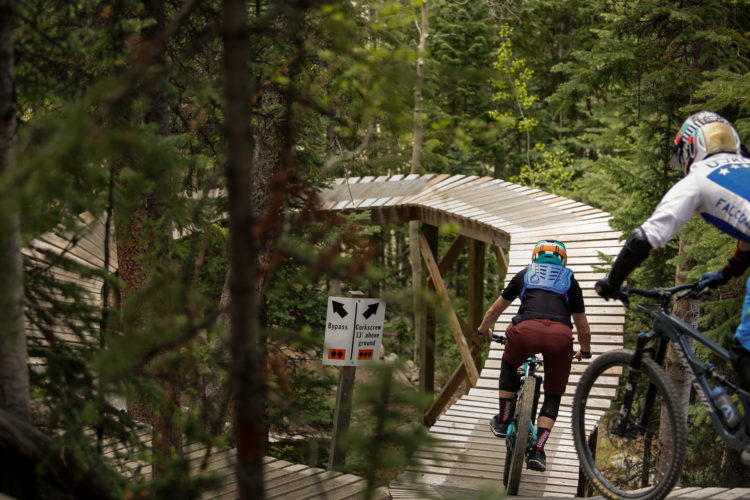
Wood’s Trail is far out on the rider’s right-hand side of the resort and it takes a little pedal to get there and back – but it’s well worth the effort! The top of the trail starts off with a quick barrage of small jumps and berms, but lower down the trail straightens out and speeds up as it feeds into a massive pair of back-to-back wooden wall rides. The lower section of Wood’s is currently under construction, but it looks like it holds a fast line of medium-size jumps.

Be sure to check out the wall rides at 1:07-1:25:

Luge

Luge is the classic intermediate trail at CBMR, and it flows quickly down the mountain. True to its rating, it isn’t very difficult: this is a great warm-up run for advanced riders. Check out the video to get an idea of what it’s like:

Psycho Rocks

The only double-black trail at CBMR, Psycho Rocks is full of (you guessed it) rocks and drops. If you are looking for gnar, a real test of your suspension, or are possibly suicidal, drop into this technical whirlwind!

Check out this video (not mine) to get an idea of what kind of challenges this trail holds:

Final Thoughts

While the Evolution Bike Park is quickly turning Crested Butte into a downhill mountain biker’s paradise, the lifts can also be of use to those who are of a more cross-country persuasion. There are many trails at CBMR that are not downhill-specific, meaning they require more pedaling and are much smoother. Cross country riders can ride the lift up, and then hop on one of these less-challenging trails for a fun ride without nearly as much climbing! Since CBMR is adjacent to many of the other area trails lying outside of the resort boundary, you can truly build an epic XC ride with a fraction of the normal effort. While this might sound lazy to some, this can be a great benefit to riders coming from much lower elevation, and to those who just aren’t used to climbing very much. Epic trails like 401 still require a serious aerobic effort, though!

While they already have 25 miles of trails, Christian and the crew are not done building: Wood’s Trail is currently under construction, and they are hoping to break ground soon on another intermediate trail with mid-sized jumps to help riders progress their levitation abilities.

After I sprayed my bike off and returned it to the shop, I wondered to myself, “What is the most fun I’ve ever had on a mountain bike in a single day?” I’m not sure, but this day of shredding might have been it!

If you’re worried about the price of admission, well, you shouldn’t be. I was amazed at how affordable the riding is! A full-day lift ticket is only $35, and if you’re a beginner, you can get a package deal with a bike rental, lift ticket, and lesson for only $70! How sweet is that?

Many thanks to Christian Robertson, Erica Reiter, and Crested Butte Mountain Resort for the royal treatment!

Glacier Mountain Biking in Alaska

Thursday, February 24th, 2011

photo courtesy blueiceaviation.com.

Matt Keller, Owner/Operator at Blue Ice Aviation in Alaska may have stumbled onto the next frontier in mountain biking: glacier riding. Matt recently posted a video of his buddies mountain biking on his blog and says “I am still waiting for some professional bikers, and a film crew to get up here so we can make a real video.” Watching the video it’s not hard to imagine a group like The Collective filmmakers and riders putting together some sweet sessions against the amazing backdrop in Alaska.

As you might imagine, a glacier isn’t the most accessible place to ride a mountain bike and getting there requires strapping bike frames onto the outside of a small airplane (there’s just enough room inside for the wheels). I’ve heard of helibiking but the idea of plane-biking is a new one to me, though it certainly makes sense in a place like Alaska. Matt tells me the trip only takes about 5 minutes to the closest glacier riding spot and 25 minutes to a larger glacier with even better riding opportunities.

In the video, riders swoop down short, round sheets of ice and power back up onto the next “hill” and it instantly reminded me of the Slickrock trail in Moab (Matt confirms the riding is similar). From a distance it might seem like glaciers are icy and slick but in the summer the crust is actually crunchy, almost like rough sandpaper. In fact, Matt says the surface is like a cheese grater so falling off your bike is not recommended. I took the photo above on a glacier in Greenland and it shows the tiny dirt particles that heat up in the sunlight and melt into the ice, resulting in the signature pock-marked surface. The sound of bike tires crunching the crust has gotta be awesome.

Of course mountain biking on a glacier can be dangerous and snow-covered sections often hide deadly crevasses below. The entire glacier is constantly shifting and in the summer frigid ice melt can flow and pool in unexpected locations.

Matt has scoped out a couple spots he likes to ride with his buddies, the largest of which offers several square miles of riding. Since the glacier is constantly changing, marking routes would be futile and freestyle is the name of the game.

If glacier mountain biking in Alaska sounds like something you’d like to try, check out the Blue Ice Aviation website and give Matt a shout. And if you’re a pro rider or know a film crew that’s looking for a unique backdrop for sick moves, Matt would love to talk to you about showcasing this unique MTB destination!

2010 Recap Video from Bob_the_Builder

Wednesday, January 19th, 2011

2010 was a big year for me. After a little soul searching I decided I would like to work in the bike industry. It seems like a natural progression given my lifelong passion for bikes and past work experience. I found a job in Vancouver, B.C., packed up my truck and drove across the continent. Over the past year I’ve made many new friends and had some amazing rides. Here’s a 27 minute video documenting some of my favorite rides of the year. I hope you enjoy it and that it inspires you to get out and spin those cranks!

Cheers,

Bob_the_Builder

Pedal Driven Documentary Centers on Conflict Between Freeriders and Federal Land Managers

Thursday, October 28th, 2010

Pedal Driven is a mountain bike documentary in production that centers on the conflict between illegal freeride trailbuilders and US Forest Service rangers in Washington state – and the creators need your help to finish the film. IMBA and others like Specialized, Shimano, and Yakima have already thrown their support behind the film and all proceeds from the release will go straight to trail building and mountain bike advocacy funds.

In order to raise the funds necessary to complete the film, the producers have set a goal of raising $15,000 toward the final production costs and that’s where we (mountain bikers) come in. With 8 days to go until the deadline, almost $14,000 has been pledged by individual donors. The cool thing about this portion of the film’s funding is that it affirms the grassroots nature of the sport and shows the strength and diversity of mountain bikers around the US.

There are a few interesting things about the fundraising you should know:

  • There’s no minimum amount you can give. If you only have a buck to give that’s cool – every bit counts.
  • Rewards are offered at various funding amounts. Give $25 or more and you get a copy of the DVD when it’s released PLUS a pair of Pedal Driven cycling socks. A DVD and a good pair of socks will normally cost you at least that much so it’s a win-win!
  • At the higher funding levels the rewards get very interesting. Wanna pledge $5000? You’ll get a whole bag of goodies including a closing credit in the movie AND a mountain bike trail in Washington state named after you. Anyone want to pool together to get the trail named singletracks.com? :)

I’ve already pledged my 25 bucks and I’m stoked to see how this film works as an advocacy tool, especially when presented to land managers and non-mountain bikers. Check out the trailer and if you like what you see, toss a few bucks to make this film a reality! Click here for the full trailer.

Five Ten Karver MTB Shoe Review

Thursday, October 21st, 2010

I’m just gonna come out and say it: Five Ten shoes are to the gravity rider like cleats are to XC racers. If you ask almost any rider on the slopes what shoes they wear (or want to wear) they will tell you Five Tens.

Five Ten didn’t actually start off in the bike market – in fact they started off way back in 1986, producing high-friction footwear for climbing. Charles Cole, the company’s founder, came up with a grippy rubber compound that produced high friction yet held up for climb after climb. To make a long story short, the company rolled out Steath rubber outsoles to all their shoes and eventually found their way into the freeride/DH scene. For the MTB market, the Five Ten line of shoes represents a tough, durable set of kicks with crazy good traction on the pedals.

The Five Ten Karver shoe is built for the really rough stuff that you encounter on the trail – bumps, logs, and of course jumps. Compared to other flat shoes I own I have to say I feel the safest in these. For starters the toe box on the Karvers feel secure with zero flex. I’ve pinched my foot between a rock and the pedal more than once so I really love the added protection I get with the Karvers. Speaking of pedaling I also appreciate the amount of power I can transfer via the fairly stiff sole. I even found I could get a bit of a pull up on the pedals thanks to the super grippy outsole.

The Karvers shine brightest on the drops and jumps. The shoes feel fantastic, keeping my feet on the pedals all the time. Even on the rough terrain like rock gardens where a foot can get tossed off the bike, the level of grip on these shoes helps me grab control of the pedal that much quicker. The Karvers feature just the right amount of padding to keep my foot secure and comfortable through the full range of motion.

The two best features of the Karvers have to be the flap that covers the shoe laces and the support cup around the ankle. I just love the feel of having my ankle held in place and my feet doubly covered to prevent unfortunate incidents with trees and rocks. The Karver can be had for about $115 and you can get them either online at Five Ten or at your favorite retailer.

I would like to thank the folks at FiveTen for providing the Karvers for review. Hopefully I’ll get you a few more reviews in the near future with the new Cyclone and Maltese Falcon shoes from Interbike. Check out the Five Ten website for more rad MTB shoes.

Awesome Land: Women of Dirt (Movie)

Friday, February 5th, 2010

women_of_dirt_film

There’s a new documentary film out about mountain biking women and judging by the previews it looks to be as adrenaline packed as any MTB film we’ve seen. Of course, this movie isn’t just about women who ride bikes – it’s about women who ride downhill, DJ, and freeride specifically. A Seattle Times film reviewer gives the movie two and a half stars out of four which ain’t bad.

The film is showing in Seattle this week and you can buy the DVD through the Bones Over Metal website for $24.95 right now. Anyone seen this one yet and care to share a review? Trailer embedded below.

CamelBak: The Don Hydration Pack with Flow Meter

Thursday, January 14th, 2010

camel11

Camelbak is a name that needs no introduction. It’s a name that’s synonymous with hydration and hydration packs for cycling both on and off road, adventure racing, hunting, and military applications. Where there are thirsty people, Camelbak always seems to be around with a solution. In 2010 Camelbak is at it again with fresh styles and new, bold colors to address the wants and needs of mountain bikers everywhere. This spring I’ll be rockin’ The Don ($120 MSRP) with Flow Meter (sold separately, $30 MSRP) and no I was not arrested (just in case you were wondering about the pic).

The Don is a full-featured hydration pack designed especially for AM and FR mountain bikers. This pack sports a lightweight but strong rip-stop material which will stand up to the abrasive nature of all-mountain biking. Another great feature The Don includes is the air director back panel which allows your body to breathe and release heat when you’re pumping the pedals. Along with this intelligent yet simple heat release solution, you also get a wider strapping system (38mm) which will both hold the pack firmly in place and distribute pressure evenly across your body, even when hucking gnarly trails. The wide straps are made of the same mesh material as the vented back panels to encourage moisture wicking.

camel2

The Don can carry 3L (100oz) of water and 17.5L (1070 cu in) of cargo split into one main compartment and a few extra elastic pockets to separate your nutrition bars and gels from your tools and any other items for your ride.  Splitting up the space into several compartments allows the Don to hold goggles and electronics without fear of scratching them up or bouncing them around too much. I personally love that feature as it allows me to carry camera equipment as well as food and tools without fear of cutting into my sandwich or trashing my camera.

camel9camel7

What really makes this a FR / park pack is that it has a convenient means for holding your helmets (full face as well as your open face) by a clever strap and flap combination. There’s even a clear flap on the side of the pack to hold your park pass! The straps that hold the flap for your helmet also double as the straps to tighten up the pack when it’s not full.

camel3camel4camel8

Taking the Don on (go figure) the Don Valley trails ups here in Ontario was just like strapping on any familiar piece of equipment. You just put the pack on, adjust the waist strap, and go. Just about the only thing I needed to learn was how to use the flow meter that I added to the Don.

camel6

The flow meter is actually a simple device: it uses a small magnetic sensor built into an impeller that rotates as you draw in water through a standard Camelbak hose. As the impeller rotates, it registers in the flow meter’s circuit board and display. Now the hard part is setting up the flow meter and using its advanced functions – I felt like I needed a PhD or something.

The simplest and most effective mode I found on the Flow Meter is called Amount remaining /  Total volume mode. Using  AR/TV mode for most all my riding I found that it worked great, giving me all I needed to know about my hydration situation. Clearly the most useful thing about the Flow Meter is it gives you an idea about how much water is left in your pack, something that was previously difficult if not impossible to do without removing the bladder from your pack. In terms of the advanced functions, I admit I fumbled around with the buttons a bit but never really found anything nearly as useful as the AR/TV mode.

Using the Don with the Flow Meter was great, though admittedly the color combo I received (Methyl Blue / Racing Red) was a bit loud for my personal tastes (there are 3 other color combos to choose from). Other than that, the Don is a comfortable and very functional hydration pack. On slope-side rides of 3 hours or more, this was more than adequate for my needs and I wouldn’t hesitate to recommend this pack to anyone.

Thanks to the folks at Camelbak for providing the Don and Flow Meter for evaluation.

Selle Italia SLR XC Gel Flow Saddle Review

Wednesday, December 30th, 2009

selle_italia_slr_xc1_profil

Selecting the perfect mountain bike saddle usually involves balancing the trade-off between comfort and weight. Super lightweight saddles often feel worse than metal folding chairs while really comfy seats are generally wide, bulky, and heavy. Fortunately Selle Italia has hit upon a winning design that carefully balances comfort and weight in the SLR XC Gel Flow.

Weight and Durability

Selle Italia claims the SLR line is the best selling high-end saddle in the world and there’s an SLR model for just about every style and budget you can imagine. While all the SLR saddles are rated for road and off road use, only the XC and XC Gel Flow are designed specifically for off road and free riding. At just 170g, the XC Gel Flow is the lightest MTB-specific saddle I know of and 30% lighter than my previous saddle thanks to the Vanox rails, lightweight silicon gel, and carbon composite shell.

The SLR XC Gel Flow is ultra durable and is, in fact, bullet proof, thanks to kevlar reinforcement. The saddle cover is made from something Selle Italia calls “Lorica” which is abrasion resistant and mud tends to slide right off the shiny, slick surface. Despite the slick surface, the saddle feels grippy under standard nylon/poly bike shorts. Unfortunately the middle and edges of the saddle don’t use the same material so mud and dirt stick in these areas (though grip is still excellent).

Style

Just looking at the profile of the SLR XC Gel Flow might make your cheeks sore but looks can often be deceiving. The SLR XC Gel Flow cuts a low profile and is fairly narrow (131mm) which gives it a super aerodynamic shape perfect for racing. The narrow tail also makes it easier to remount the saddle after behind-the-seatpost descents. I chose the white version because white bike components automatically make you 10% faster – or at least that’s what I heard :)

selle_italia_slr_xc2_top

Comfort and Performance

The saddle is one of the main contact points between rider and mountain bike which makes comfort a top priority. If you’re looking for a magical saddle that won’t leave you a little sore after a 50-mile epic, I hate to break it to you but there’s no such thing. The SLR XC Gel Flow does incorporate some features to at least make epic XC rides more bearable like a center cut-out to reduce pressure points (and also weight) plus increased gel thickness around the cut-out itself. On 20+ mile rides I’ve had no issues with soreness, though your mileage may vary and will depend on your chamois choice as well.

The nose on the SLR XC Gel Flow is elongated (275mm) which adds to this saddle’s race cred. Transitioning from out-of-the-saddle climbs, the long nose made the saddle easy to find and also makes for a convenient shoulder mount during hike-a-bike sections.

The Vanox tube rails felt super solid throughout my testing and didn’t creak or groan once despite some serious saddle time. Vanox is actually a steel alloy which means these rails flex a little more than aluminum or even some carbon rail set-ups. The upside? A little added protection for your tush on rocky trails.

Overall the Selle Italia SLR XC Gel Flow Saddle is a race-ready, lightweight, and high performance saddle that doesn’t skimp too much on comfort. It’s honestly hard to find fault with a best-selling design like the SLR – give it a try and see for yourself!

Thanks to Selle Italia for proving this saddle for review.

Maxxis High Roller UST 2.5 Tire Review

Wednesday, December 9th, 2009

picture-76

If a picture is worth a thousand words, what does this one tell you? Clearly there must be guide wires holding this rider up. Actually there are just two forces at play here: centrifugal force pushing the rider outward and a counter-reactive force being applied by the Maxxis High Roller 2.5 UST tires. For about $73 MSRP you can get these two-ply UST tires for your DH rig and while they may not be the lightest in the category (1,230 grams), they’re clearly some of the best gripping tires around.

The High Roller is super easy to install on any UST-specific rim – just remember to use a lot of soapy water to help seat the beads in place. When I installed these tires on my rims I made sure the bead was always in the drop center which made for an easy installation and required no tire irons. As with any UST tire, I try to avoid using any tools on the beads since I don’t want to risk damaging them. I used an air compressor to pop the tires into place in no time, inflated to 40psi, and was off to the trails!

picture-75I took these tires to Bob_The_Builder’s secret trail stash where we could really push the High Rollers to the limit. These tires offer very high levels of traction on surfaces that can be anywhere from soft to medium hard, both in loamy soil and even rock gardens. Speaking of rock gardens, I found that even with a full head of steam there were no issues with these tires. I can’t recall hearing a single complaint from my rims due to excess tire compression. I guess that extra layer of butyl really prevents rim dings.

The ramped knobs in the center of the tread kept me rolling quickly with surprisingly little vibration along the trail. The center knob tread pattern also produced great traction even on the rare occasions when the bike was pointed uphill. Stopping power is awesome and felt consistently smooth and grippy during decelerations (very important when it comes to switchbacks in the trail).

The angular side knobs really bite hard when you pitch into corners, keeping the bike pointed where you want it without the side-to-side squirm you may notice with other tires. I found the side knobs on the High Roller to be very stiff and secure compared to other tires where the side knobs are a bit softer and more flexible.

picture-73

I would definitely recommend these mountain bike tries to anyone who is going to hit the slopes in a serious fashion. If your rides include large drops, rock gardens, or heavily rooted trails, then these tires are for you. The dual-ply casing and great tread pattern will keep you sticking to the trails!

My overall impressions for the High Roller

8 out of 10 for rolling and efficiency
9 out of 10 for loose conditions
9 out of 10 for cornering
9 out of 10 for stopping in a straight line

Specs from Maxxis:

Durometer 42 rubber compound
Usage: All Mountain / Freeride  DH
Conditions: medium to wet
Size: 26 x 2.50
Weight: Rear 1230 grams (foldable)

Thanks to the folks at Maxxis for providing these awesome bike tires for review.

Easton All-Mountain Products: Bar, Stem, and Seatpost

Tuesday, December 8th, 2009

4

Interbike is basically like a strip-club where you aren’t allowed to touch any of the dancers. This year I got all worked up seeing the latest from Easton but left the show feeling pretty unsatisfied. After flipping through the catalog hundreds of times and burning up the Easton website I finally got a chance to test the goods for myself.

Easton hooked me up with a component trifecta that’s geared toward all-mountain / freeride / DH rigs. Most of us don’t realize it but handlebars, stems, and seat posts need updating and/or replacing every few years, particularly if they’re abused day in and day out (guilty). Fortunately Easton has just the ticket: the Monkeylite DH bar (now in 750mm width), the 65mm Havoc stem, and the Havoc two bolt seat post. These products alone or together offer the perfect complement to your long travel mountain bike.

First on the block is the MonkeyLite DH bar (MSRP $150). The first thing you’ll notice about the 2010 MonkeyLite DH is the new graphics and flat white center.  More importantly you also now have a choice of either 750mm or a slightly narrower 711mm version. The DH bar weighs around 230 grams which means it’s still lighter than most bars and incredibly strong. You get a very comfortable 9° back sweep which keeps your wrists fairly straight rather than twisted.

You also get a 5° upsweep which I noticed reduces fatigue when turning (that little amount of rise rotated my wrists slightly towards the center of the bike and made me use more triceps). The 40mm rise placed my body in just about the right spot for hitting the slopes, reducing that unsettling “over the wheel” feeling. Since this is a carbon bar you’ll notice reduced sting from taking hits. Carbon allows the bar to flex without transmitting the full force of rocks, logs and drops through the bar.

5The Havoc DH stem (MSRP $85) comes in white or black this year and has new graphics as well. There are three lengths to choose from (50mm, 65mm, or 80mm) and each sports a 10°rise. The Havoc stem is made from 6061 aluminum making it durable enough for the demanding rider without worrying about it breaking. I chose the 65mm stem (203 grams) which is not the lightest I’ve seen but I’m definitely willing to trade off a little extra weight for improved durability. The four bolt front cap was made as wide as possible to evenly distribute clamping forces, making it safe for carbon bars as well. The double pinch bolt at the steering tube is really a must for the all-mountain / freerider crowd. This is a very stiff unit that’s a great addition to any front end overhaul.

NOTE: whenever installing stems or bars, always refer to manufacturer info for torque specifications and sequences. Failure to do so may permanently damage the stem and bar.

The double bolt Havoc seat post (MSRP $80) is the third piece of the all-mountain pie. At about 285 grams for the 350mm unit you’re getting an Easton EA70 aluminum tapered wall unit that can take a ton of abuse. Available in four sizes (27.2, 30.0, 30.9, or 31.6mm), the post will fit almost any MTB seat tube out there.  The killer feature here is that you can switch between either 7mm or 8mm rails by orienting the clamp plates. Perfect for those saddles with beefier rails!

6The double bolt design allows you to easily set up your seat angle and provides a strong clamping area to prevent saddle movement. I did find the angle of the bolts a little annoying because I couldn’t use a tee-handle Allen key and ended up using a slower L-shaped tool.  On the bike and hitting trails the seat post held up great with no creaking and no slipping of the saddle position – a definite plus.

Overall the fresh new graphics, solid construction, and trouble-free installation of all these components make them a great choice for updating your all-mountain rig. Bring all three into the champagne room with you the next time you’re out!

Thanks to the folks at Easton for providing the components for review.

Answer’s Fall Line DH Grips and Rove FR Pedals

Monday, November 23rd, 2009

picture-78picture-79

Answer is a name that has been under the radar for a little while but they’re back again with an all new product line up. Here are two Answer products that I’m sure will pique your interest: The Fall Line DH Grip ($30 MSRP) and the Rove FR Pedals ($95 MSRP). Grips and pedals are the two main contact points between body and bike and Answer delivers the goods.

The Fall Line DH grip is specifically designed for the FR and DH crowd with a slightly thinner body than most grips you’ll find. This enables the rider to keep a firm grip while still allowing rapid hand position changes when the need arises. I found the grip felt a bit tacky which actually let me to slacken my grip a bit – no white knuckling, yet I still felt secure. Speaking of security, these lock on grips feature the familiar locking ring format that’s tried and true so there’s little chance they’ll come loose during the ride.

Installing the grips took just a heartbeat with only one allen key necessary. Just make sure you install the grips with the ANSWER logo facing forward. As a side benefit I found the logo added bit of extra grip due to the raised print. If you’re using a carbon bar, be sure to torque the grips down with a wrench slowly, checking often to make sure the grip does not rotate. There is such a thing as too tight, especially when you’re dealing with carbon bars.

Fall Line DH grip deets:

Weight 118g (pair)
Length 130mm
Color options Red, Gold, Black, Metal

The Rove FR pedals felt great underfoot on the trails. With 10 pins and a wide, concave, low profile (16mm) platform, these pedals felt solid when the going got rough. Unlike some other pedals I’ve used, the pins on the Roves didn’t look like they would make mince meat of my legs if a foot slipped off. Still, the slightly lower profile aluminum pins offered good grip on my shoes.

Another cool thing about the hex pins is that you can change them with a socket wrench rather than an allen key. On most pedals the pins are nothing more than long allen screws that are inserted into the pedal which allows the screws to back out easily on the trail. The Rove FR pedal pins have a positive “lock” onto the pedal to avoid this situation.

The 6061 aluminum body can take more abuse compared to other magnesium bodies and won’t show damage as easily. The combination of a cartridge bearing and DU bushing promise to keep these pedals spinning smoothly for a long time.

Rove FR pedal specs from ANSWER:

Weight 467g
Color options Back, Gold, Red, Metal
Bearings Cartridge
Axle Steel
Bushing DU
Material 6061 series alloy
Studs 10-10 hex head

Thanks to the folks at Answer for providing these products for review.

Death of a Freerider Movie Optioned by Jason Priestley

Monday, November 16th, 2009

Ok, so this is interesting and not just because my hero from 90210, Jason Priestley, is involved. Rolling Stone ran an article titled “Death of a Freerider” a couple months ago about Sam Brown, a promising mountain biker who was leading a double life as a drug smuggler and ended up committing suicide in a Spokane jail back in March (we also wrote about this on the blog). Priestley recently bought an “option” on the article which basically means he now owns the rights to create a screenplay and perhaps (fingers crossed) a movie. Variety says the plan is to start filming by the end of next year.

I haven’t had a chance to read the Rolling Stone article yet but this whole thing sounds kinda like Into the Wild, the Jon Krakauer book (then movie) about Chris Candless and his wandering adventures across the US. Candless was ultimately found dead in the Alaskan wilderness and the movie sorta explores the mysterious circumstances around his journey. Similarly, Sam Brown’s story has many unanswered questions like how he got involved in drug smuggling, why he was flying a helicopter without a license, etc.

In any event, I’m hoping the movie opens with a suitable amount of freeride footage, including the “Deconstructed Wheel” Brown built for himself. After seeing Race Across the Sky in theaters I can’t wait to see more mountain biking on the big screen, even if it’s not the star of the show.

Two videos below: Sam Brown showing off his skills and a news clip about Brown’s life


Site Map | Advertise | Partners | Contact Us | Terms | Privacy
Campground Reviews | Hiking Trails | Trail Running | Skiing / Snow Sports | Mountain Biking
Copyright 2012 Blue Spruce Ventures LLC | Atlanta, GA
singletracks.com is yet another slick Review App