singletracks is mountain biking
Sign In | Create Your Account | Site Map | Help  


Dakine Sentry Jersey and Sentinel Glove Review

Thursday, November 3rd, 2011

Sentry Jersey

The Sentry Jersey from Dakine is a baggy t-shirt-style jersey designed for downhill mountain bikers. It features a very roomy design to accommodate bulky pads and body armor underneath. Special features include mesh panels that run down the side for excellent ventilation, an anti-bacterial fabric treatment, an eyewear chamois located on the left interior sideseam, and eye-catching sleeve graphics.

Wearing the Dakine Sentry jersey, Sentinel gloves, and Syncline shorts.

Based on my personal experience with the Sentry, this jersey breathes very well even with serious body armor on thanks to the mesh side panels and lightweight fabric. I was actually surprised at how light this jersey is, and yet somehow it still feels durable enough for shredding. It’s lightweight which makes it comfortable on a cross-country or all-mountain ride, but it does feel pretty baggy without body armor. No worries – this jersey is meant for the chairlift!

Downhilling at Crested Butte Mountain Resort in the Dakine Sentry, Sentinel, and Syncline.

I really like the subdued graphics on the Sentry – to me they’re understated but stylish, not bright and obnoxious like many DH jerseys I’ve seen. The Sentry is available in black, burgundy, and concrete (tested).

The Sentry offers an excellent blend of comfort, style, and performance. And for only $50, it’s hard to go wrong!

Sentinel Glove

Dakine’s Sentinel full-finger glove features padding on the knuckles for plenty of protection, an adjustable velcro closure, and a D30 flexible palm that features synthetic suede and a one-piece seamless construction. The two brake fingers on each hand feature silicon grip for maximum control.

The seamless palm construction completely eliminates any possible pressure points. However, the stiff d3o padding can definitely take its toll if your hands aren’t up to the challenge. The first several days I used these gloves I developed some serious blisters, but after a couple of months of use those blisters have transformed into durable callouses, and I can ride for hours without a problem. I have noticed that the uniform padding gives me more control on the trail – there’s nothing to dull the feedback from the front end, providing a very snappy, precise feel.

Despite being full-finger gloves, the Sentinels feature excellent venting and are comfortable even on cross-country rides in 80 degree heat. If the temps get much warmer than 80, though, I’ll probably be reaching for a fingerless glove.

The knuckle armor is respectably burly and has saved my knuckles from several trees that were way too close for comfort!

The only possible negative that I have to mention from my test is that the silicon grip at the ends of the index and middle fingers has started to peel away. At present, there is only about 50% of the original grip left.

The Sentinel is available in black (tested) and white.

MSRP: $40.

Many thanks to Dakine for sending out the Sentry and Sentinel for review!

Twenty6 Gear for 2012: Pedals, Stems, and More

Wednesday, November 2nd, 2011

Who is Twenty6? I met with owner Tyler Jarosz at Interbike and, judging by our conversation, he is highly passionate about riding and his products definitely reflect that. The company is based in Bozeman, Montana, surrounded by some of the best biking in the country which clearly influences Twenty6 designs.

From pedals to brake levers, everything from Twenty6 has design appeal as well as function. After picking up my pimped-out package of the new Predator pedals, F1 stem, and Dualie levers, I was stoked to get back home and install these parts. Looking at the gear from Tyler, you can truly see the level of his CNC skills.

Predator Pedals

The Predator pedals have seen significant changes over the previous model (the Prerunner). For one thing, the body has been increased in size, with a bit more meat towards the outboard of the pedal. Not only did the body size get larger, but the pedal’s profile has actually changed with a more pronounced concave shape that provides better pin placement and traction. Speaking of the pins, Tyler explained to me the importance of his pins: these are not run-of-the-mill hex pins… they are engineered to have a break-away point to prevent damage or pull through.

The axle features an Enduro bearing near the axle root and a turcite bushing at the other end. Making sure everything stays mostly clean and running smooth, a Quad O-ring is designed to keep the crap out and provides a measure of pedal resistance (i.e. you can control the spin of the pedal). To keep the weight down, you have the option of either a titanium axle or a chromoly one. At a weight of 320 grams (ti axle) or 390 grams (chromoly), both options are very light for their size.

F1 Stem

The F1 Stem has been revised for this year with a one-piece mount to the upper crown while still keeping the same front cap. The added support stiffens the stem, preventing possible bending when you do case it, and it gives the rider more feedback. The stem is offered in two lengths with a choice of 40/45mm or 50/55mm and weighs ±150 grams, slightly heavier than the previous model as a result of the stiffer design. The F1 has a clamp diameter of 31.8 only, so installing your older 25.4 bar won’t work here. It mounts easily to any 4 bolt direct mount fork.

Dualie Levers

Small parts like a brake lever can easily be missed and taken for granted, but Tyler went to the trouble of coming up with some great levers for many a brake, including the Avid Codes that I reviewed earlier this year. The Dualie levers are machined from billet 6061 T6 aluminum and weigh about 50 grams (depending on the model). The attention to detail that went into the two finger design is impressive, with the machining both reducing weight and enhancing grip.

Installation

I had an easy time installing the new gear on my bike. The most work went into installing the levers on the Codes because you have to make sure that you engage the spring and carefully swap out the reach adjuster. A tip here would be to apply a bit of grease to the small hole where the spring and detent ball is installed then carefully slide the adjuster nut sideways, ensuring the detent ball stays put (use a toothpick or a slender tool to hold in the ball). The pedals and stem installations were no-brainers. The stem is a plug and play affair with a very straightforward install – just remember to torque everything down evenly (6Nm).

Predator Test

I used both the Predators and F1 stem on my Opus Nelson and the Dualie levers on my Banshee Legend, and they work great! The pedals had excellent grip, with no issues. My foot felt firm and balanced on the pedal and the large platform worked well even when it got really messy. The pin pattern on the Predator worked great at holding the shoe yet allowing me to rotate my foot without too much resistance when I needed to use some body English. You would think that the large pedal would strike every rock in sight (and I thought that too), but that was not the case. I make it a point to keep my feet at the 3 and 9 o’clock position when traveling through rock gardens and rock drops (places that will destroy most pedals if you’re not paying attention). Even so, I still thought that these would strike. They didn’t though… as long as I was upright. Even in the berms I was paying attention to see if I was close to striking, but I had no issues. The very thin profile of the pedal keeps it away from most everything, though I did strike a few times on an exceptionally large boulder section aptly named “The Coffin” at Blue Mountain.

To keep the pedals fresh, Tyler has an extensive choice of replacement pins, and he even has a repair kit available.

F1 Stem Test

The F1 stem worked well, holding the bar firmly in place without even a hint of creaking. Even after going down hard on a few occasions, I was impressed to see that the bar and stem remained perfectly aligned without a hint of movement or bending.

Dualie Test

I instantly loved how the Dualie levers felt over the stock Code levers. They provide a definite improvement in feel without any hint of slipping: I never had to use a second finger to stop the bike. Speaking of feel, the machining on the levers grab the finger nicely, even with wet gloves on. All this equates to a better, more confident braking experience with the Dualie levers. If you are looking for a major upgrade on your levers, look no further.

Bottom Line

All in all, Tyler’s Twenty6 products are definitely worth checking out. They easily offer the most color choices around! So what will all these cost? For the Predator Ti pedal you’re looking at $269 – $289 (white). The F1 stem comes in at $129 – $139 (white) and the levers are priced at $74 – $79 (white). Some of these parts may be a bit on the pricy side of things, but these are not your run-of-the-mill components!

I would like to thank Twenty6 for sending the gear down for review.

Spank Spike Pedals: Reviewed

Wednesday, October 26th, 2011

I did a bit of an introduction to Spank’s Spike pedal a while back and since then I’ve been rocking the Spike pedal on my Banshee DH bike. Today I’m finally ready to share my analysis of these pedals.

Technical Specs

The Spike pedal, unlike many other pedals on the market, is made of cold-forged aluminum, which offers increased strength and durability. This special construction also allows these pedals to be über-thin at just 12 mm (not including the pins). Within this thin profile you get an IGUS outboard bushing and an over-sized full-complement inboard bearing. The IGUS bushing is made from reinforced fibers and solid lubricants. This technique makes for a bushing with predictable characteristics such as high compressive strength and good corrosion resistance and can be run lubrication-free. The steel axle is hollowed out and is alloyed with scandium for increased strength.

The elongated hexagon-shaped pedal is made with chamfered edges (a wedge design, as compared to square edges) to increase pedal clearances. This is important for cornering – the pedal can glance off things if there is a pedal strike, thus reducing the impact force on the bike. The elongated design is also meant to prevent pedal flip. The 90+ cm² area and 20-pin design makes for a very sure-footed feel.  Pins are inserted from the opposite side of the pedal with a hex key and locked in place as if they were cap screws, unlike hex pins that rely on the use of thread lock to stop them from spinning. Finally, the seals serve dual duty, providing both protection from the elements while also acting as an anti-spin control.

Installation

Installation of the pedals requires a 10mm hex key – there are no pedal wrench options here due to the proximity of the inboard bearing. The use of thread lube is important to prevent seizure of the axle to the crank arm. If you have a crank that requires washers, don’t forget to install them. With this pedal design, the inboard pedal body runs very close to the crank arm (± 1mm) so the lack of a washer could cause it to rub.

Real-World Testing

I took my trusty DH rig to the slopes to see if these pedals really worked as advertised. Bottom line: they definitely do!

Surprisingly enough, the Spike pedals offered excellent traction. It took a while to get used to the tight proximity of the platform to the crank arms, but after a bit of fumbling around, things were good. I had no real need to play with the pins–the 10 pins per side were adequate and well-placed, giving my feet great traction while still allowing them to roll when necessary. The pins are not the most aggressive on the market, but they can still take a chunk out of your legs if you’re not careful. Wearing shin protection would be a good idea, just in case you lose a foot while getting bucked off your bike.

What I loved most about the Spike pedal was the very solid feel underfoot. The large platform allowed me to move my feet fore and aft just a touch when desired.  I really found these pedals advantageous in the corners and tight spots too. We have a run called the Coffin Drop at Blue Mountain which is pretty tricky. If you hit it wrong, it will smash up your pedals and possibly toss you off the trail into the rhubarb. The low profile and chamfered edges shine here, keeping both feet and the pedals away from the rocks.

After two weeks of riding, I did have to adjust the pedal a bit, adding a bit more anti-spin, but that was the only thing that needed adjustment. Running my DH bike through Ontario’s bad weather at Blue (cold, rainy, muddy), the pedals didn’t clog up or exhibit degraded performance in any way. They still feel as smooth as the day they were installed.

A bit of a side note: the funny thing about the Spike pedals is how very quickly you will learn how many people are checking out the gear on your bike. While waiting in line for the lift, I had many people comment on the Spikes.

The Spank Spike pedals come in five colors: orange, blue, black, ti-grey, and red (tested), which will compliment a wide range of colors on your bike. At $125 MSRP, these are available at a good price point. They aren’t crazy expensive, and they offer decent value for the money. These rank in the top three in my favorite pedals book, primarily for their excellent performance-oriented design!

Many thanks to Spank for sending the Spike pedals over for review.

Two MTB Trails, One Day: Enjoying my Fall Break

Tuesday, October 25th, 2011

My college gives us one day off for “Fall Break.” I’m not sure how a 3-day weekend qualifies for a vacation, but apparently it does! I decided to make the most of this precious time, so I hit the road and drove over to Ellijay, Georgia to investigate a couple of trails I’d never ridden before.

Ridgeway

First on my list was the Ridgeway Loop. I had heard that the hills were short, very steep and anaerobic, and that the trail didn’t receive much traffic… these reviews were dead on.

This photo is very characteristic of the entire trail.

This is definitely an old-school trail design that sends the singletrack straight up and straight down all the hills. Still, in spite of the design flaws, most of the climbs are manageable due to their short overall length; going anaerobic can be tough, but it can be done for a short time.

As for the condition of the singletrack itself, the trail doesn’t seem to receive much traffic at all. There were sticks, branches, and leaf litter on the main tread for miles. It was hard to tell, but it looked like the brush on the sides of the trail had recently been mowed down by a brush hog, and some of that debris fell on the singletrack as well. As a result, it might possibly receive more traffic than it appears to, but from one ride it was very difficult to tell.

Of course, the entire trail wasn’t actual singletrack… some rather lengthy sections were old doubletrack forest roads, and one section ran through what looked and felt like a tilled-up field, but there were a couple of singletrack jewels thrown in, too.

Hands down, the best section of trail was the last mile that drops down from the paved road junction before the turn off to the mountain bike parking and runs directly to the parking lot. This mile featured a modern trail design, and it looked like it had been cut more recently than the rest of the trail. However, it didn’t ride with the feel of a brand-new trail, so it’s difficult to say when they put this section in. Hopefully there is more of this in store for the rest of the trail!

When I dropped out into the parking lot after finishing with this swoopy delight, I had to ride back up the pavement and drop in again!

Taken on the best section of singletrack.

Downhill Trail

I had heard rumors of a downhill trail here at Ridgeway, so I packed my downhill rig, just in case. As my downhill bike isn’t in the best condition at the moment, I didn’t spend a lot of time trying to find the downhill course. I figured that if I saw the trail on my cross-country ride, then I’d go and check it out. Well, I didn’t see it, but when I got home and looked at the reviews, I realized that I should have read GoldenGoose’s review before I left, as the downhill trail apparently doesn’t actually touch any of the cross-country trails, but is very close to the parking lot.

Perhaps that’s another reason to go back and visit, but I do need to do some maintenance on my DH sled before I return!

Woodring Branch: Amadahy Trail

After spending too much time riding and hiking around in circles at Ridgeway, I finally made it to Woodring Branch to check out the Amadahy Trail.

Both of these trails are on the shores of Carter’s Lake, but they couldn’t be more different! While Ridgeway was steep, old-school, and anaerobic, Amadahy was very flat, easy, and flowed like a water slide!

The singletrack featured a beautiful bench-cut design that circles a large knob right on the shore of Carter’s Lake. The tread was mostly smooth with a light gravelly feel and is very fast, but there were a couple of entertaining sections of rocks and roots to break up the action.

While Ridgeway only provided views of Carter’s Lake, if you took a detour off the main trail, Amadahy follows the shore of the lake for about two thirds of its length. There are stunning views of the blue waters around every turn, with many opportunities for gorgeous photos.

At only 3.5 miles long, I just had to do two laps on this trail. Even then, 7 miles didn’t feel like enough. This is a wonderful little gold nugget of a trail, but it certainly isn’t a gold mine. If you live relatively close and want to check this place out, I highly recommend it, but there’s just not enough trail to make me drive an hour each way to get here again.

Your Turn: Have you ridden a new trail recently? Which one was it?

Dakine Syncline MTB Short Review

Thursday, October 6th, 2011

The Dakine Syncline features an “all-mountain fit” with a 14.5″ inseam. It has a conveniently removable Italian-made Comp chamois, ventilated mesh lining, zippered hand pockets and leg vents, a heavyweight rib knit back stretch panel, side waist tab adjustments, polyester birdseye waistband, and a crotch gusset for an increased range of motion.

But what does all of that even mean? Nothing if it doesn’t translate into a comfortable ride out on the trail.

Out on the Trail in the Syncline

I first tested the Syncline shorts during a long day of shredding the Evolution Bike Park at Crested Butte Mountain Resort. The baggy fit easily accommodated some beefy knee pads without any catching or binding. Thanks to the removable chamois, I think you could easily wear a hip and tail bone protector under these shorts and still feel very comfortable (although I haven’t tried them with one yet). The exterior of the Syncline short is much heavier and tougher than a cross-country short (as you’d expect) since it’s built to survive a few tumbles off the bike now and again without getting shredded to pieces. I’ll admit I took a couple of spills, and the Syncline shorts thought nothing of them.

When is a pair of downhill shorts just another pair of shorts… and when is it something more?

Obviously, the Syncline is designed for the downhill aficionado, and with all of these DH-specific features and its durable build, it excels in this category.

I was surprised to discover that the Syncline performs well in a number of other applications, too.

Cross-country

Despite the fact that these shorts hit below the knee, they ride very well even on cross country rides. I guess the “all-mountain fit” lives up to its name, by keeping them from catching on the knee or saddle. There were several chilly, early-morning rides in Crested Butte when I threw the Syncline on for a little extra warmth, and they were both comfortable and toasty! Obviously, because of the heavy, durable exterior they wouldn’t be ideal for hot summertime rides, but as the temps continue to cool here in North Georgia I am looking forward to many fall rides in the Synclines,

Commuting

The cooler fall temperatures have also convinced me to start commuting to school again. As a result, my Syncline shorts have been seeing significant use as a pair of commuter shorts. They’re the perfect mix between bicycle comfort and classroom style. I don’t have to  destroy my taint on the uphill slog to campus, and I don’t have to pack an extra pair of shorts to change into before class. Dakine’s Phantom pattern (tested) is low-key enough to not draw any weird stares from my fellow English students. Want to sport a different style? The Synclines are available in 5 different colors.

Bottom Line

From the big hit bike to the carbon hardtail to the commuter, the Syncline shorts provide stellar performance and classy style!

MSRP: $135.

Many thanks to Dakine for providing the Syncline shorts for review.

Mountain Biking Mont Sainte Anne & Quebec City

Friday, September 30th, 2011

Québec is famous in the mountain bike world for hosting the challenging UCI World Cup Downhill race at Mont Sainte Anne, a ski resort just 40km – about a 30 minute drive – from Québec City. I had just one afternoon to spend at Mont Sainte Anne, so when I arrived my guide, Christian, had a Scott Spark 60 ready for me.

Riding the gondola to the top of the mountain seemed to take forever. On the way up I saw many rocky downhill runs I was relieved we wouldn’t be riding down. The pitch got steeper with about 1/3 of the way to go to the summit at 800m (2625 ft) where there’s a nice view of Québec City. We started our descent on one of the “easy” trails – it was a pretty rocky ride, with baby heads covering the wide singletrack. I was getting tossed around a bit since my bike was too big and the extra length seemed to be pulling me down the mountain and through rough lines.  The initial descent was a lot rockier and bumpier than most east coast trails I’ve ridden.  There’s an old saying about Mont Saint Anne – if you can ride at Mont Sainte Anne you can ride anywhere! I was determined to make it down this mountain, hopefully in one piece.

Mont Sainte Anne Gondola Ride

We headed southeast toward the base of the mountain to the cross country trails.  Twisting, swooping, and less rocky singletrack plus smooth doubletrack and service roads make up about 150km or just under 100 total miles of trails, including the trails on the back side of the mountain.  We even rode several newly constructed trails where it was tough navigating my long bike through the fresh dirt and tight switchbacks. A couple of falls off the bike were inevitable. When you finally pop out of the woods, there are some nice views to the south.

Mont Sainte Anne Grassy

I got just a sample of what Mont Sainte Anne has to offer, and I have a new-found respect for Canadian mountain bikers! Your XC trails are tough, and your downhill trails are just plain sick.  By the time we got back, the gondola was on its last 4pm run and the downhill riders were cleaning off their bikes in the parking lot.  I was surprised that it wasn’t very crowded for a Friday afternoon.  The village and rental shop were shutting down too, so I headed back to Québec City.

The city was bustling with activity after a big bike race, the Grand Prix de Cliciste de Québec, which took place earlier that day. Québec City hosts many major cycling events and the excitement of this race and energy in the crowd was proof of the city’s fervent cycling culture.  This UCI World Tour competition consisted of 16 laps on a 12.6km course through Québec City’s historic district and along the St. Lawrence riverfront.

Grand Prix Cycliste Quebec

Québec City itself is bicycle-friendly and cycling is definitely part of many residents’ lifestyle.  It’s always refreshing to see bikes and cars harmoniously sharing the road. In fact, a bike tour is a great way to explore this city. Visitors won’t want to miss the downtown area of Old Québec and a bike is ideal since like most urban areas, parking is sparse and one way streets abound. From the famous Château Frontenac on the cliffs above the St. Lawrence River westward to the vast urban park the Plains of Abraham, there are dozens of historic buildings, monuments, and the like to peruse by bike.

Chateau Frontenac Quebec

I wish I could have stayed a few more days in Québec City to explore more surrounding mountain bike trails or the Route Verte, North America’s most extensive bike route covering over 4,000 km (over 2,440 miles) across Québec province.  If you’re a mountain biker or cyclist, consider a trip to Québec City. The city is like no other, its history and European charm combined with proximity to world-class bike trails and other outdoor adventures makes it a truly special place!

Seven Springs DH Mountain Biking Trip

Monday, September 12th, 2011

A few weeks back I had a chance to go on a road trip down to Seven Springs in Pennsylvania with my buddies. I was so stoked to pack up the gear and take that 7-hour drive from my home to Seven Springs, especially since I didn’t have to drive my car. Packing up the gear in my buddy’s pick-up took a bit of time but we had to make sure nothing moved (a lot of damage could occur just during transportation). So in the end with all the spares (shocks, springs, cranks, cables, nuts, bolts, brakes, and any other part you could possibly think of), tools, bikes (spare ride included), armor, clothing, and food, you can see that the truck got pretty full.

From Toronto the trip to to the Super 8 near Seven Springs took about 8 hours including various “scheduled” stops. Needless to say, we were baked at the end of the day. We still had to unpack the truck and basically sleep with our gear. I don’t know about you but $30,000 worth of gear open for all to see is a bit too much of a temptation. So that hour was spent for good measure. Of course after a long ride we were tired but still stoked because the next morning we knew we’d be out hitting the slopes. There was another hour or two of chatting it up and watching bike videos until finally the Red Bull / Monster concoction that we had on the drive down wore off.

Arriving at Seven Springs there was the obligatory buddy shot (*tip* take camera shots before you hit the slopes, things tend to break soon after), on the rocks which I almost overlooked; fortunately my buddy Jay saw the shot. This is where a good camera, proper lighting, and a tripod come in handy. It took a bit of running and setting up white balance as well as proper exposure to get this shot but it did turn out well.  For this shot I used a 24-70 lens with a f2.8 minimum aperture. I had fun taking the shot and playing around on the computer to change up the look of the shot.

Seven Springs offers a good mix of slopes to ride, from easy blue dot trails (007) to more complex and techy diamond and double-diamond runs (Frankenstein and EC1 – upper and lower). In fact the DH runs were so much fun I found it hard to stop and get my camera out to take pics. On the second day of our trip I hung out on the collector a bit and took some shots of my friends and some other folks clearing the awesome 25ft tables.

The slopes offer good vantage points for taking great shots, especially with a fast lens like a 24-70 f2.8

The next shot is of my two riding buddies just playing in the air – with a table top jump you get a lot of hang time. It’s almost enough time to start thinking about life. The funny thing about the tables at Seven Spring is the first few times the kicker tends to buck you slightly forward. But once you got used to it you were in for a lot of fun!

At the top of the slopes at Seven Springs there are some great trail features. The Burner line has three back-to-back features which, when hit properly, are super smooth. You come in and hit a step down wooden drop, followed by a rainbow bridge about 6ft+ high in the air, and then hit a picnic bench jump. Once you land that you have a super smooth wooden berm which then merges you into trail EC1 (upper). Lots of fun.

On the lower section of EC1 there is a mandatory roll-over drop into a quick right hand berm which will make most people think twice. I did hit it and made it but it was one of those features that I had to say OK, did it, not doing it again. A bit sketchy but that’s part of the charm. I do have to give props to the trial builders at Seven Springs as they really did a great job at using what they had. With limited elevation they still managed to make some sweet fast runs. The wood-to-wood features were all well built and flowy.

Now the only thing that bothered me a bit was the shuttle up; there is a lift but only on the weekends and only when there are enough riders to turn it on. The trailer, in my opinion, did not have enough padding to keep the bikes safe. On one of my bikes the brake line was bashed hard enough to crack the inner liner and cause it to leak. They did offer to refund my money but I was more interested in getting a new line and riding. Luckily we had spare parts with us and ended up fixing the bike ourselves and continued on the day.

Lift passes cost about $30 Mon- Thurs and $35 from Fri- Sun. There are DH bikes and equipment you can rent at the resort – $85 for the full day rental on the bikes and $25 for the armor package. The bikes were Jamis BAM’s from what I saw displayed. As far as looking good, the retail side sells Oakley, Fox and Dakine gear at a decent price too.

If you’re in the area, check out Seven Springs and consider bringing the family along. Visit their website for more details on biking and other summer activities.

Ryders Shore MTB Goggles Review

Wednesday, September 7th, 2011

The Shore goggles from Ryders is designed by mountain bikers, for mountain biking. In order to provide a mountain bike-specific fit, Ryders has incorporated a high bridge over the nose so as not to inhibit breathing and to allow the goggle to sit lower down on your face than a moto or snow goggle would. This ensures the Shore goggles mesh perfectly with almost all mountain bike helmets.

A set of mountain bike goggles also needs its own specific venting system that is inherently different from those found in moto and snow goggles. According to Ryders, “Our vents are designed to block the vapor from your mouth and nose, while channeling fresh air from the front and sides of the (goggles) to flow up the back of the lens, keeping your face cool and eliminating fog problems.”

The frame itself is designed to be ultra flexible, ultra durable (the flexibility helps with this), and lightweight. Attaching this quality frame to the face is high density, multi-layered, hypoallergenic foam that maximizes comfort and minimizes the build up of nast’ from sweating day after day. Keeping all of this in place is an adjustable strap with anti-slip beading that locks into the helmet for a solid feel.

While the frame, strap, and foam are all important, the lens is the heart of every goggle. If the lens is crappy, the goggles are worthless. Thankfully, the Shore’s lens is anything but crappy! The lens on the goggles I tested had a clear tint for low-light conditions, but still blocks “100% of UVA, UVB, and UVC rays, and harmful blue light to 400nm.” It also features a dual-lens construction, which works to eliminate fogging by putting a gap between two lens panes. Topping that off is an anti-fog coating for more protection as well as a scratch-resistant coating.

But possibly the most important feature of the Shore’s lens is the shatterproof polycarbonate lens material. No matter how hard you crash, this lens will not shatter. It may get busted up, but it won’t splinter into little eye-piercing shards. Finally, Ryders has integrated posts for tear-offs directly into the lens for easy loading.

But how would all of these features translate on the trail?

Real World Testing

Downhilling at Crested Butte Mountain Resort.

I’ve spent some quality time with the Shore goggles, but it didn’t really qualify as rest and relaxation… more like body pounding and nervous adrenaline rushes! The Shore did its job and kept my vision clear and unimpeded.

I know this may sound rather cliché, but I really did almost forgot that I was wearing a pair of goggles. They were honestly that comfortable! I’ve used goggles in the past with foam padding so thin I could feel the frame pressing straight into my face. Not so with the Shores! The triple-layer foam did an excellent job of cushioning my face, allowing me to focus on the trail in front of me. Also, the MTB-specific design worked superbly with my helmet. I had no uncomfortable pressure points to speak of.

Close up.

As for fog, I didn’t even think about my goggles fogging up until after the fact when I realized that they simply stayed clear the entire time.

At first I wasn’t sure if the goggles would stay secured to my helmet, as the strap area on my lid doesn’t have a deep recess or clip. I had no reason to worry, though, because the strap’s rubber seemed to just lock into the hard shell of my helmet as if it were velcro. This goggles stayed put all day without a single adjustment.

What more can really be said? When something just works the way it was intended to perform, it tends to take the words right out of the reviewer’s mouth! The one thing left for me to say is that the Shore goggles offer this stellar performance and quality construction with supreme attention to detail at an extremely affordable price: only $49.99 MSRP. For just 50 bones, you can’t possibly go wrong!

Many thanks to Ryders Eyewear for providing the Shore goggles for review.

The Evolution of Downhill Mountain Biking in Crested Butte: Evolution Bike Park, CBMR

Friday, September 2nd, 2011

Crested Butte is legendary as one of the birth places of mountain biking. While Marin, California may receive most of the fame (infamy?), Crested Butte was also one of the places that the earliest mountain bike pioneers called home. Unlike Marin, Crested Butte has maintained its legendary status with the oldest mountain bike club in the world, CBMBA, and the Mountain Bike Hall of Fame. The quality of the trails in the area back up this rich history: the greater Crested Butte area may boast one of the highest concentrations of singletrack anywhere in the United States, perhaps in the world!

Traditionally, Crested Butte has been strictly known for massive cross-country rides at lung-taxing altitudes on singletrack that sports truly epic views. However, that may be slowly changing.

Enter Evolution Bike Park.

Christian Robertson on the Timeline trail.

Crested Butte Mountain Resort (CBMR) has been running their lifts for mountain bikers for 8 or 9 years now, but up until just 3 years ago, the runs consisted of old hiking trails and cattle paths – they were anything but mountain bike-friendly. In 2008 CBMR made the decision to hire on a crew of full-time workers to build and maintain a park designed specifically for downhill mountain biking, and Evolution Bike Park was born.

Since that time, the bike park has grown at an astounding rate! It now boasts 25 miles of trails that are open to mountain bikes, and five of those trails have been purpose-built for downhill mountain biking and are closed to uphill riders and all other trail users. In 2009, CBMR logged 3,500 rider days; in 2010, that number jumped to 8,000. According to Christian Robertson, the bike park manager, they hope to log at least 10,000 rider days this year.

Over the past couple of years, CBMR has been a popular stop on the Mountain States Cup race series, and just this year they got certified with USA Cycling. As a result, CBMR has been added as a stop on the international-caliber Pro GRT race series.

My Experience Riding Evolution Bike Park

I was fortunate enough to be shown around the mountain by none other than Christian himself, and he was kind enough to let me pick his brain on the chairlift rides up the mountain. CBMR also hooked me up with a free pass, one of their Specialized Demo 8 rental bikes, and some body armor so I could get a true bike-park experience.

The Demo 8 performed superbly!

All kitted up, and ready to rip!

All of the mountain bike trails are serviced by a detachable high-speed quad, which means less time on the chairlift and more time on the mountain bike!

I was impressed by the number of groms tearing around the resort. Turns out there’s an organization in town called Gravity Groms.

Like everywhere else in Crested Butte, the views from the top of the lift are surreal!

Without further ado, here’s a breakdown of several of the trails that we rode:

Avery

Christian pinning it through one of the rock gardens.

Avery is Evolution Bike Park’s race course, and as such there is a little bit of everything incorporated into this top-to-bottom black diamond trail. You’ll find plenty of drops (including a 12-foot cliff), technical rock gardens, bridges, table-top jumps, big berms, off-camber turns, slick mud, a step down, and tons of roots. Basically anything you can imagine, Avery will throw at you!

After just one run down this trail, I knew it was my favorite run on the entire mountain. I absolutely love the variety and technical nature. And while it is challenging, I didn’t feel like I was going to die every time I rounded a turn.

Check out some of my GoPro footage from Avery:

Timeline

According to Christian, Timeline is the most popular trail on the mountain. Its design embodies what many people have come to expect in a fast, flowy jump trail. If you want to catch air and find your flow, Timeline is the place to do it! Almost every corner is bermed, rocks are few and far between, and the jumps vary from small kickers to table tops to massive cheese-wedge booters.

Christian Robertson.

Christian Robertson.

Wood’s

Wood’s Trail is far out on the rider’s right-hand side of the resort and it takes a little pedal to get there and back – but it’s well worth the effort! The top of the trail starts off with a quick barrage of small jumps and berms, but lower down the trail straightens out and speeds up as it feeds into a massive pair of back-to-back wooden wall rides. The lower section of Wood’s is currently under construction, but it looks like it holds a fast line of medium-size jumps.

Be sure to check out the wall rides at 1:07-1:25:

Luge

Luge is the classic intermediate trail at CBMR, and it flows quickly down the mountain. True to its rating, it isn’t very difficult: this is a great warm-up run for advanced riders. Check out the video to get an idea of what it’s like:

Psycho Rocks

The only double-black trail at CBMR, Psycho Rocks is full of (you guessed it) rocks and drops. If you are looking for gnar, a real test of your suspension, or are possibly suicidal, drop into this technical whirlwind!

Check out this video (not mine) to get an idea of what kind of challenges this trail holds:

Final Thoughts

While the Evolution Bike Park is quickly turning Crested Butte into a downhill mountain biker’s paradise, the lifts can also be of use to those who are of a more cross-country persuasion. There are many trails at CBMR that are not downhill-specific, meaning they require more pedaling and are much smoother. Cross country riders can ride the lift up, and then hop on one of these less-challenging trails for a fun ride without nearly as much climbing! Since CBMR is adjacent to many of the other area trails lying outside of the resort boundary, you can truly build an epic XC ride with a fraction of the normal effort. While this might sound lazy to some, this can be a great benefit to riders coming from much lower elevation, and to those who just aren’t used to climbing very much. Epic trails like 401 still require a serious aerobic effort, though!

While they already have 25 miles of trails, Christian and the crew are not done building: Wood’s Trail is currently under construction, and they are hoping to break ground soon on another intermediate trail with mid-sized jumps to help riders progress their levitation abilities.

After I sprayed my bike off and returned it to the shop, I wondered to myself, “What is the most fun I’ve ever had on a mountain bike in a single day?” I’m not sure, but this day of shredding might have been it!

If you’re worried about the price of admission, well, you shouldn’t be. I was amazed at how affordable the riding is! A full-day lift ticket is only $35, and if you’re a beginner, you can get a package deal with a bike rental, lift ticket, and lesson for only $70! How sweet is that?

Many thanks to Christian Robertson, Erica Reiter, and Crested Butte Mountain Resort for the royal treatment!

e*thirteen Downhill Crank and LG1+ Chainguide Review

Wednesday, August 3rd, 2011

At Interbike last year I wrote about some new products from e*thirteen and finally, after a few good months of testing, I’m ready to share my review of the Downhill crank and LG1+ chainguide. Read on to see how these components performed on the trail!

e*thirteen DH crank

The new e*thirteen Downhill crank has some unique features that I don’t think any other manufacturers have matched yet. The massive 30mm heat-treated and nickle-coated spindle features a polygon interface, resulting in 100% mating surface contact. The spindle is forged and machined 7050 series aluminum for exceptional stiffness and strength without adding too much mass. All unnecessary material has been removed from both the spider area as well as the back and sides of the crank arms which keeps the assembled weight down around 870 grams, including bottom bracket. Of course the actual weight will vary depending on the spindle length (113mm or 123mm) and crank arm length (165mm, 170mm, or 175mm).

Due to the unique 30mm spindle size and corresponding bottom bracket shell, e*thirteen includes the tool required to torque the shell in place. Speaking  of the bottom bracket, this unit is a bit different in the installation phase. It comes together very much like a BB30-type system using a wave washer on the thrust side and shims on the non-drive side, all pressed onto the bottom bracket bearing shields.

LG1+ chainguide

Along with the DH crank I also installed the LG1+ chainguide on my DH rig. The LG1+ is one of the lightest guides that e*thirteen has available (second only to a new carbon unit which just hit the market). The LG1+ mounts on the existing ISCG05 tabs on your rig or with the use of the provided adapter (an ISCG OLD version is also available). Made of lightweight machined aluminum and impact resistant thermoplastics on the guard, Taco, and Tech 3 Stealth Idler pulley cage, the LG1+ represents a top tier product. To further reduce weight, alloy bolts and hardware were incorporated into the Taco and Idler as well. The Taco, Tech 3 Stealth Idler pulley, and rear plate are all adjustable to fine tune the chainguide and ensure a perfect fit.

Installation

Installing both the Downhill crank and LG1+ on my DH bike took a bit over an hour since there are some critical steps and measurements that must be made accurately for these units to work correctly. Following all the documentation is paramount. I would not recommend installing either product unless you are comfortable using Vernier calipers and other precision measuring tools.

Installation starts with carefully measuring and checking that the bottom bracket shell has been faced and that the opposing sides are parallel. After this the BB shell must be within +/- 0.50mm of the appropriate shell width, otherwise things will start to go south. Once that is done, installing the BB cups (and required spacers) is easy using the provided tool and a torque wrench. After that you’re going to have to follow the directions carefully to find the correct number of shims for your bike. On my bike I ended up with three shims and one spacer on the crank side for the correct BB positioning.

Don’t put away the tools just yet because now it’s time to correctly space and place the LG1+ chainguide. To save some time I looped the guide on the drive side then placed my crank and torqued it in place. After that I carefully started adding the washers provided with the LG1+ to get the correct chainline. It’s a bit tricky fitting in the washers once the crank is in place, but here’s a tip: cut a piece of thick card stock to look like a miniature shuffle board paddle to hold and feed the washers. Once the chainline is done, fit the Taco and the Tech 3 pulley correctly (the back is indexed with the corresponding chainring). Fortunately the e*thirteen instructions are clear and nicely illustrated.

On the trail

During my testing I certainly struck more than my share of rocks with both the crank arms and the bash guard. Fortunately my Banshee’s ISCG mounts are very robust and they didn’t suffer at all. The LG1+ chainguide, unlike other systems including the SRS+, transmits impact forces through the fixed bash guard into the actual mount and then to the mounts themselves. By the end of my tests with the LG1+, I did find some hairline cracks on the replaceable portion of the guard. I’m guessing I would need to replace the lower guard (a $50 part) some time in the future, perhaps after another couple dozen hits.

As for the overall performance of the Downhill crank and LG1+, they both worked well together. The crank is definitely one of the stiffest I have ever ridden – standing on the pedals through rock gardens, doing 10ft+ drops and everything in between, these felt solid. One of the things I personally love doing on the bike is to pump through the flatter sections of the slopes and boost it over obstacles. With a decent platform pedal these cranks really do a great job at keeping me on the bike, and when I land there’s no hint of flexing. Having periods of extended dusty conditions and even times of drippy mud, the bottom bracket showed no signs of ingesting any debris. After every ride I typically take the bike apart and inspect all the points of stress and so I’m happy to report that the crank shows no signs of failing any time soon.

Other than the small cracks which started to develop on the replaceable bash portion of the chainguide, the LG1+ performed flawlessly (cracks could have started due to an incompatable lube I used, see e*thirteen for further details). Not once on even the gnarliest slopes did the chainguide drop my chain. Another great thing was the silent performance of the LG1+ – if I didn’t look down I would have forgotten it was even on the bike. Some other brands cause chain rub on a block or wear guide, which does two things: first, it generates noise. Second, it induces drag. For me, I choose drag free whenever possible.

For $300 you can get the DH crank (no chainring as you gotta get a 4×10⁴ BCD) while the the LG1+ is $150. I would definitely recommend the crank to anyone as it can take a beating for a long time. I would reserve the LG1+ more for the competitive person or someone who needs to get their bike as light as possible. Otherwise the SRS+ would be a better choice simply for longevity reasons. Check out e*thirteen for yourself and see these and other cool items including sweet 1×9 and 1×10 gear.

Thanks to the folks at e*thirteen for providing these products for review.

ITS Invader 2.5″ MTB Tire Review

Tuesday, June 28th, 2011

I’ve been running ITS (Intense) tires for a while now and this season I’m rockin’ the ITS Invaders on my DH rig. The Invader was originally simply called the DH tire, and for good reason too. At 1300 grams and a full 2.5 inches wide these are big tires. Some of you probably gasped at the weight, didn’t you?! Well there’s a reason for all that heft.

For starters, the Invader is a double ply tire which is two fabric layers for added protection, durability, and flat resistance. ITS also included a pinch flat bumper on the sidewalls for even more protection. The bumper is inserted between the bead and the tread to reduce chances of pinch flatting off squared edged bumps plus it adds support at lower tire pressures. All this adds up to one tough tire.

The tread pattern on the Invader is a mix between three different knob zones. The central trapezoidal knob has a decent bite and cuts into the softer stuff nicely. The double row of transitional square knobs work on corner entry and exit while the stout outer cornering knobs are slightly edged to keep your bike on line.

I installed the Invaders on my Deemax wheels with no tubes and 4 ounces of Stan’s per tire (no these aren’t tubeless tires but I’ve been able to run them without tubes). I had no problem beading or seating the tires – I just used a floor pump and they beaded perfectly with no real strain getting them on. Some tires are a pain to seal when going tubeless but the Invaders sealed up nice and fast, probably due to the double ply and extra rubber. Now this task took a total time of 1 hour (mounting, adding Stan’s and spreading the sealant around each wheel). After that I reset the pressures (I run 30psi) and I was off to the slopes.

I received these in January and had a chance to use them in very firm ground conditions initially (literally frozen) and more recently in soft, muddy terrain mixed with slate rock and roots. This extreme mix of terrain provided the perfect testing conditions. Over the course of my testing, the 50a durometer tread started to show some signs of wear which is to be expected, especially when riding the hard rocky stuff (think of dragging an eraser along sand paper).

In soft conditions (tacky mud) these tend to run a bit on the slow side as they really bite into the terrain (I found at faster speeds massive mud chunks would fling off the back of my bike and into my buddies’ faces.) This is actually a good thing since the tire offers both good speed and lateral control (some slip but manageable). On the medium terrain is where these work best; I got great directional control and good braking. On the harder terrain (hardpack and rocks) these tires work well but tend to wear quickly, especially if you make the mistake of being to aggressive on the brakes when riding rocks.

Overall the ITS Invader is a good high volume tire (your rims will love you for this) capable of handling a wide range of terrain. These feel like a mix between a Maxxis Ardent and Kenda Nevegal with characteristics of both. Over my time with these I didn’t get a single puncture or one ding on my rims (for me that is great, I hate rim dings). So the dual ply and pinch flat bumpers are working well. At about $54 MSRP these should last a full season of riding (unless you’re riding slickrock a lot).

I would like to thank the folks at ITS for sending down the Invaders for review.

How To Make Great MTB Trail Videos: Camera Mounting Options

Friday, May 27th, 2011
With the advent of the many affordable HD helmet camera options on the market (especially the GoPro), the number of point of view (POV) mountain bike videos on the internet has exploded! To be brutally honest, the vast majority of the POV videos uploaded every day aren’t worth the time that it takes to watch them.

There are 2 main reasons for this poor video quality, despite the access to excellent equipment:

1) The camera angle never changes, many shots are shaky, and/or the only perspective used is boring.

2) Poor editing.

In the first half of this two part series, I will analyze a number of popular camera mounting options for mountain biking. Hopefully this will help you add a little extra zest to your next trail video.

Helmet: Top, Facing Forward

Photo Credit: Contour.com

The default camera mounting option for most people seems to be on the top of the helmet, facing forward. This is expected, as these types of point of view cameras are commonly referred to collectively as “helmet cams.”

Unfortunately, this perspective can sometimes be the absolute worst choice for an interesting video. If you are riding solo, this shot tends to create a flag pole-type perspective with nothing in the frame to add depth to the picture. It’s almost impossible to tell how steep the trail actually is or how large the obstacles are as there is nothing else to compare them to. Also, the bike is not in the picture at all, so the viewer has no idea how exactly the rider is handling his bike.

However, if you are filming a chase scene with another rider in front of you, this angle does an excellent job of capturing what the other rider is doing on the trail. This is the only instance when I’d personally recommend this mount.

Helmet: Top, Facing Backward

Again, this angle is really only useful if you are shooting a chase scene. Obviously, it would capture the performance of the rider behind you.

Full Face Helmet:  Side Mount, Facing Forward

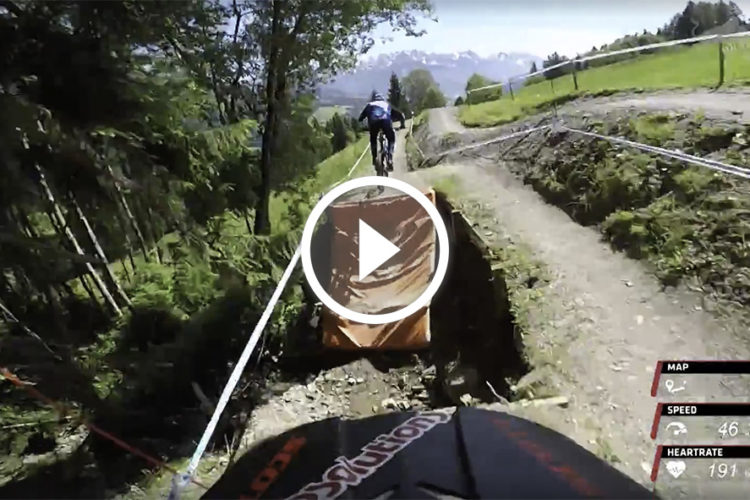
This is a pretty popular mount with gravity riders wearing full face helmets. The angle inevitably captures part of the helmet in the picture, and that little section of helmet is usually enough to lend a little bit of perspective to the image. Also, you can usually see the bike a little bit in the bottom of the frame, which is especially cool on jump lines.

Here’s an actual video to give you an idea of what this perspective looks like:

Handle Bars

Photo Credit: GoPro.com

After the forward helmet mount, this is probably the second most common mounting option… unfortunately. Because of the fact that the camera is mounted directly to the bars, it is constantly being jolted and shaken by the smallest bumps in the trail. When I watch videos shot from this perspective I can rarely make out what is going on, and most of the time my head starts hurting and I turn it off. It’s also impossible to see how the rider is working the bike.

The one thing that a bar mount does well is provide a good view of the trail surface, if it is relatively smooth.

Seat Post: Rear View

Photo Credit: GoPro.com

While at first glance you might think that the camera would suffer a lot of shaking mounted in this position, the truth is that this is actually a very stable mount, especially on a full suspension bike. This is a very unique perspective that I find is a lot of fun to watch. When you are riding a bike, you never get to see the trail disappearing behind your tires. But with your camera mounted like this, you can when you get home to your computer!

Also, the rear wheel provides a focal point for viewers to keep things interesting and to provide a little bit of depth to the picture. I also find it fun to watch how the suspension responds to changes in the terrain.

Chest Mount

When I’m riding solo, the chest mount is hands-down my favorite choice! Mounting the camera on your chest avoids the flag pole effect by providing close-up objects in the frame (arms and handlebars) that create perspective.

But the number one reason I enjoy this perspective so much is that the viewer can see exactly what the rider is doing, and how he manipulates the bike.  Everything from shifting to braking to steering is visible to the viewer, making for a much more interesting video, especially if there are no other riders present.

One word of caution: make sure that your camera is aimed high enough to catch the trail out in front, because we don’t want to be staring at the top tube of your bike the entire time!

Get Creative

From ground placements for ride-by shots to having a camera spin around your head, your creativity is really the only limit when it comes to creating a unique perspective for your next trail video!

Coming Up

In the next installment, I’ll cover a few tips to help you edit your videos so they don’t end up in the expansive vault of neglected YouTube videos.

Based on the videos that you’ve watched or created, what is your favorite video camera mounting option?


Site Map | Advertise | Partners | Contact Us | Terms | Privacy
Campground Reviews | Hiking Trails | Trail Running | Skiing / Snow Sports | Mountain Biking
Copyright 2012 Blue Spruce Ventures LLC | Atlanta, GA
singletracks.com is yet another slick Review App