



We participate in an expensive activity. Nearly a decade ago, Singletracks looked at the nine most expensive mountain bikes on the market. Topping off the list was a $13,000 BMC Fourstroke 01 XTR Di2.
Since then, prices certainly haven’t gone down. The price of that same Fourstroke increased by $500. Pivot’s topped specced Firebird will set you back over $15,000. And while it is easy (and obvious) to point out the most expensive mountain bikes, what about the “entry-level” and “mid-range” mountain bikes?
If you’re about to swipe your credit card at the local bike shop or hit “buy” online, it’s important to know how much you should expect to pay for the average bike. But first, what exactly is the “average” bike?
First, some definitions
Before we get to what a “mid-range” mountain bike is, we first need to define what an entry-level bike looks like. And you might think that defining an entry-level bike is just as easy as a top-of-the-line bike, but that simply isn’t the case.
“Entry-level” can mean different things to different buyers.
Does entry-level simply offer buyers a bike that can be ridden on trails? If that is the case, a little over a hundred bucks at a department store will do the trick.
Or, by entry-level, do we mean the least expensive bike offered by an established mountain bike brand? A Specialized Rockhopper can be found for as little as $475. A new Giant Talon starts at $650.
Still, these are hardtail cross-country bikes. Most of us want a full-suspension trail bike. Well, for just under $1,000, you can get a full-suspension Polygon Siskiu D5 that blurs the lines between XC and trail. But this bike lacks many of the modern amenities that we might expect on even an “entry-level” mountain bike.
First, it has a 2×9 drivetrain rather than a modern 1×12. The Siskiu D5 also has 27.5-inch wheels front and rear. While many will argue that 27.5 isn’t dead, brands like Santa Cruz begs to differ, as they eliminated it as a front-wheel option altogether. The Skiskiu also doesn’t have a dropper post. Perhaps the most significant knock against the Polygon is the lack of Boost spacing and the use of quick-release axles rather than thru-axles.
An entry-level bike should hew to modern standards
But now we’re starting to get somewhere. A mountain bike, even an “entry-level” bike, should have modern standards. For the sake of the article, let’s establish that Boost spacing, dropper posts, and at least an 11-speed, one-by drivetrain must be present on even an entry-level bike.
For Polygon, that means going with the $2,200 Siskiu T7.
Now let’s look at the big brands. With Specialized, if we’re staying out of the XC category, it is the $2,500 Status 2. For Giant, we’re looking at the $3,000 Trance X 2, and the new Trek Fuel Gen 7 starts at $2,900.
With no aluminum options, Santa Cruz is easily the most expensive of the big brands. Their entry into the full suspension trail bike category will set you back at least $4,000.
As you might expect, prices go up with mid-sized brands. The Ibis Ripley AF and aluminum Transition Smuggler both start at $3,500. Entry-level trail offerings from Pivot and Yeti are even more expensive, hovering around $6,250. Again, the lack of aluminum frames plays a role, but you could also argue that bikes like the lowest specced SB140 are very much “mid-range” bikes.
Marin prices the entry-level Rift Zone 1 at $1,900. So, averaging the four most affordable options–the Specialized, Giant, Trek, and Marin, we have an entry-level (average) cost of $2,575 for a modern trail bike.
Getting mid
In 2020, we asked Singletracks readers what a “decent” mountain bike should cost. And, we got a lot of responses. Of the nearly 4,000 people who responded, the average answer hovers at just above $2,000. (Note, this data was adjusted to remove responses from people who said the average bike should cost $6, $600,000, or $999,999,999… rascals.)
Another way to think of a “decent” bike is one that falls in the “mid-range” category. These bikes have better components than their entry-level counterparts, but aren’t top spec’d (and priced) options. Hoping to buy a decent mountain bike for $2,000 is clearly wishful thinking, given that the average cost of an entry-level bike is significantly above that.
So, let’s talk about what makes an “average” or “mid-range” mountain bike. First, obviously, all the same conditions for an entry-level bike still apply — modern drivetrain, dropper post, front and rear suspension, and Boost spacing. But let’s also add that the suspension should at least have compression and rebound adjustment, and the bike should have four-piston brakes.
And let’s say the drivetrain and brakes need to be somewhere mid-pack in their respective component brand lineups. Not the best, but not the worst.
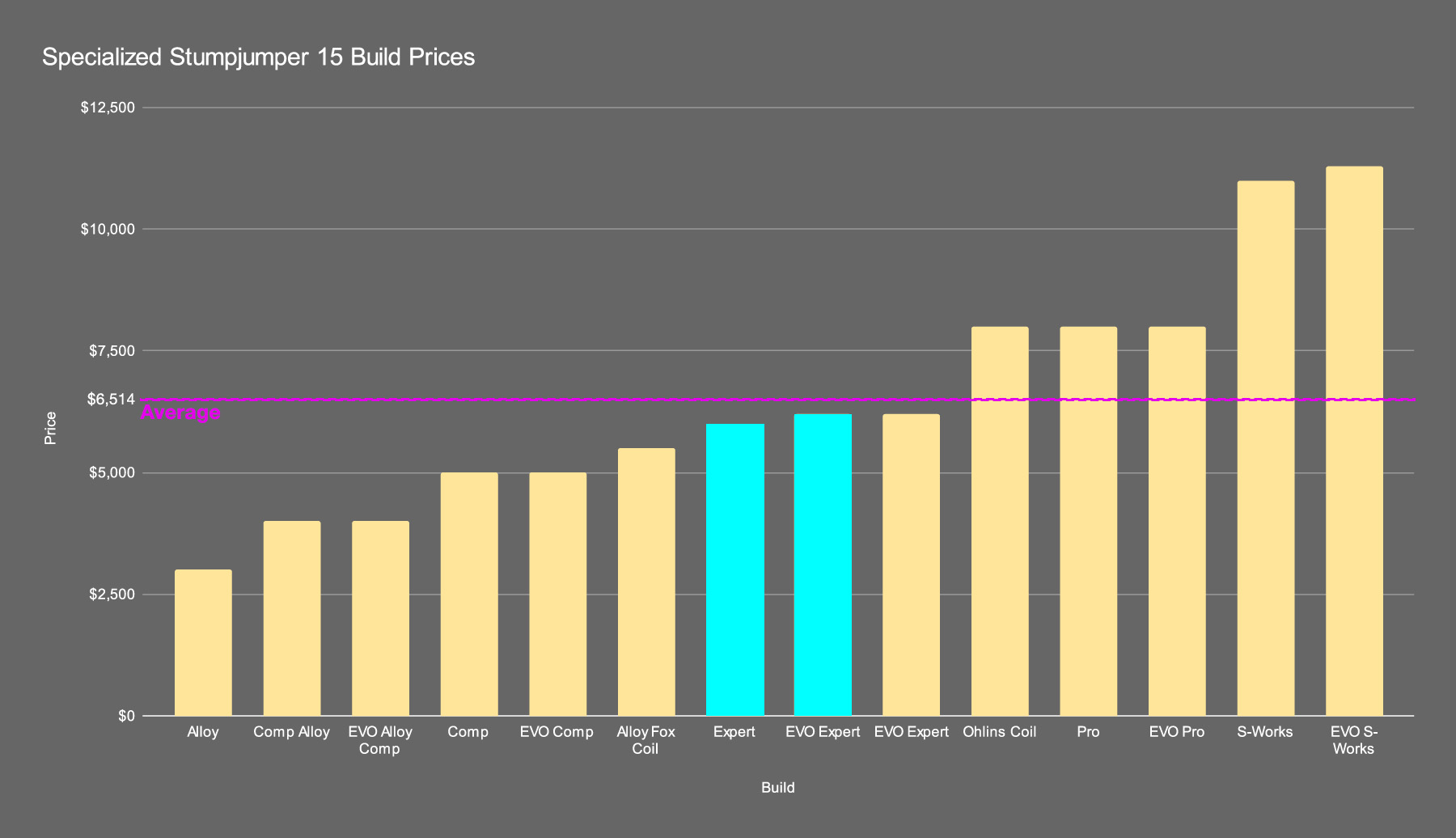
With this in mind, the Stumpjumper 15 EVO Alloy Comp is a good example of a mid-range offering from the Specialized lineup. For $4,000, you get an aluminum frame with a Fox Float X Performance Genie shock and a Fox 36 Rhythm fork. The build is wrapped with SRAM DB8 Stealth brakes and an Eagle 70 T-Type drivetrain.
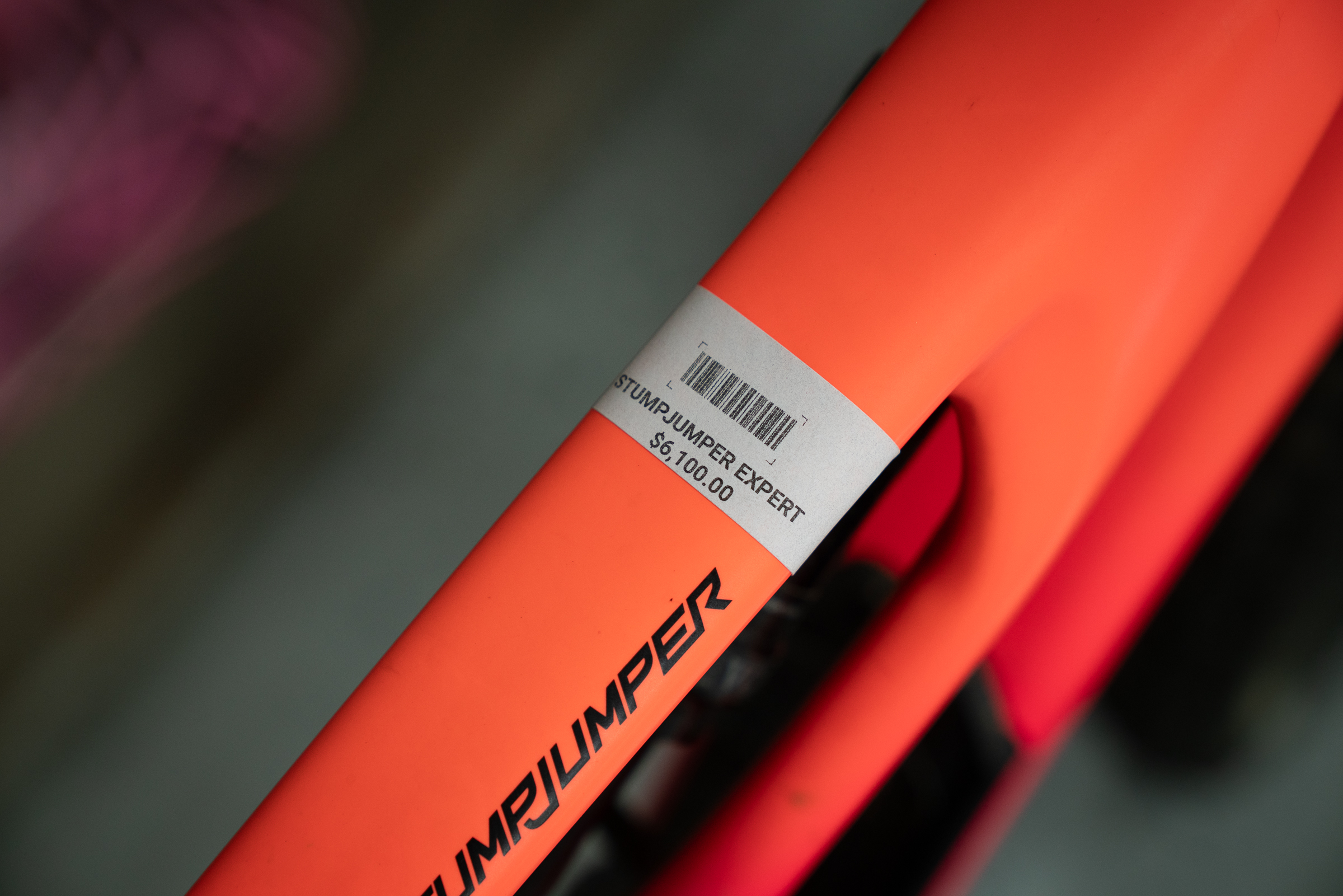
But, of course, Specialized doesn’t stop there. In fact, looking specifically at the new Stumpy 15 EVO, customers can choose from a $3,000 build up to an $11,300 S-Works. In fact, Specialized offers 14 different builds of the Stumpjumper 15 and 15 EVO, with an average price across their offerings of just over $6,500. The median-priced, Expert build, is $6,100*.
Trek has nearly the same build as the Stumpjumper on their mid-range aluminum Fuel EX 8, also priced at $4,000. From alloy to carbon, Trek offers ten builds of their new Fuel EX, ranging from $2,900 to $8,500. Considering all the Fuel EX offerings, the average price for Trek’s latest trail bike is $5,540, and the median price for a Fuel EX is $5,750.
Giant’s new offerings were a bit harder to decipher, as it seems the brand is still trying to clear out inventory that is several years old. From the looks of things, Giant offers two new trail bikes, ranging from $3,000 to $7,000, with an average price of $5,000 for the brand.
The full suspension offerings from Santa Cruz essentially start at what most riders would be considered “mid-range.” And, the prices only go up from there. Looking at the popular Hightower trail bike, prices start at $5,000 and top out at $11,400 for their top-spec bike. With nine bikes in the lineup, Santa Cruz has an average price of nearly $7,800 and a median price of $7,250.
Certainly, the lack of alloy frames keeps Santa Cruz’s prices significantly higher than those of other big brands.
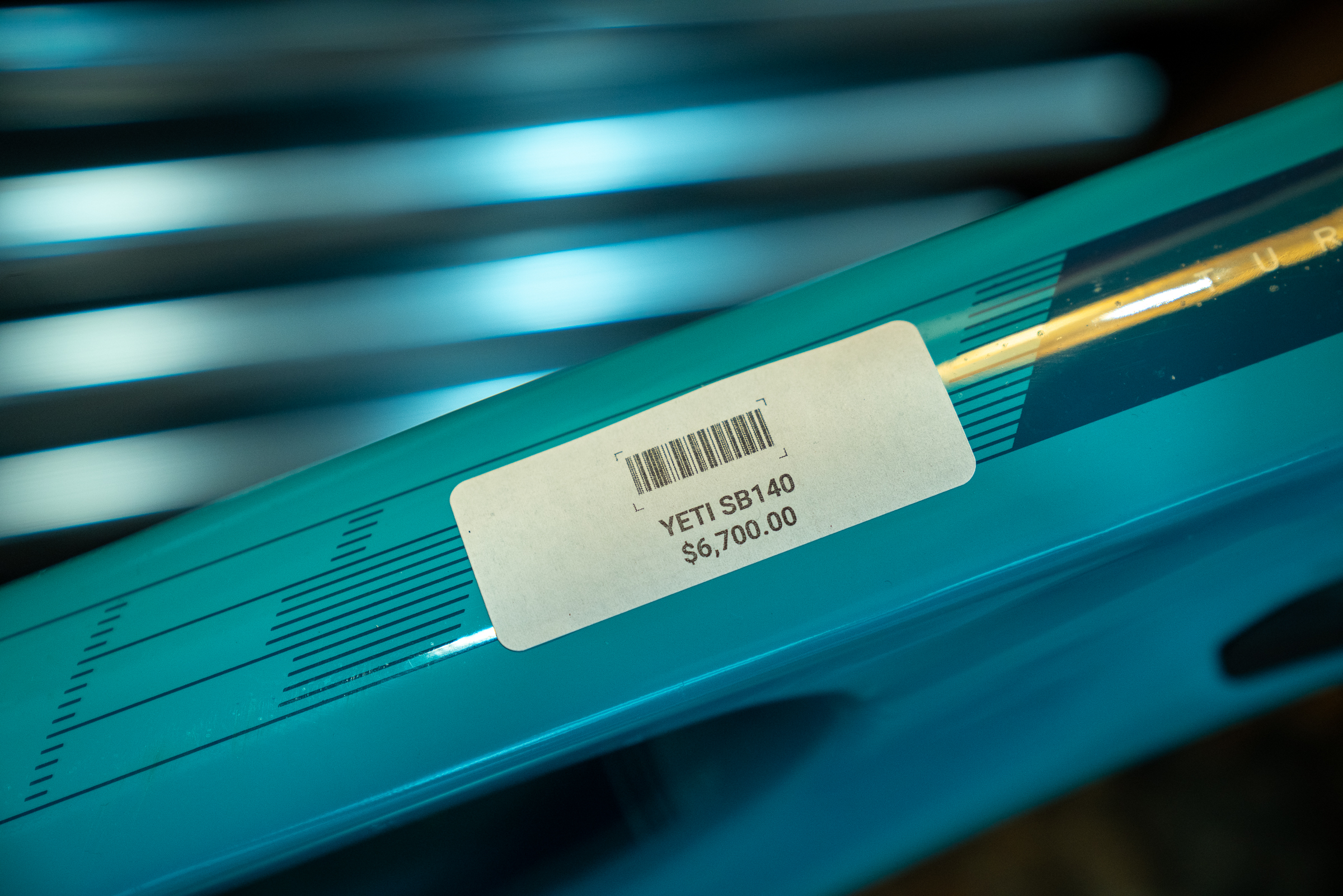
Many mid-sized bike brands are similar to Santa Cruz, where their “entry-level” bike is equivalent to other mid-range bikes in both spec and price. Pivot offers the Trailcat LT in six builds, starting at $6,500 and topping at $12,000 for their Team XTR Di2 build. Yeti has a similar spread for the SB 140, with six builds ranging from $6,200 to $11,000. This gives these brands’ trail bike average of $9,300 and $8,250, respectively. In both cases, the price of their “middle” builds (median) are very close to their average build prices.
With aluminum options, mid-sized brands like Ibis and Transition tend to have lower average prices. With seven offerings in the Ibis Ripley camp, ranging from $3,500 up to $10,000, the Ripley has an average cost of just under $6,100. Transition offers their Smuggler in five builds, including one alloy, ranging from $3,500 up to $7,800. On average, the Transition Smuggler costs $5,900.
Fortunately, mid-sized brands like Marin help to bring down the overall mid-range bike average. Marin offers the Rift Zone in four builds, starting at $1,900 and topping out at $4,700, giving a blisteringly low price for an average Rift Zone of just under $3,200.
Perhaps it is worth noting that Marin is an outlier among the mid-sized brands. Helping to keep costs lower is the lack of any carbon frames. Also, the top spec’d Rift Zone XR AXS doesn’t see nearly the level of components as other top spec’d mid-sized bikes. For example, the Rift Zone only has RockShox Select+ suspension and SRAM Code brakes, whereas others are speccing Ultimate-level suspension and top-spec Maven brakes at the top end.
So, what does a mid-range trail bike cost in 2026?
Looking at trail bikes from the top “big-brands” and “mid-sized brands,” we can average the averages to get perhaps some sort of an idea for how much the average, mid-range trail bike costs. For the big brands — Specialized, Trek, Giant, and Santa Cruz — the average cost of a trail bike is $6,210.
Mid-sized brands’ average price is a touch higher. If we exclude Marin, the average price for a trail bike from a mid-sized brand is $7,387. With Marin included, the average price of a mid-sized brand trail bike drops to $6,550.
Thinking back to that 2020 survey, when nearly 4,000 of you said the average trail bike should be around $2,000, we can adjust that cost for six years of inflation. Using an AI inflation calculator, $2,000 in 2020 is roughly $2,500 today.
If $2,500 is still our preferred target in 2026, the average trail bike costs at least $3,700 more than we feel it should, and at least $1,500 more than most big brands’ mid-range bikes.
However, there are silver linings. Bikes like the $2,500 Specialized Status appear to be Specialized’s entry-level trail bike. However, based on the build, the Status meets all the requirements to be considered a mid-range bike.
But that is the only one. The bottom line is, even the “average” trail bike costs considerably more than we think it should.
Based on this analysis, where does your primary mountain bike sit?
* Median price does not correspond to a specific build if there is an even number of builds available. In that case, the median price is an average of the two middle-priced builds.
The news stinks. Why not follow Singletracks on Google News to bring more joy to your day?


10 Comments
Mar 5, 2026
Mar 6, 2026
Mar 5, 2026
Again, I don't know the first thing about dirt bikes, but this is what I've heard...seems like it has some validity...
Mar 5, 2026
Mar 5, 2026
Mar 5, 2026
Step 2: Buy an affordable, well spec'd bike
Mar 6, 2026
Mar 5, 2026
Basically, brands like Pivot and Yeti just don't sell entry-level bikes. That's not an accident, that's intentional — these are boutique brands that are positioning themselves in that space in the market. So it doesn't seem like taking the middle of their range as a "mid-range" bike really makes sense.
If you excluded these brands, I'd have to imagine that the average number would drop closer to $5,500, like it is for Trek.
Mar 6, 2026
Mar 6, 2026