










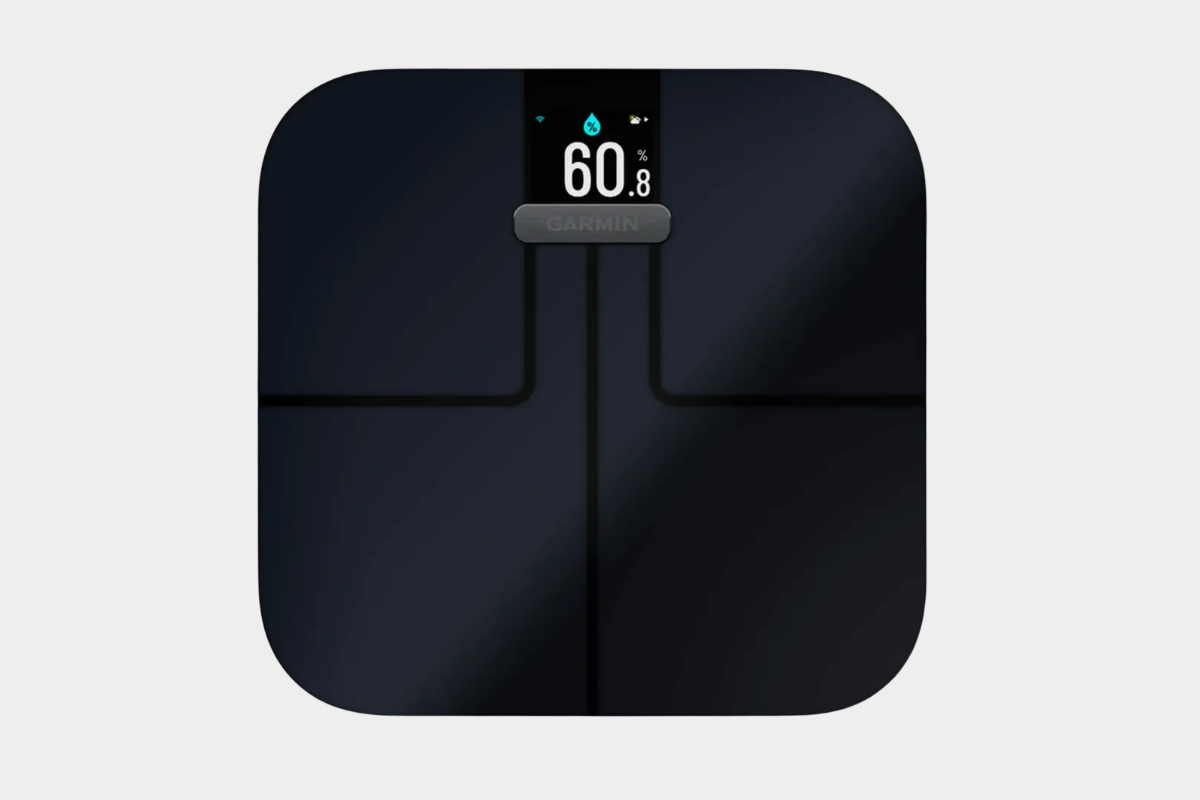
A class-action lawsuit has been filed against Garmin International in the US District Court of Northern Illinois, alleging deceptive marketing for the brand’s $199 Index S2 Smart Scale. Specifically, the suit says that the smart scale does not accurately measure body composition despite Garmin’s claims. Damages are not specified, though standard language in the complaint suggests the amount exceeds $5 million, not including interest and costs.
Body composition estimates vary
Smart scales like the Garmin Index S2 Smart Scale use bioelectrical impedance analysis (BIA) to estimate body composition. The method involves passing a small electrical current through the body and measuring how much resistance it faces. Given the measured resistance, the scale calculates total body water, which is used to estimate muscle mass and body fat composition.
A Wikipedia entry on BIA notes that “many of the early research studies showed that BIA was quite variable, and it was not regarded by many as providing an accurate measure of body composition.” The article goes on to note that hydration, among other factors, can influence the results. “Although the instruments are straightforward to use, careful attention to the method of use (as described by the manufacturer) should be given.”
BIA foot sensors are said to be particularly inaccurate
Many smart scales, like Garmin’s, measure BIA via foot sensors. The user steps on the scale, barefoot, and a current is sent through one foot while resistance is measured at the other. This is known as a two-point BIA.
According to the lawsuit, “the foot-to-foot BIA technology in the Smart Scale is incapable of accurate body composition measurements, rendering Garmin’s representations regarding the Smart Scale’s capabilities false, misleading, and deceptive to consumers.”
The filing goes on to explain that measuring BIA via the feet is problematic because it measures resistance only through the lower body, i.e., from the waist down. Depending on a person’s body shape, this method potentially under- or over-estimates body fat.
“According to a 2021 study published in the journal JMIR mHealth uHealth, scientists compared the measurements obtained from three different models of foot-to-foot smart scales that use BIA technology with DEXA [dual-energy X-ray absorptiometry] and found that the Smart Scale devices underestimated both fat and muscle mass by as much as 8kg and 8.03kg (approximately 17.6 pounds), or up to 8 percentage points,” the filing states.
A four-point BIA is considered more accurate because it measures resistance at four points on the body, typically both feet and hands.
Garmin is just one of many companies that sell smart scales equipped with two-point BIA technology. A quick search on Amazon reveals dozens of two-point BIA smart scales that make similar body composition analysis claims.
Garmin’s accuracy claims, as presented in the suit, appear on the Garmin website and in product descriptions presented by online retailers. For example, the Index S2 Smart Scale product page at garmin.com has a generic banner stating, “Accuracy matters when it comes to your goals,” though it doesn’t specifically state that its scale is, in fact, accurate. An Amazon product listing referenced in the suit is more specific, stating that buyers “get accurate measurements for weight, weight trend, body fat percentage, BMI, skeletal muscle mass, and more.”
The class action suit, filed on May 29, 2026, by Victor Maurer, claims Garmin “failed to disclose to Plaintiff and other Class Members vital information regarding the Smart Scale’s inability to accurately measure body composition, as described herein.”
The Plaintiff is seeking monetary damages and a declaration that the Garmin smart scale “cannot accurately measure body composition.” As of press time, Garmin has not responded to the suit.
The news stinks. Why not follow Singletracks on Google News to bring more joy to your day?






17 Comments
Jun 4, 2026
Jun 10, 2026
Jun 5, 2026
Jun 4, 2026
Jun 3, 2026
Jun 4, 2026
Jun 10, 2026
Jun 3, 2026
#getrich/letigiousness
Jun 3, 2026
Jun 3, 2026
Jun 3, 2026
Jun 4, 2026
Jun 5, 2026
Jun 5, 2026
Jun 10, 2026
Jun 3, 2026
#lookingforabagofcash
Jun 5, 2026