singletracks is mountain biking
Sign In | Create Your Account | Site Map | Help  


Here Comes the Sun (Ringle)

Wednesday, February 24th, 2010

sun1

The Sun Ringle name always makes me think of a rising sun – a new day, a new adventure. Well for 2010, Sun Ringle has done it again with exciting new XC and AM wheels fit for any epic adventure. And looking forward to 2011, Sun Ringlé is working on fresh wheels for the FR / DH / DJ crowd.

I recently got a chance to talk with Scott Boyd, Product Manager from Sun Ringlé, about the history of the company and about some exciting new products that will be released this year. I also managed to squeak in a few questions about what we can look forward to in 2011.

History

Sun Metal Products dates back to 1946 when Ken-Jen Metal Products started producing tricycle seats. In 1948, Ken-Jen became Sun Metal Products and started a wire-spoke wheel line. In the 70s, Sun began production of alloy rims for high performance, off-road motorcycle racing and the technology eventually made its way into high-end bicycle rims in the 1980s. In the 1990s, Sun expanded production facilities in Indiana for high-end alloy rims and built manufacturing plants in China to provide products for the growing Asian bicycle manufacturing industry. Sun Products purchased Ringlé Racing Components and in 2005, Hayes acquired the merged company.

Scott, like many of us who are passionate about MTB, started off early enjoying mountain bikes. Like me, Scott worked at a bike shop in high school and college which landed him a position at Hayes starting in 1998. In the early days he provided technical support at NORBA and World Cup events and after a few corporate acquisitions he moved into the role of Product Manager at Sun Ringlé, where he’s been for the last two years.

After speaking with Scott for just a few minutes you get the sense that he’s an extremely focused individual which in this line of business is a good thing. At the same time he’s very personable and digs talking about bike products as much as you and I dig riding them.

sun2

New stuff

So what can we expect from Sun Ringlé this year?

We have an exciting new tubeless compatible wheel platform and we’ve partnered with Stan’s No Tubes to license their patented BST (Bead Socket Technology). The line consists of the Black Flag Pro and Expert (XC) and Charger Pro and Expert (AM) models. Each are available in 26” and 29er.

(Our) focus (this year) is on the Pro series: The Black Flag Pro is a sub-1600g cross country wheel set using a 24mm wide rim and the Charger Pro is a sub-1700g all mountain wheel set using a 28mm wide rim. The 26” versions (feature) a 24-hole direct pull lacing pattern and the 29er versions (feature) a 28-hole direct pull lacing pattern. Both wheel sets have two color options to choose from. Additionally, the wheels are available and compatible with today’s axle standards. For the front: standard quick release, 15mm, and 20mm. For the rear: standard quick release, 135×12, and the new X12 or 142×12 axle.

The other hot item we are working on is our SRD Carbon wheel. It’s a 26mm wide, 1550g wheel set. It utilizes the same hubs as our Black Flag Pro, allowing for the flexibility of all today’s axle standards.

p1000819

Are you aligning the way you name parts like Manitou (Pro, Expert, Comp, Sport)?

Yes. It is a system that is universally understood by cyclists and helps identify the level of the product.

What can we expect to see come April from Sun?

During April, we will be attending the Sea Otter Classic, and the new Black Flag Pro and Charger Pro wheels will be the highlights.

Are there any restrictions as far as (rider) weight is concerned with the SRD Carbon wheels?

The SRD Carbon wheels are still in the development phase. I can say the wheel set has a stout 26mm outer width carbon rim. The wheel isn’t meant to be the lightest race day wheel, but (it’s) a 1550g wheel set that is light enough for XC racing and durable enough for everyday AM use.

When I was at the show I noticed many different colored wheels like blue, yellow, black, white, and red. Which ones are you going with?

The wheels at Interbike (actually) showed just a few color options. The Black Flag Series and the SRD Carbon will use a touch of gold (anodized finish). The Charger will use red (anodized) hubs.

I also noticed Sun Ringlé offers many 29er wheel models. How many model options are there?

We currently have 5 wheel set offerings and 6 rim offerings. One of our newest 29er offerings is the DH MTX33 model. This is currently being tested by a top World Cup team. Time will tell if they give up the 26” DH bikes for 29ers.

I see you’re offering direct pull wheels, are you using Wheelsmith spokes on those as well?

Yes, the direct pull spokes are Wheelsmith spokes made in our Milwaukee facility.

p1000830p1000837

Tell me a bit more about the Stan’s technology that you plan on using on the wheels for this year.

SunRingle is the first in the industry to license the Bead Socket Technology from NoTubes.com for both the Black Flag and Charger series.

The rims are wider inside than other designs with similar outside dimensions, meaning a wider base for the tire and improved ride quality. The design also incorporates shorter sidewalls, reducing pinch flats and the risk of denting the rim when using low pressures. In addition, the design allows for the use of NoTubes yellow sealing tape and valve stems for a tubeless application using standard tube-type or tubeless tires and NoTubes tire sealant.

NoTubes yellow sealing tape will be pre-installed on the wheels making the wheels tubeless-ready. The valves and sealant will also be included in the box (with our) aftermarket wheel sets.

I’d like to thank Scott and the folks at Sun Ringlé for giving us a glimpse on what’s to come for 2010 and 2011. Goodbye winter – here comes the Sun!

Introducing Joyride 150 Indoor Bike Park: Opening Dec 14, 2009

Monday, November 30th, 2009

51

Last week I got a sneak peek at Canada’s first indoor bike park, Joyride 150. When Bob_the_Builder found out I was going to Joyride 150 ahead of the official opening Dec 14th, he just had to come along. I dunno who was more stoked Bob or myself. On the drive up there I was trying to imagine exactly how big a 90,000 sq ft building is; needless to say, it’s large – very very large.

Walking into the facility you get a sense of the scope of the place. With the sounds of the finishing touches going on in the background, I was greeted by Leslie, one of the owners. A very nice person with a warm smile, Leslie was quick to excuse the bits of saw dust. After a little small talk about the place, we met up with two instrumental partners, Mike and Scott, both looking a bit tired, and for good reason. Both men, along with a few volunteers, were putting in 100 hour work weeks for the last 3 months to get Joyride ready for the grand opening.

Leslie took us on a tour from the entrance to the spinning classroom which is still under construction. The room is a nice size with 20 ft ceilings and room for about 30 riders. The height and shape of the room should provide good acoustics once the music is pumped in. After a quick visit of the spinning room, we really got a good look of the rest of the facility. Heading back into the front entrance we then started our main tour. The complex is divided into four main areas.

341

The first area, right across from the main counter, is the beginner section where you can practice your skills on various styles of skinnies and features that you will encounter at the park. The photo above on the left shows the practice rollers and skinnies. The photo above and right is the practice pump track which in itself is great. I have to say the quality of the build is absolutely top-notch. No expense was spared in making these ramps and skinnies smooth and flawless. Even up close you can’t feel the gaps in the wood.

61711

After admiring the beautiful wood work and moving along, we passed the still unfinished advanced skinny area which promises to be something else with many elevated features. Across from that there are lockers and an area where folks can rest, eat, and talk shop. There’s also an advanced pump track with a massive corner. Leslie was mentioning that it would be perfect for two cross (hmmmm perhaps competitions could be just around the corner). Of course at this point BTB  had to ride the course and judging by his big smile I could safely say he loved it.

51

The cross country track (yes they have one of those too) is elevated and travels around the entire complex. From here we got a great view of the main progressive jump and trick area. I have to admit doing laps on the XC circuit will be fun because you get to see everything: the foam pit, the stunts, all of it. Can you imagine riding around and taking a look at everyone having fun, jumping, and ohh yeah, taking a tumble? Heck, even BTB got into flying into the foam pit and the jump area.

291

All kidding aside, Leslie was mentioning the thousands of possible lines that riders can take to make a flowing line. A few days prior to my visit there were some circuit riders visiting and commenting on the set up, all of them making the same comment of how flowy and complex Joyride can be. One even mentioned how it would take a very long time to master the Joyrides Vert park set up.

111121

As we were walking around the XC course and having a wonderful chat with Leslie, saws busily cutting in the background, Leslie talked to us what folks should expect to pay for a visit. It will cost about $20-$30 per visit and they are also planning on setting up season passes (price is TBD). Once things start to move more smoothly they will be concentrating on discount packages with nearby hotels and a rental fleet of bikes for those who don’t want to bring in their own rig.

Joyride 150 is located just north of Toronto in Markham ON, and their closest intersection is McCowan and Highway 7. The location is pretty close to many hotels and shopping malls, for those who don’t know the area and are wondering what else is around.

Well folks, I have to say you need to add this place to your ride wishlist. Unfortunately for me, when I went with BTB I was still nursing my broken clavicle so I couldn’t ride – otherwise I think I would still be there. Expect Joyride 150 to be up and running Dec 14th and make your way over. If you build it, they will come – they built it, so get over there!

More info on the joyride150 website.

More details:

  • beginner/sport/expert sections with skinnies, lines & features to test your skills and help you progress
  • a foam pit (beginner & expert ramps) with a matching resi jump and box jump
  • rhythms & jump lines (beg-exp)
  • a BMX-style street park with quarter pipes (MASSIVE!), spines, rails, drop-ins, bowls etc.
  • pump tracks (pump & dual race-style)
  • cross-country loop with elevation (climbs), log-overs, features etc…sure to get your heart pumping and your legs burning!

Other park features:

  • cozy lounge with fireplaces & free Wi-Fi hotspot
  • concessions (snacks, drinks etc.)
  • bike rentals (various bike types)
  • bike storage
  • private party room available for rent (corporate events, birthday parties, etc.)

Coming soon to the park:

  • coaching services
  • spin studio
  • programs (skills workshops, day camps)
  • races/competitions
  • demo days/PK sessions

Pack your bags and get your tickets. This is a place to be when the snow is piling high!

Mountain Bike Disciplines

Wednesday, October 7th, 2009

bike_type_graphic

When I started riding back in the early 1990s, there was basically just one flavor of mountain biking but today MTB categories can get a little confusing. I found this helpful chart over on the Turner website and I think it does a good job illustrating some of the divisions you’ll find in mountain biking find today. The arrows and text below the chart were added for the purposes of this post.

Right off the bat you can see the spectrum of riding from XC to Downhill and everything in between. Notice how the plot gets higher and more jagged as you move to the right, representing technical difficulty (not necessarily climbing or aerobic difficulty). It’s also cool to think of this as a progression chart – beginners can move from XC to AM and beyond as skills improve.

I really like how this chart can be used to show ranges rather than discreet points along the spectrum. In this particular chart, the shaded green area represents recommend usage for the Turner 5.Spot. Notice how it isn’t just a Trail or All Mountain bike. Based on the geometry and travel (5.5″ rear) this bike works well for XC, Trail, and AM riding.

The spectrum approach is also helpful for classifying riders. Most of us enjoy a variety of terrain and saying someone is strictly a Freerider or Downhiller usually doesn’t tell the whole story.

But wait, this chart has one more trick up its sleeve! Most mountain bike trails themselves can’t be readily classified into one type or another. A mellow XC trail may have 5 foot drops in places or even a freeride area that’s 5 miles into the trail. Other trails may have short bursts of All-Mountain style terrain with XC-type fireroads connecting sections. In fact I imagine some trails could cover the entire spectrum from XC to Downhill while others fit more neatly into a single category.

Some generalities about mountain bikes can be made from this chart and I’ve added arrows describing just a few trends you can expect to see when purchasing a new mountain bike. As you move from left to right, travel (front and rear) should increase while weight will follow roughly the same trend. Price, on the other hand, isn’t so easy to classify. For example, remember this $7,000 XC hardtail from Interbike? Finding a DH bike that costs half that amount wouldn’t be too hard (nor would finding a DH bike costing 50% more).

Now, if it were possible to create a mountain bike that could cover the entire chart from XC to DH that would be the holy grail. Maybe the Cannondale Simon will deliver on that dream one day :)

ITS System 4 and 5 MTB Tire Reviews

Friday, October 2nd, 2009

picture-351picture-352

XC riders looking for a versatile tire for the fall riding season, listen up! I recently tested two of the five sets of XC tires from Intense Tire Systems (ITS) in a variety of conditions and I’m finally ready to share the results. I chose the System 4 and System 5 tires for my tests but you’ll want to choose the System series that’s best for your local terrain and trail conditions.

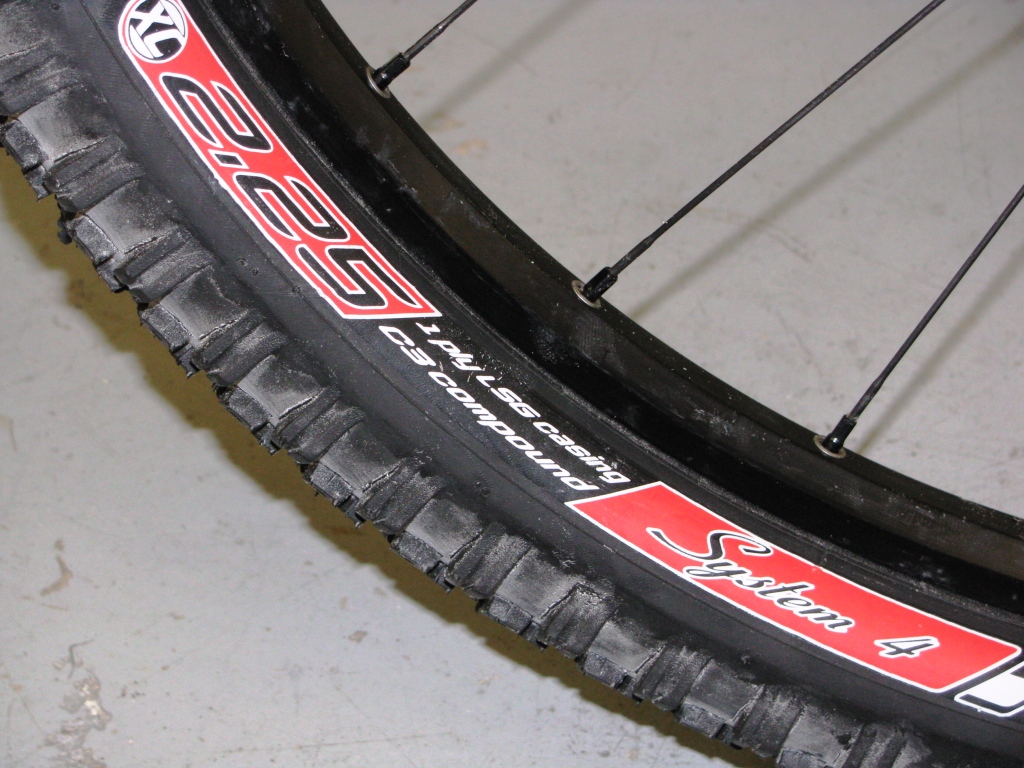
System 4 and System 5 tires are great for those will experience a wide range of weather and also for those of us who pack a few extra pounds. Both tires are 26 x 2.25″ and have the same single-ply casing with long lasting and grippy C3 rubber compound. These tires are true 2.25-inch wide tires which means they are higher volume compared to other brands (meaning fewer pinch flats for heavier riders). Both the System 4 and 5 tires can be had for about $45 a piece.

picture-358picture-357

The System 4 (left) is an all-conditions tire designed to do equally as well on soft surface as well as hard pack. The ramped and chevron tread patterns work together to keep your wheel where you want it to be. The System 5 (right) is designed for softer terrain with its mud-shedding, wide-spaced tread pattern.

I found that both sets of Intense tires mounted easily and seated nicely in the rim with a satisfying pop. As always I recommend adding a bit of talcum powder to the inside of the tire before placing the tube to reduce friction within the tire and to increase performance. After inflating both sets to 40psi, I was pumped and ready to go! (get it? :) )

First up: the System 4 tires. I decided to try these guys just after a good rainfall at a local trail that has a great mix of terrain, small climbs, and a few low spots. That day the trail had it all: freshly dried hardpack, wet spots, and even a little mud. On hardpack the System 4 did well and I couldn’t help but compare the performance to the Kenda Small Block 8s. System 4 offers great control on hardpack and rolls smoothly with little energy needed to get them moving. Leaning into corners there was very little squirm and they tracked well, allowing me to change lines at will without fear of loosing traction.

The large volume of this tire really opens up terrain possibilities beyond smooth hardpack. Riding over rough obstacles like rocks and logs felt quite comfortable, especially compared to other 2.00-range XC tires I’ve used in the past. With a smaller-width XC tire I would normally run the risk of pinching a flat, but with these I am glad to say did not have a problem. For that reason, this is a good tire to consider if you find yourself pushing the clydesdale line.

In very loose, wet terrain the System 4s did manage to clog a bit but luckily I had another set of tires in my quiver: the System 5s!

picture-389Changing over to the System 5 tires and hitting the same trails on the same day really gave me a good perspective on the differences between these two sets. The System 5 tire ran with a bit more vibration, but didn’t show it when the terrain turned soft. Just like the System 4, the System 5 ran with decent efficiency and didn’t suck up too much energy to get things rolling. The System 5 tread felt stable – not overly soft – and did great job at preventing wheel spin during climbs. However, when the terrain got extra muddy, the System 5s still clogged a little and slipped at times. On the descents these tires offered a ton of control and showed great stopping power.

With the aggressive tread pattern you might think these tires would squirm in corners but I always felt comfortable leaning into the soft stuff. Now on dry, hard surfaces you might not want to lean into these as much; instead, keep the bike more perpendicular to the ground for better traction. Like the System 4 tires, the added air volume was great for trudging through gnarlier trails that might normally serve up pinched tubes.

The System 5 is another great tire, especially for this time of year when the trails are a bit on the softer side and logs and rocks can be slippery and wet. Of course if the trails are really wet it’s usually best to stay off them – lets conserve the trails for everyone!

My overall impressions: System 4

8 out of 10 for climbing
8 out of 10 for rolling and efficiency
7 out of 10 for loose conditions
8 out of 10 for hardpack
8 out of 10 cornering

System 4 Specs from ITS:

Usage: Cross Country
Conditions: Soft – Intermediate – Hardpack
Size: 2.25
Compound LSG C3compound
Weight: 650 grams

My overall impressions: System 5

7 out of 10 for climbing
7  out of 10 for rolling and efficiency
9 out of 10 for loose conditions
7 out of 10 for hardpack
8 out of 10 for cornering

System 5 Specs from ITS:

Usage: Cross Country
Conditions: Soft – Intermediate
Size: 2.25
Compound LSG C3compound
Weight: 550 grams

These are certainly two good tires from ITS – choose the best ones for your terrain and riding conditions!

Cheers.

SUN-Ringle Black Flag Ceramic Disk Wheel Set Review

Thursday, June 25th, 2009

picture-139

SUN-Ringlé has be around for a long time now but these days they’re delivering some especially sweet products. Recently the good folks down at SUN-Ringlé sent me perhaps one of their best kept secrets (pssstt – listen up weight weenies). At just 1421 grams for the set (including quick release skewers), the Black Flag Ceramic Diskis a super lightweight MTB wheel set, especially compared to similar Mavic and Easton sets that weigh 1550+ grams.

picture-141

Looking at these wheels I got all goose-bumpy – well not literally but I don’t know how else to describe the feeling of unboxing such an artfully crafted wheel set. The build quality of the Black Flag wheels is incredible – the spoke line was dead straight (which contributes to a longer lasting wheel build) and all the spokes were tensioned precisely. Overall the Black Flag wheels have relatively high tension at the spokes (though not as high as others like the Easton XC-Ones) which sets the overall feel and performance characteristics of the wheels. Spinning the wheel in free air I could really see how smooth the ceramic bearings were and just how true this wheel set was right out of the box. Can you say butter?

picture-140

Placing a set of XC tires on the Black Flags was bit of a chore, though that probably had something to do with my tire choice. Other than that installation was a snap – just bolted on my rotors (160mm front and 140mm rear) and a cassette and I was off to the trails.

Talk about lightweight! At first I was a little worried that the Blag Flag wheels were really a set of road wheels in disguise because they felt so light. On the XC trails I was floored at how much faster and how many taller gears I could push with these wheels and I found that I was riding the large front ring a whole lot more than on my typical training ride. Putting the power down, these wheels just went – the low rotational mass combined with the ceramic bearings make for a super fast rolling wheel set. For such a light set of wheels I was impressed by the amount of control these babies offered in tight, twisty turns. I found these wheels to be stiff enough to keep them pointed where I wanted without being so stiff that they knocked my teeth loose.

Overall the Sun-Ringle Black Flag Ceramic wheel set is great for its intended purpose – fast XC trail riding. While you won’t want to use these if you plan on hucking around, the Black Flag wheels are the perfect set to use for race day. If you’re on the heavier side of 180lb these wheels may not be a good fit but running a slightly higher volume tire (2.1″ vs. 1.95″) can give you some added protection against heavy hits. The Black Flags Ceramic wheels are certainly an impressive and lightweight XC wheelset – give them a try!

Cheers!

The Sun-Ringlé Black Flag Ceramic wheel set is sold at most great local bike shops for around $840 MSRP (some dealers may sell for less). Fortunately these wheels are not über-expensive, especially compared to wheel sets with MSRP’s over $1100 for essentially the same thing.

Specifications from Sun-Ringle:

• For XC race conditions
• Black anodized, welded Equalizer 21 rims – disc brake only
• Black anodized Dirty Flea hub set with sealed ceramic bearings
• Hole Count: Front 28 and rear 28
• Wheelsmith high performance spokes – black finish
• Wheelsmith alloy nipples – black ano
• New SUN-Ringle alloy QR with hollow chromoly axles
• 26″ – 559mm
• Weight: 1421g


Site Map | Advertise | Partners | Contact Us | Terms | Privacy
Campground Reviews | Hiking Trails | Trail Running | Skiing / Snow Sports | Mountain Biking
Copyright 2012 Blue Spruce Ventures LLC | Atlanta, GA
singletracks.com is yet another slick Review App