

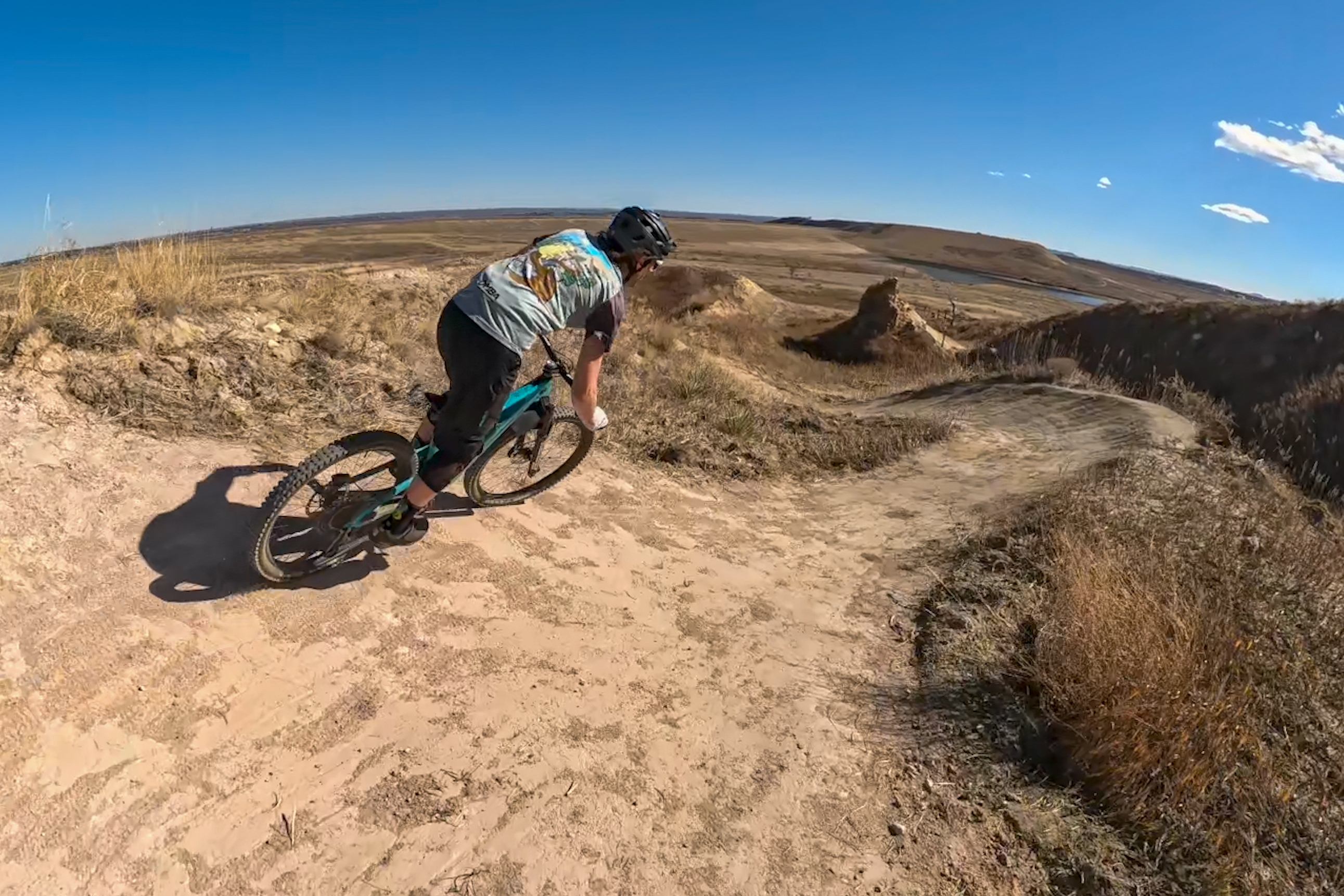
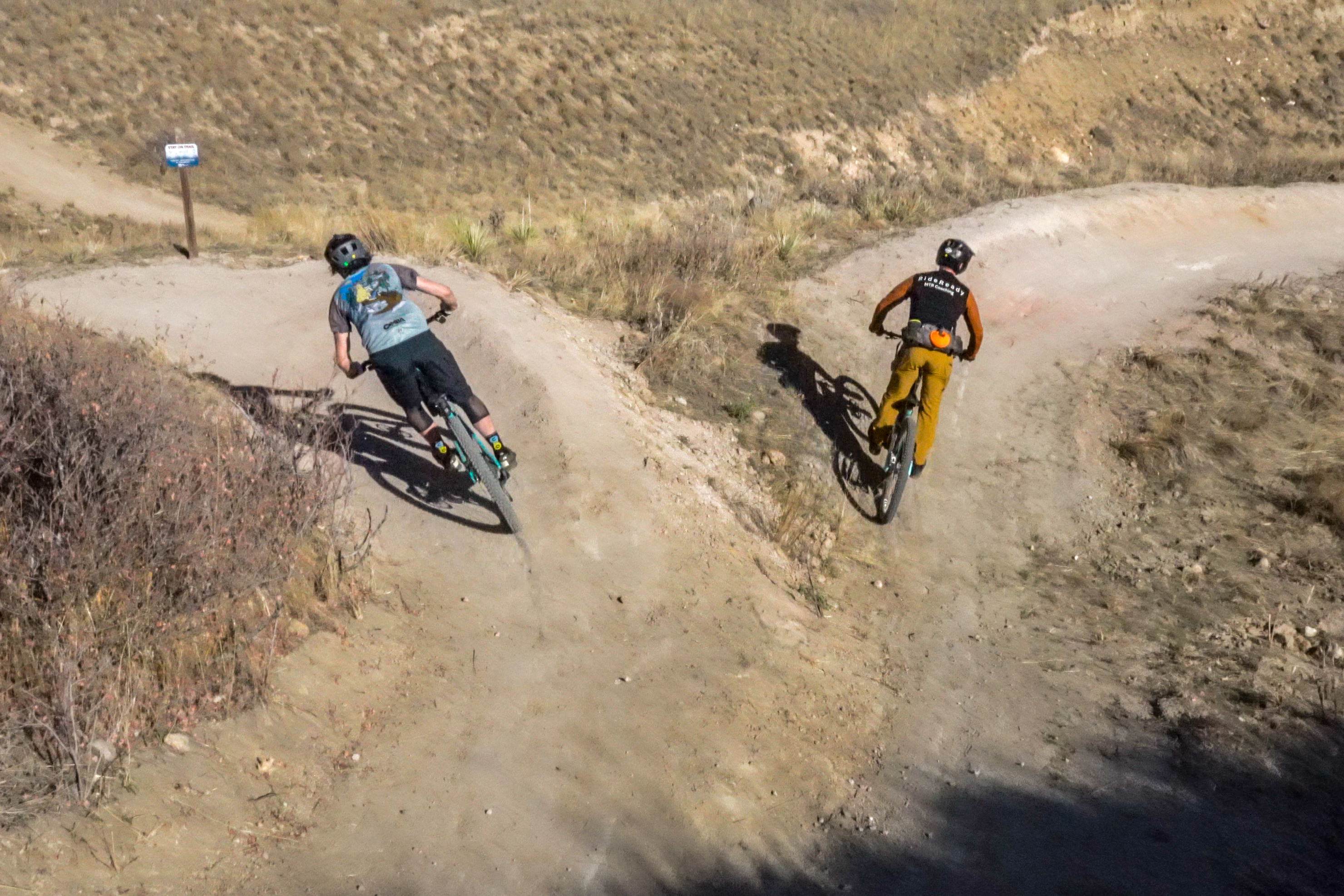
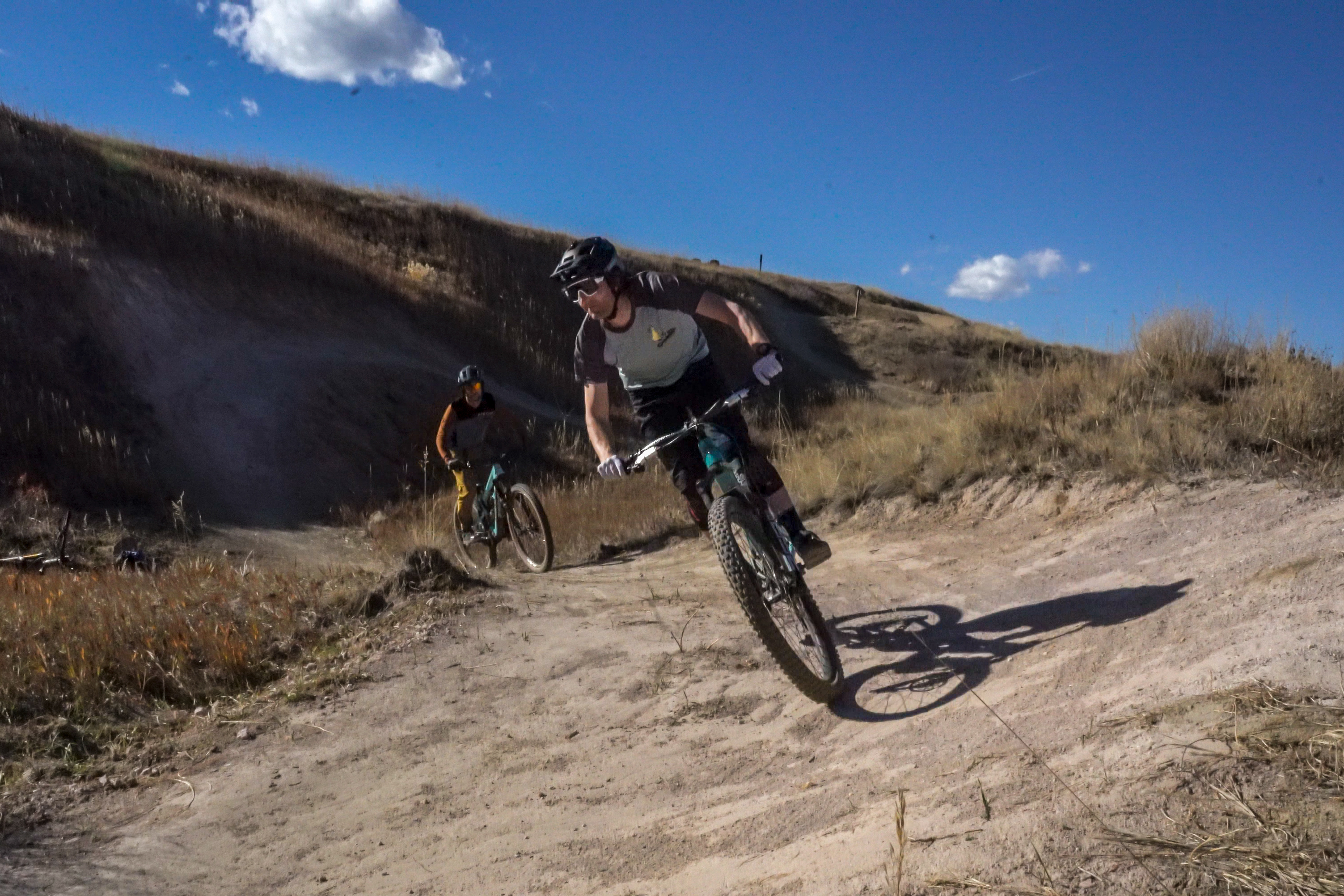
One of the most ridden trail networks in Colorado got its first directional, bike-optimized trail in November. The Prairie Plunge trail, in Lakewood’s Bear Creek Lake Park, has both a green-blue rated trail and a blue rated trail that parallel each other for a tenth of a mile and roughly 35 feet of drop. Both trails swiftly pull riders from side to side, and though there’s no jumps, riders can experience a rush of speed and plunge from the top of one berm, down to the bottom of the gulley, and up to the next.
The scale of these trails is small compared to the steep and rugged trails across the Front Range of Colorado, but it’s still a win for an area lacking in beginner trails. Prairie Plunge is the first trail in the park designed with mountain biking in mind, though it remains open for hiking too.
“That’s why this Prairie Plunge trail is the first of its kind for Lakewood,” said Gary Moore, the Executive Director of the Colorado Mountain Bike Association (COMBA), who worked with the City of Lakewood to design and build the trail.
The City of Lakewood, a western suburb in the Denver metro area, manages Bear Creek Lake Park and Green Mountain, the two most proximal trail systems to Denver for mountain biking. Both are situated between several neighborhoods and thousands of homes, making the two networks a catch-all for people venturing away from the city to ride somewhere close, or residents pedaling out from their homes after the workday to get some exercise in. While Green Mountain has seen more bike-optimized trails in the past decade, Prairie Plunge marks the first meaningful trail upgrade in Bear Creek Lake Park.
How it happened
COMBA began working with the City of Lakewood as a stakeholder in 2024 on the Bear Creek Lake Park master plan. The park was considering everything from infrastructure and fee updates, swim beach expansions, and future trail planning. Lakewood secured about $18,000 in grants for trail construction and renovation, according to Moore, and COMBA took the reins.
A handful of the older trails in the northern part of the park were rerouted as Prairie Plunge was built. These older trails, like many in Green Mountain, weren’t designed with sustainability or the modern mountain biking experience in mind when they were bedded in decades ago. Some of these trails had short, steep sections that drained water poorly and had erosion issues, and were still a crux for beginner-level riders.
The big, sweeping berms of Prairie Plunge are a first in Lakewood’s open spaces and, for a segment of riders, likely a new feeling, if they haven’t yet experienced COMBA’s more advanced works in Jefferson County’s Rutabaga Ride, or Clear Creek’s Virginia Canyon, Floyd Hill, and Maryland Mountain.
Moore has been tempering expectations because the trails are short and riders are still sharing the trail with hikers. “Lakewood has been resolute in keeping things bi-directional and multi-use,” he said.
His experience in working with the City is that both Bear Creek and Green Mountain were intended to have a preservation-first, recreation-second style of management — something important in maintaining green spaces for a major metro area that is still growing.
“There’s going to be a different feel of the experiences you’re trying to create when your overarching goal is conservation first,” said Moore.
A potentially underwater future
The new trails also come while the park is undergoing a major study by the U.S. Army Corps of Engineers to determine if the reservoir in the park should be expanded, flooding trails, beaches, and riparian habitat in the process, to hold more water as the Denver metro area grows.
Though the land is managed by the City of Lakewood, it was actually leased from the U.S. Army Corps of Engineers in 1982, and remains a “flood control project,” according to the master plan.
The feasibility study is ongoing, and stakeholders were “focused on land use improvements in areas of the park that are not owned by the Army Corps,” says a section in the master plan.
Pitching in with conservation
The last piece of work for COMBA trail builders and volunteers on Prairie Plunge might come as a surprise to many, but it involved laying down native seed, planting plants, and mitigating noxious weeds. Some parties may not think of mountain bike trail organizations as aiding in ecological restoration, but Moore admits the necessity.
“It’s hugely important,” he said. “The noxious weeds are problematic for a number of reasons, but putting in the right plants and flowers and things that are going to support the ecosystem at the very bottom of the chain — you start with the bugs and insects that feed the birds, that feed the foxes and hawks, you work right up the ecosystem. It really is the building blocks.”
Moore and COMBA have learned that once the scarification process happens, and soil from former trails is turned up, noxious plants start growing and can choke out other plant life, in turn spoiling the entire ecosystem. It’s a step he’s happy to take to ensure a healthy ecosystem, along with improved trails for mountain bikers to play on.
More beginner trails
This past summer, COMBA helped install three miles of new, flowy, approachable trails on the Conifer High School campus, just 25 minutes west. They are open to the public outside of school hours and will potentially be connected to another few miles of trail at the Flying J network.
Prairie Plunge and the other trail re-routes in the northern portion of the park are likely the only new trails on the docket in Bear Creek Lake Park for some time, says Moore. But it’s adding some weight on the beginner side of the trail scale on the central Front Range, and gives new riders the modern experience they need to eventually progress to more challenging trails.
“We just haven’t had that in the Front Range,” said Moore.
Know about a new trail project we should cover? Whether you’re breaking ground on the next must-ride destination or putting the finishing touches on a neighborhood flow trail, we want to hear about it. Drop us a line at [email protected] with high-quality photos of your build, plus details like trail mileage, location, difficulty, and what makes it special. We’re always on the hunt for the next great trail story, and there’s a good chance your project could be featured in an upcoming article.




3 Comments
Dec 22, 2025
Dec 23, 2025
Dec 25, 2025