

Any opinions expressed in this article belong to the author alone and do not necessarily represent the opinions of Singletracks.com.
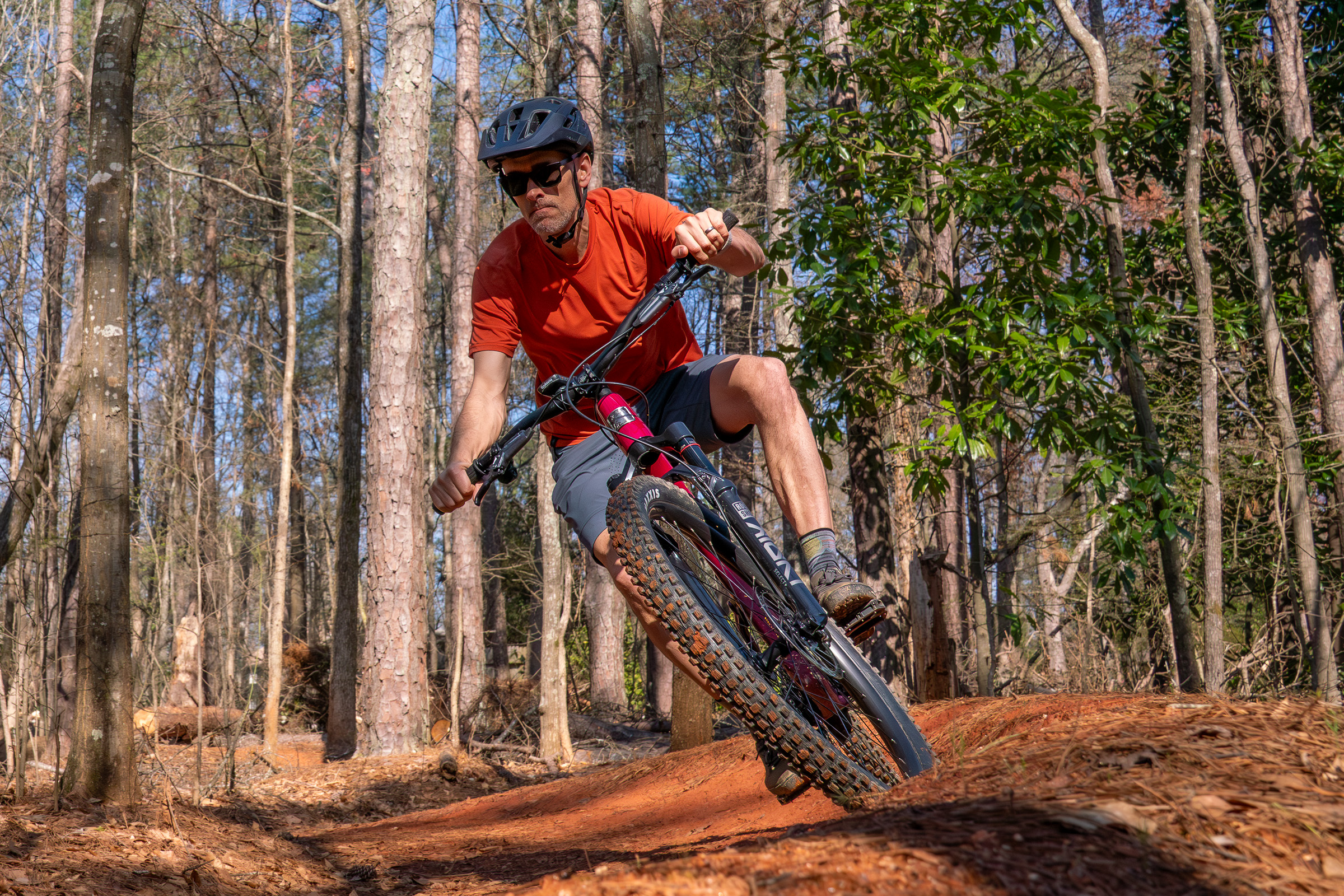
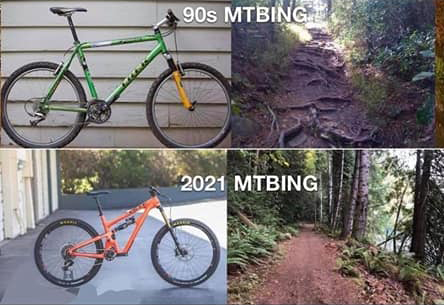
Spend a morning at almost any purpose-built trail network in North America and you’ll notice two things. The trails are sculpted, drained, bermed, and buffed to a standard that would have seemed almost fictional to riders twenty years ago. And the bikes are enormous. Long, low, slack machines bristling with 140, 150, sometimes 160 millimeters of suspension travel, their geometry optimized for speeds and gradients that most of those same trails will never come close to demanding.
This is an observation, and one worth sitting with, because it points to a quiet but meaningful tension running through the sport right now. Mountain biking has undergone two simultaneous revolutions over the past decade.
Trail design has become progressively smoother, more predictable, and more controlled. Bike design has become progressively more aggressive, more capable, and more oriented toward chaos. Somewhere between those two trajectories, a question has opened up: are the bikes being built for the trails riders actually ride, or for a version of the sport that most riders will only ever glimpse on YouTube?
How trails changed everything
The transformation of trail design is genuinely one of the most underappreciated stories in the history of the sport. For most of mountain biking’s existence, trails were the product of topography, chance, and volunteer labor. They went where the land allowed and survived however they could. Roots, exposed rock, eroded chutes, and blind corners were not design features; they were simply the consequences of trails made by hand, following the path of least resistance through whatever terrain lay in the way.
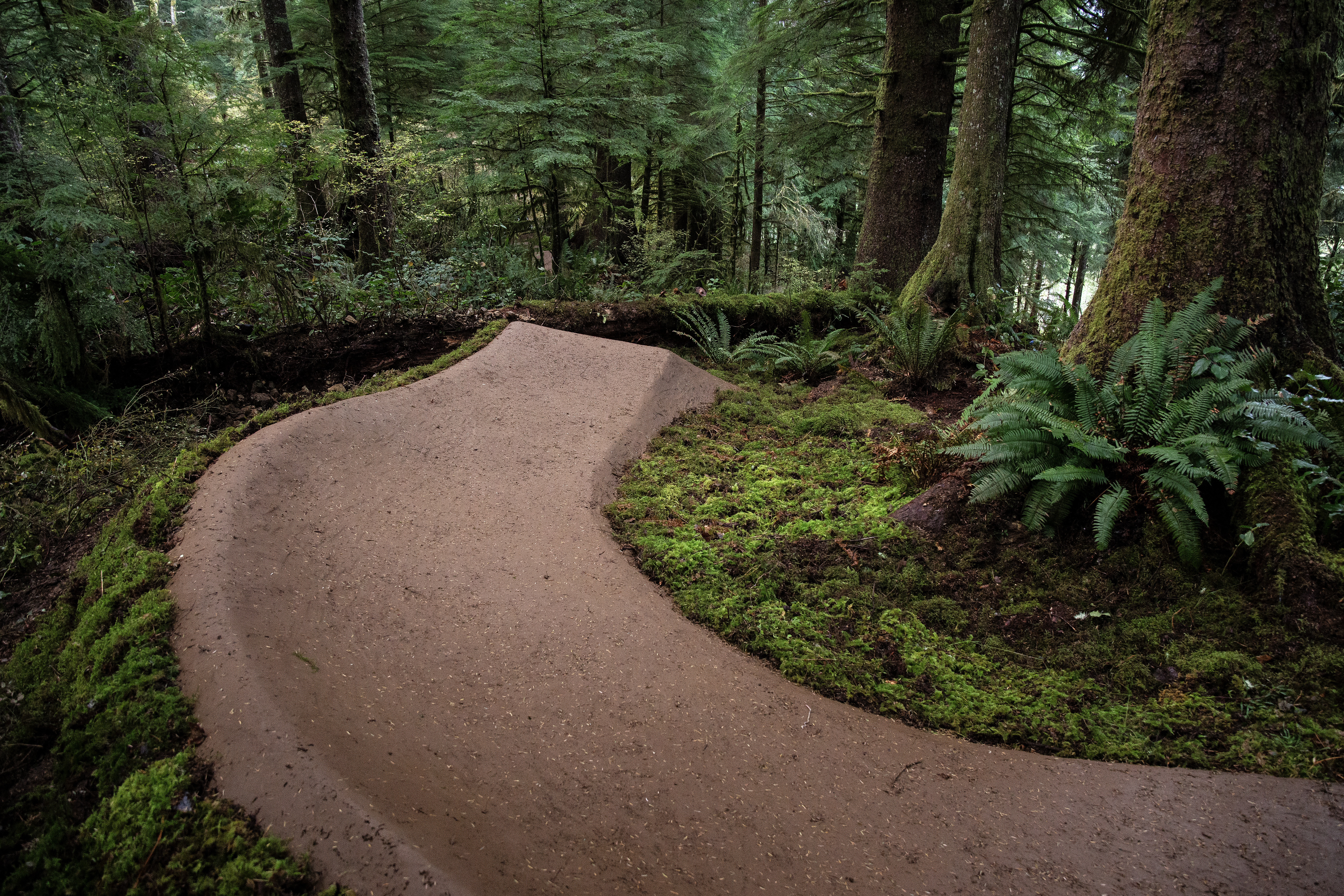
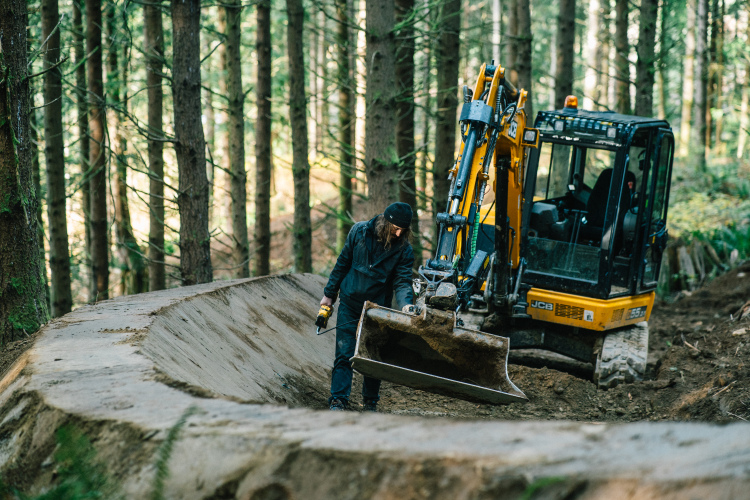
Modern machine-built trails represent a different philosophy entirely. Designed using software, shaped by excavators, and maintained with a precision that older trail systems never knew, they are engineered artifacts. Berms are calculated for rider speed and lean angle. Rollers are sequenced to generate momentum. Drainage is designed in from the beginning rather than added as an afterthought. The result is a riding experience that is faster, safer, and more immediately enjoyable for a broader range of abilities than anything the sport had previously managed to produce.
The numbers tell the story. Trail networks that once required years of scouting, negotiating, and hand-digging can now be completed in months. Ridership at purpose-built trail centers has grown dramatically. And perhaps most significantly, the barrier to entry has dropped: riders can now experience genuine descending speed and flow within their first season of riding, something that once took years of technical development to achieve.
What machine-built trails have engineered away, in large part, is unpredictability. The thing that used to make mountain biking genuinely dangerous — the surprise root, the hidden rock, the corner that tightened faster than expected — has been systematically designed out of the most popular trail formats. That is an unambiguous good for the sport’s growth. It is also, quietly, a significant change to the physical demands those trails place on a bicycle and its rider.
Meanwhile, the bikes kept getting bigger
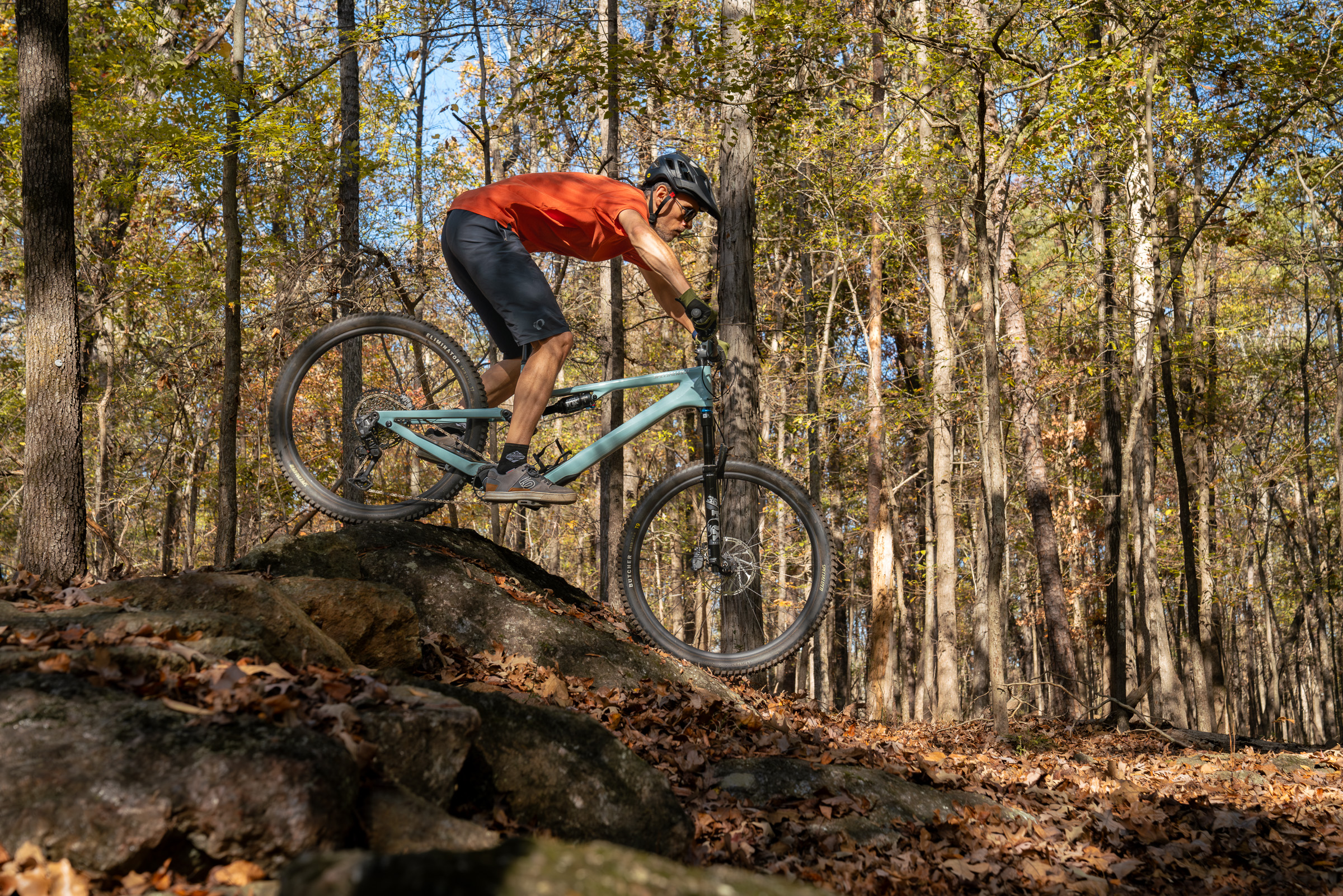
The geometry numbers tell their own parallel story. In the mid-2000s, a trail bike with 120 millimeters of rear travel and a 67-degree head angle was considered a capable, well-rounded machine. By 2015, the baseline had shifted to 130 millimeters and 66 degrees. By 2020, manufacturers were routinely shipping “trail” bikes with 140 to 150 millimeters of rear suspension and head angles below 65 degrees; numbers that would have classified as all-mountain or light enduro in any earlier taxonomy. Today, the drift continues: reach figures have grown by 30 to 50 millimeters across most categories, bottom brackets have dropped, wheelbases have lengthened, and the entire design language of the modern trail bike speaks unambiguously of speed, stability, and descending confidence.
The engineering logic behind these changes is sound. Slack head angles reduce the tendency of the front wheel to wash out at speed. Greater travel absorbs impacts that would otherwise be transferred directly to the rider, maintaining traction and reducing fatigue. Longer wheelbases improve high-speed stability on rough terrain. Each individual change makes the bike more capable on the kind of terrain that demands it; steep gradients, unpredictable surfaces, high-consequence mistakes.
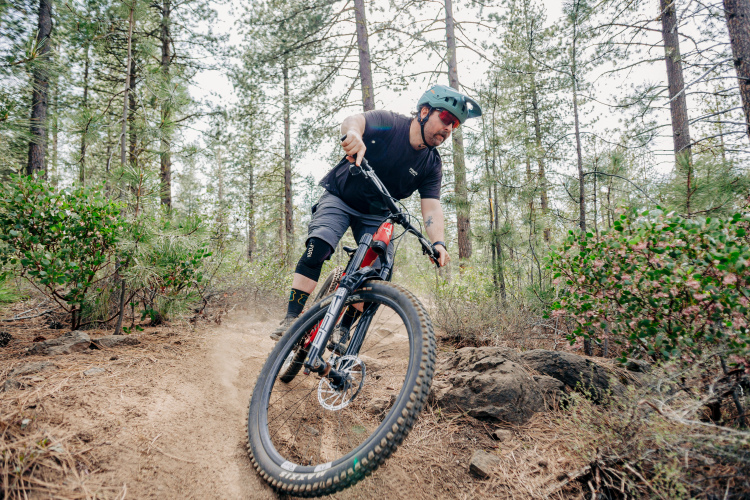
The irony is that the trail-building revolution has been progressively eliminating exactly that kind of terrain from the places where most recreational riders spend most of their time. Machine-built flow trails are, by design, the opposite of steep, unpredictable, and consequence-heavy. They are smooth, readable, and forgiving. On a well-built berm at moderate speed, a modern 150-millimeter trail bike is not using its head angle to resist washout. It is not using its travel to absorb unpredictable impacts. It is doing what any reasonably capable bike would do on that terrain: following the line that the trail has already, very helpfully, laid out.
The physics of unused capability
Suspension travel has a physical cost regardless of whether it is being used. Additional travel means additional weight; in the frame, the fork, the shock, and the linkage hardware that connects them. It means a higher center of gravity and a more rearward weight bias than a shorter-travel equivalent. It means greater pedaling bob unless suppressed by a platform damper, and it means a ride feel that, on smooth terrain at moderate speed, can veer toward the vague and disconnected rather than the direct and responsive.
There is also the issue of what suspension engineers call the active travel window; the portion of available stroke that actually does meaningful work under typical riding conditions. A rider spending ninety percent of a given trail in the first thirty percent of their suspension’s travel is not getting poor value from their bike in any simple sense. They are, however, carrying a significant system that is largely idle, engineered for impacts it is not encountering, optimized for speeds it may never reach.
None of this would matter if the only consequence were a slightly heavier bike. But there is a subtler effect that coaches and experienced riders have begun to observe more frequently as long-travel bikes have become the default rather than the exception: the progressive reduction of feedback from the terrain to the rider.
When a bike’s suspension absorbs everything: when the berms hold the line, the travel smooths the small hits, and the geometry provides stability in excess of what the trail requires; the rider receives less information about what they are and are not doing correctly. Weight distribution errors, late braking, poor line selection: these mistakes are absorbed rather than punished, which feels forgiving in the short term but can quietly suppress the development of the technical foundation that more demanding terrain will eventually require.
The industry’s position is not unreasonable
It would be unfair — and inaccurate — to characterize the direction of bike development as simple overreach. Manufacturers are not building bikes for an imaginary rider on imaginary terrain. They are building bikes for riders who may encounter a wide range of conditions across a season, some of whom will genuinely demand every millimeter of travel available. The occasional bike park day, the trail network in another state, the unfamiliar descent that turns rowdy without warning: these are real scenarios, and a bike with a margin of capability beyond what the home trail requires will handle them better than one that is optimized exclusively for local conditions.
There is also an honest commercial dynamic at work. Bikes with aggressive geometry and generous travel photograph better, test better in the controlled comparisons that dominate media coverage, and communicate a kind of aspirational capability that resonates with buyers. In a market where riders are spending four, five, or six thousand dollars on a trail bike, confidence in the machine’s limits matters, and long-travel geometry provides a tangible, legible version of that confidence.
Telling a consumer to buy a shorter, lighter, more demanding bike is a difficult pitch, particularly when the alternative sits right there on the test loop, doing all the work for them.
The market has also been trained over many years to associate longer and slacker with objectively better. Review language reinforces this framing constantly. A bike that feels planted and stable on technical terrain receives praise; one that feels nervous or demanding on the same terrain receives criticism.
The result is a vocabulary that is well-calibrated for evaluating bikes on challenging descents but poorly equipped to ask whether those bikes are well-matched to the terrain where most of their owners will actually ride them.
A different kind of capable
The conversation that is beginning to emerge in coaching circles and in the quieter corners of MTB media concerns not whether long-travel bikes are good — they clearly are, on the right terrain — but whether that terrain is what most riders are riding. If the answer is no, then the question becomes what a bike actually optimized for machine-built trails, ridden by recreational riders at recreational speeds, might look like.
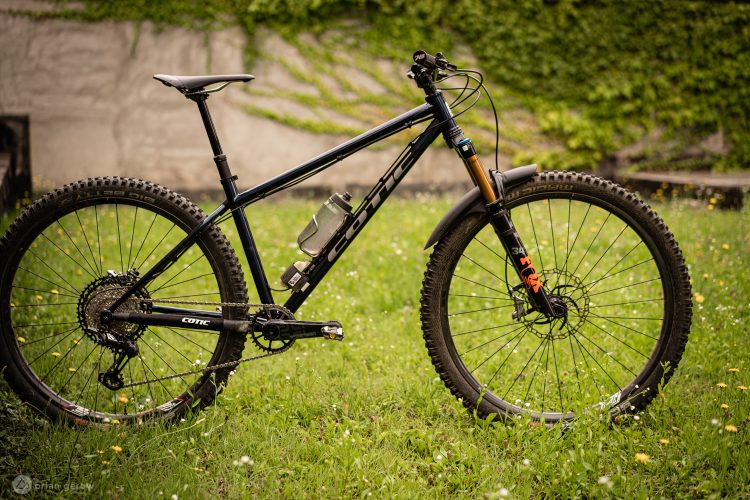
The answer, interestingly, may look something like the bikes that preceded the current era. Shorter travel, steeper geometry, lighter weight, and crucially, a ride character that communicates with the rider rather than insulating them. Several smaller manufacturers have been quietly exploring this territory, producing bikes in the 110 to 130 millimeter range with geometries that reward input rather than absorbing its absence. The reception among riders who have tried them has been telling: not a sense of being under-gunned, but a sense of re-engagement with the trail itself, of riding rather than simply being carried.
The right question
Mountain bike suspension is not overkill in any universal sense. On the steep, loose, consequence-laden descents of the Pacific Northwest, the Alps, and the southern Appalachians which are the terrains that shaped its development, modern travel figures and modern geometry are genuinely transformative. The progression they have enabled at the top end of the sport is real and remarkable.
The trail-building revolution has made mountain biking more accessible, more fun, and more repeatable than it has ever been. It has done so partly by removing the unpredictability that long-travel suspension was designed to manage. That does not make modern suspension wrong.
The trails got smoother. That is a good thing. The question is whether the bikes noticed.
Keep up with the latest mountain bike news by adding Singletracks as a preferred source on Google.
Keep up with the latest mountain bike news by adding Singletracks as a preferred source on Google.

45 Comments
Jul 18, 2026
Jul 22, 2026
I just saw photos yesterday of another popular trail here and one of the tasks was root removal :(
Jul 21, 2026
Jul 23, 2026
Jul 18, 2026
Jul 19, 2026
Jul 23, 2026
Jul 17, 2026
Jul 17, 2026
Jul 22, 2026
Jul 21, 2026
There were whispers of this happening over ten years ago. I experienced this when I spent over a month with Evil's The Calling. That was a 27.5 bike with a 150/130 set up. Up until that point I had been on 150/160 travel bikes, but that Calling was mind-blowing in how capable it was. It handled all of the nonsense I would've thought I needed a bigger travel bike for.
One of the most curious things about that moment was that I was on a shop demo (friend's shop) and while I normally rode size mediums I borrowed a large Calling. I figured it would be a handful, but that size large is nearly the same as today's mediums. I nearly bought the demo off my friend, but as I had already ordered a Wreckoning I stuck with that. However, I never forgot how much fun The Calling was and while the Wreckers I had (both V1 and 2) were great, I missed the chaos of The Calling. More recently 2.5 years ago when it came time to move on from my last frame I nearly sourced an old Calling. That bike (sized up to large) with a few minor geo tweaks would kill as a mixed wheel bike. In the end, I went with a Santa Cruz 5010 MX and haven't looked back. It takes the best of enduro bike geometry and grafted it on to a short travel ripper. By adding a 150 travel fork It's capability is superlative.
Unfortunately, this kind of bike is being cast aside for either downcountry bikes or people buying e-bikes. Oh well, I plan to keep it going until something comes along that does something my 5010 cannot. So far in my third season aboard it, it has handled everything from the any and all local rides (ATL metro) everything in the SE to big Moab epics, to bike park runs and the gnarliest lines I could ride at Snowshoe.
Lastly, speaking of gnarly I've long held to the mantra that I prefer trails that flow; not flow trails. I'll take the classic hand cut sketchy lines any day of the week over plow and build stuff.
Jul 28, 2026
Jul 17, 2026
I think we’ll head back towards specific bikes for specific applications again(price dependent - not everyone can afford two bikes), but will be focused on low weight balanced with capability. A trend currently applied to down country bikes as they become more capable than XC and lighter than Trail.
Jul 18, 2026
Luckily, not far from downtown Victoria, BC (Vancouver Island) there are (to me) Über gnarly natural-terrain trail. Full of rocks & roots. A millisecond of lost concentration is not going to ever do me good. I love rough trails. Yes, they are exhausting, punishing and challenging to ride.
Great article. Natural terrain trails are my delight. You are welcome to ride machine groomed trails. Vive La difference!
Great website BTW. I’m finding good value with my lifetime membership (even at 68 years old.).
Jul 17, 2026
Jul 18, 2026
I would hope that our LBS first question when meeting a buyer would be, where do you intend to ride. From there they would consider the local trails and go from there.
Jul 17, 2026
I do have a sweet lightweight trailbike that is poppy and super fun but it wants to yeet me over the bars in steep chunk (which is has! resulting in broken bones), which is why I got the big enduro bike.
Jul 17, 2026
It's means they're all getting easier and more comfortable to keep those who'd never take up these sports to buy and be cool! . E bikes are a great example too and add to the problem you're talking about... they can ride up and now have to get down safely... ( Note. I'm not saying they're isn't a place for ebikes for genuinely older riders or people with physical challenges.)
My long term mtb rider buddies comment on this already. Yes we enjoy better bigger bikes and our Strava times are faster than they were 15 years ago because of it.
Squamish and BC trails have been going through the same problem and it's not going to end...smoothed out. A lot of trails are built or even rebuilt flat here and ' fun' for those who'd never have taken up these sports. Trails are losing their challenge to make the 'cash cow' buyers safe.
The tennis/pickleball comparison in surfing goes. Tennis is to surfing what pickle ball is to sitting in the hot tub.
Your article also nails it about the fate of mtb.
Jul 17, 2026
Jul 20, 2026
Jul 19, 2026
Jul 21, 2026
Jul 17, 2026
Fast forward 25 years - when I was doing more road riding than off road. In 2020 I bought my nephew's used Specialized Epic carbon hardtail and fell in love with the sport again. A couple years later I upgraded to full suspension and went with a short travel Trek Supercaliber (60/100). The terrain that I ride matches this bike's capabilities and I feel like it has improved my riding skills significantly. As I've written before in these comments I'm more interested in climbing than jumping and at 69 years old I feel like I'm riding better and enjoying myself more than ever.
Bottom line is people need to do their research before dropping thousands on a bike and discovering they have too much or not enough bike for their style of riding.
Jul 18, 2026
Jul 19, 2026
Jul 20, 2026
Jul 17, 2026
Jul 17, 2026
Jul 17, 2026
I don’t bike anymore from lack of interest, but I got myself a Chromag longer travel hardtail to make the trails more interesting again. Before that I wanted a burly, shorter travel bike. Something more capable at handling abuse than a weight shaving setup. But to get suspension that doesn’t flex with a stiff breeze the only option were bikes with the feel of a Hummer.
I prefer line selection. Both flow trails and big bikes remove that.
Jul 18, 2026
Jul 18, 2026
Context:
- I’m an MTB Instructor
- I have a Ripmo, Chromag hardtail, fatbike. Gravel bike, dirt jumper.
- I live in a non-descript area with 2 lift served hills, 3 dedicate trail centers, and 150km of green and blue (and secret black) public trails
- Also within 50mi of more dedicated centres
- 5 hours from Quebec City and Kingdom Trail VT
- I am in Utah event March
My take: Every riding location has a unique and varied culture of riding which is driving the accurate generalizations above in various forms. Trails govern riding, riders grow and experiences change over time.
As a lifelong trail rider, DH was always the more extreme version of riding. It intimidated me, and I didn’t have a DH bike. But then I got a DH bike and discovered that discipline and more steeps, flow and jumps. Now people can and do explore these categories more readily. This leads to “easier” DH trails, and harder “enduro trails as the riders move back and forth.
What I’m not seeing, is markedly better riders. Yes, there are more better riders as a result of increasing ridership, but the bell curve of talent is the same. Mostly OK, some good, a few great, a few really dangerous (although they don’t tend to last). Mostly people still decide to ‘ride more’ rather than practice skills and train for harder trails and while this is perfectly OK, they are often relying on their equipment rather than skills and fitness. Again, there really is no problem with this either; people want to ride, feel challenged, tick off trails and brag about it, and the upgrade their tires. People want the experience, quickly, with a minimum of work. E-bikes contaminant the sport a bit for me. Hey, if you ride and e-bike and it keeps you moving, that’s great, but it’s not helping most become a better rider. Nope. Very few e-bike riders (at least in my area) are better for their lack of fitness and heavy equipment. More mediocre laps is not better for me. But hey, it’s another, different variant on the sport, and one day I might choose to ride one so I try to remain positive.
Renegade trail builders still remain abundant too. I think trail building has come a long way in 20 years and is much better positioned to help communities, resort and riders. Private paid riding areas are at the forefront of trail experience in many areas. And that will govern what gets built. It’s all fun. It just sucks to me that riding now cost $20 to $120 a day.
I do more varied riding now than ever since I started riding in 1986. I love it. I get sad when my secret, unofficial trials gets renovated (easier) and become legit. (Although a lot of those changes are for trail runners). But I try to remember that I still have other secret trails, 3 riding areas of different styles, 2 lift-served hills and 100mi of double track where I live.
If you’re down about things, learn some new skills. Flow trails need certain skills. Jump trails need certain skills. Try DH for half a day. Do a 30mi adventure ride on Forest trail (no pads needed). Hell, rent an e-bike and see what the fuss is all about.
Enjoy the ride.
P.S. - 150/130mm Trail Bike is probably the best tool around. Ibis Ripley for the win. (Although I would over-fork to 160mm)
Jul 21, 2026
Jul 20, 2026
Jul 26, 2026
Jul 18, 2026
When I was demoing for a new mountain bike in 2018, I rode a Yeti designed for fast xc riding. I struggled to get down a rocky, bouncy trail. I thought my skills must be incapable of any improvement over what I could do on my 2012 Ibis Mojo.
Next I test-rode a v3 Ibis Ripley and rode right down the same trail with no problem.
I was sold!
I recently bought a Santa Cruz Vala e-bike. I've been taking it to Henry Coe State Park, south of here. Henry Coe had become too difficult on my Ripley or any purely human-powered bike, with its thousands of feet of climbing, some of it steep. After getting the Vala, I found that the climbs once again had become manageable, and with its relaxed geometry I'm finding myself descending black-diamond singletrack as though I'd taken 40 hours of skills classes. I had the same reaction to the Ripley over the Mojo: it was as though I'd taken hours of skills classes, without having done so.
The one drawback is that it's harder to clean tight uphill switchbacks on the Vala than it is on the Ripley, and in turn it's harder on the Ripley than it was with my Mojo 26er. I find myself occasionally walking through a switchback that I could clean on the other bikes.
Jul 17, 2026
Jul 17, 2026
A Toyota Corolla is not the same as an old Sedan Deville just as an old 100/100 trail bike is not the same as a new 150/150 trail bike. They will all do the job of getting you from one place to another, but it's how you feel at the end of the trip that matters.
Here's to old guys, new technology and smooth rides. To bike manufacturers and trail builders both, salute.
Jul 17, 2026
Jul 23, 2026
Jul 23, 2026
Jul 19, 2026
Jul 17, 2026
Jul 18, 2026
I live in Minnesota. We have what we call sustainable trails here. So yes, drainage is planned from the get go. Most trails are pretty well groomed. Most trails look more like BMX race tracks today compared to 20 years ago. They are fun and flowy. We do have Duluth and the North Shore of Lake Superior where things get a bit gnarlier, but not insane.
I just got back from Whistler this past week and I rode Mt. Galbraith right from Transition Headquarters. When I think of these companies in this area, Kona, NORCO, Evil, Transition, and others...I understand why they make the bikes they do. The PNW is a really fun and can be a fairly gnarly place to ride. But even then, a lot of newer trails being built there are good flow trails more riders can ride. The other nice thing about a well designed flow trail is it holds up better and requires less constant maintenance.
A lot of the steeper stuff at Whistler get all chunked out and has tons of braking bumps. It's because they are so steep and fast that the large majority of riders ride their brakes. Sure, more advanced riders and do less braking and go super fast ripping through the corners, but not myself and most others on the trail.
The less steep stuff at Whirler was much more fun to ride because my arms were not getting beat up constantly by the braking bumps.
I love a good hardtail and my latest is the new Surly Sorceress. For this area of the world and Surly's home town, it's a perfect bike!
I would guess that 80% of riders could get by on a XC or down country. Or better yet, a hardtail.
And don't get me started on the 32 inch wheel discussion. This article clearly points out that we don't need bigger wheels. Heck, 29 inch is not even ideal for shorter and medium height riders. 27.5 is the gem.
A few years ago I got an Esker Hayduke 27.5 bike. It had around a 66 degree head angle and it absolutely rocked! It was probably one of the most fun bikes I have ever owned. My Surly Sorceress had a 27.5 on the rear and I added 1 degree to the head angle with a Wolf Tooth GeoShift headset. 29 inch wheels are too big if you want to have fun and toss around your bike.
Jul 23, 2026
Jul 20, 2026