singletracks is mountain biking
Sign In | Create Your Account | Site Map | Help  


MTB Trends: The Rise of 29ers and Long Travel Bikes

Thursday, February 9th, 2012

I admit it: I’m big mountain bike data geek. I want to know how many people ride a particular trail, what kind of bike they’re riding, and how often they ride it. And if you’re familiar with singletracks.com, you know we collect this data and display it on trail and gear pages for everyone to see. We even use these metrics to produce our best trail and best gear lists and over the years we’ve collected a ton of data from many of the 150,000 mountain bikers registered on the site.

Recently we decided to start mining that data to see what kinds of trends we could uncover for some slick mountain biking infographics. Our first order of business: determine what types of mountain bikes are trending up or down in 2012.

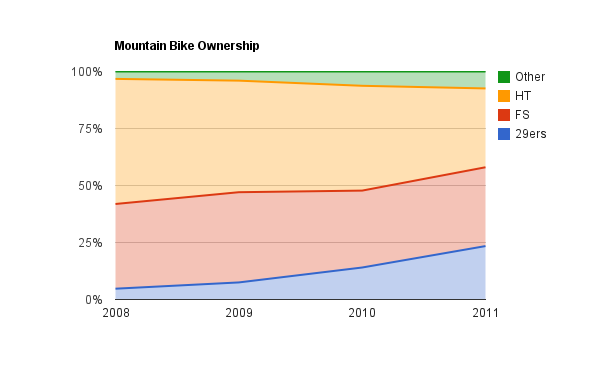
This chart above shows percentage ownership of various types of mountain bikes. For our purposes, full-suspension (FS) and hardtail (HT) bikes are generally of the XC-variety (4 inches of travel and under). The “Other” category includes mostly longer travel bikes (all mountain, downhill, freeride) but also includes hardtail dirt jumpers. The 29er category includes both full suspension and hardtail bikes. There is no overlap between categories (that is, a hardtail 29er will only show up in the 29er category and not the hardtail category too).

Reading the chart you can estimate the percentage of ownership by subtracting the difference between colored lines. For example, in 2011 FS bikes comprised about 30% of the bikes owned — 55% minus the 25% share for 29ers. Make sense?

Now for the analysis. Clearly 29ers are trending up in a big way, with just 5% of singletracks members owning a 29er in 2008 vs. 25% in 2011. But what is 29er growth coming at the expense of? Hardtails with 26-inch wheels, no big surprise. But take a look at the FS share in the red block. It looks like the FS share hit its peak in 2009 and lost ground in 2010 and 2011, perhaps due to more FS 29er choices on the market in the last two years. The “Other” gravity-type bikes are gaining ground too, though at least here on singletracks they aren’t a big part of the picture yet.

So what can we expect in the future?

Using the numbers from singletracks members’ wishlists, we see a similar trend, at least with respect to 29ers. Almost 25% of members wanted to buy a 29er in 2011 which should push the ownership percentages even higher in 2012. This isn’t a big surprise to me – the 29er trend still has a lot of steam, despite the far off predictions of a 650b resurgence in the market.

From this chart it’s also clear that 4-inch (and under) FS bikes aren’t as lust-worthy as they used to be. The FS wishlist share is trending downward while the longer travel share (AM, FR, DH) is growing. As such, I also expect to see long travel mountain bikes growing on the ownership side for the next several years, especially once costs come down a bit.

Another way to look at this chart is to consider the mountain bike buyer’s timeline. In the first chart we see the share of HT mountain bikes is much higher than in the second. It stands to reason that a lot of people own HTs because that’s what they start out with (these bikes are generally less expensive) but for their second bike (the wishlist) they’re more likely to want a bike with some travel (either short or long).

Caveats

As you might expect, this data and analysis comes with a few caveats. While the data is from a very large set, it still only captures singletracks members who use the gear lists and it also assumes people are truthful in their gear list choices. Further, the analysis relies on the way the bikes have been categorized on singletracks which may not be 100% accurate.

So what do you think? Share your analysis in the comments and feel free to suggest other MTB trail and gear data you’d like to see crunched!

Report from the Fringe: Electric Assist Mountain Bikes at Eurobike

Thursday, September 22nd, 2011

If you haven’t heard, Eurobike just exploded with the best bikes ever in the history of bikes existing earlier this month. This post will differ from most of the others you may have read in its distinct lack of breathless excitement over the sheer incredible awesomeness of this year’s crop of uber-machines. Yes, each new model year brings very unique and often beneficial design improvements. Every show season there are worthy lighter, faster, stiffer, aerodynamic-er bikes. But let’s inject some perspective into the whole monkey-riding-a-pig show: the yearly production cycle of the bike industry is largely driven by sales. Our tired and shabby mounts must be superseded by new sexy shiny wonders of technology on a regular basis so we hate the old and love the new. Buy, buy, buy.

Wait, wait – now I just sound like a crusty, contrarian retro-grouch. That isn’t really me. I like new innovative stuff – the shiny bits draw my attention like a walleye to a lure. It is easy to get jaded when it’s seen all at once; the good with the bad, the over-hyped and the tastefully understated. But no matter how it’s presented the great thing about seeing all of the bike industry’s new hotness all at once is getting a feel for the trends. I’m sure you’ve all read a blog post or twelve about the 29er’s arrival in force on The Continent. Of that trend I approve wholeheartedly.

But there’s another trend that speaks to me in a personal way. In a previous life I was an electrical engineer riding a desk with a set of pens in my pocket protector and a stack of blueprints always at the ready. Upon my rebirth as a bike industry employee I worked on an electric assisted monstrosity, among other things. Because of my unique history, the advent of electric assisted mountain bikes as a noticeable presence this year was very interesting.

These eMTBs have been visible for a few years at the European trade show as pre-production concepts and one-off show models. The interesting thing to notice this year was not only the sheer number of brands and offerings, but the appearance of ground-up designs for electric components and the frames into which they were built. The first iteration of the electric MTB was a regular bike with a motor, battery and controller slapped on. What is different this year is the purpose-built frames that were specifically designed for the unique construction, weight and requirements of the assist package.

The greatest thing about this “second generation” of assisted mountain bikes is the fact that the designers took the time, cost and care to centralize the mass. In the first wave of ebikes the motor was in the front or rear hub and the battery was commonly placed behind the seat tube. Having a 10-pound hub creates obvious handling challenges, and getting room behind the seat tube for a battery makes for some long stays and slow steering. In the new bikes the necessary evil of added weight is at least placed low and as close to the center of gravity as possible. Check out the new motor drive at the bottom bracket in the pictures above and below.

So take from this what you will. Before you dismiss it out of hand as “cheating” understand this: they do things a little differently in Europe. Many of these bikes are sold to resorts and will live life in the rental fleet. What more perfect use of the assist motor? It serves to help out the tourist who may not be a true die-hard rider any more but has sufficient skills to really appreciate the alpine scenery from atop a saddle – they just need some help to get to altitude. Think of it as a self-contained chairlift. The newest models are so light that once you’re at the top you can switch off the battery and enjoy the ride down without losing too much in the handling department.

The next real hurdle is the charging infrastructure. One of the reasons these type of contraptions work for resorts is that there is a support system in place; mechanics to do the regular maintenance, a regular schedule of battery care and charging, etc. And when you own an entire fleet the risk of Big Mechanical Issues is lessened since you’ve probably got a shelf full of spare parts, extra batteries, pixie dust and wizard potions to keep these things going. The radius of use is well defined and after a season you know how far a charge will get you and can define the recommended trail routes accordingly. As an individual owner of an electric assisted bike I’d be wary of going out on an epic adventure for fear of getting stuck in the middle of nowhere with a 55 pound bringer of sadness under me. How will the bike industry address these issues? Will eMTB 3.0 be radder, lighter and come equipped with frickin’ lasers? Are we in for integrated lighting? Where the hell is my flying car?!?

All these questions and more will be answered in a year. Stay tuned, I’ll let you know how it turns out when I post my Eurobike 2012 report. One thing’s for sure – I hope to hell there’s no more of this in our future:


Mountain Bike Trends from 2010

Thursday, December 23rd, 2010

I have a feeling this article is going to be a lot more interesting (or perhaps comical) when you read it five years from now. When I sat down to make a list of mountain bike trends from the past year none of it seemed revolutionary: carbon frames & components, endurance racing, 29ers, wide bars, and purpose-built trails are all pretty mainstream at this point. But if you had asked someone about any of these topics just 5 years ago you might have gotten a blank stare. Only time will tell if you’ll get the same reaction 5 years from now…

Carbon Components

Mountain bike frames made from carbon fiber were unthinkable several years ago and even now some riders scoff at the notion but the fact is carbon fiber is a material that’s here to stay. These days carbon is also showing up in mountain bike components like handlebars, crank arms, seatposts, and even water bottle cages. Thanks to advances in manufacturing and design, carbon mountain bikes are not only getting lighter, they’re also getting stronger and more affordable.

Endurance Racing

Ultra endurance mountain bike races like the Leadville 100 have gained national attention in recent years while older endurance racing formats like the 24-hour race are starting to fade. Stage races and multi-day epics like the Arizona Trail 300/750 and Trans North Georgia will only get bigger as individuals seek new ways to challenge themselves and their gear.

29ers

To say 2010 is the year of the 29er isn’t really fair but big-wheel bikes have never been more popular. We predict the platform will only grow in popularity over the next 2-3 years and over the long term 29er bikes should definitely stick around.

Wide Handlebars

This one sorta took us by surprise and as a trend it seems a little faddish (though we could be wrong). This year virtually everyone – from pro-riders to schmo-riders – was gushing about how great wide bars are for mountain biking. Yes, you can get more leverage and control out of wider bars but if you ride narrow, tree-lined singletrack there will be a trade-off. It does seem a little odd that no one thought of riding wider bars before…

Purpose-Built Mountain Bike Trails

In the early days of mountain biking, riders only had access to trails that were built for hiking. Today, groups like IMBA have established best practices for trailbuilding which results in more sustainable trails but also trails that are even more fun to ride. The private sector is also stepping up its game with new sculpted summer DH runs opening at most major ski-resorts and indoor ramps designed for MTB. In some ways mountain bike technology is adding to the push for more progressive trail features and today’s trailbuilders are happy to oblige.

We’re stoked to see how these trends play out in 2011 and to see what new mountain bike trends pop up in the coming year!

Why freeriding might be the future of MTB

Wednesday, February 18th, 2009

Dirt Diggler DH trail in Fernie, British Columbia. Photo posted by birdman.

Ok, so I’m not a freerider – not even close. My riding style is probably best described as cross-country or off-road touring – you know, somewhere below wanna-be freerider and freeride poseur. But I’ve been thinking about freeriding alot lately and I’ve decided that freeriding is pretty much the future of mountain biking. Here’s why.

First of all, freeriding is fun to watch. Sure, it’s also fun to watch a blur of riders race around a cross-country mountain bike course but, like many endurance sports, cross-country mountain biking isn’t very spectator friendly. Freeriding, on the other hand, is full of death-defying moves on artfully crafted trails and stunts. Even non-mountain bikers drool over freeride videos posted on YouTube while the best selling mountain bike DVDs are almost entirely freeride-focused. Freeriding is just the inspiration many need to start mountain biking and today’s new riders are more likely to admire the guys from the Collective Films than Gary Fisher or Joe Breeze.

Freeriding is also accessible. With the US and Canada seeing increasing urbanization (and suburbanization) it’s becoming more and more difficult to site and build large scale mountain bike trail networks. Freeride courses, on the other hand, can be much more compact since stunts can be combined in different ways each time around the course. Freeride stunts can even be found indoors at places like Rays Indoor MTB Park and kids who live in cities can use urban or trials rides to hone freeriding skills.

Unlike cross-country mountain biking, freeriding also makes for a more social mountain biking experience. Instead of falling into a heads-down paceline on the local MTB trail, freeriders are a bit like snowboarders as riders watch each other attempt stunts and offer encouragement (or derision if merited :) ). Of course other mountain bikers socialize but it’s usually before or after the ride. Freeriders get to socialize during the ride.

Finally, freeriding just might be the future of mountain biking because it can be a little dangerous and that makes it cool. The stunts and jumps themselves are dangerous but there’s also a sense of anti-establishment running through freeride culture, much like in the sport of skateboarding. In a time when IMBA an others preach sustainable trails and professional stunt construction, freeriding is attractive because it’s so free. Riders are free to ride where they want, however they want, whenever they want – like in the early days of mountain biking. Just think: the opposites of free riding would be called “restrained riding” or “expensive riding” – and neither of those sound like any fun :)

Yep, I may not be a freerider yet but I’m definitely starting to get the fever. The great thing about freeriding is that it’s all about skills progression and anyone can get started no matter what type of bike you ride. Check out the freeride forums here on singletracks or browse freeride bikes and photos here to get educated!

Bike trends: Pimp my rims

Thursday, September 25th, 2008

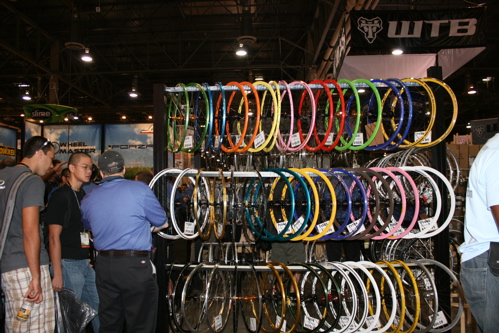
One trend we’ve noticed here at Interbike this year is the proliferation of rim art on both road and mountain wheel sets. There are a ton of smaller companies pushing the idea but even Mavic has a CrossMax SX wheel set decorated with swirly flourishes. Cool idea – but let’s not get too crazy ;)
mavic.jpg

colorful-rims.jpg

wheel-art.jpg

tomac.jpg

crank-bros.jpg


Site Map | Advertise | Partners | Contact Us | Terms | Privacy
Campground Reviews | Hiking Trails | Trail Running | Skiing / Snow Sports | Mountain Biking
Copyright 2012 Blue Spruce Ventures LLC | Atlanta, GA
singletracks.com is yet another slick Review App