

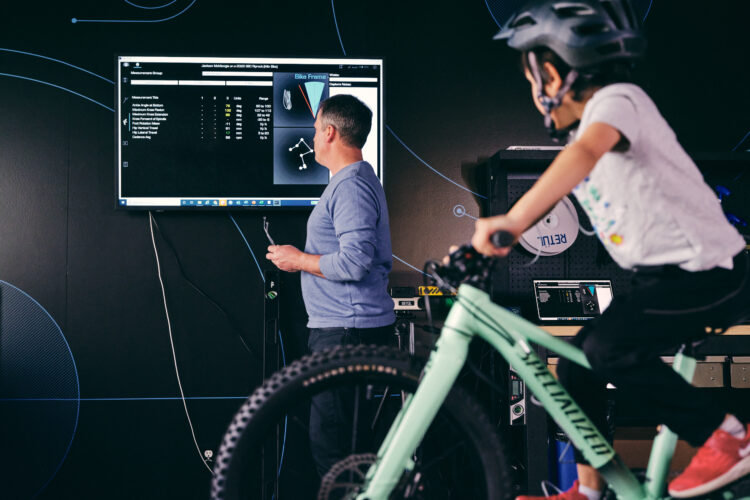
Jason Williams is the Senior Sports Scientist in the Human Performance division at Specialized and a bike fitter at Retul, a Specialized brand that’s focused on delivering technically advanced bike fitting and product matching technology. Retul works with top level athletes and uses collected data to help inform product design, notably the Specialized Body Geometry line.
In this episode we ask:
- Is bike fitting today different than it was 10 or 20 years ago? Have bike fits always been so data-driven?
- Has bike fit data traditionally been fed back into bike design?
- How are current trends in mountain bike frame geometry like steeper seat tube angles and longer reach affecting bike fit?
- Is there tension between a good bike fit, and the idea of a “normal-looking” bike setup?
- How do ride dynamics play into bike fitting? Are you able to optimize a rider’s weight distribution on the mountain bike?
- Is there an easy way to tell if you are running the proper bar width for your body?
- What are the considerations for sizing up or down?
- Are there riders who could benefit from shorter or longer crank lengths?
- Are ergonomics a part of bike fitting, for example brake lever and shifter setup? Do customizable electronic controls help?
- What are some of the interesting things Retul has learned fitting professional and amateur riders alike?
Check out retul.com get more info or book a fit.
Become a Singletracks supporter and enjoy ad-free browsing: singletracks.com/support
Never Miss an Episode
- Listen on Spotify
- Listen on Apple Podcasts
- Listen on Google Podcasts
- Listen on Stitcher
- Listen on Overcast
- Get the RSS Feed
- View all Podcast Episodes
Automated transcript
Jeff Barber 0:00
Hey everybody! Welcome to the Singletracks podcast. My name is Jeff, and today my guest is Jason Williams. Jason is the senior sports scientist in the human performance division at Specialized and a fitter at Retool, which is a specialized brand that’s focused on delivering technically advanced bike fitting and product matching technology, Retool works with top-level athletes and uses collected data to help inform product design, notably the specialized body geometry line. So, thanks for joining us, Jason.
Jason Williams 0:33
Sure thing, you bet.
Jeff Barber 0:35
So, tell us how did you get interested in sports science and bike fitting specifically?
Jason Williams 0:40
I would say that I, you know, it’s been a long, a long path in the bike industry for sure. I’ve held a lot of different positions within bike retail. Was a mechanic for a lot of years, sold bikes, and eventually evolved into a bike fitting role many years ago now. So, really, a long history in the bike retail world that led me into bike fitting, and then more recently into the the more science based and product design side of of fitting, as it relates to product design and development.
Jeff Barber 1:15
Okay, so yeah, I mean, were you interested? I don’t know. Bike fitting, like my initial impression was always that it was kind of like boring, and that it was like for roadies. And you know, you go into a bike shop, and they might have like a dusty, like you know, machine that they would use to occasionally fit people on a bike. Like, what got you interested, though? Were you like, this is this is really cool, or this is really important, or like, what was kind of your draw to it?
Jason Williams 1:40
Yeah, it’s a good question. I would say that largely the the the interest came from certainly an interest in bicycles. I always liked working on bicycles as a mechanic and and working with the equipment side, but strictly working with the bicycle to me, you know, was a little bit limiting, and so I always enjoyed working with the rider as well as the bicycle. And I think that’s really where the the fun comes is is actually matching the individual to the product and and trying to find product or position solutions that are optimized for the rider. So yeah, the the fun comes in in the rider equipment combination.
Jeff Barber 2:24
Yeah, yeah, that’s interesting, right? Because if you work in a shop, like a lot of times you sell the bike and it goes out the door. Maybe you work on it when it comes back, but right, the fitter is the one that’s actually yeah talking with the person that rides it and seeing how they ride it and how all that interacts?
Jason Williams 2:42
Correct. Yeah, it’s it’s just interesting to to work with the individual and try and find solutions that that really help them with performance or comfort or injury reduction, whatever their goals are, and trying to tailor the experience to the individual’s specific you know goals or requirements.
Jeff Barber 3:02
So is bike fitting different today than it was like say 10 or 20 years ago? It seems like you know retool, especially the the bike fits are really like data driven and and things like has that always been the case or is that a relatively new development?
Jason Williams 3:18
I would say it’s it’s a little bit of both. There are elements, threads in Bike Fit that are, in some ways, very similar to the way they were 10 or 20, even 3040, years ago. But obviously, the the advent of technology, specifically motion capture, video capture, a lot of tools that we have now to take a deeper look into data collection and understanding the rider has led us, I would say, deepen our understanding of how the rider and the bicycle interact. But there are some, you know, kind of traditional, sort of old school bike methods that you know, bike fitting methods that that I think still have, you know, some presence in the the fit work that we do to this day as well.
Jeff Barber 4:06
Interesting. Well, so with all that data, has that is it relatively new then to like take that data and then feed it back into to bike design, or is that you know retool seems again seems unique in that like it’s part of specialized, and so not most bike brands that I know of, they don’t have a bike fitting arm where they’re able to like use that data. So is that is that kind of a new idea?
Jason Williams 4:33
Yeah, I think you know you hit on really a key element of the way Retool and Specialized interact because you know Retool as a as a brand on its own is is a fit specialist company. So we we use data to help riders with their position, but we can also use that data in a big picture context to help with, let’s say, optimizing. Shoe fit or optimizing saddle fit, and then of course, big picture, looking at how riders interact with their bicycle and whether frame geometry or part spec should change to help riders as a whole. Right, the whole riding population benefit from the the findings that we’ve uncovered as retool specialists. So you know we we have 10s of 1000s of retool fits that we’ve collected over the years, and that’s a really rich data set that lets us mine for any little nuance that you might ask for how a rider interacts with a specific type of bike or product, we can mine the retool dataset to really find some some rich insights and look for data that would help us inform a decision company wide or even an individual decision with a fitter in the stand.
Jeff Barber 5:56
Yeah, interesting. Yeah, my my favorite example of that, and kind of what opened my eyes to the possibilities with retool and that you know relationship with specialized is kids bikes. Like you know, you guys, I guess, did some fit tests with kids on bikes, and that’s something that you know nobody, not many kids are getting fitted on bikes. And so once you do that, though, then you’re like, huh, maybe we’re not, you know, building kids’ bikes the way we should. You know, maybe just shrinking them down, you know, from adult sizes is not the right thing. Maybe the reach needs to be a little shorter, or, you know, the cranks are too long, or or that kind of thing. And so, yeah, it’s really interesting what you can do once you have all that fit data.
Jason Williams 6:40
Yeah, that was a it was a really fun project. Actually, we we sort of coupled the original data collection with a bring your kids to work day, right? So a lot of us literally brought our kids in and and put them on some bikes, and we we ran the the retool equipment as we would with adults, and it was apparent right away that you look at the way the kids were interacting with their kids’ bike was drastically different from the way we would, as an adult, interact with our mountain bikes or urban transportation bikes, and so there were some really big flags. You mentioned a couple of them: the crank length, the stance width, the stem length or handlebar position, not to mention bike weight. You know, it’s always one of those observations that not fit related, but boy, when the bike is half the weight of the rider, that’s a that’s a tough proposition. And so we really did a deep dive into the fit nuances of kids’ bikes, and it was it was really fun because I think you don’t have to be a professional bike fitter to look at a lot of kids riding bikes and say that does not look like an optimized bike fit. Yeah. So even if we can push the needle a little bit and kind of give more kids a better position that’s more comfortable and more efficient and more you know more effective to pedal the bike, you know that’s building future riders. So like the work we do with kids is is really valuable. Building a rider population for the future.
Jeff Barber 8:04
Yeah. Well, so I want to talk about some of the current trends that we’re seeing in mountain bike frame geometry and kind of how that’s affecting bike fit. And the two big ones that come to mind for me are reach. You know, we’re seeing reaches getting longer, or they had been for quite a while, and also seat tube angles. So, are you seeing anything along those lines that are that are helping bike fit, or are they making it more of a challenge?
Jason Williams 8:31
That’s a really good question, and we could certainly spend the whole hour just talking around around these two points. But yeah, I think you hit on some really kind of key evolutions in mountain bike geometry, especially trail or kind of longer travel enduro fit geometry on mountain bikes these days, and you know not to to go too far back in the time machine, but but certainly if you think about a let’s say 100 millimeter travel bike from 10 or 15 years ago, you know it had a geometry that was pretty fixed. You know, a seat tube angles of 73, and the head tube was not that different from the seat tube angle, and kind of a traditional cross country approach. And you know, as suspension improved, we pretty quickly said, okay, we can add travel, and so you add travel, then you slacken out the front end, and so you put a long travel fork on a shorter travel bike, and all of a sudden you have a really slack seat tube angle, and you have a bike that has lots of suspension. Feels great going downhill in some ways, but man, it becomes really hard to climb hills. So the mountain bike designers kind of followed. You know, riders were putting longer forks on, so then the bike designers followed that to say, “Okay, we have to compensate for the longer travel forks and the the slacker head tube angle. And so, in a way, the the seat tube angle followed the increase in suspension and the slacker angles and the longer wheelbase.
Jeff Barber 9:55
Yeah.
Jason Williams 9:56
So I think it was sort of a chicken and the egg question. I think the the. Steepening of the seat tube was a response to the the longer travel bikes getting too slack, and then riders started to steepen, or sorry, frame designers started to steepen C tube angle to compensate.
Jeff Barber 10:12
Does that like drive you crazy as a bike fitter to be like, guys, come on, like, because it seems kind of reactionary, right? It’s like, okay, we we like the designers; they made this change, and then bike fitters or you know riders, pros are saying, “Wait, but now you know there’s this new problem, and they’re like, “Okay, okay, we’ll fix that, and we’ll do this. And then you’re like, “Ah, yeah, like can we just just look at it as a whole?
Jason Williams 10:34
Yeah, it is interesting because there is a bit of there is a piece of sort of chasing the trend here, right? Where if the trend is longer top tube and steeper seat tube angle, and people just want to sort of frame designers, maybe want to one up the rest, right? If you’re going to be the leader of the bunch, you go to the steepest or the longest, right? And you can you know put a mark in the sand as being the most cutting edge geometry, whether it’s right or wrong, by pushing that extreme. So yeah, I think there is an element that, as a fitter is interesting because the geometry of these frames changes faster than our ability to sort of wrap our heads around how that affects the the riders. Yeah, and so you know, for us as Retool, we’re in the place to measure how the rider and bike interact. And so what we can do now is we can look at with the current geometry trends. We can look at how the riders interact with the bike currently, and we do have some data how the riders interacted with the bike going back you know 10 years or so. So we can actually look at sort of evolution of of that bike rider interaction. But I think to your point, you know, the ideal scenario would be looking at sort of the bike rider interaction as a whole, right? And that is definitely something that has a lot of potential to use data to look at the sort of the rider weight distribution and how the rider sits on the bike and pedals both uphill and downhill, and trying to optimize the bike for a rider in all of the the conditions they might encounter on the trail.
Jeff Barber 12:06
Yeah.
Jason Williams 12:07
So yeah, there’s a lot of potential work to be done to really understand the whole system, as opposed to just as you said, steepening the seat tube angle. You know, following trends or trying to lead trends in that category.
Jeff Barber 12:18
Yeah.
Jason Williams 12:19
There’s one other point that I I do want to make on seat tube angle that I think is pretty relevant here. You know the the anecdote of of kind of jumping on you know longer travel bike and riding up a steep climb, and I think everybody listening would understand that pretty quickly you might have a tendency to to scoot forward under the tip of the saddle. Right, it’s a pretty common scenario. Even some mountain bike saddles are designed with that in mind, so that you can actually have a bit more cushion and and sit on the tip of the saddle to effectively steepen your body’s seat tube angle. So riders for decades have steepened their seat tube angle when climbing, and it’s something that you do automatically. Your body’s really good at at self selecting that steeper position. We contracted with the CU Locomotion Lab here in Boulder, Colorado, to do a test and to actually analyze the effect on the body of a steeper or a slacker seat tube angle. And in my mind, it was some really cutting edge research to to quantify the benefit of a steeper or slacker seat tube angle, and what they found was that essentially counterbalancing the slope of the terrain with a steeper seat tube angle did have a performance benefit to the rider. So, with a steeper seat tube angle, there is a benefit when climbing steeper terrain that matches that that slope change. So it’s natural that people want to have a steeper seat tube angle. I do think it helps climbing. There’s a there is a physiological benefit to that steeper seat tube angle that has been proven scientifically in a lab that that is noticeable and it is something that I think is worth noting that that steeper seat tube angle does help riders climb steep terrain.
Jeff Barber 14:05
Yeah, but it also sounds like your body position does too. That to a degree you can you can get that same effect up to a point, I guess, just by changing your body position. And so you’re trying to take that into account. And is that something that’s currently going on with bike fitting? I mean, is it a pretty like dynamic fit, or is it still like you’re sitting on a bike in a trainer and and doing sort of motion capture that way?
Jason Williams 14:32
Yeah, it is. It is a good point. So there, there’s elements. You know, we certainly talk about retool as a dynamic bike fit in that we are measuring both left and right side of the rider while they are pedaling, so as opposed to a static bike fit where the rider would stop pedaling, we would measure a joint angle. Retool is dynamic because it is actually a a live motion capture while the rider is pedaling. So there is that. But to your point, it isn’t a trainer. It is generally placed on flat or level ground, so the dynamic fitting of uphill downhill is still kind of this future state of bike fitting that we’re chasing after to try and understand. You know, I think we have a good handle on the climbing dynamics, as I just mentioned. You know, the science is there. We understand certain benefits when climbing, but many of your listeners really ride to get to the top and then optimize for the descent. And so the descending aspects is is really it’s a tricky data point to capture because you know that’s happening sort of on the fly, going down steep and technical terrain, and to try and replicate that in any way to sort of measure the rider in that scenario is tricky.
Jeff Barber 15:48
Yeah,
Jason Williams 15:49
there’s ways to do it with you know data collection units, especially if we were to tap into suspension, you know, tuning tools. You know, some of the the tools that can actually get live feedback from the suspension. There’s ways that we could actually look at how the rider’s weight distribution is changing based on you know the suspension function and movement of the the bike travel. But yeah, definitely a future concept to try and understand the the nuances of how the rider bike interact on a steep technical downhill.
Jeff Barber 16:20
Yeah, yeah, really interesting, and it seems like too you with a with like pro riders, maybe you have an opportunity with that because you have so much data. You can, you know, there’s video of them riding and and different things, different conditions, and you can optimize for that. So is that kind of maybe where that type of stuff starts is it with pro riders, and then eventually, hopefully, it trickles down to like regular recreational riders.
Jason Williams 16:47
Yes, absolutely. It’s kind of a combination. We actually see it go both ways. We because we do a lot of fitting at retail, we see some you know fit trends or fit theory that actually trickles up to the professionals, but obviously a lot of it is working with our sponsored athletes, understanding how they perform best. Right. So going back to the early days of fitting, I think the the earliest bike fit manual was, I believe, 1972. The Italian Olympic Commission. They they basically studied the Olympic contenders from Italy, and they looked for trends in their their fit position, and then essentially disseminated that information to help other people aspire to what the Olympics Olympic athletes had benefit. So there’s always been a tendency to so to look to the best performing athletes out there, and then try and replicate that position. And so, you know, we do that. I should say not replicate that position, but at least learn from those trends, right? Because you know, it’s clear that copying a top athlete’s position maybe not the best for all of
Jeff Barber 17:56
us.
Jason Williams 17:56
But if we can learn from trends and find where athletes perform best, and then take some pieces of that information and apply it to the population. Then we really can find benefit and apply that, or or give that benefit to our general public.
Jeff Barber 18:11
Yeah, that’s really interesting. So you and I talked a little while ago for a different story about bike fit, and specifically, it was about fitting tall riders. But one of the things you mentioned that I found really interesting was this idea that there’s like a tension between a good bike fit and a quote-unquote normal-looking bike setup, right? So like maybe maybe you do a fit and you’re like you could really use like a longer stem, but a lot of us are like, yeah, but that would look weird, like on a mountain bike these days. Is that a tension that you have to deal with pretty regularly, where where the proper fit isn’t always like the best looking fit, and and that people will like kind of push back against that?
Jason Williams 18:56
Yeah, I mean there there is an element there traditions in some ways, especially if we think about road racing, or road racing obviously has a long heritage that is pretty steeped in tradition. So there’s a lot of of tradition that we deal with in in the road race category. You know, mountain biking as a category is is almost intentionally bucking the trend or bucking the tradition, right? So saying, right? We’re going to do something different, and so that’s why I think to our discussion earlier that we’re we’re chasing the trend because mountain biking is, you know, has always been sort of this cutting edge chasing after something, you know, new and different, more travel, you know, dropper posts, all of the innovations that have come from mountain biking means it’s a really dynamic category, but within that within that umbrella, you’re right. Like a short stem, a a current trail mountain bike these days shall have only 35 to 50 mil stem. Period. That is the stem length. Now for. As a fitter, I might say, “Boy, you’d really be better if you had a 70 mil stem on there. But boy, a 70 mil stem on a current trail bike would look a little odd, and people might sort of you know think that’s crazy. So maybe the question then is, okay, ideal scenario that longer reach frame would give you that 50 mil stem with a reach that’s appropriate for your body. So, you know, I think one of your questions earlier was sort of tailoring the you know the bike size, and I think mountain bikes these days have a much more liberal interpretation of size. It’s not so clear small, medium, large. It could be larger or smaller, more based on you know the reach that an individual finds as their kind of sweet spot for handling that bike on technical terrain. So I think that’s kind of what we see is this overlap where it’s not so much that we’re changing stem length to optimize for the rider, but it’s tricky and can be a little bit of a trouble for purchasing bikes when you really want to find that ideal, you know, frame reach for your specific handling and preference.
Jeff Barber 21:09
Yeah. Well, yeah. I wanted to talk about that, like sort of those considerations for sizing up or down. Like you mentioned, it’s becoming more common, and you know, Specialized actually is one of the brands that started doing that early on, saying we’re not going to call these you know small, medium, large. We’re going to call them you know S 123, just to you know because a lot of us it’s like I’m a medium. That’s what I wear. That’s what I ride. But it’s not always that simple, right? So, so what is the best way that people can kind of determine what their size is? Is it reach? Is there like one number that’s more accurate or like more important for people to look at, or how how would you go about choosing the right size if if you if sizes are so fluid?
Jason Williams 21:58
Yeah, certainly. So, you know, on the the retool side, you know certainly we can look at the way the body interacts with the bike, and it may be tough to say which is the most perfect size, but we can certainly rule out which sizes are less ideal, right? So in the extreme, we can say, okay, that’s really very short. The reach is too short for you, or the reach is really quite long. Now you may find that within a window of acceptable reach, you’ll have two or even three frame sizes that still work with your within the window of acceptable reach. So then it comes down to not so much a specific measurement or number, but more the way the rider would like that bike to behave or handle underneath them. So, and what we find is it’s very terrain dependent and rider specific, as all things in bike fit. You know, by example, you may have a rider who’s been riding mountain bikes for a long time and comes from a history of cross-country bikes and you know a little shorter travel, you know traditional cross-country mountain bikes, but they want to get into a longer travel trail bike. You know the a lot of the new trail bikes would feel really short, so that might that rider may want to go to a longer frame size to kind of get a cockpit length that feels more familiar to their traditional bikes. You could have a downhill rider who’s like really aggressive downhill rider, and they’re okay with the short reach, and they may actually want that kind of compact, tight fit for jumping and for maneuvering. Right. So the the tighter reach that they’re more familiar with, whether it’s from BMX or just riding gravity bikes for a long time, and they might be willing to tolerate a shorter reach for the benefit of of handling downhill specifically, whereas the longer reach for climbing may feel a little bit more familiar to that traditional cross country rider.
Jeff Barber 23:55
Yeah, interesting. And those
Jason Williams 23:56
are just two sort of like sub examples, and obviously not everybody falls into to those categories, but that’s kind of one way I sort of think about some of the nuance in in frame reach and and preference.
Jeff Barber 24:07
Yeah, yeah. It still feels like though. I mean, unless you are a really experienced rider, you’ve been riding for a while, you’ve tried different bikes, or you know maybe you’re really familiar with a certain style of riding, you can do that. But otherwise, you’re kind of like I don’t know. I mean, is that is that where a bike fitter can come in? Is it like that early? Or I feel like most of us, by the time we go to a bike fitter, like we’ve already got a bike. We you know we’re kind of committed at that point. Is there like a like a pre sale kind of bike fit situation that people could consider.
Jason Williams 24:42
Absolutely, I mean, I do think there’s the ideal scenario would be a situation when you could establish a dialog with a bike fitter, maybe even take some measurements on your previous position and see what your what your baseline position is on previous bikes. And then say, “Hey, I’m looking to buy a new bike. Which frames do you think would be most optimized for me? So, you know, using that fitter as a sounding board to give some perspective on, “Oh, that that new bike from such and such a company looks really cool, but that’s way out of range for for you based on the numbers that I have on file. So,
Jeff Barber 25:20
yeah, yeah,
Jason Williams 25:20
establishing a good dialog with a fitter or a really experienced sales associate at at a retail location that can really help you with some of those details is is really beneficial. There are scenarios when you could actually get a pre fit to you know design a position and then see which bikes match your your ideal position. It’s certainly very common in custom road bike design, and especially road bike design. A little bit of a a stretch in the mountain bike world, right? To think about going in and getting a pre fit, but it certainly is possible. There are some fit studios that do a lot of work along those lines, but ultimately, I think even if it just begins with working with a fitter to establish a dialog, take some measurements, and then just have the discussion, then you have a bit more confidence in the the bike that you go and purchase, and then maybe work with the fitter to fine tune. Once you’ve kind of found the bike that you and the fitter both agree is the the most optimized for your specific needs.
Jeff Barber 26:24
Yeah, interesting. Yeah, and I mean my kind of perception of bike fit is evolving and expanding. Sort of the more I learn about it, and you know, yeah, I mean, I think initially and maybe still for most people, it is about fit and you know making sure you’re like comfortable in the bike, but it’s also obvious that all of that stuff really leads into like how a bike handles you know specifically for mountain biking, and that’s kind of an area that I guess people have questions about. You know, like if I have a steeper seat tube angle, like what does that do for me? You know, and and if I have a a slacker front end, is that good for the type of riding I like to do? So yeah, really interesting.
Jason Williams 27:08
Yeah, and it it is interesting that you know the frame geometry has an effect on the way the bike handles, but the frame geometry has an effect on the way the rider sits on that bike.
Jeff Barber 27:20
Right,
Jason Williams 27:21
and I think the the key there is that the weight distribution, both on the front and rear contact patch, the where the tread meets the ground or front and rear axle for that matter, the weight distribution between front and rear end of the bike relative to the rider is such a huge piece of the puzzle, I think we all could kind of have this mental image of sitting on a bike, let’s say 20 or 30 millimeters too far back from a sweet spot in the center. I think we all could say that that bike’s probably not going to handle very well if you try and climb over a log on the trail, or if you try and get over a rock pile. You’re just too far in the back seat. On the flip side, if you imagine taking that theoretical sweet spot weight distribution wise, and then take your body center of gravity, center of mass, 20, 3040, millimeters farther forward, and then you say, “Boy, you hit the the rock on the trail the wrong way, and you might go right over the bars, or you know it may be too much weight on the front end and you wash out a front tire, so you know there’s elements of the geometry that affects the rider’s weight distribution relative to the contact patch, and that is kind of in ride dynamics. It’s the rider’s weight rider plus Camelback or fanny pack or whatever they’re riding with is such a it’s a much bigger part of the overall equation, right? Even a 35 pound bike is a small piece of the puzzle relative to the 170 pound rider sitting on top of
Jeff Barber 28:52
it.
Jason Williams 28:53
So getting that rider positioned in a really nice place between the wheels, not too high or too low in the front end, not too high or low in the back end, and in a a nice place front to back, that’s kind of the the sweet spot that we’re looking for as riders and fitters to find that balanced position on a mountain bike.
Jeff Barber 29:12
Yeah, that’s a really good way to explain it. Sort of that interaction between the geometry and performance and fit and how it all comes together. So we talked about you know some of the trends or the like traditional things that people expect in terms of like mountain bike components. Talked about the stem handlebars is another big one for mountain bikers. You know, for years we’ve said wider is better, and you know, handlebars have gotten very wide. At this point, I’m riding like 820 millimeter wide handlebars. So, how do I know if that’s like the right width for me? I mean, does how much of that is based on my body size, and how much of that is based on. On just performance, or or maybe is it just trends? Is it just we’ve decided like that’s cool? You need to have the widest bars you can get.
Jason Williams 30:08
Yeah, it’s a really good question. Again, if we sort of were to look at the the spectrum of current mountain bike handlebar width, 780 maybe is kind of a sweet spot. Sort of on the upper end, you see a lot of 760s cross country bikes, maybe down into the low seven hundreds, and as you said, like full downhill enduro style could be upwards of 800. So you know, just in a quick like assessment of that range, let’s say 700 to 780. That’s an eight centimeter, 80 millimeter range, and it you know it’s wide, yes. But if we think about the the road bike comparison, we have you know road bike candle bars from 36 centimeters up to 44 or 46 centimeters, and that’s also a an eight to 10 centimeter spectrum. So the spectrum on mountain bike bars is wider than road, yes, but the overall range is actually similar, and so I would make a case that I think smaller riders with narrower shoulders probably would benefit from a a bar that’s more tailored to their shoulder width. However, you have petite riders who really like a wide bar, and that’s on them. If they like a 780 and they have very narrow shoulders, and they have the performance and handling that they like, I’m not going to talk them out of that. But if they struggle a little bit to manage the bike and the bike just feels huge, it feels like they’re driving a truck, then I would maybe make a case that we tailor the bar width a little bit to the shoulder width. That said, it’s heavy on preference of the rider. The rider is always the boss when it comes to what they would like that mountain bike handling to be. So yeah, I sometimes will make a case to narrow if the bars are just gratuitously overly wide. Yeah, we might trim them down a little bit. I also feel like we found the top end, right? Like bars got wider and wider and wider. I feel like that 810 820 is is really the top end. We’ve even seen some riders, you know, kind of hit the 800 plus and maybe back it off to 780 or 760 and actually come a little bit narrower after they’ve tested that that top end, so I feel like this is my gut speaking here. I feel like we’ve hit that inflection point where bar width has gotten wide enough, and maybe we’ve found that sort of upper limit, and that probably is in that 810 range, 820 possible. But yeah, that’s getting pretty wide.
Jeff Barber 32:38
Yeah,
Jason Williams 32:38
but unfortunately, there’s no great way to to take a measurement and and recommend a bar is it probably could be something that could be developed in traditional road fit. It’s always pretty close to one to one. You can measure the shoulder width, and if the shoulders are 42, the bar is 42. And that’s a like I said, that’s a long standing 100 year old tradition. Road bikes, we actually see the opposite these days, where elite level road racers are going narrower than shoulders to get an aero benefit. Right, so in aerodynamics, there could be a potential gain in going to a handlebar that’s narrower than shoulders. So it’s not to say right or wrong. I think the tailoring of the bar width is really based on riding style and preference in the goals of the individual, for sure.
Jeff Barber 33:24
Yeah, yeah. It sounds like I mean the reason that there isn’t an answer, like an exact answer. The yeah, you measure your shoulders and add three or whatever, is because you know. I mean, while that’s part of it, the other part is the performance side, and so yeah, depends which discipline you’re doing, and so yeah, maybe it is a formula where you plug in you know different variables, your size, and then type of writing you do, and and maybe that gets you at least closer to finding the right bar width.
Jason Williams 33:54
Yeah, and as with any formula, like the formula gives you a good starting point. So you might punch in the numbers on your shoulder width and get a recommendation of a 760, but then you get out on trail and you ride it and you say, yeah, that it’s good, but I’d like it to be a little wider. So 780 is your preference to make a small adjustment on the you know kind of what the algorithm might output, and then each rider might sort of fine tune based on their individual preference.
Jeff Barber 34:20
Yeah. Okay. So another one along those lines is mountain bike crank arm lengths, and this is one too that people lately have been kind of looking at again and saying maybe, maybe like the standard is not right for everyone. So what’s going on with mountain bike crank arm lengths? That one, it seems like it’s not. It doesn’t matter the discipline, right? That’s more based on body size. And so, what what are your thoughts on sort of the standard mountain bike crank arm lengths?
Jason Williams 34:52
Yeah, that’s it’s a really good question. What I would say is that the crank arm length is a place where retool data can be. Really strong because it is a a sort of a joint angle based feature, right? So the the crank arm length it’s fixed, and as you pedal through the pedal stroke, the crank arm length affects your ankle, knee, and hip angle throughout through the pedal stroke range, and so the retool data set is really strong because we have 1000s of riders in our database, and we can actually pick out from the data if the cranks are, in a sense, too long or too short for an individual. So we could say, “Boy, your your knee angle and your hip angle are very closed off, and you might actually have some unwanted stress on the knee and the hip because of those long cranks. So the retool data can actually make a strong case for shortening crank length if the cranks are too long. So the data is is a really strong player. You know when we’re doing a fit and we can say yes, this is too long. I would recommend shortening. As a general rule, the shorter cranks have benefit because it keeps both knee flexion and hip flexion more open, so less likely to be a stressor on those joints. Even potentially less likely to put stress on the low back or other parts of the body up the kinetic chain. The so the for me as a fitter, I generally have no complaint about a shorter crank because it does keep those joints open. Now, there’s tradition; some people might like the feel of a longer crank arm for more sort of leverage or torque or whatever they feel through the, you know, through the pedal stroke. And you know, again, that comes into preference. And and if a rider has been riding 175s for 30 years. You know, even if the data says you should be on a 170, they may struggle a little bit with the sensation of being on a shorter crank if they have a muscle memory and a body that’s familiar with 175. There’s elements, of course, of ground clearance, pedal clearance as well, and so a lot of these trail bikes, you know, they’re as low slung as possible, right? We want to get that bottom bracket low and and keep that bike low center of gravity close to the ground. So the potential to smack a pedal on a rock on the on a tight section of trail is pretty high. So the the sideline benefit of giving yourself two or five millimeters or more of clearance at the bottom of the pedal stroke is is not to be overlooked, right? The shorter cranks do have a kind of a benefit in trail riding that is significant, and realistically, I don’t see any penalty fit wise, right? So generally, if if the bike does better and you clear the rocks better with a shorter crank, I’d be hard pressed to find a fit penalty that would trump the shorter cranks.
Jeff Barber 37:43
Interesting. Yeah, that’s that’s that’s really helpful. I’m sure for a lot of people who, yeah, maybe that’s an area that they can explore to to get a better fit and yeah, to feel better on the bike as well. We’ve talked a lot about bike frames and components and hard goods and some of the changes you can make there, but it seems like the the apparel and the clothing and the things that we wear can be just as important. I saw an online post from a couple years ago where you were recruiting volunteers to test a new shammy design. So, what’d you learn from that? Like, what what was going on with that, and and how does that work?
Jason Williams 38:24
Yeah, that’s that’s a good one. That was a that was a really fun project. We have a lot of ambassadors in the field, a lot of routers just out testing product, and you know we were getting a lot of feedback that comes no surprise to to a lot of listeners that the traditional kind of classic padded bike shorts that you might buy at the local bike store, you know, I think are you know quite literally targeted in a lot of cases towards the you know classic road rider or you know you know bicycle tourist or etc. And you know the use case of a mountain bike trail rider can be very different. You know, there’s there’s elements of you know hanging out by the jump and setting up a line and and a lot more sort of off the bike or even hike a bike scenario where you are spending a lot of time pushing your bike up a drainage to then hit a sweet downhill line and so you know the demands or you know the requirements of a trail rider these days are very different from, like I said, kind of that traditional kind of road heritage padded bike short.
Jeff Barber 39:28
Yeah.
Jason Williams 39:28
So to that extent, you know, there’s elements of walkability. We want that short to be comfortable to walk in and hang out in, and maybe have a an after ride beer at the car. You know, things like that that are like the reality of of wearing a pair of trail shorts, and so we were looking at ways to to give the the performance benefit of padding and protection, you know, from the saddle, but also to really optimize around you know thermal considerations, you know, ventilation and you know less you know less of a of a. Hot and and sweaty chamois, better walkability, better sort of comfort on off the bike, and so that kind of that all around picture of what the experience would be with those with the shorts was kind of something we were going after, even to the extent that a lot of mountain bike riders will sometimes go without a chamois or a pad at all, right? Because a they’re not sitting a ton; they’re walking, hiking, and when they are riding, they’re standing up quite a bit.
Jeff Barber 40:28
Yeah, we got dropper posts, so
Jason Williams 40:30
yeah, dropper posts exactly, and so so yeah, the demands of the the shammy padding itself is very different from from a traditional bike short. So yeah, fun fun avenue to explore and to kind of find ways that we can get products that are really tailored to a very specific application. In this case, kind of that trail rider experience. And yeah, I definitely found a little bit more minimalist pad could could really be a bit more comfortable for the hike a bike and you know have some thermal benefits as well.
Jeff Barber 41:01
Interesting. Is that going to be in some kind of future product, or is that still at the phase where you’re like trying to figure out if it makes sense?
Jason Williams 41:12
That’s a good question. I think it it will for sure lead to our big picture perspective on how our apparel line fits together, because you know pretty clearly, we’re going to want a thick padded short for the people that really want maximum protection, and then we may want something kind of in the middle that’s kind of a recreational sort of comfort, maybe commuter short, and then you may want something that’s more minimalist and a little bit lighter weight for a like a liner style short that goes underneath a mountain bike baggie. So, I would say that those insights definitely lead to our our big picture perspective on what cycling apparel should be for a given a given rider group.
Jeff Barber 41:53
Yeah. So we talked about saddles and chamois. Are there other contact point points that mountain bikers tend to overlook that maybe are are pretty important. We can perhaps get a more comfortable ride in if we if we have the right gear.
Jason Williams 42:10
Yeah, you know I think as you mentioned, saddles are really important. I think it is in some ways overlooked as far as its element. A lot of riders will find a saddle that works for them, and if if it doesn’t cause problems, then it’s likely to stay on that mountain bike for a long time. But certainly, no surprise to anyone that there are hundreds, if not 1000s, of saddle options out there. And again, working with a fitter to help narrow that field down and find a saddle that can really work for your individual physiology and your specific problems or complaints. There’s really great resources out there, both online or in retail locations, that can help you to to sort of down select from the 1000s of saddles, maybe down to a couple of top players. So yeah, the the saddle chamois combo-it’s-it’s always one of the core pieces of of the fit equation. You know, the other big one when it comes to the to the bike, we really only contact the bike in three places, right? So the saddle, the shoes, and and pedals, and then of course the hands, the the shoes, the the insoles, or the the foot support in the shoe is another huge piece of of fitting in the work that we do in the studio. There’s rarely a case when I don’t see some reason to make a small modification to the arch support or or what the the foot shoe interface is. So we do a lot of work with either custom insoles that are custom molded to the foot, or something that’s an aftermarket insole with a little bit more or less arch support that’s tailored to the individual, because all of the legs’ power, all of the legs, you know, effort has to go through that foot to turn the pedals over, and so the the foot shoe interface is huge, and then you compound that with the the shape of the shoe. Right, the the shoe needs to fit to match the shape of the foot. We have wide feet, narrow feet, long feet, short feet, and and really finding a shoe that’s again tailored to fit naturally to the shape of your foot, and then supporting that arch with a good arch support. Those two pieces are are huge when it comes to both performance for you know riding speed and performance, but also long term comfort on the trail.
Jeff Barber 44:27
Yeah, and I guess the cleat position too. If you’re running clipless pedals, that can make a huge difference. Like the position front to back, and even the angle is that one that you tend to change for people, or that people need to to look at more closely.
Jason Williams 44:45
Yeah, absolutely. The cleat placement on the on the shoe is is really very individual. We want to match the cleat rotation to the natural position of of the rider’s feet to make sure that we don’t put stress on the knees and hips. The cleat placement front. Back actually can be related to as we talked about earlier the seat tube angle and the geometry of the bicycle. So the you know the way the rider sits on the bike does affect where that neutral natural cleat placement can be, and again a good fitter can help with optimizing the cleat placement, both rotation and fore and aft, to to help a rider find a placement that’s that’s both low stress injury preventing, but as well as helping to optimize and give that rider a really good feel of connection to the bike.
Jeff Barber 45:31
Interesting, cool. And then, so the last connection point is going to be at our hands and the grips and our ergonomics part of the bike fitting? Like you know, not not just the grips themselves, but like how you’re placing your brake levers and your shifters and your dropper post remote. Is that something that bike fitters look at, or that you look at sort of from a product design perspective?
Jason Williams 45:56
Yeah, absolutely. There’s a handful of elements at play there. Usually in the studio, we will do the foundation work in a fit, which is sort of saddle to pedals, and and seat down is where most things start, and then we make our way to the front end and start looking at the handlebar, the grips, the brake levers, etc. Most handlebars have some variation of back sweep and up sweep, and of course, that back sweep and up sweep is affected by how the bar is clamped into the stem. Right. So a handlebar can be very smiley, be rolled forward and be sort of up swept, or a handlebar can be rolled backwards and sort of down swept, or or kind of frowning. And so some of the fit work is setting the the bar rotation in the stem to get the sweep and up sweep of the bar, back sweep and up sweep of the bar, into an appropriate place for the rider’s wrists.
Jeff Barber 46:49
Okay.
Jason Williams 46:49
Now, of course, some bars have more and less back sweep, and you know you may find that there’s a bar that has too much or too little back sweep, and it doesn’t match your natural wrist angle. So I would say that there are different variations in the sweep of the bar that can have a really dramatic effect on how you interact with the grip. Of course, the grip itself is a factor. You can have grip diameter as well as sort of ergonomic shaped grips that can support the hand more or less. You know, softer or firmer foams. There’s a lot of little nuances to the touch points that you know is sort of personalized, but also is worth exploring to find a grip style that that lets your hand and wrist feel very natural and comfortable. You know, once those are locked in, then I would look to brake lever placement, shift lever placement, dropper lever placement. All of those. You, I’d like to think that the rider can have access to shifters and brakes without essentially moving the hand to go looking for those features. Right? We want we want the rider to stay, you know, in contact with the bar, stay in control of the bike, and have access to shifters and brakes without moving. If a rider has to like shift their hand to go after a certain control feature, then they’ve essentially lost control of the bike for a moment because they’re not, you know, they’re not holding the bar properly. So I really want to optimize all of those all of those control touch points so that the rider can be neutral and engaged with the bar, maintain control of the bike while also using shifters and brakes, you know, kind of on demand.
Jeff Barber 48:19
Yeah, our electronic shifters and systems do those make it easier? I feel like because they’re you know they’re electronic, they don’t they can be any shape essentially that you want, and you know you don’t have to worry about lever throw or any of that stuff. Does that make bike fit easier for people? Do you think?
Jason Williams 48:38
Yeah, it’s a combination. I think the the way the electronic features work is, as you said, generally there’s less throw, so the rider doesn’t need to, you know, quite literally, the rider doesn’t need to work as hard to shift the gears. Now, it doesn’t seem like shifting gears is work, but if you think about the entire effort of the body, you know, especially if you go for a long ride, you know, there is a cumulative effect of of shifting, and if that’s hard to do, then you are you are burning matches just to shift gears if you’re working hard to do that. So electronic shifting is really beneficial because the rider is just there’s so much less movement, so much less work to to do that job of changing gears. You can do it more often, right? You can shift more frequently. You can always be in the right gear. You don’t stress about you know when you shift because the electronic derailleurs are very strong and they shift under load brilliantly. So the there’s no reason not to be in the right sort of gear ratio for you know for your effort. But at the same time, these are also very expensive parts, and the designers that design them, they do I think take into account a little bit more ergonomic adjustment with a high end shifter and and brake lever setup. So most often, well, for me as a fitter, the benefit of a high end equipment is that brake levers have more reach and pad tack. Tech point adjustments and the shift levers may have more range of adjustment, both rotation or or inside outside range adjustment. So, so yeah, the the benefit of the higher end stuff is you know it’s fancy, it works really well, it’s probably lightweight, but it it also has an enhanced suite of adjustments on the fit side.
Jeff Barber 50:20
Yeah, yeah. Like you’re mentioning, you know, the electronic shifters in particular. I’ve heard that from a lot of people that they really benefit from just. It’s just easier. It doesn’t seem to take as much energy to shift. For me, especially mountain biking, it just seems like I’m able to keep my thumb wrapped on the grips better when I have that you know those controls just so much closer. You don’t have to move your thumb as much, and so you’re not taking your your grip off of the bars as much. And I would think, especially people with smaller hands, probably is is really beneficial for them.
Jason Williams 50:58
Yeah, absolutely. It’s just less less total movement, right? If you don’t have to spend, you know, time and energy moving your hand in the right position to shift the gears, then you’ll shift more often. You’ll more often be in the right gear, and it just takes less stress on the wrist and hand to do that work.
Jeff Barber 51:14
Yeah. Well, so finally, I want to ask you about any trends or things you’re seeing in the mountain bike world in terms of design as it relates to fit, or just human performance. Like, what are some of the innovations or things that you’re excited about on the horizon?
Jason Williams 51:33
Yeah, I think we kind of we dipped into some of this earlier, but you know, as you said, the sort of dynamic ride feedback, whether it’s from you know the shifting or the suspension or some other accelerometer or some other kind of data feedback loop that’s built into the bike that can do some of this sort of adjustment on the fly, right? I mean, to think about you know suspension tuning that could tune based on the terrain you’re on. If if the bike knows that you’re on a steep slope and can make some adjustments to you know tailor the suspension tuning, and you know in mountain biking, you know our discussion is is heavy on fit, but the way the fit and suspension interact on a mountain bike is is huge, and so the there’s the potential that suspension you know can kind of live tune to kind of adjust for you know a good or bad fit right if you if you get a little off balance and you’re sitting a little bit in the back you know maybe that bike can I’m just talking purely theoretical here but you know like there are sensors that can sort of live read data from the shocks and could actually make adjustments based on based on the way the suspension is performing. So I think, in a purely theoretical sense, I think there’s the sky’s the limit as far as what we can do with data collection and and understanding how the suspension is moving and and by that right understanding how the rider is interacting with the bike, all in the interest of making the bike go faster and be safer. Right, if we have a a good tune and the bike is set up well and responding well to the trail, it’s less likely to crash, less likely to wash out, and and more likely to be faster. So you know the the performance benefit of a of a well-tuned suspension is huge, and I think it’s also safer and a more pleasant, fun experience for the for the user.
Jeff Barber 53:28
Yeah,
Jason Williams 53:29
so that’s definitely not a trend. That’s just my like sort of dream scenario. But you know, I think the my feeling is that we’re sort of on the cusp of a lot of this potential technology, and I think in the next decade or so, we’ll see a lot of really exciting stuff. Where kind of digital technology and suspension and the bike itself can all be part of this this ecosystem that can all be getting live data. So that’s my sort of future dream state of mountain bikes. But I actually don’t think it’s that that far fetched.
Jeff Barber 54:00
Yeah, for sure. Right, a lot of this stuff is sounds like things that are already out there or that are just getting started, and it gets back to kind of the beginning of our conversation about how Retool, in particular, is very data driven in terms of collecting data and then using that to inform product design, and it’s it’s a feedback loop that just yeah seems to be accelerating for specialized, but for other brands as well. So yeah, very cool to see.
Jason Williams 54:31
Yeah, for sure.
Jeff Barber 54:32
Well, Jason, thanks so much for taking the time to chat. I learned a ton, and I’m sure our listeners will as well.
Jason Williams 54:40
Well, it’s been a lot of fun chatting with you. I I’m a total geek for this bike fit stuff, and it’s really fun to talk about mountain bike fit and and all the all the little details that we can get into. So, thanks for the time. I really appreciate it.
Jeff Barber 54:52
Yeah, awesome. Well, you can get more info or even book a fit at retool.com and. We’ll have a link to that in the show notes. That’s all we’ve got this week. Talk to you again next week.
The news stinks. Why not follow Singletracks on Google News to bring more joy to your day?



0 Comments