

A friend recently shared this video of the 1994 NORBA Championship Series men’s cross-country mountain bike race in Helen, Georgia, and I had two thoughts.
One: Sports broadcasters made really questionable fashion and music choices back then.
And two: This looks nothing like mountain bike racing today.
From the bikes to the course to how pro racers rode their bikes, it’s clear that everything has changed. At the same time, if you look closely enough, you’ll see that one important thing has stayed the same.
The bikes were comically under-gunned
Watching this video, you can see the top riders like Ned Overend, John Tomac, Tinker Juarez, and Dave Wiens getting absolutely beat up riding hardtails across the rocky and rooty trails. It doesn’t appear that anyone was on a full-suspension bike, and every fork looked to have 100mm of travel or less. Just watching the descents gives me arm pump. And also a headache.
And check out those tires. They’re even skinnier than today’s gravel tires, which clearly made handling a challenge. Judging by the video, the riders were running extremely high pressures, no doubt to avoid pinch flats, which had the bikes skittering through the roughest sections. Not to mention the wheels were small-diameter 26ers.
The wheels, in part, make these pros’ bikes look ridiculously small for the riders by today’s standards. The handlebars are incredibly narrow and the wheelbases are short. All appear to be running double or triple chainring drivetrains.
Contrast that with today’s bikes featuring 100-120mm+ of suspension travel front and rear, high-volume tires, and modern geometry, and it’s not surprising that XC races are much, much faster in 2026. In fact, Canyon recently noted that over the last 10 years, professional cross-country race speeds have increased by 33%, and I would argue that’s due in large part to how much bikes have improved.
But race courses have changed a lot, too.
Are today’s cross-country mountain bike race courses more or less technical?
The answer depends on who you ask, and also what you mean by the word “technical.”
In 2018, Singletracks’ Matt Miller concluded cross-country race courses had become more technical in part to satisfy television audiences and also to take advantage of how capable modern bikes had become. When I put this to three-time Olympian Geoff Kabush on the Singletracks podcast recently, he pushed back against the idea that modern courses are more technical.
“I would argue there’s more features, but I wouldn’t necessarily say they’re more technical. They hold up a lot more in the weather.”
Which is to say, today’s courses are generally purpose-built and lean toward man-made features rather than natural terrain. And boy, did that Helen course lean on the wild side.
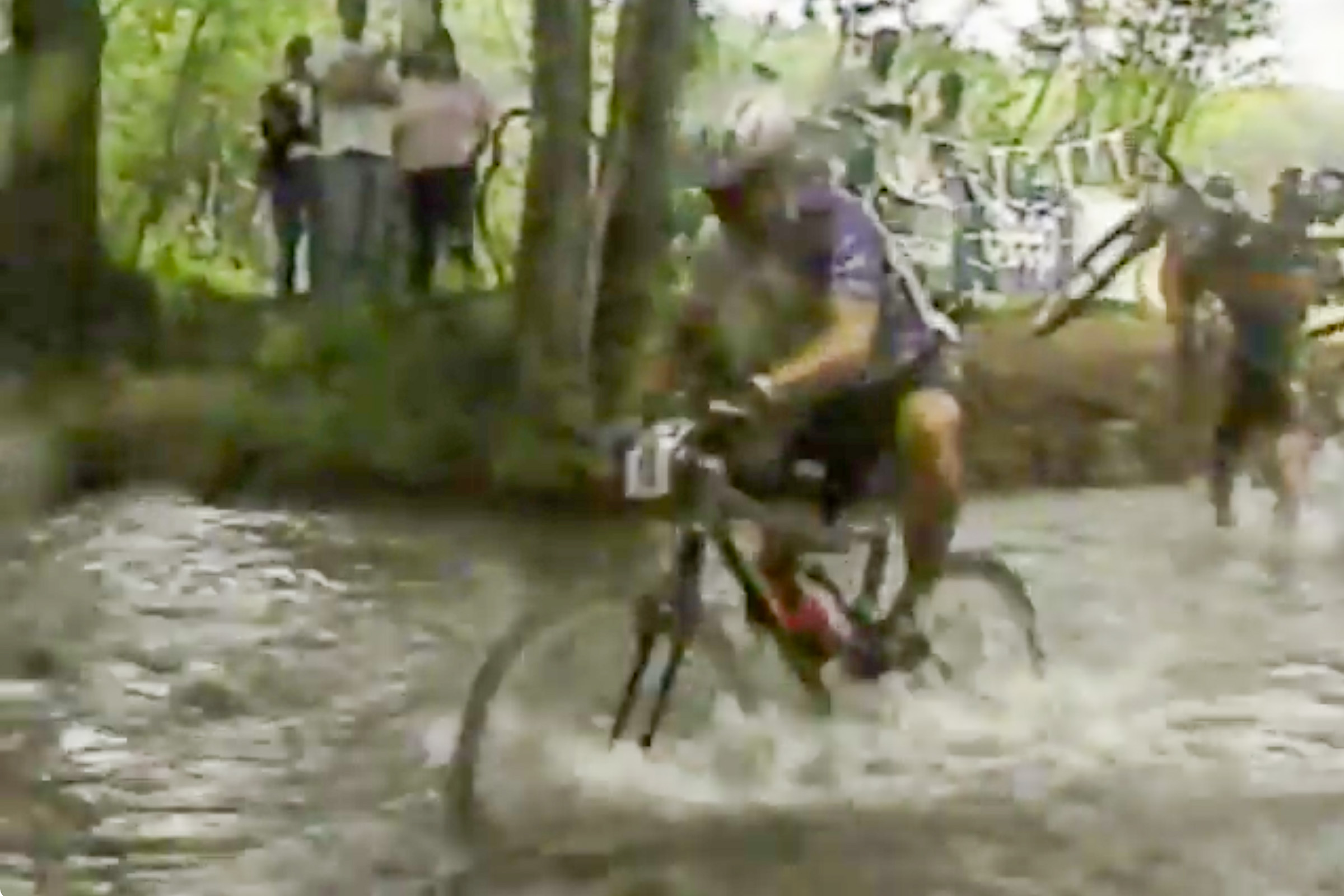
For starters, you’d never see a creek river crossing like this in a professional cross-country bike race for safety and even environmental reasons. Perhaps not surprisingly, most riders chose to run across the raging stream rather than take their chances trying to ride it.
A mountain bike trail guidebook published after the race rated the course a triple black diamond.
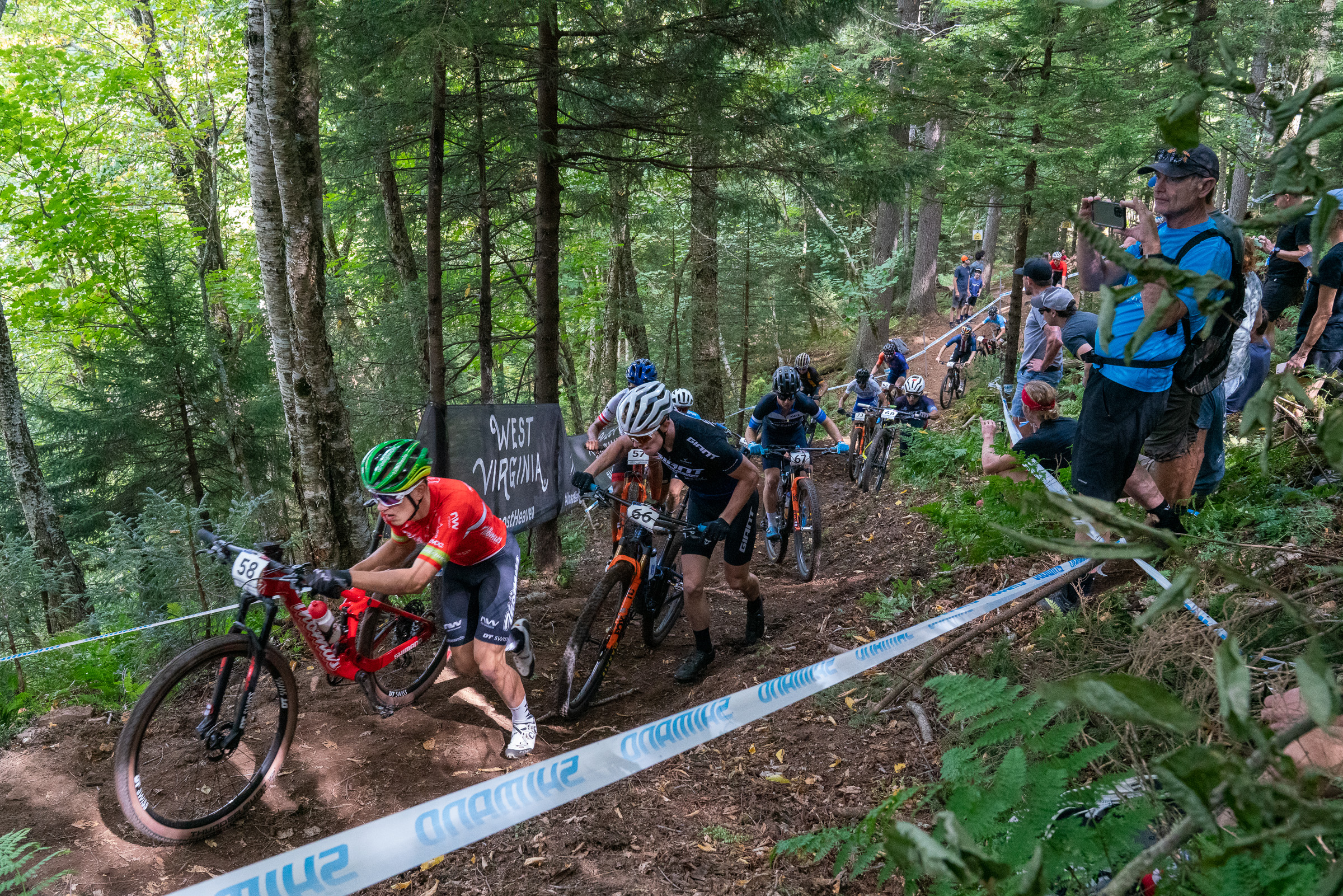
At one point in the video, Penny Davidson says, “this is a downhill approach to a very tight and technical hike-a-bike section.” Hike-a-bike on an XC race course? I’m not sure if the course was designed to force riders off their bikes, but it’s clear the riders found it challenging. That’s not to say riders bike every inch of today’s courses either; check out this pileup at the 2022 Snowshoe World Cup XC race above.
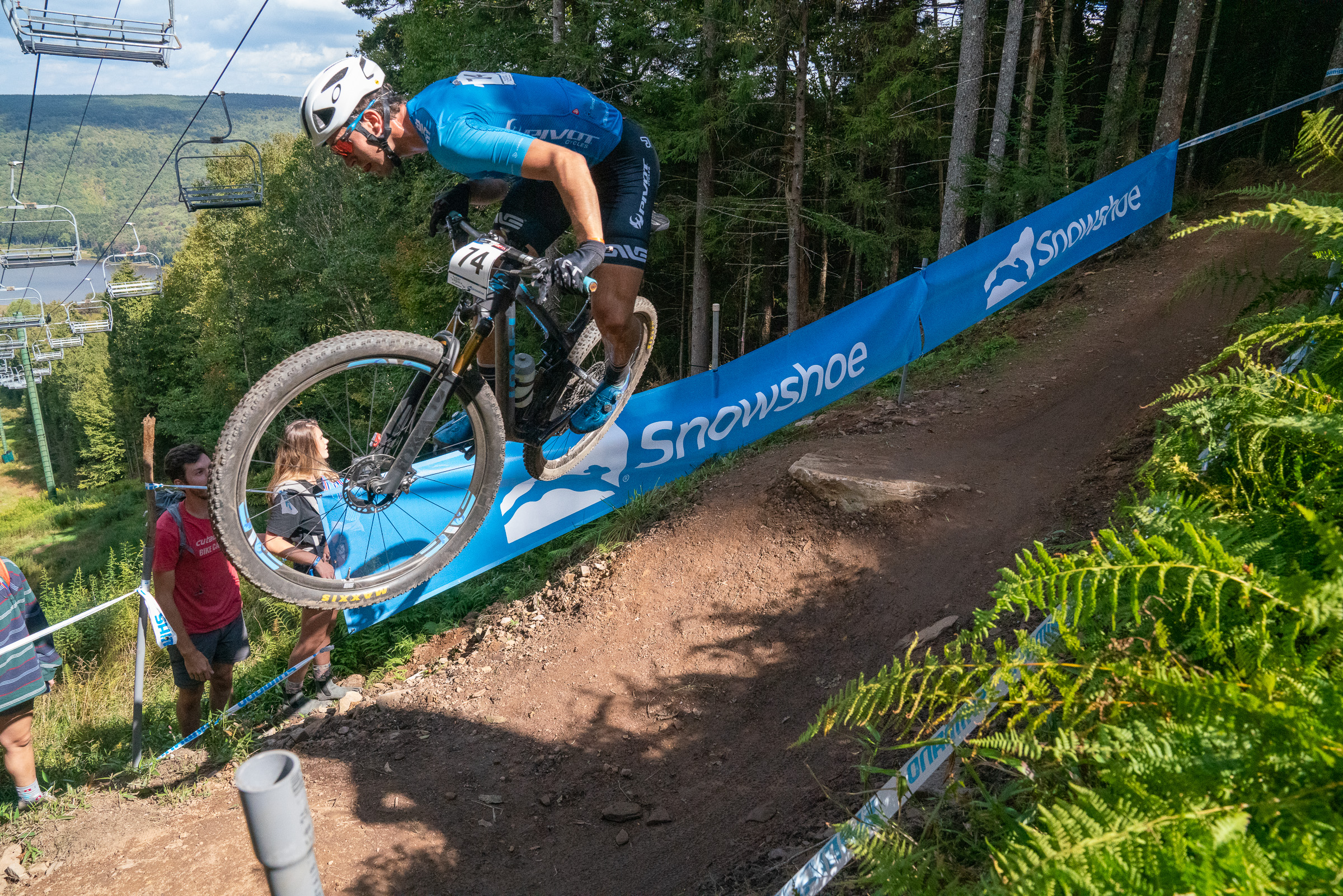
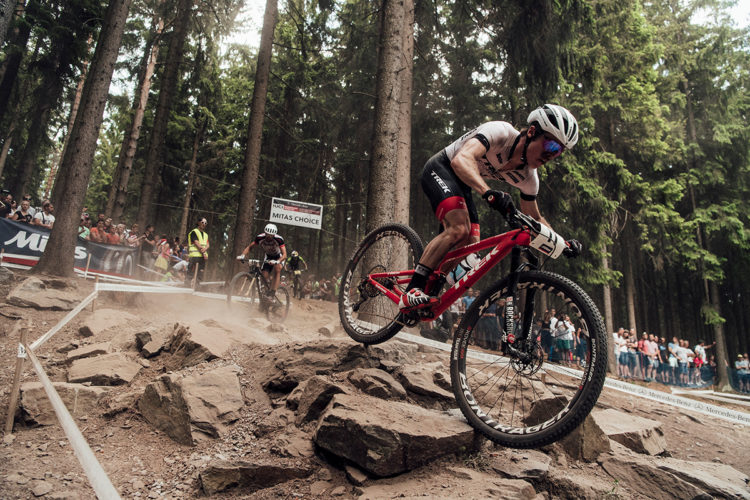
To be fair, modern XC race courses have their own share of challenging features, though perhaps “technical” isn’t the right word for them. Riders today will find jumps, rock gardens, and root drops in short bursts that make for great photos even if they don’t separate the riders like a sustained climb or technical stretch might have in years past.
Overall race times and distances are shorter today as well, which some attribute to the demand for more spectator- and TV-friendly courses. Whereas some NORBA races stretched to more than 30 miles and nearly three hours, today’s professional XC races are generally under an hour and a half and cover less than 20 miles.
How we ride our mountain bikes has changed
Another friend who watched the NORBA video commented that the riders seemed to be pedaling in really high, grindy gears at a slow cadence, especially uphill. Not only that, we see riders jumping off their bikes and charging through steep and technical sections on foot, cyclocross style, which makes me think the gearing wasn’t optimal, at least for this particular course.
In this video, at least, nobody’s wheels leave the ground. It’s all smash and no float. Here again, modern bike features — like high-volume tires and suspension that actually works — allow riders to pedal in a much smoother, more controlled way.
Mountain bikers are as passionate as ever
The one thing that hasn’t changed since 1994 is mountain bikers’ passion for the sport. Just look at those crowds and the intensity of the racers sprinting to the finish!
Is mountain biking easier today? I’m not sure about that, though clearly it’s changed a lot. Work is underway to clean up parts of the old Helen NORBA course, and I’d like to get up there one day soon to see how the trails stack up against today’s trails.
But you can bet I won’t be riding them on a 1990s mountain bike.
Keep up with the latest mountain bike news by adding Singletracks as a preferred source on Google.



13 Comments
Aug 12, 2026
These new manufactured courses you see on the world cup level might to challenging and fun to watch but seem to have lost what mountain bike racing truly was or is.
Aug 12, 2026
Aug 12, 2026
Aug 16, 2026
That’s me last weekend at the Downieville classic. Not carrying my bike in the river crossing
Aug 12, 2026
Aug 16, 2026
Aug 13, 2026
Also, "From the bikes to the course to how pro racers rode their bikes, it’s clear that everything has changed. At the same time, if you look closely enough, you’ll see that one important thing has stayed the same." Everything, or just one thing, OK, whatever.
Yet XC racing is still similar. By the circuit courses at ski areas and parks that can handle the event itself. And going around and around is still the thing. Also there's still the spandex.
John Tomac used to jump his bike back in the day, river crossings were not that common.
Really, give everyone from that time a break, with what the bikes and technology were. Tires were 2.25", similar to the width as what XC racers ride now, yet don't forget, these were 26". The forks were not as good. Full suspension was just getting started, heavy, and not that effective. Bikes are way better now.
Also only some wore turtlenecks and aviators. That said, mustaches are now a thing again for those who think that's cool.
Aug 12, 2026
Aug 12, 2026
As far as the work being done, I'm told there's been an effort to clear deadfall on the trail, and that more regular maintenance is planned in the future.
Aug 12, 2026
Aug 12, 2026
Aug 12, 2026
Aug 12, 2026