

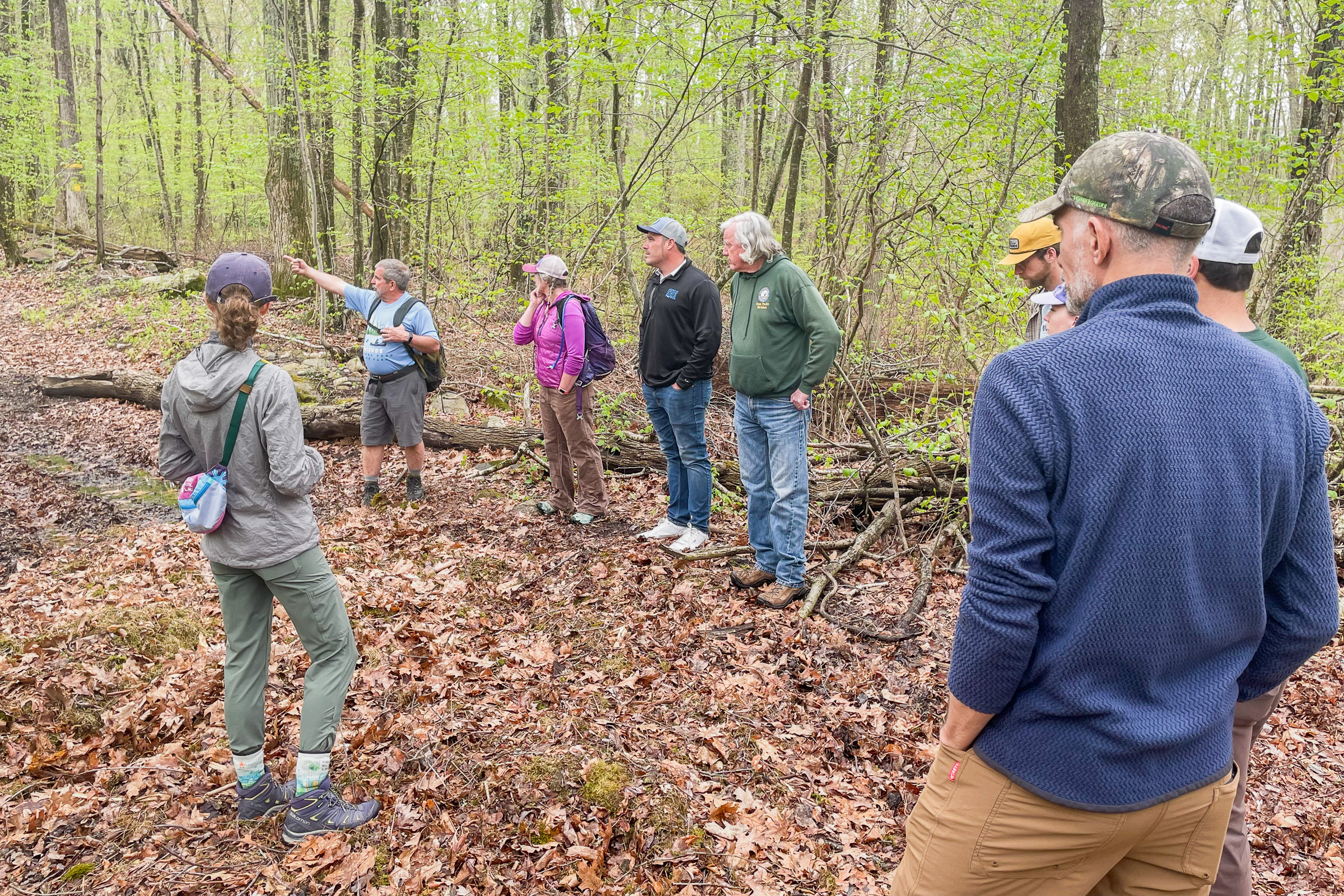
A 2020 land acquisition led by the Trust for Public Land (TPL) in Connecticut tripled the size of Mono Pond State Park. Moving forward, some six years later, TPL and the many partners involved in the project have developed a Master Plan for the park — namely, a 13-mile trail system. And, the new trails at Mono Pond will hold an interesting distinction for Connecticut. Upon completion, these will be the first purpose-built mountain biking trails on state land.
The first mountain biking trails?
Surely the state of Connecticut has mountain biking trails, right? Yes, they do, many of which we’ve covered. A couple of years ago, we spoke with Mick Ferraro, Director of Communications and Outreach for the New England Mountain Bike Association (NEMBA), about Satan’s Ridge. Clearly, the trail was built by mountain bikers for mountain biking.
But, despite its proximity to the Nepaug State Forest, Satan’s Ridge is on private land that borders the state forest. While accessing the trail requires passing through Nepaug, Satan’s Ridge isn’t actually located there.
In fact, no mountain-bike-specific trails are located on any Connecticut state land.
“[Mono Pond] will be Connecticut’s first master plan for a state property designed with trails specific to mountain biking,” Ferraro told Singletracks. “While Connecticut has plenty of incredible trail systems available for mountain biking, Mono Pond will be the first state property with mountain bike-optimized trails designed from inception.”
The Mono Pond State Park Master Plan calls for 13 miles of new trails in total. Cally Guasti, the Connecticut Program Manager for TPL, broke them down for us. Of the 13 miles of trails, 8.5 miles will be shared-use, and one mile will be foot-traffic-only.
That leaves “4.4 miles of bike-optimized trails.”
“The plan proposes an interconnected trail network organized into three experience zones — hiking-focused, shared-use, and mountain bike-focused,” Guasti said. “This allows visitors to choose different loops and experiences depending on their interests.”
While the “three experience zones” are somewhat interconnected, the deliberate separation will help reduce potential trail conflict. Those on the multi-use trails can expect to encounter other user groups. At the same time, those wanting a more tailored experience for their chosen activity can access the user-specific trails, be it mountain biking or hiking/trail running.
Guasti also mentioned that the trails are still under development, so discussing trail specifics at this time is somewhat difficult. But she did say that they plan for the mountain bike-specific trails to focus on progression, with “beginner, intermediate, and advanced bike-optimized trails.”
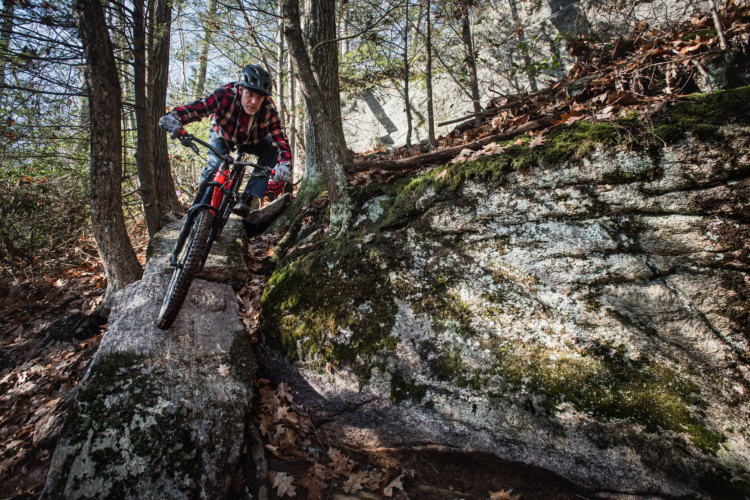
They will also incorporate as much of the natural terrain as they can at Mono Pond State Park. “Connecticut is known for its rocky, technical riding, and Mono Pond will incorporate many of these natural features that we love here in New England,” Ferraro added.
Mono Pond State Park
Mono Pond is located roughly 25 miles east of Hartford, close to the smaller towns of Columbia and Lebanon. Thanks to a land acquisition, the park grew to 650 acres, with plenty of room for a trail system.
“TPL partnered with the State of Connecticut and the towns of Columbia and Lebanon to permanently protect more than 400 acres of forest that were at risk of development,” Guasti explained. “That expansion created the opportunity to build a connected trail network.”
After the land was secured, TPL worked with IMBA Trail Solutions to develop the Mono Pond State Park Master Plan. The goal of the plan was to create a sustainable and connected trail system that accommodates a variety of users. Other instrumental partners were also brought in to push the project forward, including NEMBA, Friends of Mono Pond, and others.
As the project moves forward, funding becomes the next top priority. Guasti told us that TPL has submitted an application for a Connecticut Recreational Trails Grant. If awarded, TPL plans to match the funds, which should be enough to build the first four miles of trails.
“The initial phase would focus primarily on the mountain bike-focused portion of the network, which connects to the Airline State Trail,” she said. The Airline Trail is a designated greenway stretching over 50 miles, connecting to other areas with trail access for multiple user groups.
TPL, NEMBA, and the other parties involved have their fingers crossed for the Recreational Trails Grant to be awarded. If it is, work on phase one will start when the ground thaws in 2027, and the first phase will open roughly this time next year.
The news stinks. Why not follow Singletracks on Google News to bring more joy to your day?



1 Comments
Aug 12, 2026
The title should be "CT, 100 Years Late to MTBing, Starts as Small As Possible". This is like neglecting your children for years, then patting yourself on the back for cracking a window. Shame to everyone involved for not calling this what it is. Too little too late!!! Idk if youv'e been around.... but we already built trails on OUR land!!!!