
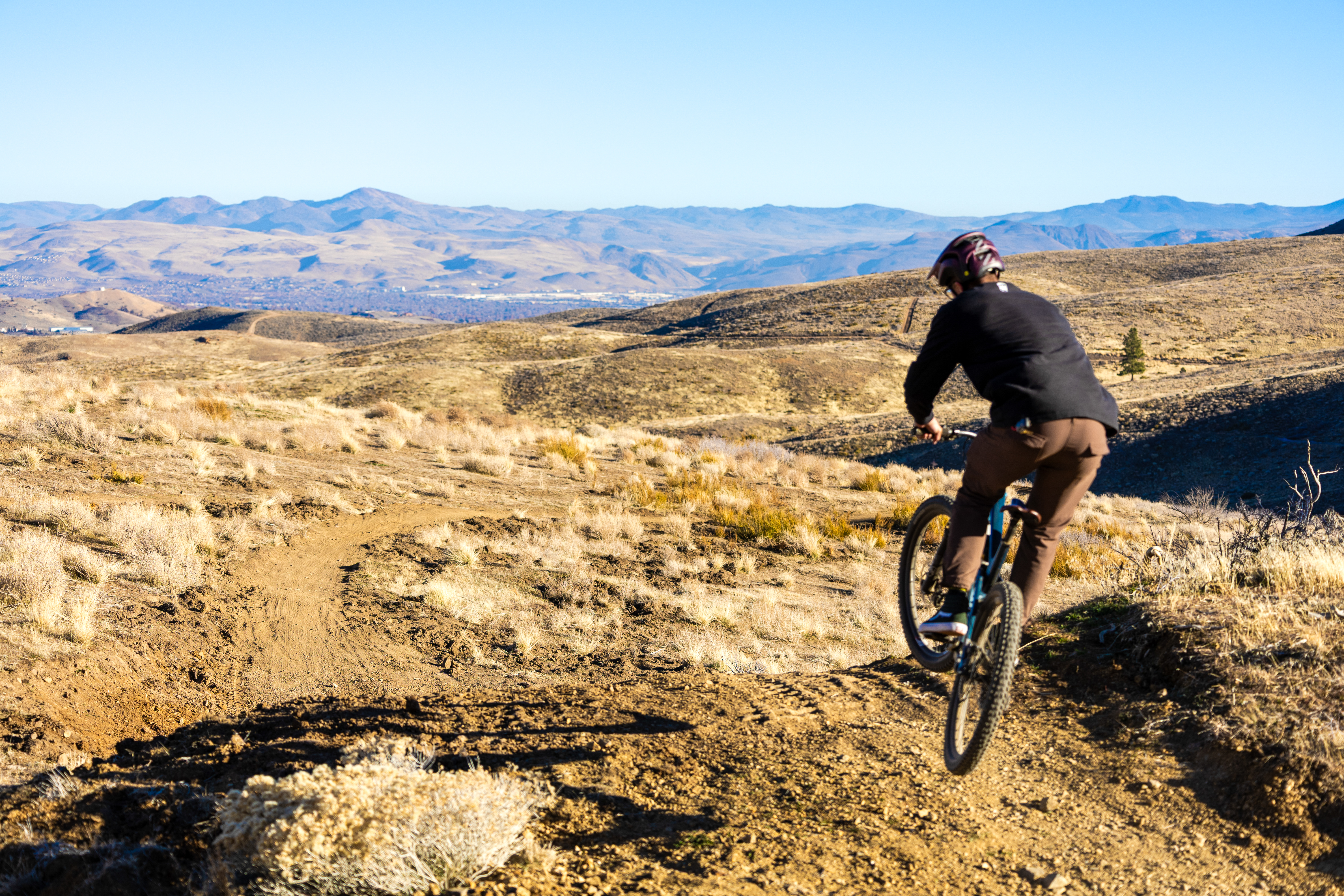
Plenty of cities boast trails close to home, but how many of those backyard trail systems sprawl for 70 miles of singletrack? With a 12.9-mile trail addition that’s currently in progress, Reno, Nevada’s interconnected Peavine Mountain and Sierra Vista trail system will soon boast 70 miles of superb singletrack, thanks in part to funding from a local rider whose father was a gambling industry pioneer. And all of it will be rideable from many residents’ back doors.
When the Biggest Little Trail Stewardship (BLTS) (formerly the “Poedunks”) began working on Peavine Mountain, the network already had some 48 miles of singletrack. Many of these were historic routes and user-created trails. Over the years of careful work, this mess of singletrack has transformed into a cohesive and well-managed trail system that’s now renowned as one of the best mountain bike trails in Nevada.
The Sierra Vista bike park is a recent addition and is rideable in conjunction with Peavine via a short connector. Sierra Vista boasts plenty of bike-specific features, like jump lines and about five miles of trail.
Not willing to rest on their laurels, BLTS is currently building a new 12.9-mile addition that will increase connectivity to the northeast side of the Peavine network and has already added one of the area’s best flow trails.
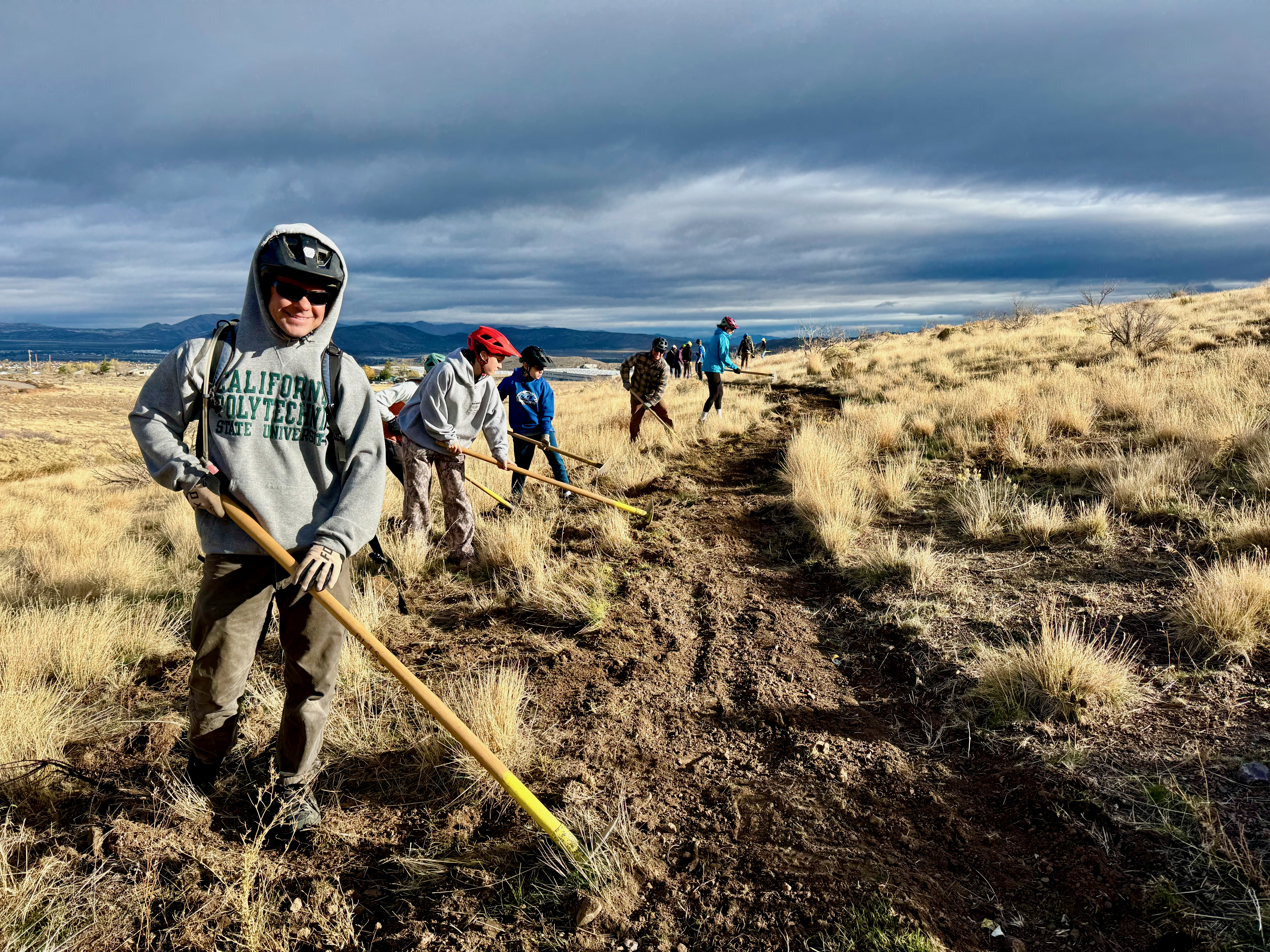
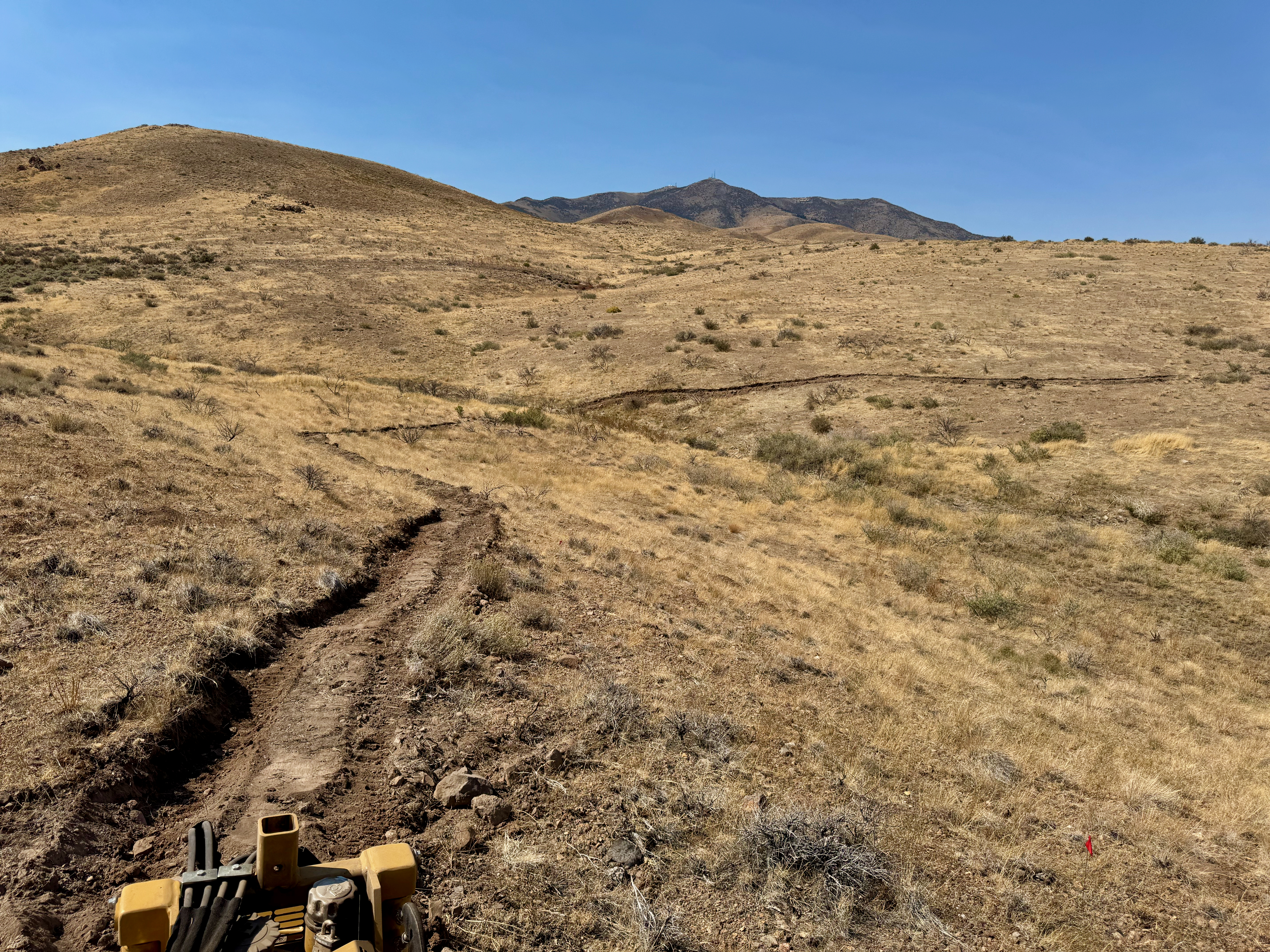
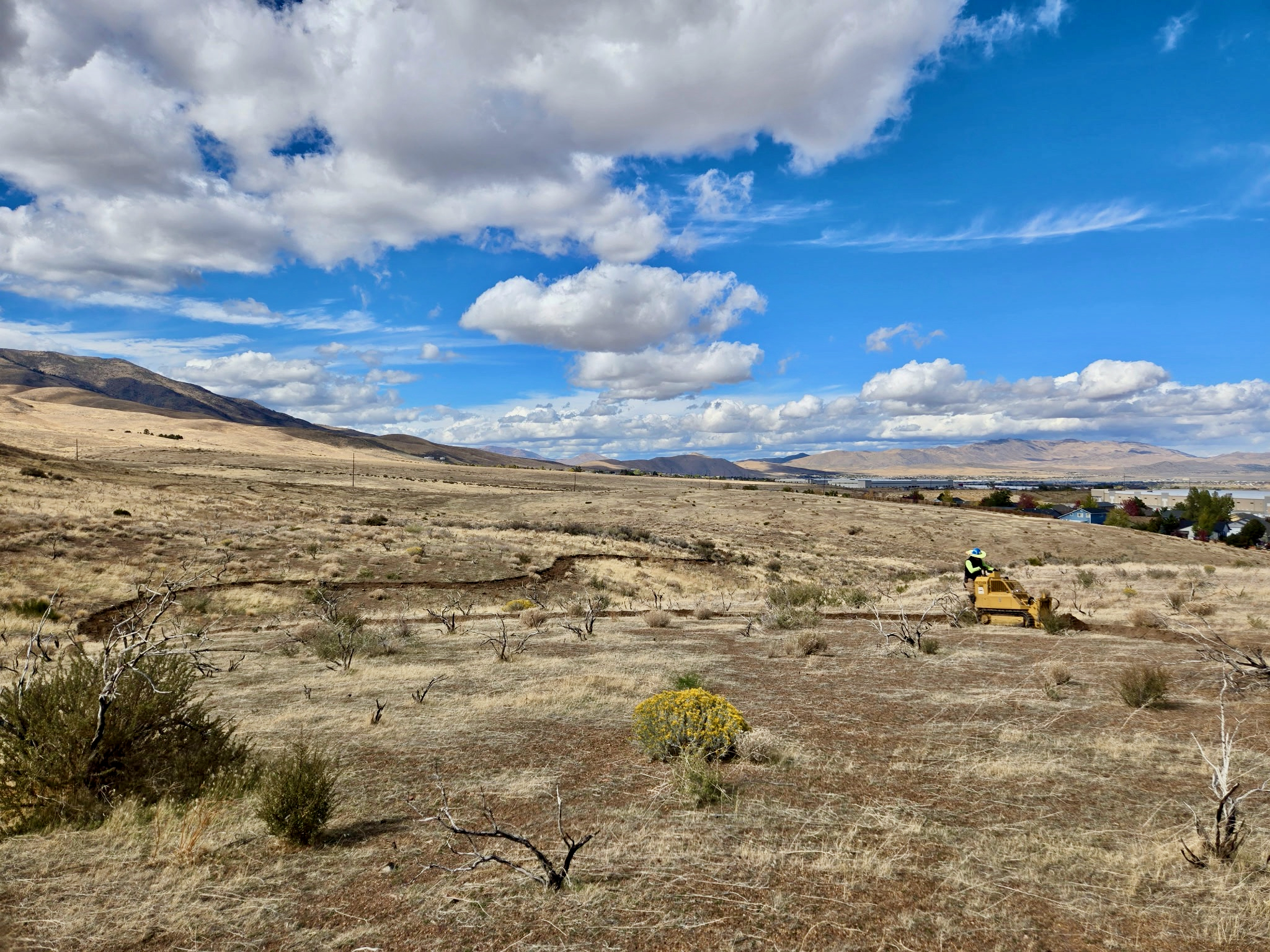
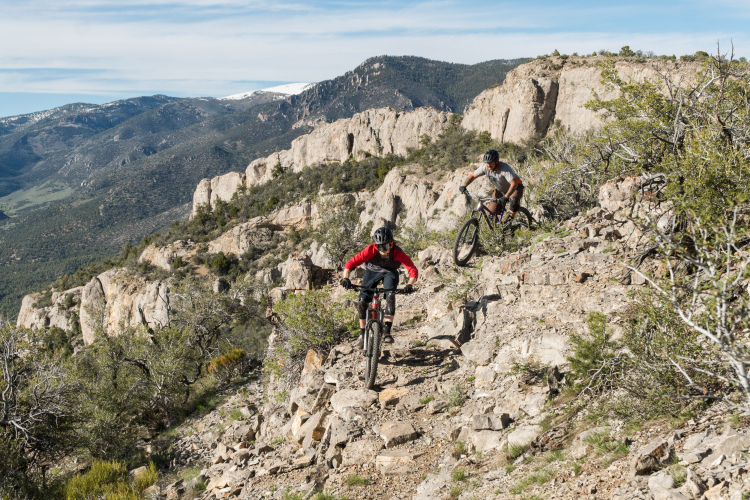
Black Springs Trail. Photos: Curtis Johnson
Increased connectivity is the primary goal
“The northeast area didn’t have any connectivity into the trail network,” said Curtis Johnson, President for BLTS. Even though they had Forest Service trailheads, those trailheads served roads, including a gated historic canyon road, but there was no connection to the non-motorized Peavine trail system. “We’ve been looking at that for years and years, and wanting to kind of connect that.”
The two neighborhoods are Raleigh Heights and Black Springs, and about seven miles of the proposed 12.9 will serve as connections to these areas of Reno. Johnson mentioned that the history of the Black Springs neighborhood is particularly interesting. “In the city of Reno, if you were an African American person, you couldn’t actually buy property by city statute. That changed in like the 1960s, but in the 40s, this area was in the county, and there was a gentleman that was selling properties to African Americans,” Johnson explained. “So [Black Springs] actually became an African American community, which it still is. They had their volunteer fire department, and they contracted for the water and power and all that. So they’re pretty proud of the community that they developed there, and just knowing the history, most people don’t realize it.”
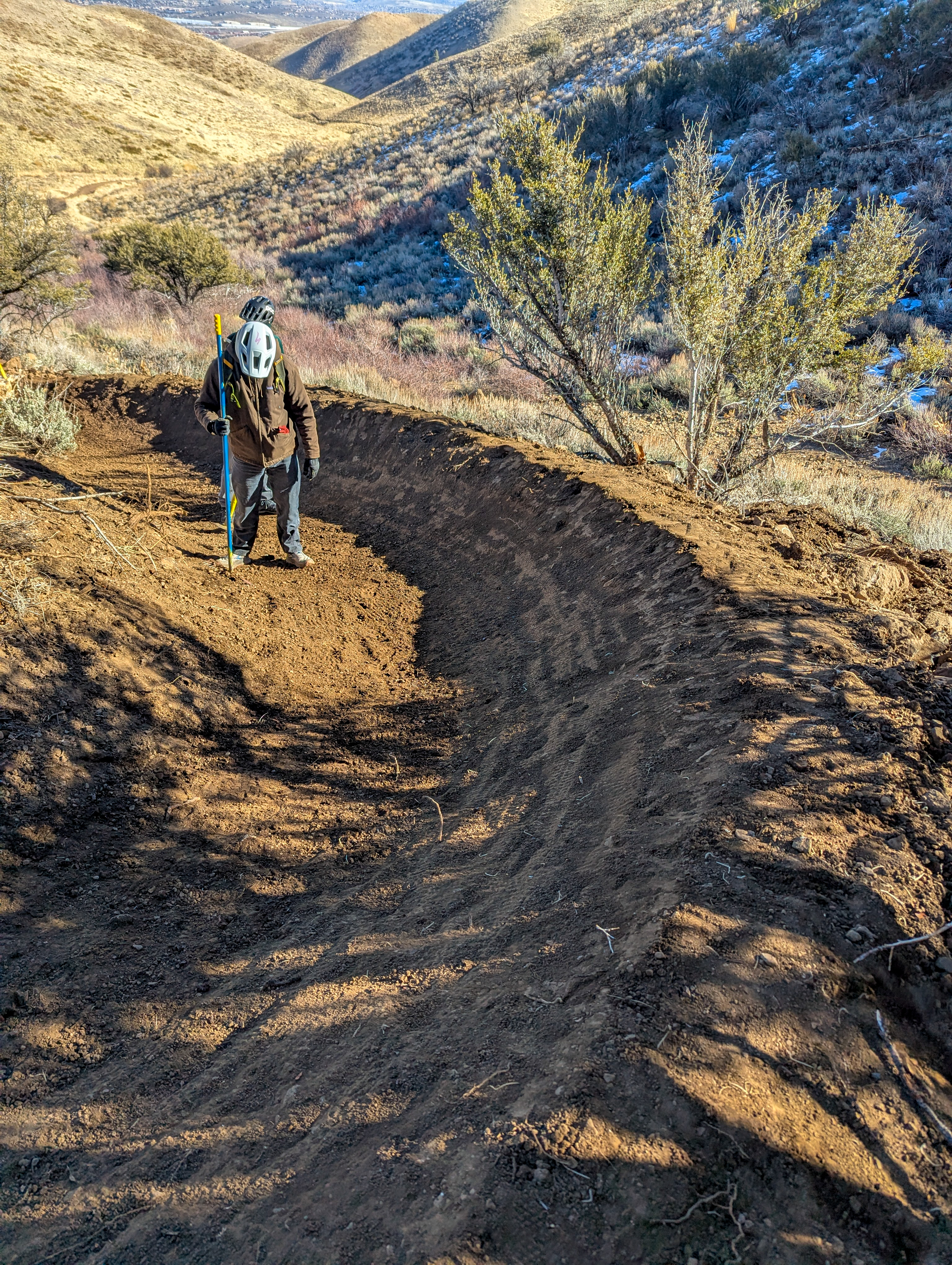
One of the trails that’s currently under construction also bears the name “Black Springs” and will connect directly to that community. This 2.5-mile beginner trail will be fairly flat, connecting the Horizon Hills trailhead and Raleigh Heights Park. BLTS expects the trail will serve the local NICA team well, thanks to restroom facilities and good parking.
The majority of the trail has been rough cut, but BLTS still has about 0.2 miles of rough cut left to complete, followed by the final finish work. While recent snow in the area has slowed down the trail work, BLTS still anticipates an opening in spring 2026.
The best flow trails on Peavine Mountain
Two of the most noteworthy trails that have already been completed in the NE Peavine project include Golden Fleece and Hopper.
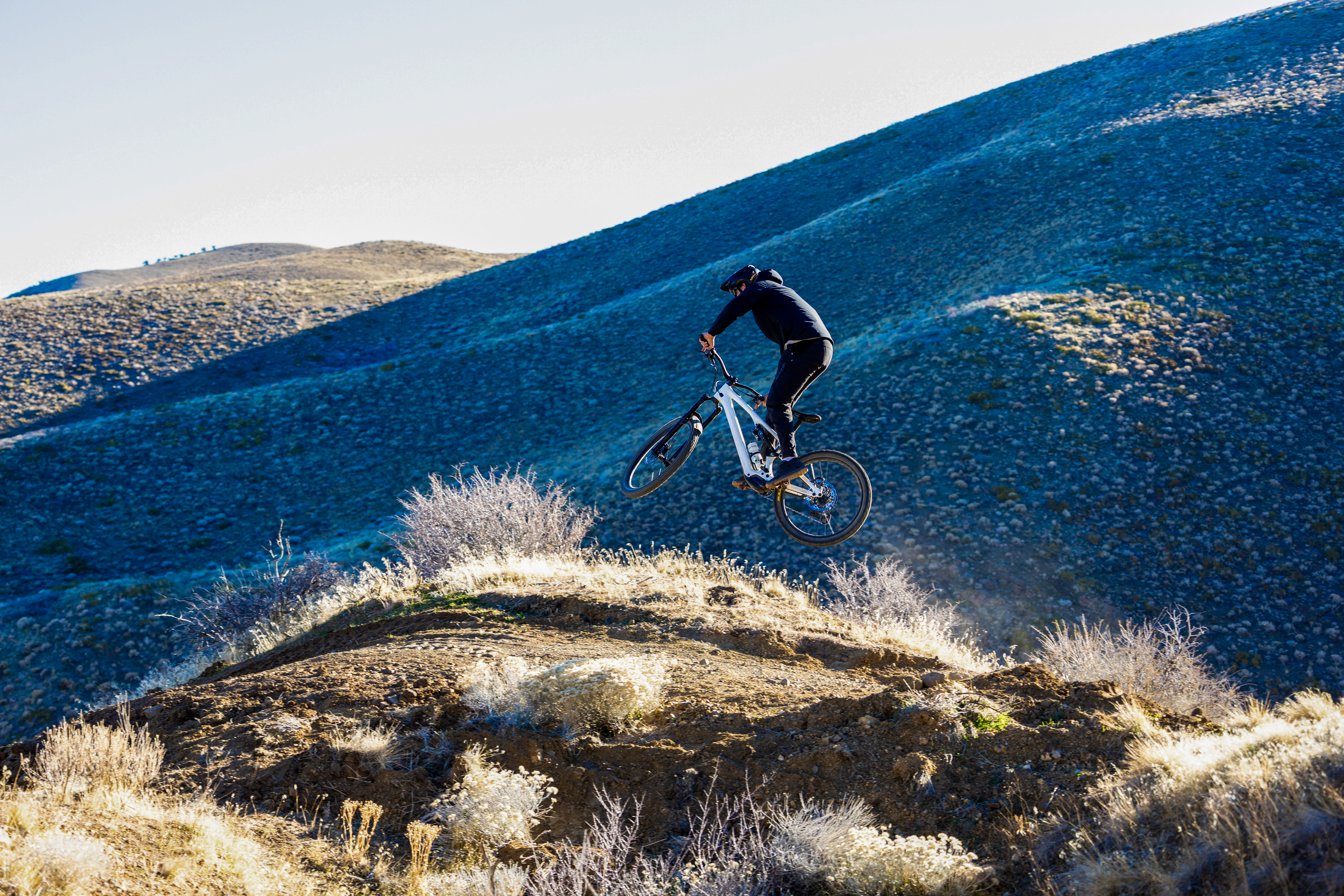
Golden Fleece: a three-mile flow trail
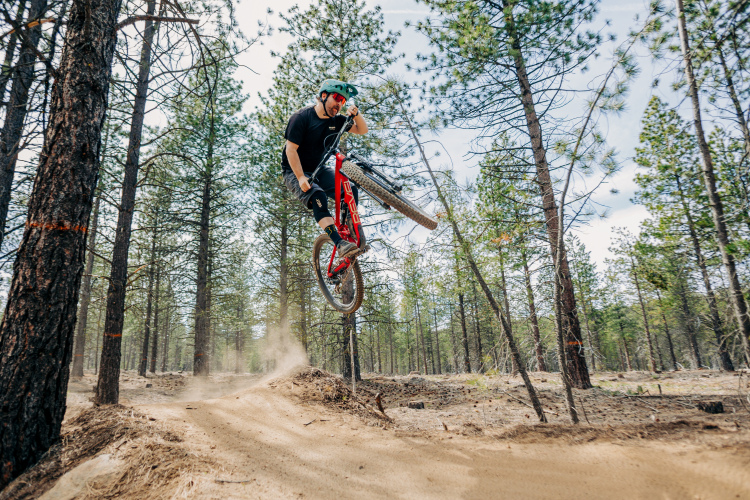
Golden Fleece is a “three-mile world-class flow trail,” according to Johnson. This lengthy descent boasts numerous berms and tabletop jumps, and some sections where riders ripping at high speeds can double things up.
While Golden Fleece rides best in the downhill direction, it’s still technically designated as a two-way trail. During the build process, some of the grades on the upper trail “were a little bit steep, so we had to reshape [it] a little bit,” said Johnson. “Didn’t change the flavor at all — it’s pretty fun.”
The upper section boasts the biggest features, with some jumps stretching 15 feet or more. In the lower section, Golden Fleece “drops into a canyon where it starts going faster,” said Johnson. “And then we narrowed the trail down, so you get more feel of speed, even though you’re not necessarily going as fast.” The bottom part drops into a steep section, and then it swoops through a series of old mine tailing piles.
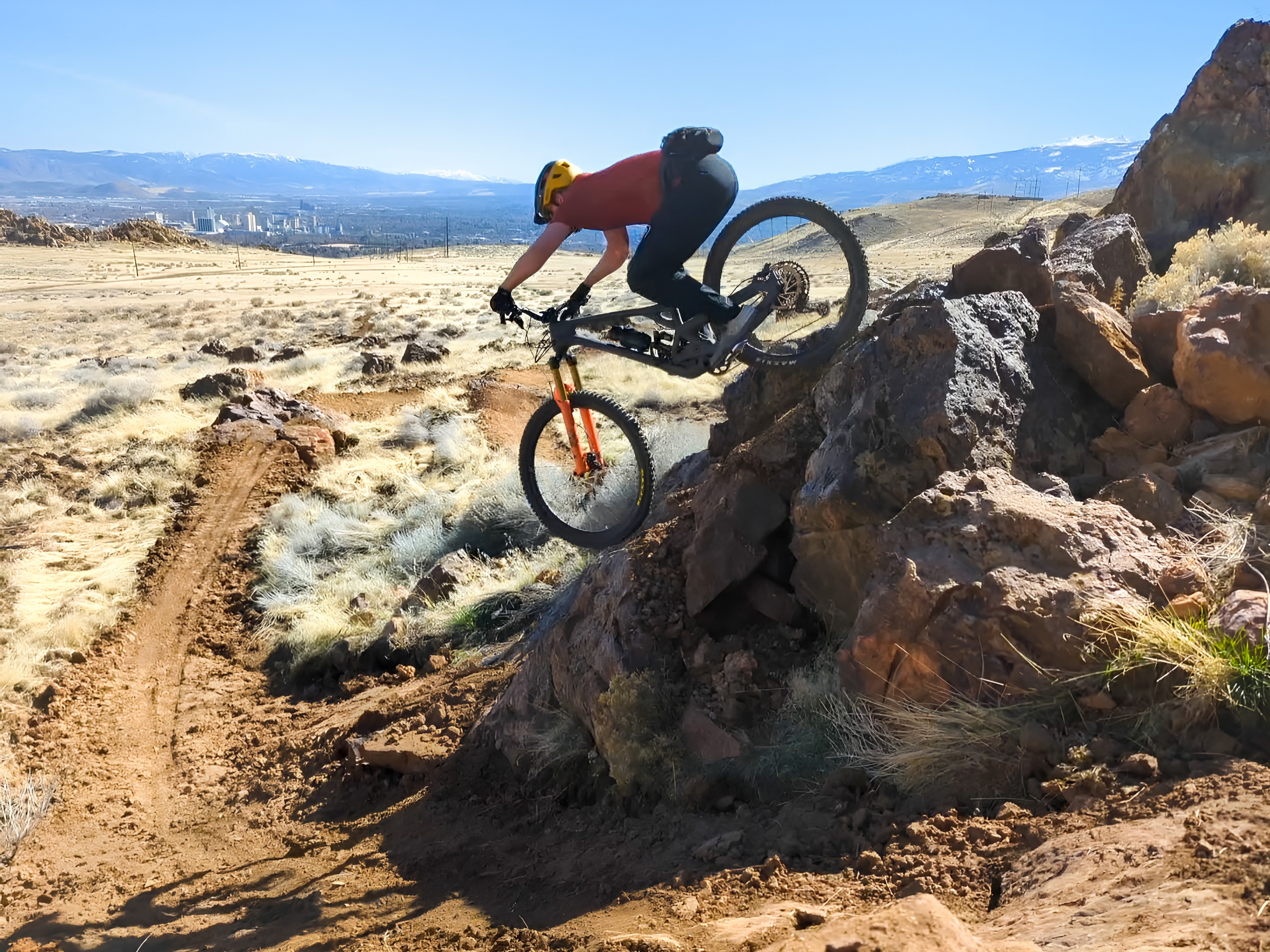
Hopper Trail: legitimizing a social jump line
The Hopper Trail began life as a series of user-created jumps, but now, it’s a legit Forest Service trail.
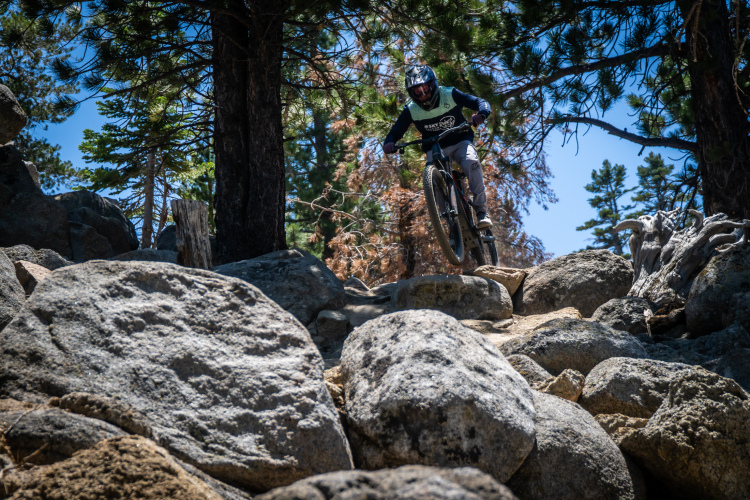
“Obviously, they’re needed because people were building them and doing them, but they were pretty dangerous — poorly built,” said Johnson. “So we actually got the approval through this process to make that into a […] professionally built jump line, and increased it. There’s a large rock drop of about 15 feet, and we made it like three or four different versions on that.” Where a bunch of “lousy” berms had originally been built, BLTS constructed a 0.15-mile rock garden filled with a number of entertaining features.
While Hopper might be short, this double-black-diamond trail is now a popular local test piece.
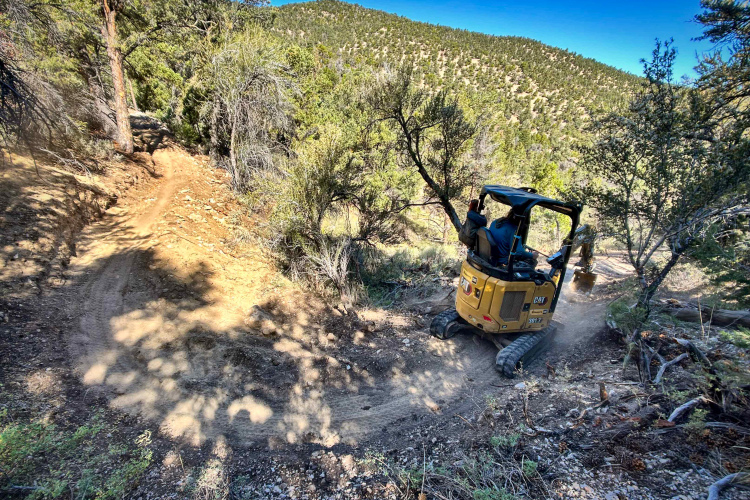
While BLTS owns a few machines for high-end work like Golden Fleece and Hopper, they’ve contracted with Steve Wentz from Momentum Trail Concepts. Wentz is based in Reno, and loves to contribute to his local trail system.
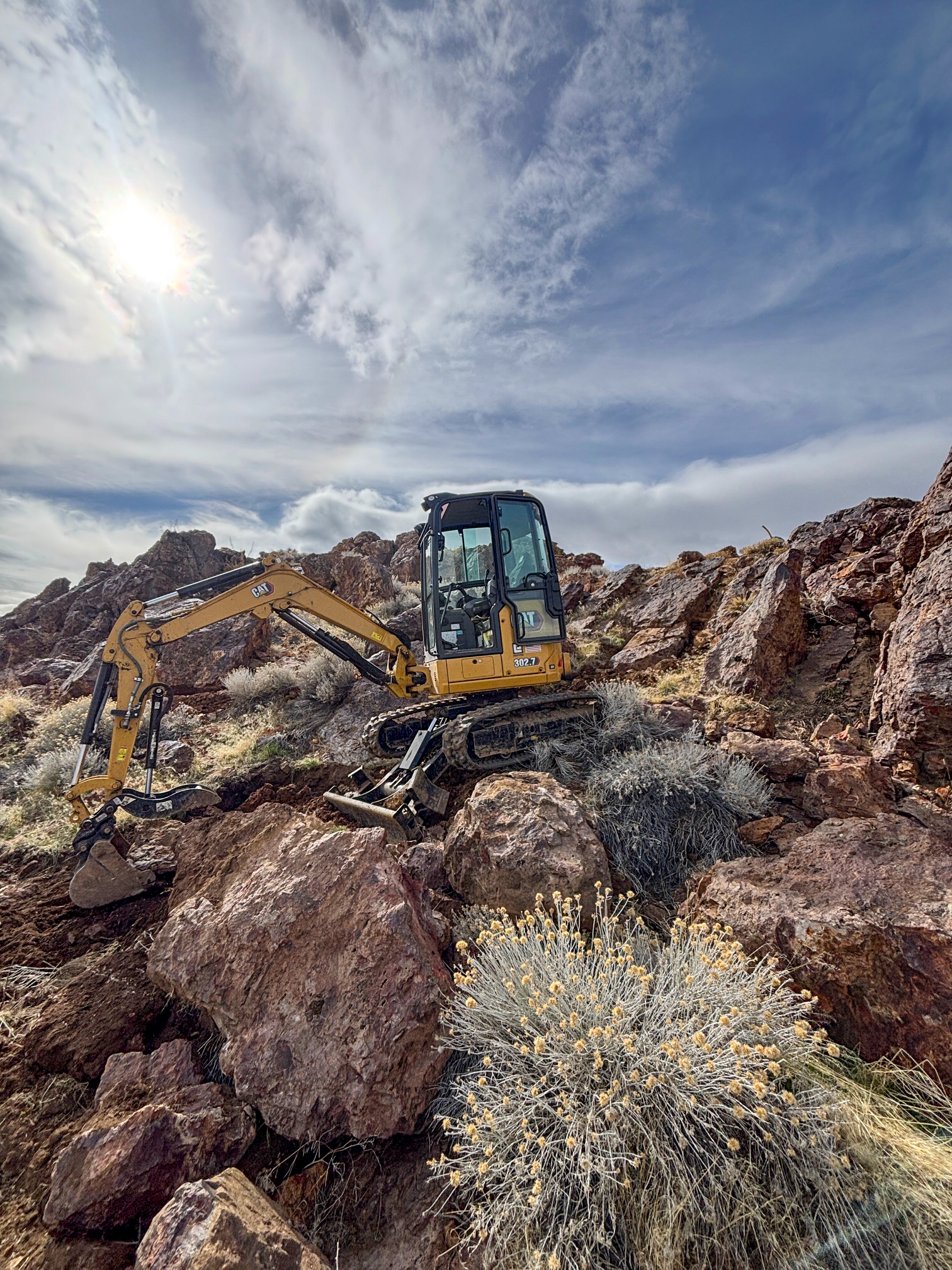
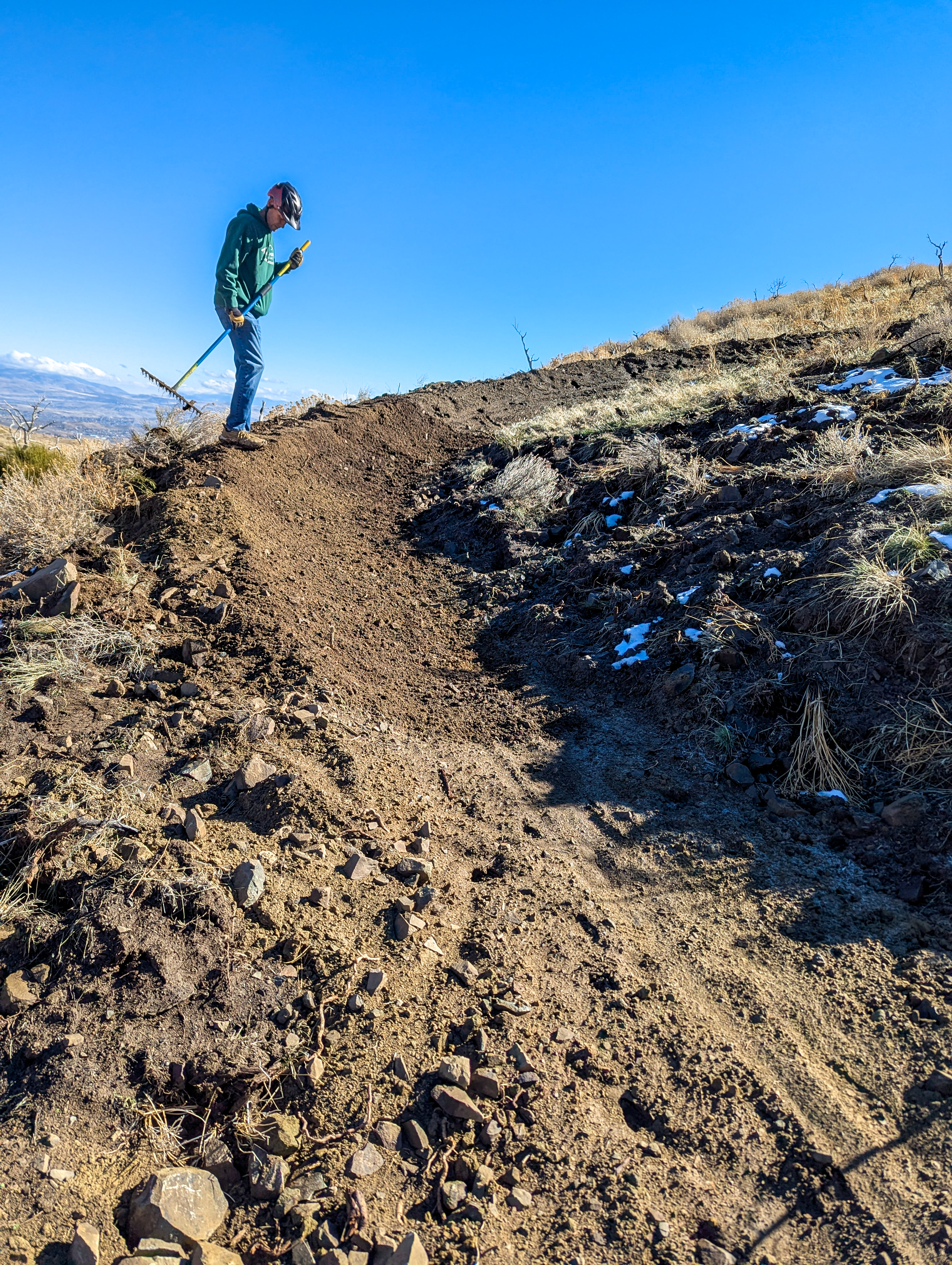
Photos courtesy BLTS
Hundreds of thousands of dollars in funding from a late rider’s trust
BLTS had applied for an RTP grant to fund the first phase of the NE Peavine trail development, but didn’t get it. Then “out of nowhere, we got a call from Charles Schwab, and they might have some monies available for us,” said Johnson. “He says, ‘Well, at least $100,000,’ which to us is gigantic. Once they kind of put together what we really needed for part of this project, and a couple other projects that we had going, we actually got $200,000 from them.”
The funding came from the Greg Nelson estate. Gregory Warren Nelson was a local rider who died tragically on a winter hike in Taos, NM, in 2023. In addition to being a lawyer, Nelson had received a substantial inheritance from his father, Warren Nelson.
Warren was a pioneer in the gambling industry and became an owner-operator of the Club Cal Neva. He was inducted into the Gaming Hall of Fame in 1989 and was a renowned philanthropist.
Greg had determined that his entire estate would go to charity, primarily funding local mountain bike trail development. In addition to donating to BLTS, Greg’s estate has also donated to the Sierra Buttes Trail Stewardship, Sky Tavern Bike Park, the Sierra Front Trail, the Tahoe-Pyramid Trail, and more.
BLTS has applied for another RTP grant to fund the rest of the build, but the executor of the Nelson estate has already told them, “what you don’t get from RTP, she’ll make up. So we should be fully funded.”
With funding essentially secured, Johnson anticipates completing the rest of the 12.9-mile expansion sometime in 2027.
Updated on March 9, 2026, at 2pm Mountain Time to accurately reflect the approval of one-way trails on the Carson District of the Humboldt-Toiyabe National Forest.
Know about a new trail project we should cover? Whether you’re breaking ground on the next must-ride trail network or putting the finishing touches on a neighborhood flow trail, we want to hear about it. Drop us a line at [email protected] with the details, and your project could be featured!
Keep up with the latest mountain bike news by adding Singletracks as a preferred source on Google.



0 Comments