

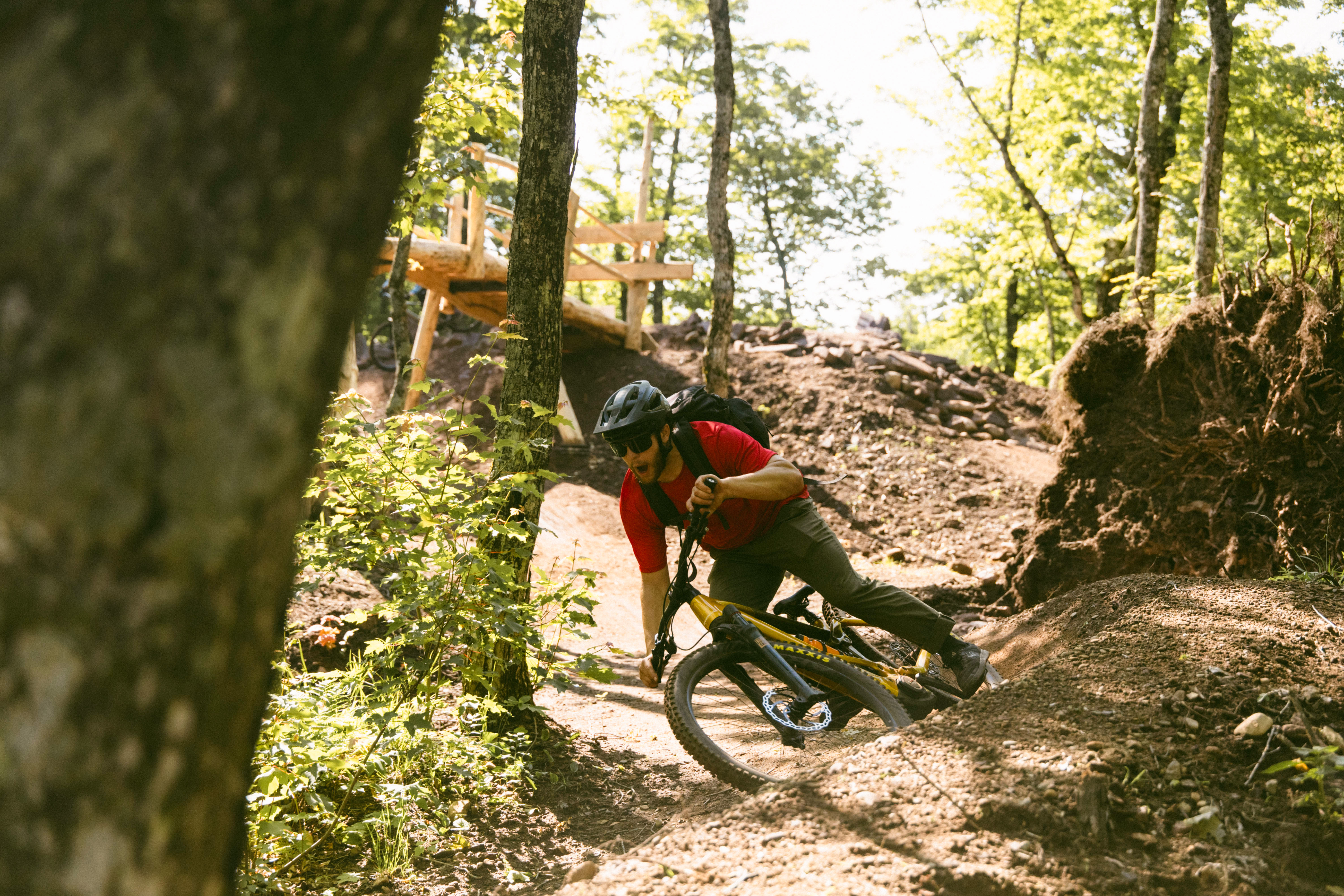
Today we’re talking with Nick Ryan, the Trails Coordinator for the Copper Harbor Trail Club in Michigan’s Upper Peninsula. Copper Harbor has been on mountain bikers’ radars for years, both for its remote location and its incredible trail quality. With some exciting new projects underway and a lot of lessons learned over the years, we get up to speed on Copper Harbor with Nick.
Support this Podcast
- Review the Singletracks podcast on Apple Podcasts or drop your feedback in the comments below!
- Make a donation to help sustain future episodes.
- Become a Singletracks Pro Supporter.
Never Miss an Episode
- Listen on Spotify
- Listen on Apple Podcasts
- Listen on Google Podcasts
- Listen on Stitcher
- Listen on Overcast
- Get the RSS Feed
- View all Podcast Episodes
Automated transcript
Jeff Barber 0:00
Hey everybody, welcome to the Singletracks podcast. My name is Jeff, and today we’re talking with Nick Ryan, the trails coordinator for the Copper Harbor Trail Club in Michigan’s Upper Peninsula. Copper harbor has been on mountain bikers radars for years, both for its remote location and its incredible trail quality, with some exciting new projects underway, and a lot of lessons learned over the years. I’m excited to dig into the story with Nick. Thanks for joining me today.
Nick Ryan 0:28
Thanks for having me on Jeff. I appreciate it.
Jeff Barber 0:31
So to kick things off, can you tell us a little bit about what the copper harbor trail club is all about, and what your role looks like as a trail coordinator?
Nick Ryan 0:42
Absolutely so as a trails club, it’s kind of our role to advocate, develop and maintain all human powered trails and activities, kind of in copper harbor and connecting to copper harbor. My role specifically within that, goes into managing maintenance, completing the maintenance, helping to manage contractors, helping with design processes for new projects. And then I also do quite a bit of help with media, and then investing in kind of our long term vision for what it’s going to look like going forward. Got a lot of cool things in the work, and it’s pretty cool thing to have to be a part of. Man, I’m quite fortunate.
Jeff Barber 1:19
That’s awesome. Well, how long have you been in the role?
Nick Ryan 1:22
This is year two for me.
Jeff Barber 1:25
And were you doing, like, advocacy stuff before, like, what’s sort of your background?
Nick Ryan 1:31
Yeah. So I actually, I went to school for outdoor recreation and digital cinema as a combination, cool combo, yeah, yeah, it was pretty rad. I was in kind of my second semester when the pandemic hit. All those classes went online. I was paying for my education, so took a year off, went out to Utah, worked in the ski and bike industry out there for two years, and then came back and was working in a bike shop here when the opportunity arose. You know, one of the things moving back was I wanted to be more involved with kind of the local community here. We’ve got a ton of resources in the Upper Peninsula, and to get the opportunity to kind of make this place super rad, was like. That was the main drawback. So as soon as a little door opened up at the trails club, I stuck my foot in it and hopped on as soon as I could.
Jeff Barber 2:20
That’s awesome. Well, you mentioned that the trail club is focused on human powered recreation. So, I mean, biking, obviously, is one of those, like, what other activities do you kind of advocate for and build trails for?
Nick Ryan 2:34
Yeah, absolutely. Hiking is a big one. You know, we’re initially a summer trails organization, and we’ve done a lot of winter powered stuff over the years as well. Last year we kind of really kicked it off, you know, we bought a side by side, a whole grooming set up to do cross country ski trails. And then, you know, those are open to fat bikes as well, and snowshoeing in the whole nine. And then, you know, as we continue to expand winter operations, we’ll do more fat biking, more cross country skiing, backcountry skiing, that’s something that we’ve got a plethora of terrain for, that we haven’t really got a chance to tap into formally yet. You know, I think it’s a Best Kept Secret sort of thing for now, but as we kind of expand in the future with the winter stuff, that’s going to be a big part of it.
Jeff Barber 3:15
Yeah, awesome. Well, I guess one question people will have is about E bikes. Does that fall under human powered what’s kind of the E bike status on the trails there?
Nick Ryan 3:26
It does. Yeah, we allow class 1e bikes across the system. So you know, as long as you’re not rocking a throttle and pedal assist up 20 miles per hour, we are happy to have you aboard.
Jeff Barber 3:33
So, you know, Copper Harbor has this reputation for being like a big and really popular trail system, but obviously in a location where there aren’t a lot of people living there full time. So how do you approach trail maintenance and planning and budgeting and all that stuff when you have a lot of visitors, but only a small group of people to like, maintain and get back to the trails?
Nick Ryan 3:59
Yeah. I mean, it’s a massive undertaking. We are going into next season with 65 miles of trail, some of it being in town, some of it being out of the east bluff, which is about 15 minutes outside of town to, you know, backcountry epics that could be anywhere from 40 minute drive all the way outside of town. So it’s tough, yeah, yeah. And right now we have me and our Assistant Executive Director, Harrison, who’s in the woods with me about one and a half to two days a week, and that’s, that’s the maintenance team. So, you know, we are fortunate. We get some help from rock solid a little bit in the spring, when we don’t have them doing construction projects. But other than that, like it’s us doing a bulk of the work and and trying to make everything stay fresh. And with putting out new trail every year, it can be really difficult to keep the old stuff looking good and, and, you know, I think right now, specifically, we’re trying to kind of catch up to that process. You know, we’ve been. Building, building, building, for so long, and now it’s okay. Well, we have to make sure we’re protecting the assets we have, and how are we doing that in the most efficient way possible? Because the reality is, there’s only so much time in the day, and we got to maximize every minute of it with two people for 65 miles.
Jeff Barber 5:18
Yeah, yeah. Well, we were talking just before the recording, and you’re mentioning that that you don’t live in copper harbor. I mean, it’s hard to find a place to even live there. So, yeah. I mean, like, what is the the kind of year round population there? Seems like it’s tiny.
Nick Ryan 5:35
Yeah, it’s right around 100 people. I’m really fortunate. I’ve actually been crashing at my boss’s house that it’s getting constructed this summer, so right on the water this year, and
Jeff Barber 5:48
It’s getting constructed, it’s not even a complete house? Are you just like sleeping on the floor there?
Nick Ryan 5:53
No, no, I’m actually I’m in a rooftop tent. I’m in the driveway, not even in the house. No, not even in the house. No, it works out well, it’s finally getting close. It’s been a big process for them, but now it’s coming together. So they’re actually living there part time now, while his daughter started in the one room school house. And, yeah, it’s, it’s a pretty unique place, just in terms of the social outlook. You know, there’s not a ton of bars to go out to, but, man, if you’re into outdoor recreation, like we have some of the best access in the country to almost any activity you could want.
Jeff Barber 6:25
That’s awesome. Well, you mentioned kind of the different zones of trails and riding in the area, and one of them the East bluff development, I think you said it’s about 15 minutes out of town, and it’s separate from kind of the main copper harbor trails. How did that development come about, and how does it sort of fit into the bigger picture of the Copper Harbor Trail Network?
Nick Ryan 6:49
Absolutely, as a lot of people know, you know, we’ve got a really tight knit relationship with rock solid trail contracting. You know, Aaron was formerly the president of the club, helped establish the club, and so when the East bluff came up for sale, I know him and a couple of other locals that are pretty invested in the Q and R were pretty apt to buy it. It’s got some incredible terrain and some really varying terrain, from kind of like steep cliff stuff to good loamers to kind of some cedar swamps. Like we have a lot of different stuff that we can access there that we didn’t necessarily have access to on Broadway side. So it was really like, Okay, can we expand our user experience to different people, to more people, and to give something different flavors? You know? I think a part of it was the long term vision as using as a showroom as well. You know, rock solid. Can invest in this place locally, and then also, like, we get to have pretty excellent trails that show off the high end of their capabilities. And, you know, better access for all the people here in the qanon, people that come to and from, yeah, I keep coming back to the fact that it’s a really special place. And you kind of don’t know until you’re there, but it’s, yeah, just expanding access to the natural places was a big part of it. And, you know, giving more different experiences.
Jeff Barber 8:05
How are the trails different? What are they like, more advanced trails in that area? Or are you going to see, like, more features of like, what’s, what’s kind of the difference between the two zones?
Nick Ryan 8:16
Well, I think it was just, I mean, there’s a multitude of things. You know, ultimate creative freedom existed there, you know, being on private land and and having it be a bike park style trail. And the rock is different over there as well, too, than it is on the Brockway side. So, you know, we can do different things with grinding it down into rock faces and and making slabs and that sort of stuff. And then, you know, on the Brockway side, it’s a lot of Rocky, kind of Sandy silt, whereas on the east bluff we have a bit of sand, and then a lot of loam over there too, that is kind of just waiting to get trimmed up. So the cedars do a really good job with, kind of making it loamy. And then along with that, you know, keeping the natural feel, we’ve done a ton of like cedar wooden features. We’ve done some flyovers, some massive bridges and, and the cool thing with it all beans, you know, will eventually go bad over time, but, you know, it feels way more natural and doesn’t bring in a bun out a bunch of outside chemicals and and all that sort of stuff. So it’s, it’s a pretty unique spot.
Jeff Barber 9:14
Yeah, that’s awesome. So last we heard, there were plans to develop up to 40 miles of trails in the East bluff development. How’s that coming along?
Nick Ryan 9:24
Yeah, it’s coming really well. You know, we’ve got a lot of opportunity to expand. A lot of it will go into the kind of Heartlands project land, but there’s a whole back side of the bluff that we haven’t even touched yet that’s got some really cool, steep terrain, a bunch of rock features that are going to go in. We’ve got some big plans for that. And then, as well as stuff off the front side, you know, we’re talking about potentially a downhill trail that kind of mirrors the shuttle routes. You can see people riding kind of as you’re coming up the hill, and then kind of some mini gravity zones in there too, where you can kind of do quick laps and be able to session stuff and really focus on. Skill improvement as well. Going into next year, you know, a lot of our budget is going to be allocated towards Point Trail, but we will still be picking away at some gravity stuff for our friends on the downhill side as well.
Jeff Barber 10:12
That’s cool. So another project that I’ve heard about is this Keweenaw Heartlands project that’s like this massive conservation project. How does the Copper Harbor Trail Club’s mission intersect with this project?
Nick Ryan 10:27
Yeah, I mean, it’s 32,000 acres that is going to be open to public land, so the DNR is going through a planning process right now. You know, wanting to make sure we’re not hurting any animals or invasive species, anything like that. And so for us, like it means access to a whole new playground of natural terrain. And again, it kind of goes back to expanding the experiences. Like we want to continue to give people more ways to ride, explore and appreciate the natural world and and the heartlands is going to create a pretty big opportunity. So the DNR has our master plan. We were pretty vocal, and, you know, promoting all their surveys and things of what the public wants to see. And so we’re hoping that we’ll be able to get into a pretty good chunk of that for connecting trails, more enduro trails, more downhill trails, like we want to do a whole host of stuff out there, and hopefully in time that’ll get going here in the next year or two.
Jeff Barber 11:24
Yeah, that’s awesome. How big is that? I mean, you mentioned, like, more than 30,000 acres. How big is that area compared to, like, what exists now in terms of, like, the footprint of the bike trails?
Nick Ryan 11:36
Yeah, that’s a great question. I think it would kind of totally encompass what we have currently. Wow. So it’s a pretty big, you know, plot of land, which, again, I don’t know if we’ll get all of it or access to all of it, but, you know, the opportunity you get access to 10,000 acres, like, that’s a huge monument, yeah, yeah. And, I mean, going back, this process kind of happened in 2004 and this led to the creation of the Point Trail. You know, the DNR held surveys, and there was already motorized access to kind of get out to these pretty fantastic spots along the tip of the qanon, but no non motorized access. So that’s basically what birthed the Point Trail, and and started it in 2015 and now we’re getting close to finishing it here in the next year. So, yeah, it’s been a full project. But the fact that that kind of, you know, coincides with this process of, you know, getting access to all this, all this Heartlands land is is pretty incredible. And it’s cool, like in 2004 I would have been three. And so now I feel like I’m kind of helping to carry the torch here in the future, as we get access to a lot of this new stuff.
Jeff Barber 12:49
Awesome. So you mentioned the Point Trail. Tell us a little bit more about that project.
Nick Ryan 12:56
Yeah, the Point Trail is, is pretty spectacular. It takes you from town and runs you kind of all the way around the tip the qanon, taking you to some of the most beautiful spots we have, from High Rock Bay to fish Cove to Montreal falls. Well, soon to be Montreal falls, that’ll be on next year’s list, but yeah, it’s cool. It’s kind of, it’s two way single track, and there’s a bunch of flowy sections, there’s some rock sections, and a lot of it runs right by the lake. So you get a real like, coastal feel like we are, you know, five ish feet from the beach. Wow, you’re on the water. Yeah, it’s really cool. It’s honestly spectacular. It’s been a project, like I said, it’s been in the works since the early 2000s and and we’re kind of just getting close to getting her wrapped up, barring no more setbacks, which it seems like we’re in the clear. But you know, with that stuff, there’s always a hiccup or two, seemingly hiding somewhere in the brush.
Jeff Barber 13:55
Yeah. How long is the trail like from end to end, or will it be?
Nick Ryan 13:59
So right now the out and back is about 32 miles. And then in its full entirety, it’ll be right around 30 to 35 miles in there.
Jeff Barber 14:10
Okay, wow, that’s huge. So I know that back in like 2020, and 2021, the pandemic brought a big surge of new visitors to copper harbor. So I’m curious what lessons did the club learn from that increase in tourism, and how has that changed what you’re doing today?
Nick Ryan 14:32
Yeah, I mean, the pandemic was huge for outdoor recreation as a whole, and I think for us, it really just defined that we need to be, you know, moving people out of congestion zones in the right way, from where we’re building to why we’re building, to how we’re building, like all that kind of wraps into this large scale plan design project that is, you know, our trail system, it’s 100 person town. There’s not a ton of infrastructure like, we can’t handle 30. 1000 person event, you know. So, like, how are we managing this as the climate continues to change, as we can continue to see more tourism, you know, we you’re coming to copper harbor to come to copper Harbor, like, we’re an hour drive up the peninsula to get to us. And, you know, just the pandemic really brought that to light of, like, hey, we need to be dialed in on our P’s and Q’s and make sure that we are doing this in a responsible way for the infrastructure of the town and also the like, the natural world that we get to play in.
Jeff Barber 15:31
Yeah, yeah. Do you does the club or the town, or anybody track visits from bikers? I’m curious how the numbers today compared to, like, maybe before the pandemic, Are you still seeing a large number of visitors?
Nick Ryan 15:46
I would say there’s, there’s nobody tracking that right now. But if you show up on a midday in the summer, I mean, like, you know there’s bikers there, because they’re everywhere, like, the town is flooded with them, which is actually, it’s really cool, like, it’s pretty crazy to see, like, anywhere you look, there’s bikes on cars and people riding around the streets in the whole nine we are looking at doing kind of a tourism study coming up here in the near future as a part of the heartlands project. But we haven’t gotten around to that quite yet. I believe they did want a while back. But obviously, since the pandemic, it’s changed a lot since then, and we’ve had a lot of trails since then as well.
Jeff Barber 16:24
Yeah, yeah. Well, I mean, you mentioned that the town isn’t really set up to host, like, a huge, huge event, but I know there are things like, there are races and skills clinics and stuff like that. So what, what does it take to host those kind of events are you guys set up to to handle various events that come to town?
Nick Ryan 16:45
Yeah, yeah, we do a really good job of working with the locals for for our events. You know, they do a wonderful job of setting us up for success, whether it’s offering up lodging when needed or being prepared for the amount of influx of people. You know, our biggest event is copper harbor trails fest. It’s Labor Day weekend. We usually have around about 1000 participants across kind of all the races. There’s usually a downhill, I see 5k enduro, kind of the whole nine. And by the way, if you’re thinking about coming to copper Harbor, great time to do so it’s cool that, you know, like a lot of the other races locally, you get people that kind of spread out and go place to place once the race is over. But in Copper Harbor, there’s nowhere to go, so everyone comes back bent space. We all hang out, and it’s really good party. But, you know, I think it kind of starts with having an incredible team. We have three employees that really kind of go the distance to helping make these things possible. From both Adam Yeoman, our executive director, and then Harrison Smith, our Assistant Executive Director, they do so much legwork in all the minuscule details to get these things going. And then it’s also, you know, people that come up for these events do a great job of, you know, not leaving stuff out on the trails. And we get great volunteer support, like it’s a it takes an army, not a village, an army, but people that make it happen. But yeah, we make it happen. And, you know, while they can seem stressful because there’s a lot to do, like, every event we do, I come out of it feeling so fulfilled, like it’s such a blast. People are so stoked. Like, all we hear is, man, the trails here are so cool. Whole Nine, you know, I think it kind of comes back to being a labor of love, and we’re all out here riding bikes in the woods, which is pretty cool.
Jeff Barber 18:41
Yeah, that’s awesome. I think I heard that you have, you have an area that’s kind of set up for for skills clinics specifically. Is there like, infrastructure in place? I mean, a lot of places have like, a skills area, and it’s kind of like a forgotten kind of thing. Most people just blow right past it and, you know, hit the trails, but it sounds like, sounds like the skills area that’s been built. There’s a little bit different, is that, right?
Nick Ryan 19:08
So, you know, with us having a pretty big history of men’s and women’s weekends, it was really important to us that we kind of develop trails that are going to be suitable for people to come and improve their skills. You know, people want to come there to bond and to meet new friends and the whole nine, but you also want to leave going, Hey, I learned something here. And so how can we increase the repetitions and the knowledge and make it all flow? So we built a new skill zone last year out of the east bluff, which has been tremendous. It’s been great. It’s got a drop zone, jumpstone, some rock garden, some burn practice areas, and then some technical climbing in it as well. And then also, kind of going back to the mini gravity hubs that we talked about, where we’re creating kind of shorter trails that are laughable and you can hit over and over with, you know, multiple size features that really just kind of preach progression and and allow, you know, our. Are groups of people to go and just hit these things over and over and over, to build that confidence to get up to the bigger stuff. We actually just finished up a trail on the Brockway side called a log jam, for those who know, copper harbor. It goes right down next to daisy dukes, and then kind of flows back in at the bottom, so you can lap it over and over, multiple size drops. And then we even built a drop that’s basically a scaled down size, scaled down to size of the overflow drop, so you can actually, you know, hit that and then build up to hitting the actual overflow gap, which is, it’s super neat. It’s been a huge hit. It’s got the best berms, Copper Harbor. Oh, see how long they last. Yeah, but it’s rapid, man, it’s cool. We opened it last week, and it’s been a huge hit so far.
Jeff Barber 20:45
That’s exciting. So you mentioned that copper harbor and the Copper Harbor Trail Club specifically has a unique relationship with Rock Solid Trail Contracting, which is well known now for building trails all over the US and maybe the world, not sure. But the founder, Aaron Rogers, He previously served as the president of the club, and so I’m curious how that connection has shaped the trail system and also the some of the projects that you’re working on today.
Nick Ryan 21:17
Yeah, knowing Aaron on a personal level, like, we couldn’t be more fortunate to have him around one he is immensely invested in the area. And, you know, I think for him, I don’t want to speak too much for him, but it’s, it’s, you know, making something cool in your backyard. Like he’s really invested in that idea and being able to share it with everyone. You know, it’s, it’s not something that he’s here to keep to himself. A good example of that is we will do weekly group rides. And once a month we will end at Aaron’s house, where we have a private chef come make us all food. And then, you know, we have campfire, getting Lake fanio, getting the sauna like and he opens up his home to, you know, 50, not random people, but you know, strangers to a certain extent. And so like that support kind of flows into what rock solid does, you know? Obviously, they help us with design construction, and are really kind of keen on, like, making sure we’re doing things the right way and having our back when needed. And it’s really been a really solid collaborative process, especially this year. I think going in with kind of our newest staff and re solidifying bonds has been, has been huge for that. And, you know, it’s cool with different builders, we get different flavors, like we have a lot of input and kind of what’s happening, what we want to see, and then we kind of let them bring it to life, which is really cool, and they do a big job. But this place wouldn’t be what it is without Rock Solid.
Jeff Barber 22:53
Yeah, yeah, that’s cool. I mean, it kind of seems like Copper Harbor was like, I mean, it still is sort of a showcase for what rock solid can do. And of course, they’ve gone on to build trails all over the place, and are heavily invested in Bentonville as well. So for folks who have ridden there, you’ve certainly seen some of the work that’s been done there. But yeah, copper harbor is still seems like that’s kind of the showcase. And, yeah, it’s really cool to see what’s going on up there. So, 321, so looking ahead, what do you see as the future for the Copper Harbor Trail Club? I understand that there’s an effort to bring in more young folks into leadership roles there. Like, why is that an important next step for the club?
Nick Ryan 23:45
Yeah, well, I mean, with there only being, you know, 100 people, roughly, in Copper Harbor, you know, we do have the nearby Houghton, which is about our south where Michigan Tech University lies, and it’s got a bigger population there. So a lot of our board members, you live down in Houghton, and so for us, like, the town is beginning to transition to kind of a younger demographic, and we want to make sure we’re we’re rolling right with it, you know, I mean, like I’m 24 years old. Our assistant Ed is 25 or about to be 25 and we’ve got a couple board members that are in their mid 20s, early 30s, like really trying to bring, kind of the next generation into this, because it’s starting to transition, and we’ve got a long runway to make cool stuff. We want to make sure that we’ve got people that are here for the ride and then are doing the good work and kind of a whole nine so bringing people that can be with the organization for an extended amount of time bring different skill sets and just a different mindset too. You know, I think still having that young energy is also a big bonus. You know, it’s easy to get worn down with lots of hours in the whole nine but we’ve done a really good job of kind of trying to set ourselves up for the future, to be successful and make sure that we can continue to maintain the trails we have. And keep building new ones. I mean, there’s, you know, we’re about to have a lot of access here in the near future, and we want to do it right. So having the young voices in mixed with the old voices has kind of been good to continue to transition our club into the future.
Jeff Barber 25:14
Yeah, I’m sure a lot of people who are listening, you know, if, if they’re involved at all in their local mountain bike club, they’re probably thinking, Wow, you guys have people in their 20s and 30s, like, that’s young, you know, like most of these clubs, the people who actually, you know, go to meetings and, you know, take on these leadership roles, especially the volunteer roles. I mean, they tend to be middle age and older, right? These are people that have more time. And, you know, they’re not out, you know, riding all the time as much as they were, but they want to give back. So, yeah, I’m curious. I mean, are you talking about, like, like, high schoolers and people like that, and, like, what, what sort of role do you see them then playing there? Obviously it’s not going to be, like, fundraising or, you know, doing a lot of the planning stuff. But it sounds like you’re, you’re really looking for their, like, perspective and energy. So like, how would you envision using those younger people in the club?
Nick Ryan 26:10
Yeah, yeah. I mean, we’ve talked about, you know, we’re kind of going through a staffing transition right now, and so potentially bringing in some interns for next year, and doing kind of some different things, such as that. And a lot of it comes back to, you know, early on, the maintenance and outreach ideas, those are kind of the two big things, right? So lots of young people are pretty fluent in the whole social media game these days, and that’s going to continue to evolve and change and trends, and having their perspective on that end is huge, and then also getting fresh bodies out there in the woods that want to learn what it takes to maintain trails. Like it isn’t something that’s super sexy to the maybe non user and even the person who’s not looking for those details, but I find it immensely satisfying, like just dialing in every little detail, every speck of dirt, every rock, making sure it’s in its exact home where it needs to be. Someone’s going to have to carry that torch as we continue to move in the future and and getting young people involved is a great way to do so.
Jeff Barber 27:14
Yeah, that’s great. Those are some great ideas for sure, to like, you know, use use that enthusiasm to like, help you market your club and get other people involved, whether it’s social media or whatever the venue. And then also, yeah, these, these younger people, they have more time to do trail work. And yeah, I guess it’s just a matter of convincing them that, like it’s a good thing to do with their time.
Nick Ryan 27:42
So, yeah, and I would say, like, you know, volunteerism is tough for us, you know, with there being 100 people in town and and so, you know, I’ve been looking at it as a staff member of like, how are we building out our staff to kind of counteract, you know, what we can’t find in volunteers? It’s tough on a Saturday in July to get a bunch of people to come to Trump, yeah, it’s, it’s too nice out, and we don’t get enough nice days year round for people to say, Hey, I’m gonna go dig in the dirt. Early season, we get great numbers. It’s wonderful. People are so stoked to come help open things up. But it’s tougher when we get into that mid season where, you know, things have to get done for the events and and that sort of stuff. So, you know, building out kind of the Stoke is going to go a long way to help kind of offset that, that large challenge that we have ahead of us.
Jeff Barber 28:31
Yeah. So I’m curious how the club is funded. You know, you mentioned that there are several full time staff positions, but I’m sure it’s a challenge funding a club that has to take on such a larger mission like that. So what are, what are your funding sources look like?
Nick Ryan 28:49
I think we’re really fortunate. We’ve got a kind of great donor base that’s been built up over the years. Think early on in the club, they did a really good job with outreach and media opportunities and getting our name out there, and the draw of the idea of this place in the middle of Lake Superior, being somewhere you could go ride a mountain bike, I think really helped help build up that donor base. We’re also fortunate enough to kind of partner with SRAM for a match donation program. So they allocated $250,000 a year for five years, again, that’s matched. So we’ve been really pushing that during Giving Tuesday, which for us, you know, is another way that we can match. So when you match donations twice, and you’ve got a great volunteer and donor base like that goes a long way to getting us funded and and the SRAM partnership is coming to a close here next year. So you know, we’re going to be looking for our next big fish and and who we can get on the line to kind of help us build out this next project of the 32,000 acres that we’re going to get access to here in the near future.
Jeff Barber 29:55
Yeah, yeah. Well, our out of town visitors are. A good source for support. I mean, I assume the trails are free to ride, but yeah, are there? Are there ways, is it easy for people to, like, make donations or to kind of give back, if they’re they’re really stoked on the trails?
Nick Ryan 30:14
Yeah, yeah. You know, it can be tough because there’s almost no internet in copper harbor. Yeah, yeah. So that can make it tough. We’ve added Wi Fi out of the east bluff this year for people to make donations there. Obviously, you can always donate on the website, but I think a lot of people show up and realize what a special place it is, and they’re like, Oh heck yeah. You know, I need to come back here over and over and over again. Let’s, let’s help these guys out, because seemingly every time you come here, there’s going to be something new to ride. And I think people have invested in that and realize what we bring to the table as an organization, and the kind of unique opportunity we have to make copper Harbor, I mean, we say Midwest in my mind, like I wanted to be one of the premier riding destinations in the world. And so I think there’s lots of people that understand that and are willing to give their hard earned money to us to help make it happen, to fuel their recreation experiences, which is, honestly, is unreal.
Jeff Barber 31:13
Yeah, that’s awesome. So for listeners who might want to plan a trip to Copper Harbor, when do the trails typically open for the season?
Nick Ryan 31:22
Yeah, I would say, usually open kind of early to mid May, depending on snowpack and the whole nine. You know, we get over 300 inches of snow up there every year, so it’s quite a bit getting that all gone and melted off. But yeah, I would say, if you’re looking to plan a trip, I mean, trails fest is a wonderful weekend. Obviously, it’s Labor Day weekend, but then also, like early October, when the colors get going. There’s lots of beautiful fall colors everywhere, but the qanon has some of the best. And also the dirt is just incredible. Like the moisture holds so much better in the kind of early to late fall, and it’s not nearly as packed with people. So I mean, if you’re coming, that’s the time to come.
Jeff Barber 32:06
What’s like the latest that you could go and avoid the snow?
Nick Ryan 32:11
You know, I think you could get away with mid to late November. Oh, well, it really depends on the season. Actually, two years ago, we were riding the day before Christmas. Oh, wow. I know people rode on Christmas as well. Granted, we had a pretty down snow year. But, yeah, like, I mean, even late November is pretty cool time. You know, it’s leaf all you can see everything through the forest and and it’s, uh, the dirt man, the dirt is so good in the fall.
Jeff Barber 32:38
Yeah, that’s awesome. Well, you know, you’ve mentioned a few times how remote copper harbor is, and looking at the map, it’s up there. It’s, I mean, it’s literally the highest, the northernmost point in Michigan. What’s the best way to get there?
Nick Ryan 32:56
Oh, that’s a great question. Like, if you’re coming from the east side, you got to stop in Marquette, because you can make a trip out of it. You know, you come up through the bridge, hit Marquette on your way. There’s great trails there, I should say there, not that I’m here. And if you’re coming from the other side, you know, going through Iron Mountain and coming up, there’s a little budding riding destination happening over there, and they’ve got some really cool things in the work down at Dickinson County. Okay, hit one of those two spots on your way through. And then, of course, like, there’s stuff kind of in the Greenland area on your way up through the Q and R. There’s Michigan Tech trails at the university. There’s sweet town and Calumet. So there’s kind of a whole host of places to ride that offer a bunch of different experiences, kind of on your way up. It’s worth the trip. It’s worth every minute that you drive. I promise you’re gonna get here and be stoked. Like it’s it’s magical, man, that’s great. I had never heard it put like this, but you know, we’re kind of, we sit in the middle of Lake Superior, and then you look at the map, and you’re like, oh yeah, we are kind of that little shark friend in the middle of Lake Superior. So we’ve got, you know, just really unique ecosystem. And, yeah, incredible trails.
Jeff Barber 34:14
Well, I live in Atlanta, and I’ve still never been to Copper Harbor, so assuming I was gonna, like, fly somewhere with my bike. What airport would I even fly to? And how far is it from there to Copper Harbor?
Nick Ryan 34:28
Yeah, you fly into the Houghton airport. It’s about an hour drive from there, so, yeah, it’s not too bad. And then, you know, there’s lodging options in the harbor, for sure. If you wanted to fly into Marquette, you could do that as well, and it would be about a three hour drive from there. And then you could also go into Green Bay, which would be three and a half fish. Okay, so, yeah, you’ve got a couple options depending on what you’re looking for.
Jeff Barber 34:53
Okay. And so Houghton has, I assume, flights going lots of places.
Nick Ryan 34:59
Yeah. I mean, it’s definitely not a huge airport, but you are able to fly in and out of there, technically, speaking.
Jeff Barber 35:07
Aall right, cool. Well, yeah, I mean all of that to say too, that, you know that’s part of what seems to make Copper Harbor unique, is that it is remote, and if you’re there, you’re very intentionally going there to ride bikes. And it sounds like there’s just an amazing community there that, yeah, is super unique.
Nick Ryan 35:30
Yeah, yeah, 100% you know, it’s, it’s a little cliche, and it maybe doesn’t make all the sense in the world, but it’s like, you know, when you’re there, you get it, and it’s a truly special place, and until you show up and your boots on the ground like it’s not going to totally connect. You know, we’re all up there because we’re not all there. That’s kind of the local bit. And yeah, I would just encourage anyone who has interest, like, make your way up. There’s nothing better than, like, superior riding bikes and hanging out in the woods.
Jeff Barber 36:01
Awesome. I’m convinced. Well, Nick, thanks so much for taking the time to chat today and for sharing the latest from Copper Harbor. It’s definitely exciting to see how the trail system continues to evolve whilst staying true to its roots. So thank you, and thanks for all that you’re doing there.
Nick Ryan
Cool. Thanks, Jeff.
Jeff Barber
Well, you can find maps and learn more about the Copper Harbor trails at copperharbortrails.org and be sure to subscribe to the Singletracks podcast so you don’t miss future episodes. And also be sure to head over to Singletracks DotCom for even more mountain bike news, reviews and trail guides. Thanks for listening. Catch you next time. Peace.
The news stinks. Why not follow Singletracks on Google News to bring more joy to your day?



1 Comments
Nov 22, 2025