singletracks is mountain biking
Sign In | Create Your Account | Site Map | Help  


New 2012 gear from Interbike

Monday, October 17th, 2011

Interbike is a fascinating place, and if you ever get the chance to stroll through the booths you will find tons of fascinating products. Jeff and I were both really impressed with some of the things we saw, and at other times we were thoroughly unimpressed by some of the downright-ridiculous designs. We made sure to swing by most of our usual stops to chat with folks such as e*thirteen, Fox, iXS, Spank, SRAM, Shimano, Intense, Santa Cruz, Osprey, THE, and Easton. Interbike is seriously the greatest when it comes to getting a sneak peak at the latest gear and talking with your favorite riders.

e*thirteen

One of my first stops was at the e*thirteen booth. It’s hard to believe you can improve on such a great crank, but e*thirteen managed to squeeze 60 grams out of last year’s design by using an alloy axle and machining a little bit off the spider here and there. Not only did the crank just go through a weight reduction, but they also managed to change up the bottom bracket, making it more durable and easier to install.

Along with the cranks, there are two clever new pedals from e*thirteen: the LG1+ and LG1R. The pedals feature an alloy body, plates that attach to the pedal, and user-selectable 4mm or 7mm pins. The LG1R has titanium spindles and pins while the LG1+ features chromoly. The difference in weight between the two pedals is 88 grams (380g and 468g, respectively).

Race Face

Hard Goods

Race Face was at the show, but you had to look really hard to find their booth. :) Essentially the hard goods line-up has changed ever so slightly with the introduction of the Chester cranks. The Chester is basically Race Face’s entry-level DH crank, the Respond is their mid-level, and the Atlas is their top-tier DH crank.

Race Face is also getting ready to launch the SIXC, which is a new DH crank modified with a longer-than-average axle. The SIXC cranks will be lighter than the new XO DH coming out from SRAM and the rubber boots are a nice addition meant to save the crank ends from damage.

Soft Goods

I spent some time talking with Wendy from Race Face and she was proud to show off some of the clothing and protection that will be offered for next year. It looks like the trend is toward simple colors with large contrasting logos and neat argyle prints (kind of like the Singletracks jersey). Needless to say, Wendy (who also does the design work) has done a great job at making gear that will look cool for both men and women.

The new trend in MTB armor is softer, more flexible pieces and Race Face is on the ball with their Flank line-up. This soft wrap-around leg armor features a ton of excellent elements such as D3O on the impact points of the knee and shin and a Terry Cloth liner.

Stay tuned for more from RaceFace in the near future.

Niterider

A brilliant example of lighting at Interbike was Niterider. With all their lights out on display, this booth really was a beacon in a sea of bike gear. Niterider’s best and brightest, the Pro 3000 LED, uses 6 large Cree LEDs and a massive Li-Ion battery; the whole package retails for less than $700. Along with the top model, Niterider has a light for just about every budget, including both rechargeable and non-rechargeable units. I had a chance to talk with Tom, the founder of Niterider, and it seemed that we both shared the same passion for good lighting systems and the conviction that there really weren’t any good bike lights available when Niterider started out.

FSA

FSA was displaying all of their 2012 gear nearby and the smell of high quality, nicely-finished carbon saturated the booth. The K-Force and SL-K gear for the XC-Trail rider may be a good idea for those looking to save some weight. I really appreciated the extensive use of uni-directional carbon in the products that were on display. The cranks feature a spine of aluminum to keep things stiff along with the monocoque structure that you see. With other carbon goodies in the form of bars, seat posts and stems, FSA was out to impress.

Ritchey 29er

Despite not being a big 29er fan, I just had to stop and stare a while at this beautiful 29er by Ritchey. For one thing, I owned one way back in the day that was made by Tom Ritchey himself, and my bike had the same “America F*$@ ya” paint job. I kinda miss that bike, and this beautiful ride, although very modern, still has that classic look to it. I found myself wishing I had the cash to pick one up.

From the integrated seat post clamp, to the adjustable rear dropouts that allow you to go either singlespeed or geared, to the highly-polished look, this bike really is a stunner. It’s a steel frame and has a projected cost of $999 (frame only). Depending how you build it up, you can get weights down to 21lbs for a single or 23lbs if you’re going with gears.

THE

THE was showing off their new colors for this year’s T2, along with some cool armor and gear. There’s a decent mix of mild to wild color schemes for you.

Loaded Precision

Loaded Precision was showing off a few new components for this year with their signature series wheels and pedals. For those of you who are interested, they will have a 150mm rear axle available soon in addition to all the present wheel configurations… and in a variety of colors to really pimp your bike out. Anthony from Loaded also mentioned the growing number of products in their XC line-up, including some fire-red 29er wheels!

Topeak

Topeak was there showing off their vast array of pumps and gear. Some interesting additions included a new chain tool called the Link Meister which is geared toward serious users and shops. The head on the Link Meister adjusts so that you can get the pins out perfectly straight without messing things up, thanks to an adjustable shoulder which cradles the chain in the link separator. A really robust set of mud guards for suspension bikes caught Jeff’s eye as well as mine. It may have been sheer fascination about the whole idea, but I have to say they looked pretty sweet. I was thinking about tossing a pair on my DH bike…

For the Apple fanboys and fangirls out there, Topeak showed an iPhone 4 (and now iPhone 4S) compatible stem mount. Unlike the other iPhone handlebar mounts we’ve seen and used, this one put the phone front and center and leaves a cut-out for the phone’s camera. Not only can you use your iPhone as a GPS/cycling computer, now you can use it as a POV camera. Brilliant!

Randomness

When you go to Interbike, you will inevitably come across some oddities along with all the cool ideas. Below is one such product in the making (which type is it? that’s up to you). Still a prototype, this 4-wheeled pedal bike features full independent suspension using Rock Shox Monarchs. As Jeff and I chatted with the owners, we did see many places were weight could be removed. Presently this bike is pushing over 50lbs.

Azonic

Azonic proudly displayed the Outlaw wheels, which have been their staple product for many years and are now available in a 29er version and in an expanded color line. Along with that were bars and stems in the same color patterns for that perfect match.

Azonic has partnered up with O’neal to produce some cool looking threads and skid lids. Their focus seems to be all about color and a mix of retro patterns with modern graphics.

Twenty6

Before the show started, I got an invitation to visit Twenty6. Twenty6 is a small, high tech company that machines kick ass gear. Not only is the gear super slick, but they also have some rich color choices.

Below is just a sample of different color options. I’ll have a review written up soon on the Predator pedals, so stay tuned!

Pro Riders

Remember when I mentioned that Interbike offers access to celebrity riders? Well, great riders like Matt Hunter and Darren Berrecloth were at the iXS booth for a while signing posters and chatting it up.

I even got to spend a little while chatting with Matt. Having limited time, I just had to ask him how he did a particular jump in Seasons where he boosted off a kicker into a loose wall of dirt… it looked absolutely crazy! I got him to talk about how he felt going into it for the first time. It turns out a mix of confidence and fear with a bunch of adrenaline thrown in motivated him. I was really impressed to hear that he is human like the rest of us. Just in case you’re wondering, you can meet Matt in Whistler yourself during the summer months at the Summer Gravity Camp.

iXS

Speaking of iXS, they had a great line up of new 2012 gear on display. With a huge range of colors and improvements, I can’t wait to see when they will all be available. The new METIS shown below looks even better up close. The additional pad in back provides a perfect mating to a Leatt brace, and it provides excellent ventilation.

Not only does iXS make cool helmets, but they also produce a bunch of hemispherical goggles that really rock. They offer a dozen graphic styles to match or clash your helmets. iXS’s gloves and clothing are definitely something to behold. This is one website you must visit.

Spank

Spank had a bunch of shiny, new parts on display as well. They had a prototype stem that I thought looked absolutely amazing! The stem was beautifully CNC-machined, but I was told by Gavin Vos, the co-owner of Spank, that it is just a sample and that the final forged unit will be even stronger. The introduction of complete wheels from Spank also really peaked my interest. Even though I have no issues lacing up my own wheels, a complete solution with both hubs and rims is something I personally like.

The new Spike bar with another Spike stem prototype on display.

Speaking of Spike, stay tuned for a review of the new Spike pedals which, based on my initial rides, are excellent. These beasts have forged bodies with 20 pins on a true flat / thin body. How thin? 12mm to be exact. Not the thinnest, but in practical terms you can’t get much thinner without sacrificing strength.

In a previous post we talked a bit about wheels. Well, Spank has a few wheel sets bound to suit your riding style. The Spike and Spoon wheels look excellent with a bunch of innovative features like the BeadNip profile, the OhhBah inner wall, and zero eyelet construction. Again, Gavin explained why they decided to go without eyelets. They thought, “Why drill an extra large hole and add an eyelet, when precision drilling the holes with the correct angle will make a better interface and stronger wheel?”

Kore

Kore had a bunch of glossy parts out on display as well as a neat prototype of a new 35mm-diameter bar. They aren’t trying to set another standard just for the heck of it, but they reason that with bigger hit bikes, there is a real need for stronger gear that is more resistant to fatigue.

SRAM

One of my last Interbike stops was with SRAM. I talked with Tyler Morland for a while, and he showed off all the goodies to me. SRAM knows how to deliver! For one thing they had celebrities there with their bikes. Can you name the rider pictured below?

You know you done good when you have a tire named after you, like Danny Hart. Danny was around with his Giant showing off all the SRAM gear.

SRAM had all their components on display with new colors like the XO Silver, and there were other new additions to the line up like the XO DH chainring and bashguard.

Jeff and I both agree that the new X5 Group could be a game-changer next year. It looks like X9 but at a much lower price point. Tyler pointed out that essentially these two groups are the same and that the reduced pricing is a result of changes in materials. You will probably start seeing these on bikes in the $800 range – nice gear at a cheaper price point.

Shifting looks very X9ish as well.

The biggest story with SRAM is that you will have two more choices on gear for a total of 4 gear ranges for the chainrings: the original 42-28, 39-26, and now a lower 38-24 and an even lower 36-22. Another important set of products that SRAM will be releasing are easy-to-get repair kits for all your forks, shocks, and other gear.

Santa Cruz

The final stop that I had to make was Santa Cruz bikes. Like SRAM, you couldn’t miss this gorgeous booth with wall-to-wall wood and bike porn. Not to mention that Greg Minnar, Steve Peat, and Josh Bryceland were on hand as well.

Below are three of my favorite Santa Cruz bikes from the show:

The new carbon Nomad. This bike already was made even stronger than the aluminum version of the V10.

The new Carbon V10.

I got all goose-bumpy when I saw this rig! And to think that you can literally jump an entire highway with this bike and it’s still lighter than some XC bikes. What a testament to the strength found in newer carbon structures.

Santa Cruz Tallboy.

I have a lot of respect for this bike; the Tallboy is the bike that really turned me onto 29ers. A few people I know have this bike and they work magic on it–it climbs like a billy goat!

Well folks stay tuned for more – I hope to get a few more Interbike pics posted of even more sweet mountain bikes!

Light & Motion Seca 800 Review

Wednesday, October 12th, 2011

I probably mountain bike at night more than most folks – usually once a week year ’round, including the summer. One thing I’ve found is that nothing takes the fun out of a night ride more than having a bad light. A proper mountain bike light should be durable and reliable while offering proper illumination on the trail, allowing you to ride the same way you ride during the day. The Light & Motion Seca 800 does all of the above better than any light I’ve owned.

So let’s start with the stats. On paper the Seca 800 features 6 LEDs pumping out 800 lumens for 2 hours and the whole package (battery and head unit) weighs in at 341 grams. In the real world the numbers turn out even better – I got at least 2:15 run-time on high at 328 grams. There are settings for low, medium, high, and flash mode; charging time is about 2.5 hours. Viewed from the side the Seca 800 looks like a bank of stadium lights torching the singletrack.

On the trail the first thing mountain bikers will notice about any lamp is the beam pattern and projection. Light & Motion likes to point out that lumen count is just one factor in determining a light’s effectiveness; the pattern the light forms is almost equally as important. And this is where the difference between the Seca 800 and a single bulb and reflector unit is readily apparent. The Seca 800 beam is hotspot-free and works equally well mounted on the bars or the helmet.

That last bit is a big deal (to me anyway). A bright single bulb light works OK as a helmet lamp because you can turn your head to point the light where it’s needed at any given time. But oftentimes that means making unnatural movements or worse, taking your eyes off the line in front of you when you can least afford to do so. Mounting the Seca 800 on the bars also places the weight of the light and battery on your bike rather than on your helmet or in your jersey pocket.

Even mounted on the bars and without a supplementary helmet lamp, the Seca 800 does a great job illuminating short drops and low hanging tree branches, better than any other light system I’ve used. On the trails I typically ride I’ve found I can get away with keeping the light set on low or medium for most of the ride, though I suppose if I was a faster rider I’d need to ramp up to high more often.

The included bar / helmet mount clamping system is really simple and effective – just pull the rubber strap tight and hook it over the plastic pin. Once the strap is in place it doesn’t move; in fact it’s so stubborn that whenever I need to angle the light up or down slightly I have the release the strap – it’s that tight.

Light & Motion uses robust cable connectors that create serious suction to keep everything connected during the ride. There’s nothing worse than having a cable snagged and suddenly being left in the dark. In more than 2 months of riding with the Seca 800 I haven’t had a cable jiggle loose or get disconnected.

The Seca 800 features an intelligent power management system that warns you when you’re running low on battery power. In my tests, after about 2 hours, 15 minutes on high the lamp dimmed a little. According to the manual, the green LED on the power button should start blinking at this point but mine never did (this isn’t really helpful anyway if the light is on your helmet). After the initial dimming I got more than an hour and fifteen minutes (!) of additional run-time on high, though at a slightly lower light output level. With just a few minutes of run-time remaining, the Seca dropped the light output again and flashed the main lamps. At this point the green LED on the power button should also flash rapidly. With such a conservative warning system, I never worried about being caught out in the dark by surprise.

High, medium, and low settings simulated using Adobe Lightroom software. Can’t see much difference? You get the same effect on the trail at night – switching from high to medium doesn’t change the beam pattern, just the intensity (and even that’s subtle as you toggle from high to medium to low).

I love the sleek headlamp design and even the battery is well thought out with a groove on one of its three sides to fit snugly against a frame tube or stem. The power button could use a little work in my opinion – it’s hard to find, especially with a gloved hand and it’s also hard to tell when you’ve pressed it since the button “click” isn’t very positive. A rubberized button might be just the trick here so the texture stands out from the smooth metal and plastic surface on top of the lamp.

If you’re looking to extend your mountain bike season with a new light this fall, don’t let lumen counts and battery life numbers blind you to what’s really important: performance on the trail. The Light & Motion Seca 800 ($499 MSRP, $129 for an extra battery) is easily the best light system I’ve owned and offers reliable, effective illumination in a variety of terrain. Don’t get caught out in the dark this fall!

Mountain Bike Light Buyers Guide

Tuesday, November 2nd, 2010

Just in time for the end of daylight savings and shorter trail days, we’ve put together a mountain bike light buyers guide. Mountain biking at night adds a new dimension to familiar trails and it’s a great way to extend your riding season; use this guide to find the best lights for you!

Trail speed and terrain considerations

Before you choose a light for mountain biking it’s important to consider the types of trails you’ll be riding at night and the speeds you expect to carry. For example, if the trails you’ll be riding are technical you’ll want a brighter light with better fill than if you’ll be riding wide dirt paths. And if you want to go fast you’ll need a light with more range (i.e. power) than if you expect to slow things down in the dark. Also keep in mind how often you’ll be night riding; if it’s only once or twice a month in the winter you may not want to sink a ton of money into a light system.

Where will you mount your light?

There are basically two choices here: bar mount and helmet mount.

A helmet mounted light tracks wherever you’re looking – around a switchback, at a rough patch of trail, etc. – which many riders prefer. The trade-off is that helmet lights generally aren’t as powerful as bar mounted lights due to weight considerations. Remember, with a helmet-mounted light you’ll need to strap the battery pack to the helmet itself or in a jersey pocket which can harsh your flow on the trail. Lights are typically mounted to a vented helmet using velcro or stretchy straps. Helmet mounted lights typically shine down on the trail more which is good at eliminating shadows but shortens the distance the light will carry forward.

Bar mounted lights are typically more powerful and tend to feature larger battery packs that are longer-lasting. Light mounting arrangements may vary and some are better than others at dealing with tapered bars and varied bar diameters (look for ones with rubber straps or a clamp with plenty of screw length). Batteries are usually mounted separately and most riders choose to place them under the stem or in the frame triangle below the top tube. Light at bar height will shine farther down the trail but will tend to produce more shadows in uneven terrain.

Many small- to medium-sized light kits include hardware for both helmet and bar mounting so you can see which one works best for you. Of course the best of both worlds is to ride with a combination of helmet and bar lights but for beginning night riders a medium-power helmet lamp is a good start.

Light emitters: LED or nuthin’


These days it’s hard to find major bike light manufacturers offering anything other than LED lamps and it’s no surprise: LED lights are reliable and super efficient. Stay away from lower priced halogen and HiD based systems – these lights suck battery life and produce a ton of excess heat.

To compare brightness between light systems, check the number of lumens (companies often claim competitors’ lumen counts are flawed but it’s still a good starting point). At a minimum you’ll want about 150 lumens to ride trails at night – and at that point you’ll be find yourself riding pretty slowly. :)

Beyond lumen counts, the actual beam pattern is important to consider. The simplest pattern is a round one (since LED bulbs are round) but much of that light is wasted on the edges of the trail. Some lights offer a round beam pattern with a center “hot spot” and a diffused outer halo that’s good at illuminating your peripheral vision while highlighting what’s ahead. A well thought out beam pattern on a bar mounted light system all but makes up for the fact that your light doesn’t follow your eyes like with a helmet-mounted system.

Most lights ship with multiple light modes (high, medium, low, strobe, etc.) and some even offer customizable light modes but in our experience there’s no need for more than one or two modes. High mode works best for most rides unless you need more run-time (more on that in the next section) while a strobe mode is mostly good for commuting and dusk rides where you’re more concerned about being seen than actually seeing the trail.

Batteries matter

The heart of any light system is the battery so it’s important to pay attention to quality and reliability. Most mid- to upper-level light systems include a rechargeable Li-ion battery while less expensive systems may ship with NiMh batteries. Charge times can vary widely (from as little as 2.5 hours to 10+ hours) so be sure to check – there’s nothing worse than forgetting to charge your light the day before a big ride. Be sure to follow the manufacturer’s charging instructions to maximize the life of your battery.

Longer battery life comes with a trade-off: batteries are heavier and more expensive. Look for run-times on high that are at least long enough for your typical ride (we look for 2 hours minimum). To compare systems it can be helpful to calculate a simple ratio of max lumens to run-time on high. For example, if a 300 lumen light gets 4 hours of run time (240 minutes), that’s 0.8 lumens per minute (this number doesn’t mean anything – it’s just for comparison). If another light’s ratio is 1 lumen per minute that means the second light is more efficent (holding other things like battery size/weight constant).

Because batteries will degrade over time and technology is changing rapidly we don’t recommend purchasing used bike lights unless you’re able to test and verify actual run-time yourself.

Tail lights

It’s always a good idea to bring along a blinking red tail light on any night ride, even if you don’t expect to encounter any cars. Choose a bright, inexpensive light that can be easily strapped onto a hydration pack or attached to your seatpost.

Recommendations (Updated November 2, 2011)

At this point we’ll offer some specific mountain bike light recommendations but remember to consider your budget and how you’ll be using the light to make the best choice. Products listed below are ordered by lumen count.

NiteRider MiNewt.600: This 600 lumen light is USB rechargeable and is a one-piece unit meaning there are no cords to get tangled on the trail. The smart charger juices the MiNewt in about 5.5 hours for 1.5 hours of run-time on high. Handlebar and helmet mounts are included and at $149 MSRP this simple little light is a great value.

Magicshine GMG Special 900: This simple light system pumps up the volume with 900 lumens of light and a battery that offers about 3 hours of run-time on high. At just $89 MSRP this is one of the best dollars-per-lumen values but because this system is fairly new to the market, the jury is still out on reliability. So far so good!

Light & Motion Seca 1400: The mack daddy of our recommendations, this light produces an astonishing 1400 lumens of light and weighs just 500 grams. You’ll get about 2.5 hours of battery life on high and you can mount this portable torch on your helmet or handlebars. The side-beam pattern is second to none but all this performance comes at a price ($699 MSRP). In our tests the Seca 800 works very well too and can be used comfortably as a bar-mounted light.

You can read in-depth reviews of even more bike light systems or read and compare mountain bike light reviews for these and dozens of other light systems on the market. See you on the trail!

Light & Motion Seca 1400 Trail Light Review

Monday, October 25th, 2010

The bright lights just got brighter! If you thought 900 Lumens was a lot of light, the good folks at Light & Motion didn’t stop there. This year the top kit in Light & Motion’s performance line-up showers the trail with 1400 lumens. And get this – this is a totally redone unit, not just a brighter LED strapped onto an existing battery pack.

For starters, Light & Motion redesigned the reflector – the photo to the left below shows the new Seca 1400 compared to last year’s Seca 900. The new beam pattern design makes even more efficient use of every lumen. Rather than focusing more light in a single spot and making you think the light is brighter, the Seca 1400 spreads out the light so your entire field of vision sees a bright, even path. This is something that can only be done with an array rather than a single LED.

Another significant change from the Seca 900 is the way the light attaches to the bar. The Seca 1400 includes a low profile mount that grips the bars better, reducing the chance of getting lopped off during a ride. You still get the smart Multi-Chem charger which will keep the charge time down to about 2.5 hours plus a sleek travel bag to hold the light and battery.

The Seca 1400 features four light intensity settings: high, medium, low and flash. With the light in “race mode,” you can toggle quickly between just high and low intensity for access to the most commonly used settings. The battery produces decent run times as well with 2.5 hours at full blast, 5 hours at medium, and 10 hours at the low setting. Think of it this way: at full power you’re at 1400 lumens but at medium you still get 700 lumens which is brighter than most out lights out there – with 5 hours of run time!

One of the great things that I love about Light & Motion is the fact that they keep everything really simple and use the same connectors from year to year. So if you have an older light from them you could also use that battery on this unit and vice-versa. That’s a bonus for super long night rides – just bring along the battery from another Light & Motion kit for extended sessions.

The smart charger is another awesome feature that you won’t find anywhere else – it works with any battery from Light & Motion and it’s faster and safer than most others you’ll find. The Smart Multi-Chemistry basically charges the battery to peak efficiency and keeps it there until you unplug. The upshot: a fresh charged battery whenever you’re ready to ride.

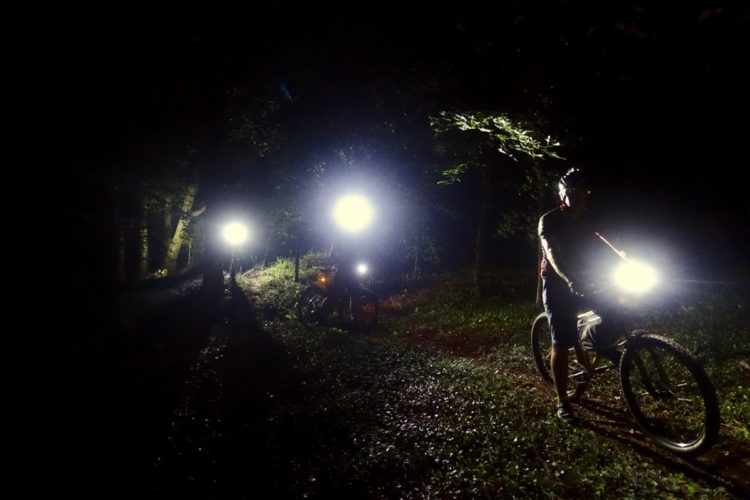
I love riding fast and just because it’s dark outside I don’t want to slow down – luckily the Seca 1400 has me covered. For one thing, unlike other systems I’ve tried, there is no real “hot spot” in the beam pattern, making it easier to read the terrain. The Seca 1400 pumps out light that is uniform both down the trail as well as side-to-side. Even on switchbacks I found the widespread, sun-like light from the Seca 1400 allowed me to see where I was going. In the video below you can see for yourself (the video was shot at 10pm under canopy so there was zero light from any other source). What you may not see, due to how these helmet cams work, is the secondary or fill light. The camera meters light only in the main beam so unfortunately the exposure is slightly off. Nevertheless, it gives a good impression of real world performance on the trail.

Some lights tend to wash out the ground features and hide ripples and unevenness in the terrain but not the Seca 1400. I really noticed this when I rode sections back-to-back with the Seca and then using a budget brand light – talk about an unfair fight. Of course to get this level of performance you’ve gotta be willing to pay the price – in this case it’s $699 MSRP. I know it sounds pricey and to be honest not everyone needs that level of light on the trail. However if you’re a rider who rides fast and often or you simply can’t afford to have a system that could fail or not work properly in rough conditions, the Seca 1400 is your go-to light. After a few test rides I found I didn’t need the Stella 200 on my helmet anymore to augment my bar light – that’s money in the bank.

I personally love the quality of this light. The entire package is low profile and compact so it doesn’t take up much space on the bars, it’s aerodynamic, and it’s less prone to disastrous snags along the trail. With the perfect beam pattern and the near true white light fired from this unit, you’ll swear the sun is following you on your ride.

I have to thank the folks at Light & Motion for illuminating my evening rides and providing the Seca 1400 for review.

Light & Motion Stella 200L Review

Wednesday, March 17th, 2010

stella1

STELLAAA! I always wanted to say that. Last fall I did a write-up on the top model Seca 900 Ultra from Light & Motion. If you read the review you know the Seca is a seriously powerful light unit. I’m sure that review left more than one person wishing they had one but the price is admittedly not for everyone. Not to worry, the folks at Light & Motion make a unit which is just as good in terms of quality and craftsmanship but at a price most can afford.

The Light & Motion Stella 200L ($249.99 MSRP) sports a single 200 lumen LED with a custom designed reflector to maximize light output. Everything you need is included in the box: the lithium-ion 3-cell 11.1V battery, smart charger, low profile helmet mount, and battery strap. The light includes just the right amount of cord so you can comfortably mount the unit on your helmet or on the bike.

stella4

The construction of the Stella is second to none. The light unit is compact and lightweight (72 grams) and features an integrated heat sink. It has a fresh bronze anodizing treatment which will keep the light looking pretty for a long time, even in the dark. The simple on/off button is integrated into the head unit with a sealed membrane to keep water out. A single touch of the button adjusts the light output:  the high setting tosses 200 lumens for 5 hours; medium gives you 100 lumens for 10 hours; and low eeks out 50 lumens for 20 hours (most spots south of Alaska don’t have that much darkness in a single day!). There’s also a flash setting which will burn for 100 hours, perfect for commuting or emergencies. Placing the light in “race mode” allows you to quickly toggle between just high and low settings.

The Stella is powered by a 3 cell Li-Ion battery which is both lightweight (180 grams) and small – perfect for mounting on your toptube, the back of your helmet, or even in a pocket of your hydration pack. The battery pack features waterproof seals good for submersion up to 20 feet and an internal circuit to protect the battery from overcharging or rapid discharges.

stella200-light-output

Mounting up the Stella takes only minutes. In fact it will probably take more time to decide if you’re wearing it on your helmet or mounting it up on your handlebars. If you’re using the Stella as a standalone light, I recommend placing it on your helmet since a helmet mount shines the light wherever you’re looking. The beam pattern on the Stella 200 is ideal for a single LED, producing a focused beam with a feathered fill light on the periphery of the pattern. The Stella beam pattern gives you decent distance with enough light on the edges to make out what’s around you.

In the photos below I have set up a test area so you can see the amount of light the Stella 200 produces at night. For comparison I also show the Seca 900 Ultra placed in exactly the same position aimed the same way. The photo markers are placed for scale: the first is 10 feet, the second triple marker is 20 feet, third single 30 feet, fourth single 40 feet, and finally fifth triple 50 feet away. The second and fifth triple markers indicate an average trail width.

The Left **Stella 200L                          The Right **Seca 900 Ultra

stella6stella-7

Hitting the trails in and around Toronto at night was awesome. Although I took my Seca 900 Ultra, I found that unless I was really going really fast I didn’t have to turn it on. Riding without moon light was really fun as well. The Stella 200 produced a perfectly white light everywhere I turned my head and the beam gave me about a 45° arc of light. At about 50 feet ahead of the bike I got about 15 feet of the spot light and another 25 feet or so of fill lighting. This is really more than enough light for most people but perhaps not enough if you’re racing and going really fast. But for the discriminating casual rider this light will light up your life.

stella-5

The photo above has been colorized so you can see the spot and the fill along with the feathering.

I also found I could use the Stella for many of my lighting needs in and around my house. Seeing that I am renovating the house, this small unit comes in super handy in tight spots due to its small size. But don’t let the size of this unit fool you – it will burn super bright for a very long time.

Overall I have to say this is by far one of the best lights out there for the money. It’s compact, tough, reliable, and good looking plus it produces a tremendous amount of usable light thanks to a single beam pattern that’s second to none. Get one for 24 Hour racing and keep using it on night rides next fall!

Specs from Light & Motion

System Weight: 250g
Output (lumens):

  • High – 200
  • Med – 100
  • Low – 50
  • Flash –
Run Time (HR:MN):

  • High – 5:00
  • Med – 10:00
  • Low – 20:00
  • Flash – 100+
Battery Type: 3-cell Li-ion
Battery Weight: 180g
Charger: Li-ion Smart
Charge Time (HR:MN): 05:00
Modes: Cruise, Race, Flash
Mounts: Handlebar

A quick thanks to the folks at Light & Motion for providing the Stella 200L for review.

Light & Motion Seca 900 Ultra Bike Light Review

Monday, October 12th, 2009

picture-390

Calling these bike lights “Ultra” is an understatement. There really should be a warning label on the box saying “DANGER! Do not look directly into the light as permanent eye damage may result.” After fully charging these monsters I plugged them in, lightly tapped the switch, and POOF! I can’t see. OK, so maybe the label would just be for people like me :)

Light & Motion introduced the Seca 900 Ultra bike lights (MSRP $699.99) this year for the serious rider and XC marathon / 24-hour racing crowd. These lights come with six Cree R2 LEDs which are the highest rated LEDs available anywhere. And as if it wasn’t enough to have six R2s in this lamp, Light & Motion also designed a very high quality reflector to efficiently direct and sculpt the beam pattern to maximize light output (this is key and where other lights fail). The Seca 900 includes a nine cell 11.1V  Li-Ion battery capable of tossing out 900 true lumens* for 3.5 hours of run time on the high setting. Other settings include medium (450 lumens for 7 hours), low (250 lumens  for 14 hours), and a flash setting that will run for 100+ hours.

The included Multi-Chem smart charger uses the ultra-efficient Delta temperature method of charging. This method basically monitors the temperature of the battery over the charging cycle to ensure that the battery gets both a full charge while not overheating. And it does the job in just 3 and a half hours.

picture-402

picture-391

The graphic on the right shows the test data for the Seca 900 and you can see that it produces more than the advertised 900 lumens. Actual light output during testing was more like 953 lumens but for sake of honesty and accounting for possible production variances Light & Motion keeps the rating at 900 (besides, Seca 953 just doesn’t have the same ring to it). You can also see most of the light is in the light-blue to white area of the spectrum which keeps everything as bright as possible.

Light & Motion uses a custom array to optimize and maximize the light pattern for night riding. The Seca 900 features a gem shaped beam that’s flat on top and converges toward your tire in a V-shape. Extra light converges toward the center of the beam for maximum distance.

Installing the Seca 900 Ultra literally took less than 5 minutes on my bike. The handle bar mount is a one-handed breeze: simply loop the light through the mount, stretch the strap to secure it on the hook, and adjust the angle. In setting the angle you’ll want the outer pattern to just touch your tire with the lower edge of the spot about 20 feet in front of the bike. Installing the battery was a matter of simply feeding the strap through the adapter slots, slipping the battery into the adapter, and strapping everything down securely.

picture-404picture-403

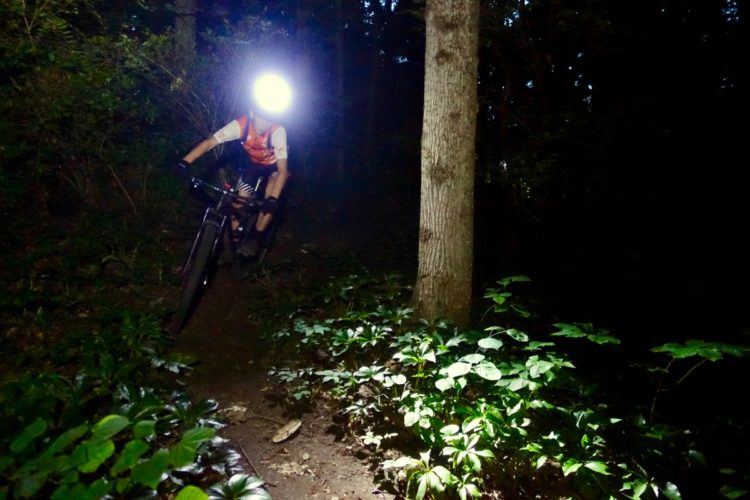
On the trails I have to say these are by far the most powerful set I have tried. These lamps toss so much light it’s literally like riding in a perfect bubble of daylight. Even when the terrain got bumpy or required a lot of steering, I felt very comfortable thanks to the light intensity and pattern. I found I could go as fast as I wanted without fear of missing a root or obstacle in the shadows. The video below shows me on a pitch black trail with no external lighting. The only light in the video is coming from the Seca 900 which basically has about as much power as a nuclear reactor. Notice how the light illuminates the trail even when cresting bumps!

The Seca 900 system also includes something called “Race mode” that allows you to quickly toggle between low and high intensity light settings for climbing and descending (respectively). This means fewer clicks to get to the two light modes you really need during the race!

Overall I can honestly say if you can afford to spend the extra bucks on this bike light, you will not be disappointed in any way. With the Seca 900 Ultra you’re getting a superior product with incredible battery life and leading on-trail performance in a svelte, easy to use package.

If you don’t think your riding isn’t quite up to the level of the Seca 900, consider giving the Stella 300 Dual a try. At half the cost of the Seca 900, this system is a bit more affordable and provides enough light to navigate dark trails with a good degree of comfort.

* One lumen is defined as the amount of light produced by a light source that emits one candela of luminous intensity over a specified angle. This is a more consistent way of measuring output rather than using Watts.

Technical specification from Light & Motion:

Battery Type: 9-Cell Li-Ion
Battery Weight: 486g
Mounts: Helmet, Handlebar
Modes: Race, Cruise, Flash
Charge time: 3:30min
Charger: Multi-Chem Smart
System Weight: 686g

Run Time (HR:MM)

  • High – 3:30
  • Med – 7:00
  • Low – 14:00
  • Flash – 100+

Output (lumens):

  • High – 900
  • Med – 450
  • Low – 225
  • Flash –

Light & Motion Seca MTB light system

Wednesday, September 24th, 2008

light-motion-arc.jpg

The Light & Motion ARC was the top-rated light system on singletracks in 2008 but the bad news is Light & Motion doesn’t make the ARC any more. The great news is the replacement, the Seca series, makes some huge improvements over the popular ARC line.

The biggest improvement the Seca brings is the use of LED lamps instead of the HID lamps used in the ARC. LED uses less power than HID and is more rugged than other bulbs. The Seca uses 6 LED bulbs to produce 700 lumens when set to “high” – but as we found out raw light output isn’t the whole story.

light-motion-beam.jpg

The Seca is designed to maximize and focus the power of all 6 LEDs into the areas where you need to see the most. Three of the bulbs focus on a center spot for long distance visibility while the other lights illuminate the edges of your field of vision without wasting light around the top edges. The optical engineering that went into this design is pretty high tech as you can see from a prototype of the reflector here. The resulting beam pattern is in the shape of a closed eyelid as you can see in the center of the photo above.

seca-prototype.jpg

Because LEDs produce most of their heat on the bulb side (rather than the beam side like HID) the Seca has an interesting looking heat sink on the back. Light & Motion sells three versions of the Seca (the 400, Race, and Ultra) but here’s the secret: They all use the same light, just different batteries! So if you can’t afford the top of the line just yet, buy the Seca 400 and upgrade your battery later – sweet.

seca.jpg


Site Map | Advertise | Partners | Contact Us | Terms | Privacy
Campground Reviews | Hiking Trails | Trail Running | Skiing / Snow Sports | Mountain Biking
Copyright 2012 Blue Spruce Ventures LLC | Atlanta, GA
singletracks.com is yet another slick Review App