

The Taipei 101 rises 1,671 feet above Taipei, Taiwan. When all 106 floors were completed in 2004, it was the world’s tallest building. Since then, 10 other buildings have stretched even further into the sky.
At the center of the Taipei 101, suspended between the 82nd and 97th floors, is a 660-ton steel sphere. The sphere is 18 feet wide and can move up to five feet in any direction. It isn’t some industrial art piece at the center of the Taipei 101; rather, the 660-ton steel sphere is the building’s tuned mass damper.
What is a tuned mass damper (TMD)?
Commonly found in large structures such as bridges and buildings (as hinted at in the quick lesson on the Taipei 101), TMDs help protect these structures in the event of high winds or earthquakes. The TMD acts as a counterbalance — if the building is pushed in one direction, gravity pulls the TMD in the opposite direction. Mass dampers don’t need electricity or power of any sort to counteract the forces of nature on a structure; rather, they use physics and the movement of the building.
“Whilst our TMD has the namesake, it is actually not a strict TMD by definition. The name effectively communicates the concept,” Rimpact’s owner, Matt Shearn, told Singletracks.
So, the Rimpact TMD is not technically a true tuned mass damper, but Shearn shared that the overall idea is the same. According to Shearn, the Rimpact TMD helps soften the energy transfer between an impact and the rider. The result is a smoother, less fatiguing ride.
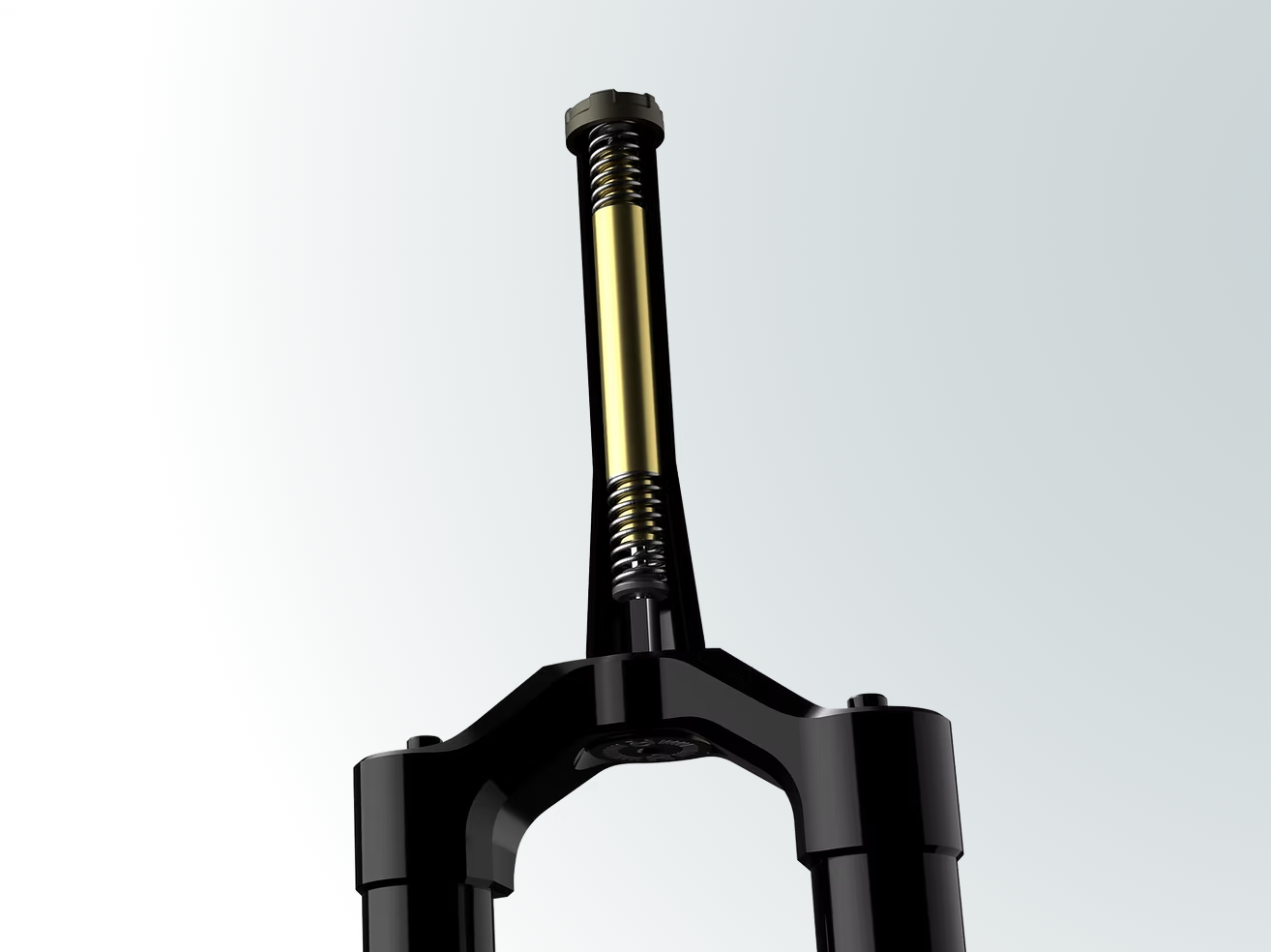
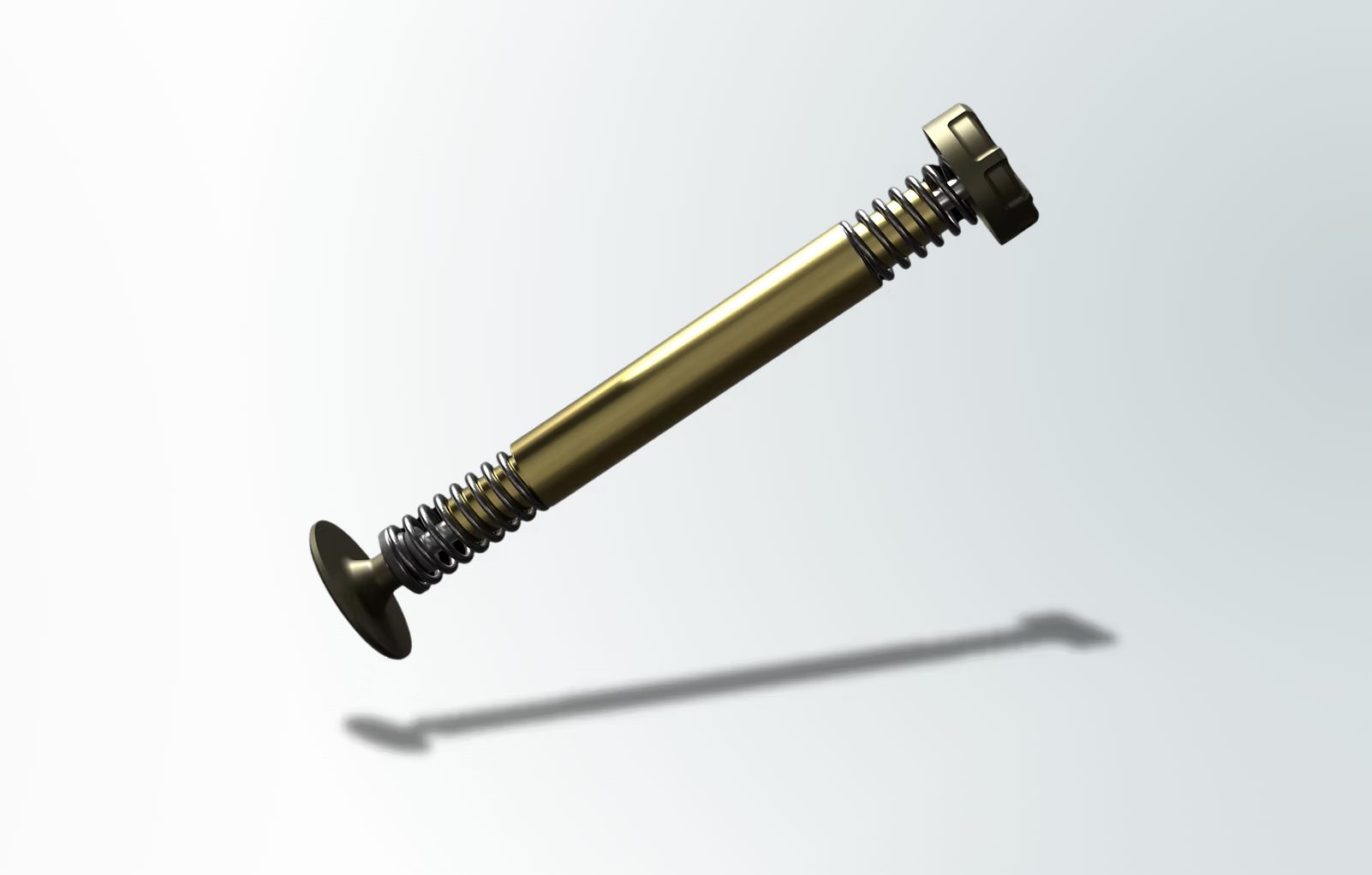
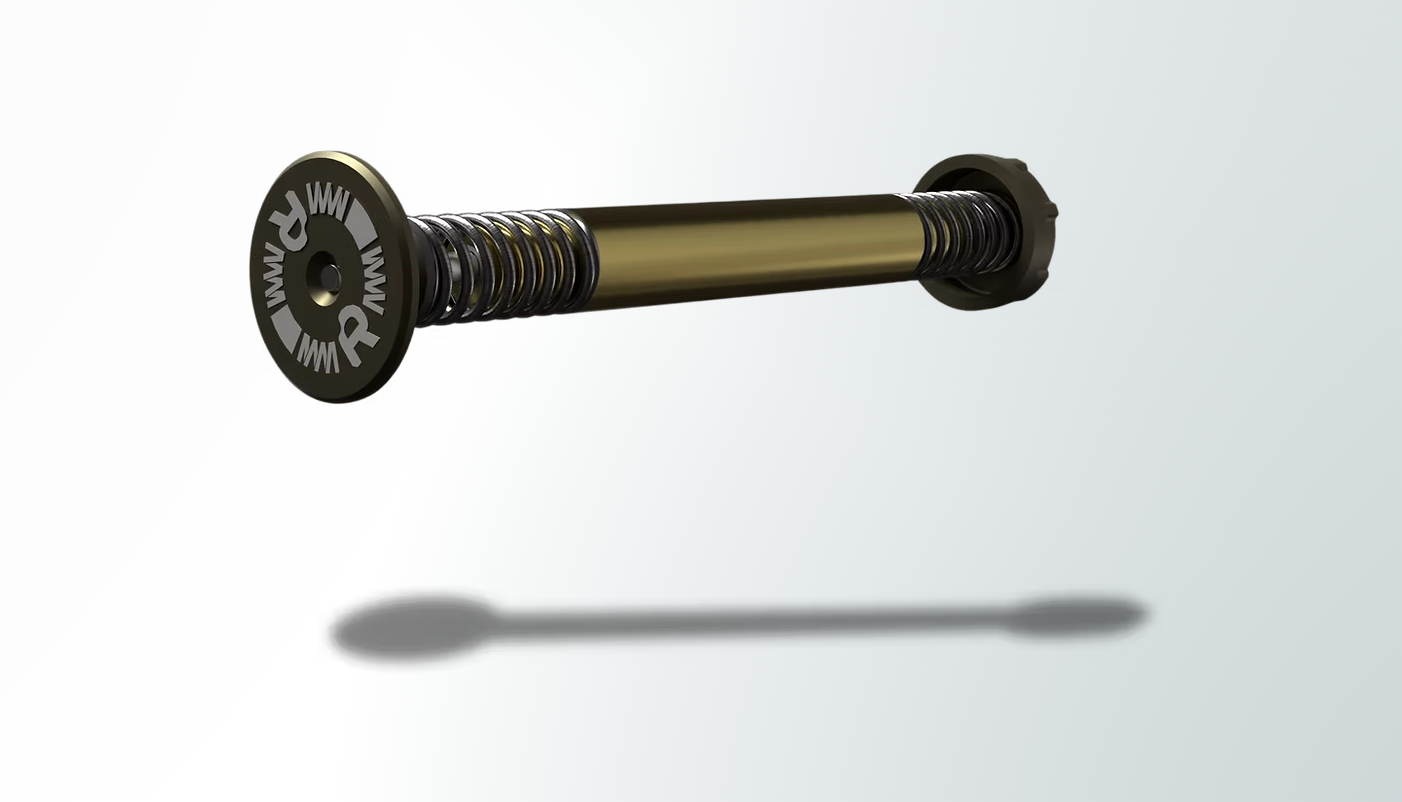
Designed to be neatly stashed away inside the fork’s steerer tube, Rimpact’s TMD features a 250g “mass” suspended between springs. This mass works similarly to the 660-ton sphere at Taipei 101, counteracting the bike’s movement caused by impacts on the trail.
The counteracting nature of the TMD absorbs those impacts rather than allowing them to be transferred to the handlebars and into the rider’s body. But, rather than a true TMD that we’d see in a bridge or building, Shearn said the Rimpact TMD is perhaps more like another product we’re familiar with.
“Like an airbag, the TMD slows the transfer of energy to the rider,” he said. “With the device installed, the peak compression spikes the rider feels through the handlebar from each impact are lower, resulting in a more controlled and less fatiguing ride.”
Rimpact is not the only brand offering a tuned mass damper for mountain bikes. Eric Performance offers mass dampers for the front and rear of the bike, mounted to the steerer tube and rear disc mount, respectively. Their device features “a steel ball suspended by a precisely calibrated spring [to absorb] impacts and vibrations.” The idea is similar to Rimpact’s steel rod between two springs, with the main difference being the TMD’s location.
Rimpact puts theirs in the steer tube. They do this for a couple of reasons. First, locating it in the steer tube puts it perfectly in line with the bike’s head tube angle. Secondly, there is no risk of damaging it in a crash. And, lastly, our legs are much stronger than our arms. Over a long DH run, it is our arms that will happily take a bit of extra cushioning wherever they can.
Where is the data?
But does it actually work? In a world where handlebars, wheels, and even frames claim to reduce the impact of trail chatter, will something like Rimpact’s TMD actually create a noticeable difference?
Unsurprisingly, Shearn says “yes,” but is realistic about the product.
“Fitting one and using it will subtly improve how the bike feels on an impact-by-impact basis, but the improvement stacks over a full run or a full day of laps,” he claimed. “By the end of a bike park trip, enduro race or epic, you’ll feel significantly fresher as a result of the TMD working continuously to chip away at the unwanted energy.”
Single data points, or data “in a vacuum,” as Shearn described it, are somewhat irrelevant. Mountain biking doesn’t take place in a vacuum or in any controlled setting — simply put, there is too much variance. The same impact on a trail can have different effects depending on speed and the exact spot of impact. Even a rider altering the pressure of their grip on the bars will show some variance.
Rather, Shearn shared the results of a longer test Rimpact performed with the TMD. He said that over 120 test runs (all on the same course), using the TMD reduced the average lap time by 1 second per minute of trail time. So if a World Cup track stretches into race times of three minutes, ideally, racers using a Rimpact TMD should see a time reduction of three seconds.
“These findings have been corroborated by a number of the top teams on the DH World Cup circuit, and this is why so many racers choose the Rimpact TMD at the top level.” And they do. Rimpact supports teams such as Commencal/Muc-Off and Canyon DH.
What about the average Joe?
These World Cup factory teams are staffed with professional mechanics to precisely set up a bike for the rider’s and track’s specific requirements. To be clear, a Rimpact TMD isn’t a magic component that will fix bike setup. While he mentions that the TMD is agnostic to how well a bike is set up, it won’t “make a poorly set up bike feel dialed.” Shearn reminds Rimpact users that proper bike setup, such as suspension setup and running proper tire pressure, should still be a priority.
You also don’t need to be a professional mechanic to install the Rimpact TMD. This is a brief overview, so definitely check out Rimpact’s full installation guidelines. First, some checks: the steerer tube needs to be at least 180 mm, measured from the underside of the fork crown. Also, you will need to ensure that at least 2mm and no more than 7mm of steerer tube extends out the top of the stem/last spacer.
Next, you’ll remove the star nut from the steerer tube (Rimpact recommends hammering it out with a long screwdriver). Unscrew the TMD’s bottom cap, placing the TMD into the steerer tube from the top, with the bottom cap sitting roughly 4-5mm inside the bottom of the crown. If it sits outside the crown, remove the TMD and add a stem spacer. Once you are at Rimpact’s recommended settings, torque the TMD top cap to 5Nm.
But you don’t have to be a World Cup-level racer with a professional mechanic to benefit from Rimpact’s TMD. According to Shearn, the “TMD will provide the same performance improvement and energy reduction to all users, regardless of the rider on the bike.” For a World Cup racer, the ideal outcome is a faster time. But for those of us who aren’t looking to save a few extra seconds, the TMD cuts fatigue and increases “perceived control.”
Shearn summed it up like this: less fatigue = more control = more confidence = more fun.
“More fun” will add a total weight of 420g to your fork and will set you back £199.99 — roughly $266.
Keep up with the latest mountain bike news by adding Singletracks as a preferred source on Google.





2 Comments
Jul 28, 2026
Jul 28, 2026
A TMD only works within a narrow frequency window
A true tuned mass damper isn't a generic vibration sponge — it's a secondary spring-mass system deliberately tuned so its own natural frequency sits close to a specific resonant frequency of whatever it's attached to. When that structure vibrates at the target frequency, the damper mass moves out of phase and cancels a chunk of the motion. The catch is that this only works well within a fairly narrow band around the tuned frequency — move far enough off it and the benefit collapses fast. This is textbook Den Hartog theory, and it's why skyscraper and bridge TMDs are tuned to one specific sway mode, not "vibration in general."
The other thing that decides whether a TMD does anything is mass ratio — the damper mass as a fraction of the *effective mass of whatever it's trying to influence*, not the whole system. Against the full bike-plus-rider mass (~85-90 kg), a 250g damper is well under half a percent — irrelevant, and nowhere near enough to affect suspension behavior, sprung mass dynamics, or how the fork initiates its stroke. But against just the local fork-upper/steerer/bar structure — the part that's actually ringing after an impact, on the order of 1.5-3 kg — 250g lands in the 8-12% range, which is squarely in the window where TMD theory says you'd expect a real, measurable effect. That reframes the whole product: it's a local hand-arm vibration absorber for a specific frequency band (probably somewhere in the 20-50 Hz range, which is where hand-arm sensitivity peaks), not a suspension performance aid, and not something that "counteracts the bike's movement" the way a building damper counteracts sway. Rimpact's own note that the device is "largely unnoticeable" during jumps and manuals is consistent with this — a spring-mass system tuned to a much higher frequency will just move in phase with the fork during big, slow events and do nothing there, which is exactly what you'd expect from a narrowband device and exactly why it can't be doing anything to suspension initiation.
Worth separating from all of this: the claimed 1 second per minute lap-time improvement, from 120 runs on one course, isn't controlled for learning curve, line optimization, or conditions changing over that many laps. It's a completely different (and much weaker) piece of evidence than the vibration-absorption mechanism itself, and I wouldn't lean on it either way.
A steerer TMD is one option among several vibration attenuation mechanisms
Other reactive mass dampers (Countersycle, Eric Performance's steerer/disc-mount units) — same physics, different mounting location. Motorcycles have used bar-end mass dampers for decades; this is the same idea repackaged for MTB steerers.
Constrained-layer/viscoelastic damping — thin damping material bonded into the bar, stem, or steerer that dissipates energy as heat through material hysteresis instead of a counter-oscillating mass. Broader bandwidth than a TMD, shallower peak reduction at any single frequency, but doesn't require guessing the right tuning for the day's trail conditions.
Elastomer isolation at the stem-bar interface — removes rigid metal-to-metal contact in the load path entirely, trading some steering precision for a broadband cut in transmitted vibration.
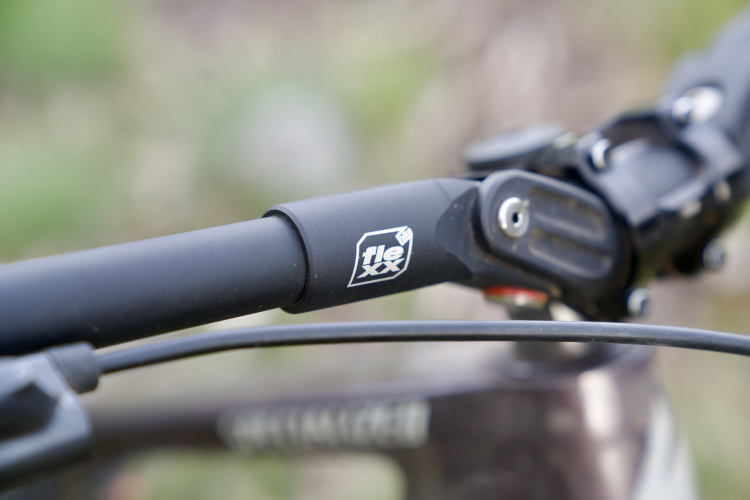
Compliant bars & stems (Fasst Flexx, suspension stems) — a soft mechanical low-pass filter in the path, again broadband rather than tuned.
Grips, bar tape, gloves — receiver-side isolation. Doesn't reduce vibration in the bike itself, but is cheap, mechanism-agnostic, and directly addresses the thing you actually feel.
Tire pressure & volume, tire inserts, suspension tuning — source-side reduction. Cuts the vibration energy entering the system in the first place rather than absorbing or filtering it downstream, arguably the biggest lever of all, though it changes other ride characteristics too (rolling resistance, cornering support) so it's not a clean substitute.
None of these are strictly better across the board — a correctly tuned TMD gives the deepest attenuation at its specific frequency, while the broadband options (compliance, material damping, tire/source changes) are more robust to the fact that trail impacts don't arrive at one consistent frequency.
Where a $250+ steerer-mounted device is genuinely differentiated is being narrowband, tuned, and hidden — not in being uniquely capable of reducing vibration, which several cheaper and more broadband approaches also do, just via different physics.