


A SRAM patent application was recently published that describes a fork with a rotational stop integrated into the crown. Such a stop prevents handlebars from overrotating and impacting the rider or frame, and also protects cables and hoses, especially on frames that feature internal headset routing. Similar in function to products such as Trek’s Knock Block and Acros’ Blocklock, SRAM’s design distinguishes itself by securing one side of the rotational stop to the fork crown.
The design
As described in the patent documents, a rotational stop integrated into a fork’s crown mates with a stop or set of stops that are part of a bike’s headset or frame.
“The crown interface 248 generally is configured to facilitate relative rotation between the crown 248 and a frame or headset arrangement of a bicycle,” reads one part of the patent application. “For example, the crown interface 248 may be sized and shaped to directly contact a bearing of a headset assembly as described in further detail below. Alternatively, the crown interface 248 may be sized and shaped to retain a crown race (not shown) which in turn is configured to interface with a bearing element.” (Emphasis added.)

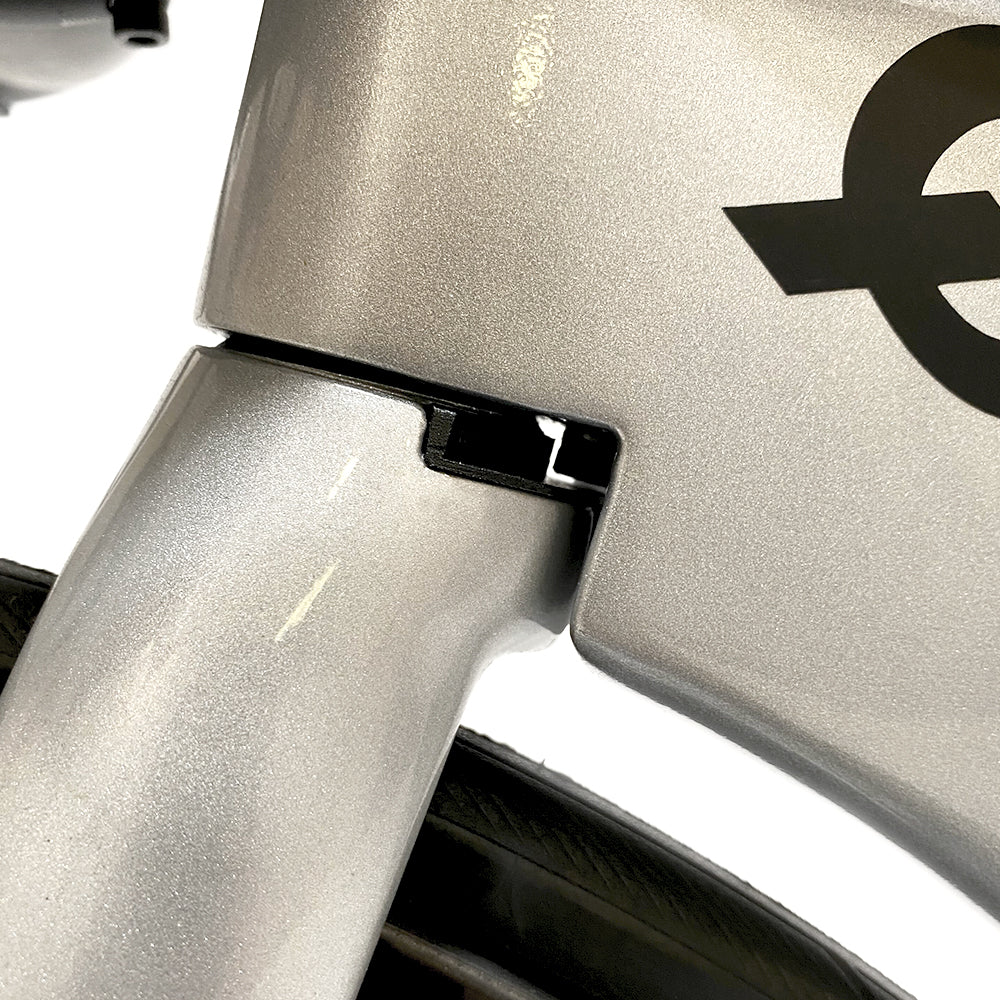
Acros Blocklock is a headset system with a rotational stop mechanism between the crown race and lower headset, rather than between the fork and headset as in SRAM’s design. Quintana Roo makes another steerer stop product that actually does place a stop on the fork that could be considered similar to SRAM’s design, though their second stop is on the bike’s frame. Note that SRAM’s steerer device patent application is just that — an application — and has not been granted yet.
The SRAM patent application is written broadly to cover a design where the steering limiter’s protrusion could be located on either the crown or the headset. A corresponding recess on the headset or crown, respectively, would form the mechanical limiter. As such, the provided drawings hint at both possibilities.
Reduced stress on the steerer
SRAM’s patent application suggests that placing a rotational stop on the crown, rather than at the steerer tube as existing designs do, reduces strain on the crown/steerer junction.
“It is advantageous to resolve rotational forces with the crown 146 in order to limit stresses on the interface between the crown 146 and the steerer 144,” according to one of the patent documents. “Particularly in examples where the steerer 144 is installed into the crown 146, extreme rotational forces in these scenarios may affect the interface between the crown 146 and the steerer 144 towards adverse side effects such as creaking or knocking due to increased tolerance.”
In current systems, when a handlebar is forced to rotate too far, that torque is transferred through the stem, down the steerer tube, and twists against the junction where the tube meets the fork’s crown. SRAM’s design removes the steerer tube from the equation. By putting the stop directly on the crown, impact forces are sent straight into the headset cup and frame, bypassing the potentially weaker steerer-to-crown connection.


A range of possible rotation angles
The patent document indicates that the maximum steering angle—ranging between 100° and 160°—is tunable. This would likely be achieved by swapping out the “stop body” (the bumper unit on the crown) for one with a different size or mounting it via different fastener holes.
The Acros design also features an adjustable steering angle, and buyers can choose from 120°, 135°, and 150° Blocklock headsets. However, SRAM’s implementation of this feature may be novel, as the language used suggests multiple ways to execute it.
“The stop body 272 may be a separate, removable element from the crown 246. The
stop body 272 may also be formed with or permanently, or semi-permanently, affixed to the
crown 246, for example with adhesive, welding, brazing, or the like.”
A SRAM fork with an integrated stop would require a compatible headset or frame
While the patent focuses heavily on the fork crown, it also explicitly outlines the necessary mating part: a headset cup or frame interface featuring a “limiting feature” (essentially a protrusion) that locks into the crown’s stops. This suggests SRAM generally envisions this working with a specific lower headset cup, which they could produce themselves or license the design to headset manufacturers.
The patent document suggests that forks with the steering stop system could be adapted to work with a traditional headset: “The ring element 598 shown in FIG. 22 may be supplied to
ensure compatibility with frame or headset assemblies not configured to accept rotational stop
features.” Or, the stop could be removed from the crown entirely, as suggested elsewhere in the patent document.
So, a new SRAM fork with a rotational stop design could be fitted to your old bike using a special ring element, though you wouldn’t get the benefit of limited rotation. But what if your bike is set up to accept a fork with a SRAM rotational stop, and you want to run a Fox fork?
The patent application doesn’t say, but it would seem buyers would at least need to swap out the lower headset cup to make a non-SRAM fork work.
View the patent documents below to get more details.






4 Comments
Dec 18, 2025
Dec 19, 2025
Dec 22, 2025
Dec 20, 2025