
Mountain biking can feel like it requires a lot of stuff, but compared to other outdoor hobbies — golf, say, or fly fishing — it’s relatively light on the prep. Put your gear on, throw some lube on your chain, maybe put the bike in the vehicle, and then hit the trails. Pretty simple, and pretty forgiving. Forgot your gloves? You’ll live. Lost your way on the trail? There’s probably another way down.
Now imagine you’re an adaptive rider getting ready for a big day on the trails. Breakfast with the crew, a bit of minor wrenching in the parking lot, then as many runs as you can manage with beers and burgers afterward. But before any of that can happen, you need to think about this:
- It takes you two hours to get out of bed, shower and get all your riding gear on.
- If you don’t put your shoes, socks, chamois, pants and pads on just right, they might give you a sore that gets infected and puts you in the hospital — or worse — without you even knowing.
- You need a diner with no steps, a wide door, plenty of space around the table and a big ground-floor bathroom.
- Your bike weighs more than 100 pounds, and it takes two people to lift it in and out of the truck.
- The trails you ride up (and down) have to be wide enough to allow a 30-inch-wide bike through them, shallow and smooth enough to let that bike climb without getting its chassis hung up, with berms shallow enough that you don’t tip over when you’re riding them, and no significant gaps or drops.
- You can’t ride alone, in case you fall, because you can’t get upright again without help.
Still ready to hit it as fast and hard as you can, hollering and whooping like a kid? Meet a couple of riders who are.
Tragedy plus time equals…something
In 2013, Martyn Ashton is one of the most famous cyclists on the planet. A lifetime of trials riding, following in the footsteps of his hero Hans Rey and others, made Martyn one of the world’s best competitors, and he’d adapted to the burgeoning demand for YouTube cycling content with spectacular style. His Road Bike Party video, published in 2012, was a global sensation, with more than 14 million viewers delighting as he took a $10K Pinarello road bike on an insanely inventive stunt mission, dropping off roofs, backflipping and railing the walls of an abandoned water slide. Alongside Danny MacAskill and Chris Akrigg, Martyn had reached a mainstream audience, and he was halfway through filming the sequel when tragedy struck.
Performing for crowds as part of the entertainment at a MotoGP race at Silverstone in the UK, Martyn fell off a 10-foot-high bar, landed badly on an already-injured back, and has been paralyzed from the waist down ever since.
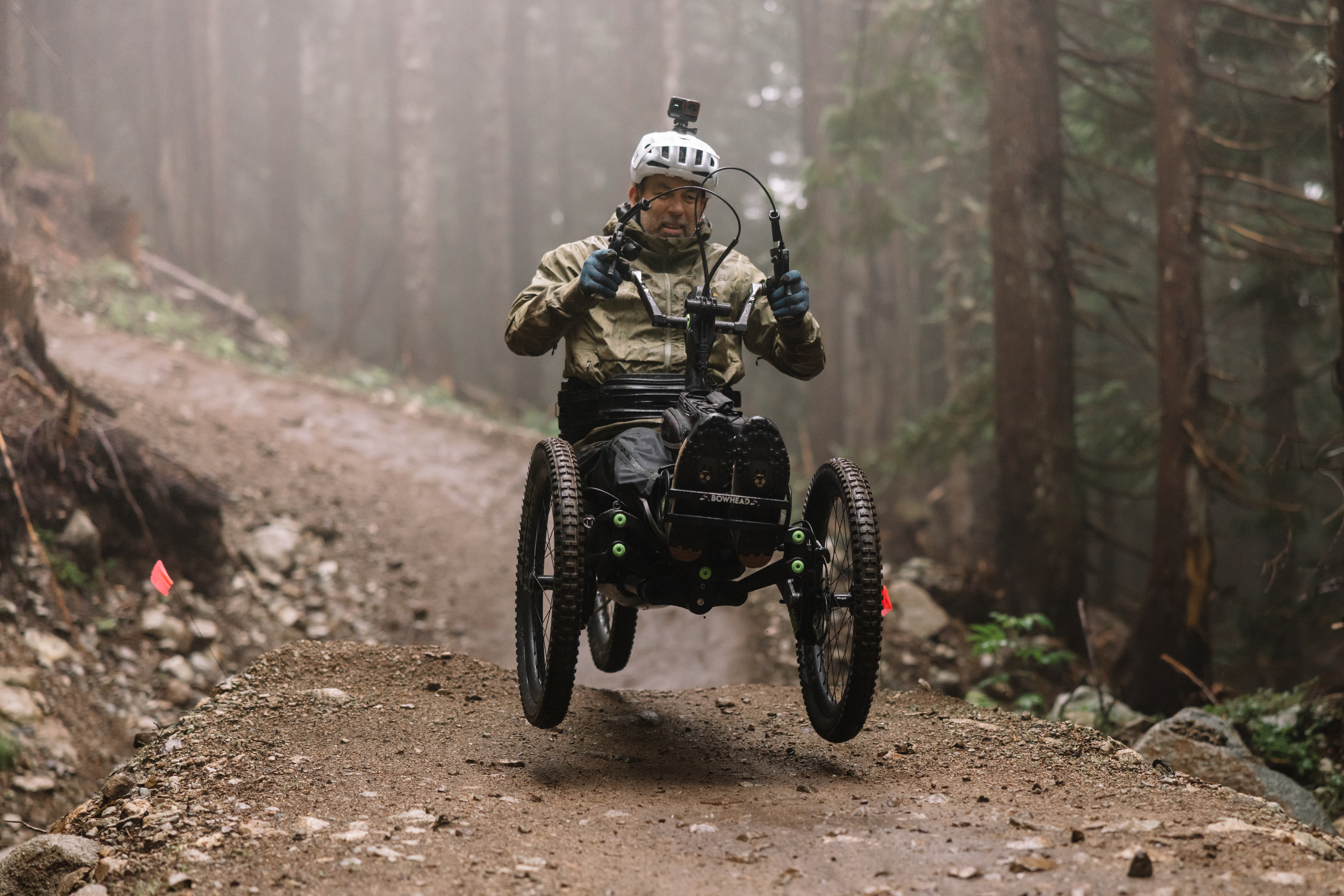
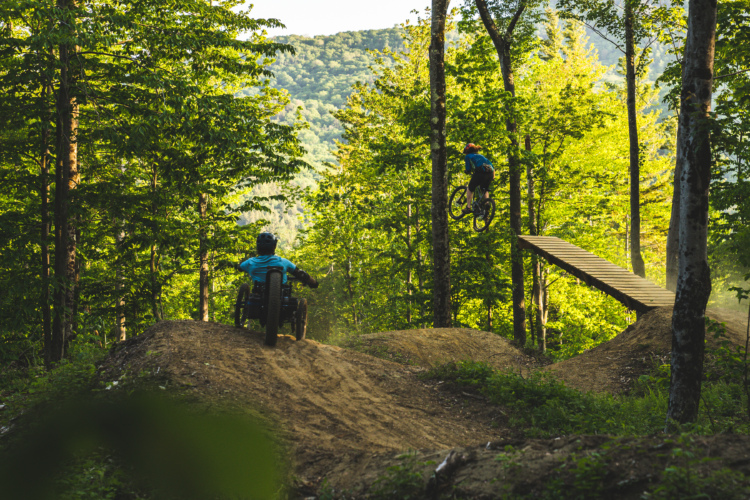
I can’t imagine what an injury like that feels like to someone who’s been a professional rider for 20 years, or how anyone can find it within themselves to even look at a bike again, let alone have fun on one. Standing trailside on Half Nelson in Squamish with photographer Rob Perry, I don’t have to — the noise alone confirms it. When the high-pitched whoops and giggles emerge from the forest gloom, and Martyn and Blake Samson rattle past like a couple of Roman chariot racers before flying off a tabletop at nearly 20mph, it’s proof positive that Martyn’s having the time of his life. And after just 10 minutes riding with them, I am too.
Trials on the trails
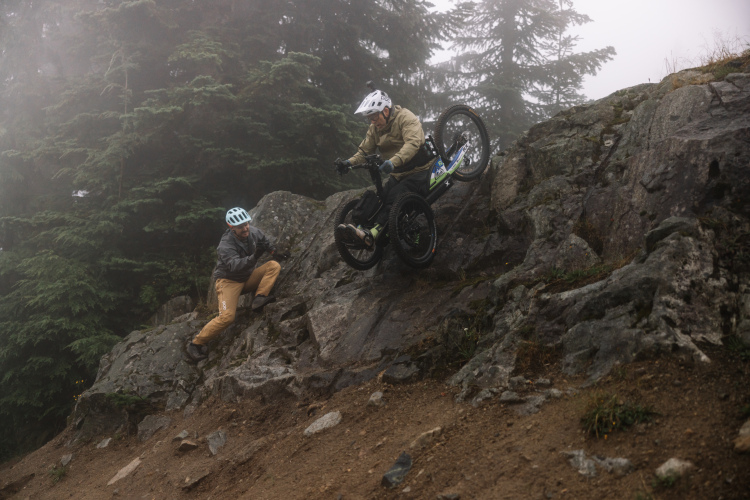
Riding with adaptive MTBers is an absolute adrenaline bath, not least because it’s very, very dangerous. Until I saw Martyn and Annikje Wade (a former DH racer and SRAM ambassador) hit some of Squamish’s faster, lumpier DH trails, I had no idea how much risk adaptive riding really involves. Following them down Half Nelson on a drizzly July morning was a fast, sketchy, and joyous eye-opener of a ride.
Just think about all the things you can do to get out of trouble on a fast, steep trail run. You can turn sharply to avoid a gap. You can unweight your front wheel, or manual, or bunny-hop. Pop off an awkward ledge, pump into the base of a steep double, or, if worst comes to worst, jump off the back or side or even front of your bike altogether.
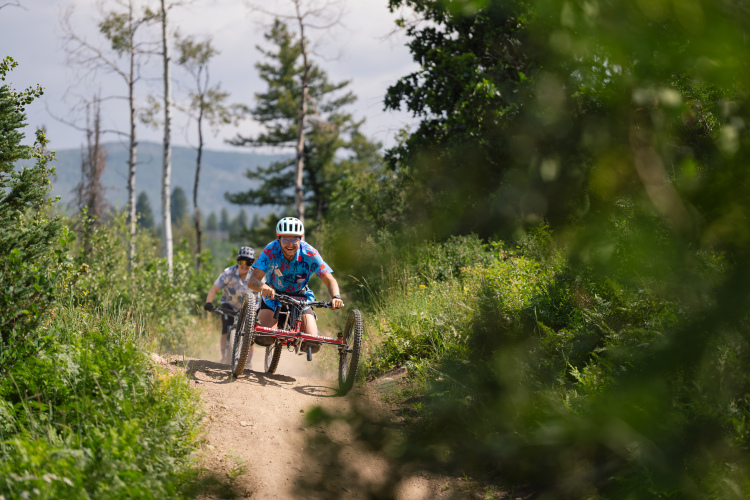
Not these folks. Martyn and Annikje are strapped into shallow bucket seats, with their legs out in front, toes up, feet and ankles secured to the frame, and another harness around their waists. They’re not on their bikes, they’re in them, with no way to get out. They’re also about three feet lower than an able-bodied rider, with less visibility of what’s coming up. Their bikes have two wheels up front, with suspension on each, connected to a central steering column, all of which makes the bikes front-heavy. There’s no way to push down into the forks and unweight, so getting air on any jump or drop guarantees a high-speed (and perilous) nose landing. Take a steep berm a little too slowly, or at the wrong angle? The bike might just tip over, rolling down the slope with the rider attached. Even if they escape injury, they might have to wait upside down like a flipped beetle until someone can put them back on their wheels.
Spicing things up
If there’s anything better than clearing tricky trail sections yourself, it’s watching your buddies do them too. And it’s the heightened risk that made my three days of riding with Martyn and Annikje so magical. Every rock garden, tabletop, and slimy BC root took on a greater significance. Every moment of trail jeopardy was magnified, and the stoke on every feature we successfully cleared was on a level I’ve rarely experienced.
Every run feels so much more precious, because it’s so hard to get back up there and do it again.
Martyn Ashton
It also highlighted, in a way that made me ashamed I hadn’t thought about it before, how the small details of trail design really matter. It’s impossible to know what adaptive riders need unless you’re literally tucked right in behind them, watching them hit every feature, because only then can you see how easy it is to get it right without compromising able-bodied riders, and how frustrating it is for Martyn and Annikje when that doesn’t happen.
No special treatment
Adaptive riders are a tiny proportion of the MTB community. Even if the sport’s growth gets exponentially faster, the vast majority of trails are going to be ridden by the able-bodied. For some people, that has framed the debate around creating or modifying trails to make them adaptive-friendly as an argument about making huge, expensive changes to cater to a handful of riders.
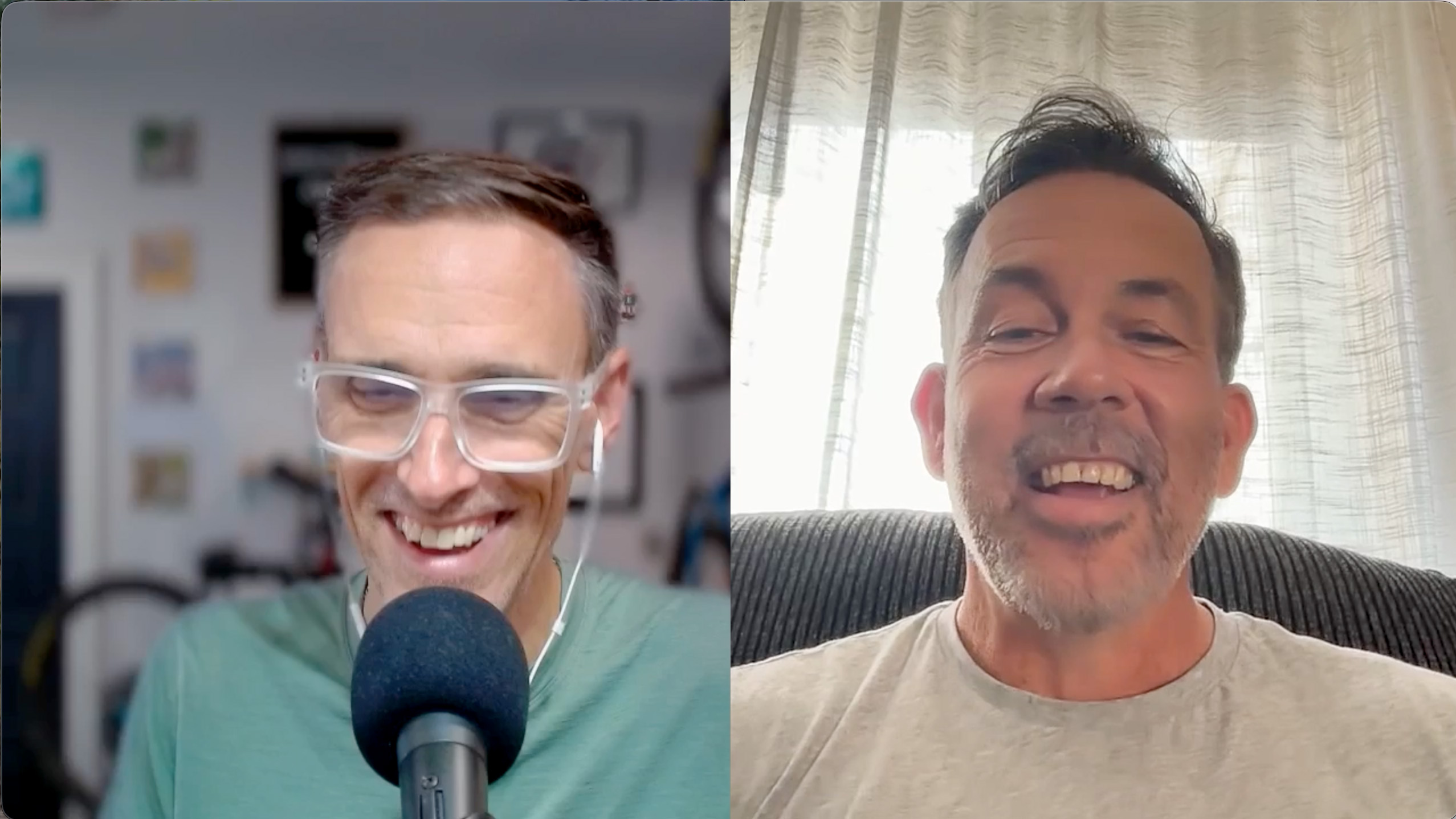
Martyn and Annikje don’t see it that way, and spending just a few days in their company, watching them ride and hearing about their experiences, really opened my eyes. Not just to how valuable riding is to them, but to how little work it actually takes to make trails that work for them and every able-bodied rider too.
For example, width is a real issue. We all rode a (nameless) trail in North Van that was wide enough for an adaptive bike on paper, but only by a couple of inches on either side. It might have seemed fine to an able-bodied trail designer, but think about how you feel when you ride between two trees with barely enough room for your bars — it’s a scary moment. So imagine feeling that squeeze every few seconds all the way down, for want of an extra foot of width on the trail.
When you say something’s ‘adaptive-friendly,’ you need to be specific — what bikes are going to have a better time and which don’t? We all have to be really careful about trail grading and selection.
Martyn Ashton
Jumps, drops, rock gardens, ledges — they’re all part of what can make trails exciting to ride. Adaptive riders love them too, and all it takes to make them equally appealing is a trailbuilder who understands the little things that can stop an adaptive rider dead. A root across the trail big enough to snag the chassis. A sneaky double that’s just long enough to be impossible to clear, and spaced just tightly enough to trap the bike at lower speeds. A corner too steep and tight for a long, low, heavy bike to navigate without tipping.
No complaints
Neither Martyn nor Annikje complained once about any trail we rode, nor expected any special treatment whatsoever. They don’t expect every trail to be rideable for them, or a future of total accessibility, or for whole hillsides and trail systems to be leveled and rebuilt for their MTB pleasure. What they do want, and resent when it doesn’t happen, is for trailbuilders, park owners, and resort managers to make them, and adaptive riders like them, a genuine part of the process when new trails are being considered. Or to put it another way: if you’re not consulting, testing, and refining your trails in conjunction with adaptive riders from the beginning, then why think about them at all?
I didn’t ride with Martyn and Annikje for long. But as I waved my goodbyes in Squamish and headed back to the UK, I knew I’d experienced something I’d never seen before in 25 years of mountain biking, and that I’ll take any opportunity I can get to do it again. If you get the chance yourself, don’t pass it up.
Keep up with the latest mountain bike news by adding Singletracks as a preferred source on Google.


0 Comments