

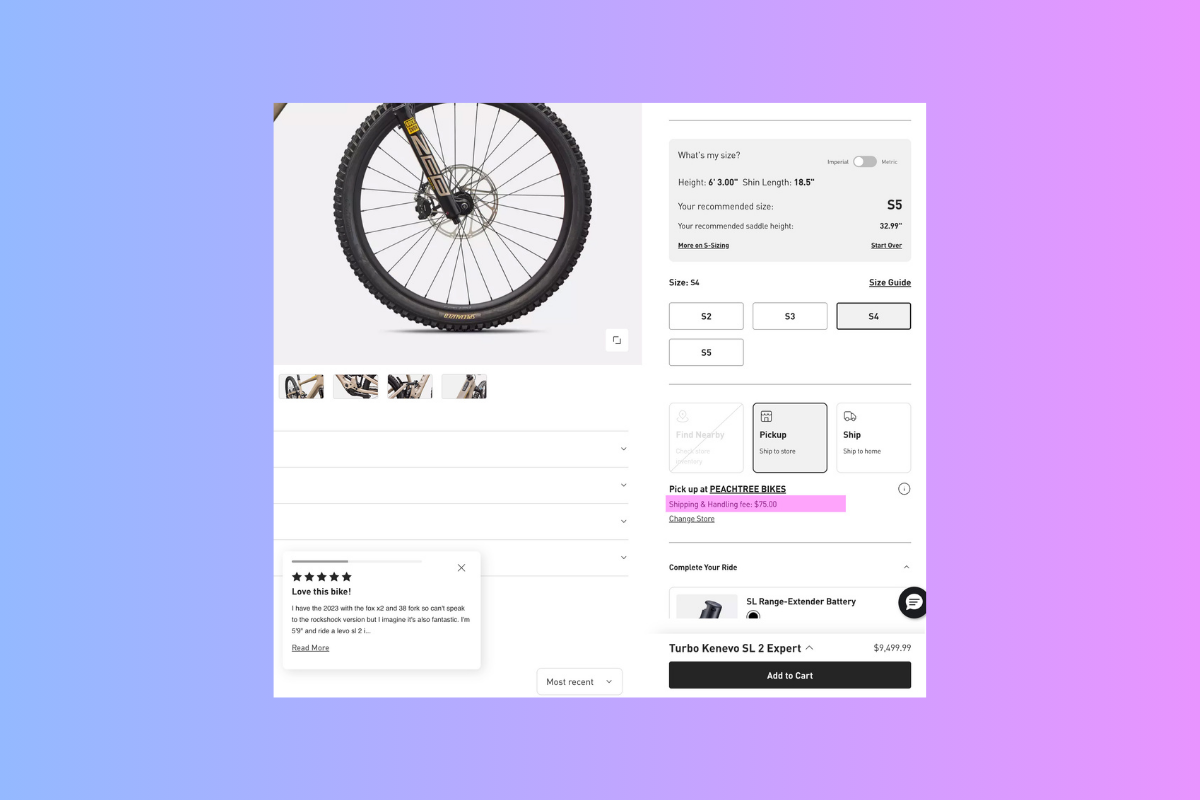
A California man has filed a Federal class action lawsuit in the Northern District of California against Specialized, alleging the company engaged in unfair pricing practices. At the heart of the issue are two mandatory fees Specialized charges buyers that the suit claims were not disclosed until customers reached the checkout screen, in violation of California and Virginia state laws.
Plaintiff Christopher Rossow says he visited the Specialized website to purchase an Epic 8 Expert mountain bike on September 3, 2025. The price of the bike was listed at $3,575, but when he selected “Ship to Store” for pickup, an additional $75 “Shipping and Handling” fee was added to the checkout screen. “This cheap trick has enabled Defendant to swindle substantial sums of money from its customers,” the lawyers wrote in their filing.
According to California law, businesses must disclose mandatory fees associated with a purchase up front, though they may “exclude shipping charges, but not handling charges.” As a result, companies like Airbnb have adjusted their online offerings to display “all-in” pricing that includes all fees, though in reality, that price still doesn’t include certain fees, such as taxes, which are exempt.
The lawsuit points out that Specialized doesn’t explain how its $75 fee is split between shipping and handling. Even if the fee is completely related to shipping, the lawsuit argues that fees associated with shipping to a store are not the same as fees that cover shipping directly to a customer. It seems the case hinges on this distinction, as clearly Specialized incurs a cost to ship the bike to the store as a result of the customer’s purchase, unlike bikes already in a shop’s floor inventory, which are purchased by the retailer “on spec.”
“By analogy, if consumers were to walk into a brick-and-mortar bicycle shop, see a racing bicycle listed for $13,999.99, pull the tag and take it to the checkout counter, they would expect to pay $13,999.99 to the store, plus sales tax to the government,” they wrote. “If at checkout they noticed in fine print on the credit card pad that they would also be charged an extra ‘Shipping & Handling’ fee of $75.00, they would reasonably be outraged. And yet this is exactly what Defendant does every day through its online bicycle store.” To be clear, in-store customers are not charged the additional fee; only customers who initiate their purchase on the Specialized website are. [Edit: some readers have commented that in-store customers may be charged the shipping and handling fee in some cases.]
A recent check of the Specialized website shows the brand now discloses the $75 fee on individual product pages and in the cart, though that change does not absolve the company of any alleged past wrongdoing. The lawsuit notes it potentially applies to hundreds or possibly thousands of customers, and the amount of money involved “exceeds $5,000,000.00, exclusive of interest, fees, and costs.”
Though Rossow didn’t purchase an e-bike, the lawsuit claims e-bike customers were charged a mandatory $15 environmental fee that wasn’t disclosed properly either. That fee covers the cost of a Specialized battery recycling program.
Fees aren’t going away, they’re just changing
Consumer backlash against hidden service fees has been growing over the past several years, leading to laws like the ones in California and Virginia. However, retailers are finding new ways to get around the laws by automatically adding fees for service, but making those fees optional, forcing consumers to opt out.
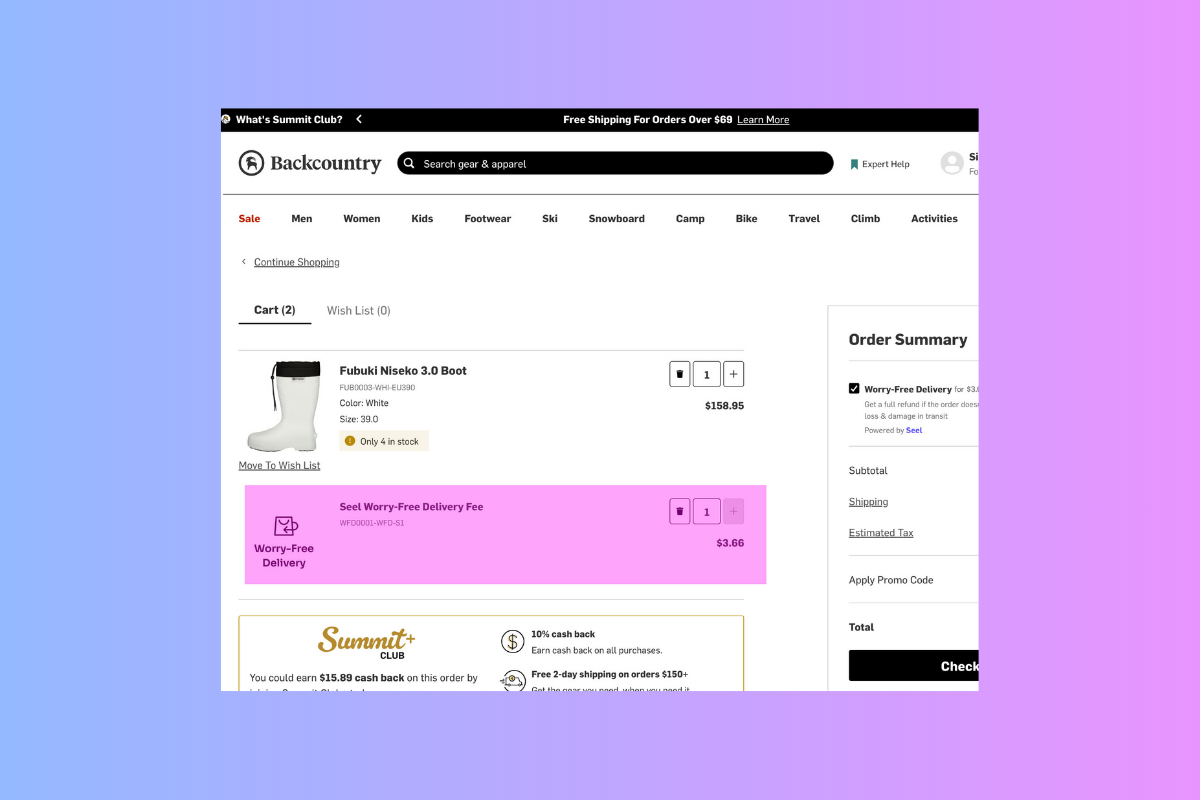
For example, Backcountry.com and other online retailers have partnered with a company called Seel to offer customers “Worry-Free Delivery” insurance with purchase. The fee, which is generally a few dollars and is calculated as a percentage of the purchase price, offers quick and easy refunds in the event of lost or damaged shipments. It’s automatically added to orders, though customers can remove the service from their cart (if they notice it before checking out).
Keep up with the latest mountain bike news by adding Singletracks as a preferred source on Google.



13 Comments
Feb 25, 2026
Feb 26, 2026
Feb 26, 2026
Feb 26, 2026
To the point of Specialized screwing dealers, this is nothing new, and we were told to include the shipping in the price of the bike if we wanted to. Shops not including it chose to eat that cost, and were not forced to.
Feb 26, 2026
Fighting over $75 on a 4 grand bike. Just wondering, did he still buy it?
Feb 26, 2026
Their shipping cost is undoubtedly more than $75 nearly anywhere in the United States.
And stop buying your bikes online, you're going to ruin the bike industry. You have to support the local store. Let them at least try and match whatever you're buying online. Call them first.
Feb 26, 2026
Feb 25, 2026
Feb 26, 2026
Feb 26, 2026
However, if your distributor has the item in stock, it can be added to your bike store's regular order and you shouldn't have to pay shipping. Including for bikes, but you'd have to wait. So that's what Specialized should have on its site - you can talk to your store for slow/free shipping or pay shipping to get it faster.
Feb 26, 2026
Feb 26, 2026
Mar 2, 2026