singletracks is mountain biking
Sign In | Create Your Account | Site Map | Help  


SunRingle ADD Wheel Review

Monday, January 9th, 2012

SunRingle has been on a roll lately, as they have revamped their entire line of wheels. Beginning last year with a revamp of their XC, Trail, and AM lines of wheels, they’ve just completed the full rework with their DJ and DH wheels.

I was talking with Scott, the production manager from SunRingle, a while ago, and he mentioned that they were working on these new wheels, but couldn’t give me the details. With the release of the new ADD I finally had a chance to try them out!

Specs

What exactly is new here? Well, nearly everything. Like the new Charger Pro wheels, these hoops feature SunRingle’s new 28-hole straight-pull spoked hub. With a 20mm only front hub but a rear hub with all four configurations using adapters (135×12, 142×12, 150×12, and 157×12), these will surely fit your gravity ride.

Along with the redesign of the hub to accept the straight pull spokes, you get premium sealed cartridge bearings which keep things spinning smoothly. As an added feature to help keep the weight down, SunRingle decided to run double-butted Wheelsmith spokes and alloy nipples to shave a few grams without compromising strength too much. The new 30mm hoops utilize Stan’s no tube technology and come installed with Stan’s rim strips. Included, but not installed, are the Stan’s valves and bottles of sealant to get you started if you’re going tubeless right away. Outwardly fresh graphics and your choice of hub color finishes off the wheels.

These wheels come in at 2,000 grams ± a few (depending on axle configuration), making these pretty competitive as far as weight is concerned.

Installation

Installing a set of Schwalbe Muddy Mary UST tires was a snap (literally)–all that was needed to seat the beads on the rim was a quality floor pump. I have heard people complain about the troubles of setting tires on rims before, but if you just follow what Stans says on the website, it is foolproof. After the initial set-up of shaking the Stan’s sealant in the tires, I was ready to go. I set the tires to 26 PSI, installed an 11-25 cassette, and set off.  Nearly all the testing was done at the Dagmar test site, with both myself and Bob_the_Builder taking turns punishing these wheels.

Testing

As a standalone test, not thinking about any other specific wheel sets I have tested before, I could tell these wheels were a bit different. Not so much in performance, but in sound. The ADD wheels feature a slightly deeper tone to the cassette body compared to other wheels. Along with the sound, the cassette engagement is a bit coarser than other brands, meaning it takes more crank rotation to engage the cassette–about 10-12 degrees compared to about 6 degrees on others. It’s not much of a difference, but I noticed it nevertheless.

As far as rolling speed with tires, these keep up with the best of them! The ADD wheels roll very fast, and even when we tossed the bike hard into berms, we felt very little flex. What both I and Bob_the_Builder loved was the durability and solid feel of the wheels while taking off and landing. Even if we had the wheel slightly sideways coming in for a landing, we noticed very little flex, where with other wheels you hear pinging spokes. Sailing off rock gardens as fast as I was willing to send it, these wheels took the abuse without a ding, which is a good testament to the design of the rim profile. Not once did I burp or flat a tire during all that jumping and abuse.

But perhaps the best thing about the ADD wheels: they sell for about $750, a couple of hundred dollars cheaper than their competitors.

I would like to thank the folks at SunRingle for sending down the ADD wheels for a review. Stay tuned for a head-to-head comparison of these and other wheels in the coming months.

Fulcrum Red Fire DH Wheelset Review

Monday, December 12th, 2011

When I think about Italian-made cycling products, I almost always think about road racing gear. Swinging by the Fulcrum booth at Interbike this year changed my perspective. After looking over the lineup of wheels they are sporting for mountain as well as road, I knew that I had to set up a few reviews!

I manged to get my hands on Fulcrum’s top-shelf DH wheelset: the sexy Red Fire.

Tech

With their machined rims and straight-pull spokes, an untrained eye may mistake the Red Fires for a red set of another familiar brand that paints their DH wheels yellow.

Fulcrum’s Red Fire wheels don’t just hide behind fancy red anodizing, though – these wheels are something that any serious rider should take a good look at. Starting at the rim, the Red Fire has some important technical features which enables these wheels to handle serious abuse. The most obvious is the milled inner surface, designed to remove weight where it is not needed, while keeping plenty of material around the 32 asymmetrically-drilled eyelet-less holes.

Note: the holes do not go through to the inner rim surface, making these rims UST compatible. Not only is the inner surface not drilled, but the added safety ridges keep the tires firmly in place even at lower pressures (I ran them as low as 22 psi). To facilitate installation when running UST tires, the inner profile has a smooth, curved drop center which allows for both ease of installation and seating of the tire.

To ensure the rim stays round, the Red Fires are welded and milled to increase hoop life and strength. The easy-to-source stainless steel butted straight-pull spokes by Sapim are a great additional feature for this wheelset, so getting a few spares from your LBS shouldn’t be an issue (266 mm). Both front and rear wheels are laced up with 32 spokes in a conventional three-cross pattern.

The wheels feature beefy large-diameter aluminum hubs which house the industrial bearings in double rows on each side of the hub, with a few more in the cassette body for good measure. Speaking of the cassette body, the steel body runs a 3 cam pawl spring arrangement similar to that of the popular Easton Havoc series. What sets these apart is the locking bearing adjustment, which is a nice touch and well-worth the extra 6 grams or so that it adds. The front 20mm and rear 12mm through-axles round out the package and ensure that you’re getting a solid-performing duo.

Installation

In the box you get instructions, tire levers, spoke tools and a small stub of a nipple. Do not toss these parts out! The little nipple is magnetic, and the powerful earth magnet that is supplied (also in the package) is used to move your spoke nipples into place in the off chance that you break a spoke. So keep that gear safe.

Installing a set of UST tires on the Red Fires was a snap. I normally use an air compressor to mount tubeless tires, but using a quality floor pump like a Topeak Mountain will work with these tight rims. The inner 23mm width is generous enough to form a decent profile. I typically use 2.4 – 2.5″ tires and both have no issues with squirming on the rim or ballooning.

Although you can install a regular non-UST tire on these wheels, why would you? This is a question that my inner circle of friends have all asked themselves, and now they are running UST tires (those that can afford UST wheels). We all agree that it seems like the best way to go. I went with Muddy Mary and Fat Albert tires and using just a floor pump, it took little effort to snap the beads into place (spray a bit of soapy water on the bead first). A cassette and rotors was next, and away I went!

The Test

Testing was done at a smallish hill that my friends and I frequent that’s not well known to many besides a few core riders. This place has all the elements a larger hill has – from rock gardens to table jumps to big step ups and step downs to some of the best groomed, high speed berms in this part of Ontario. The only problem is there isn’t a lift… so down you fly… and up you trudge.

I was out shredding with a number of other riders whose opinions I really trust (including Bob_the_Builder), and we had a real go of it!  The first thing I noticed is the super-silent cassette body. I was kind of worried that it wasn’t working because it was so quiet! The engagement on the cassette is bang-on, like Easton and Mavic, requiring very little movement of the crank to engage. Definitely a positive point.

I hardly noticed the 2,200 gram weight. Standing alone on its own merits, I would say this is a fast-rolling set of wheels (stay tuned for a shoot-out test in the future). With a few pedal strokes and gravity on my side, these hoops helped propel the bike up to speed in no time.

Due to the relatively low weight, stopping these wheels is a non-issue. The Red Fire did very well on the big hits and rock gardens, with no signs of damage despite plowing them (sensibly) through rock gardens and sessioning step-downs and jumps over and over again. I was impressed at how laterally stiff the wheels felt when tossing the bike in the berms. Some wheels with straight-pull spokes tend to ping a tad if the wheel bends – but not these – which is a testament to how well-built and strong a wheel can be made. I have not had to turn a spoke to date: the Red Fires are still spinning smooth and free of dents!

All in all this is a great wheel set! They aren’t the lightest out there, but they hold up well to abuse and offer excellent performance. A pair will set you back around $960 and are priced similarly to the other top brands.

A big thanks to the folks at Fulcrum for sending the Red Fires down for review. Stay tuned for more from Fulcrum, and be ready for a wheel shoot-out in the near future!

Dakine Descent Short and Descent LS Jersey Review

Friday, November 18th, 2011

Dakine is one of the big mountain bike apparel companies that really keeps an eye on performance as well as style. Add in durability and a good fit and you have the recipe for the perfect mountain bike gear! I rocked Dakine for more than half the summer and now I’m ready to share my review of the Descent long sleeve jersey and shorts.

Descent LS Jersey

The Descent LS Jersey has a familiar DH cut with a high v-neck collar and a rather roomy fit. The Raglan-cut jersey naturally has a nice-fitting arm in the long sleeve version thanks to the tubular cut. If you’re planning on wearing full armor you need to buy one size larger than normal for a proper fit.

Made from a durable 220 gm/yd polyester, the Descent jersey takes abrasion fairly well. I have had a few close calls with trees and even a crash or two on the rocks, and with the exception of a small tear (I was using elbow guards at the time), everything has held up great. Sewn into the jersey’s left side seam is a protected chamois to clean up your lens when things get really down and dirty. And to prevent stinking like a trash can, the fabric has an anti-microbial treatment which manages the deluge of bacteria that can cultivate while riding (or leaving you jersey in the trunk of your car for a week after a big ride).

As far as style goes, the asymmetrical  graphics are a bit different but I think they’re pretty cool. What looks like simple stripes from afar is actually an intricately printed maze – the graphics are definitely eye-catching.

Descent Short

The Descent shorts are purpose-built: constructed from 400D plain-weave nylon, they feature a mesh-polyester liner. That makes for a durable and comfortable short.

As far as fit, Dakine has you covered with perforated panels for better air flow, a ribbed crotch gusset for comfort, and a bit of extra stretch to provide maximum range of motion. What makes this a truly downhill-specific short is the 16″ inseam legs: perfect for just covering the knees, even with armor. The ratchet-type waist adjustment and back lumbar pad add to the durability, fit, and comfort.

If you didn’t already pick up on this from the pics, the Descent shorts and jersey are designed to match. Running both together makes you almost feel like a sponsored rider! But critically speaking,  the jersey and shorts do fit together perfectly with approximately the same fit and a similar feel to the materials.

The Test

The Descent shorts and jersey found themselves used and abused on the slopes of Blue Mountain and Horseshoe Valley resorts. Coincidentally, the instructors at Blue also use the same gear. You can imagine the confusion that arose from time to time. I was informed that the guys at Whistler also use the Descent jersey and shorts. With that kind of street cred, I feel like I’m in good company!

During the late summer months and into the fall, the Descent gear held up superbly! Despite taking various spills on rock gardens and hard-packed berms, the jersey and shorts endured, with very little sign of wear. I personally loved the feel of the material and the roomy fit that the Dakine gear provides. In case you haven’t been on a downhill or freeride bike before, there is a lot of body movement going on, with the legs and arms really working it. The combination of roominess and cut keeps the clothing from snagging up. Nothing bugs me more than having my clothing snag and pinch while I’m trying to get my groove on.

Not only do the Descent jersey ($60 MSRP) and short ($100 MSRP) look good, but they measure up in the performance and comfort arena as well.

Thanks to Dakine for sending out the Descent short and long sleeve jersey for review.

Twenty6 Gear for 2012: Pedals, Stems, and More

Wednesday, November 2nd, 2011

Who is Twenty6? I met with owner Tyler Jarosz at Interbike and, judging by our conversation, he is highly passionate about riding and his products definitely reflect that. The company is based in Bozeman, Montana, surrounded by some of the best biking in the country which clearly influences Twenty6 designs.

From pedals to brake levers, everything from Twenty6 has design appeal as well as function. After picking up my pimped-out package of the new Predator pedals, F1 stem, and Dualie levers, I was stoked to get back home and install these parts. Looking at the gear from Tyler, you can truly see the level of his CNC skills.

Predator Pedals

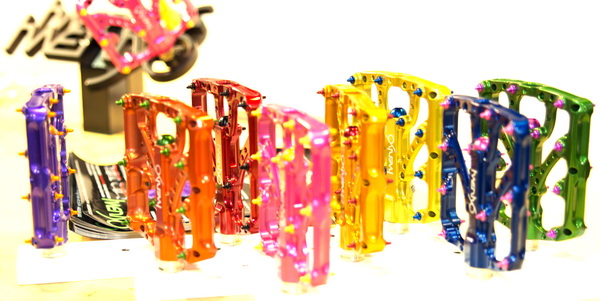
The Predator pedals have seen significant changes over the previous model (the Prerunner). For one thing, the body has been increased in size, with a bit more meat towards the outboard of the pedal. Not only did the body size get larger, but the pedal’s profile has actually changed with a more pronounced concave shape that provides better pin placement and traction. Speaking of the pins, Tyler explained to me the importance of his pins: these are not run-of-the-mill hex pins… they are engineered to have a break-away point to prevent damage or pull through.

The axle features an Enduro bearing near the axle root and a turcite bushing at the other end. Making sure everything stays mostly clean and running smooth, a Quad O-ring is designed to keep the crap out and provides a measure of pedal resistance (i.e. you can control the spin of the pedal). To keep the weight down, you have the option of either a titanium axle or a chromoly one. At a weight of 320 grams (ti axle) or 390 grams (chromoly), both options are very light for their size.

F1 Stem

The F1 Stem has been revised for this year with a one-piece mount to the upper crown while still keeping the same front cap. The added support stiffens the stem, preventing possible bending when you do case it, and it gives the rider more feedback. The stem is offered in two lengths with a choice of 40/45mm or 50/55mm and weighs ±150 grams, slightly heavier than the previous model as a result of the stiffer design. The F1 has a clamp diameter of 31.8 only, so installing your older 25.4 bar won’t work here. It mounts easily to any 4 bolt direct mount fork.

Dualie Levers

Small parts like a brake lever can easily be missed and taken for granted, but Tyler went to the trouble of coming up with some great levers for many a brake, including the Avid Codes that I reviewed earlier this year. The Dualie levers are machined from billet 6061 T6 aluminum and weigh about 50 grams (depending on the model). The attention to detail that went into the two finger design is impressive, with the machining both reducing weight and enhancing grip.

Installation

I had an easy time installing the new gear on my bike. The most work went into installing the levers on the Codes because you have to make sure that you engage the spring and carefully swap out the reach adjuster. A tip here would be to apply a bit of grease to the small hole where the spring and detent ball is installed then carefully slide the adjuster nut sideways, ensuring the detent ball stays put (use a toothpick or a slender tool to hold in the ball). The pedals and stem installations were no-brainers. The stem is a plug and play affair with a very straightforward install – just remember to torque everything down evenly (6Nm).

Predator Test

I used both the Predators and F1 stem on my Opus Nelson and the Dualie levers on my Banshee Legend, and they work great! The pedals had excellent grip, with no issues. My foot felt firm and balanced on the pedal and the large platform worked well even when it got really messy. The pin pattern on the Predator worked great at holding the shoe yet allowing me to rotate my foot without too much resistance when I needed to use some body English. You would think that the large pedal would strike every rock in sight (and I thought that too), but that was not the case. I make it a point to keep my feet at the 3 and 9 o’clock position when traveling through rock gardens and rock drops (places that will destroy most pedals if you’re not paying attention). Even so, I still thought that these would strike. They didn’t though… as long as I was upright. Even in the berms I was paying attention to see if I was close to striking, but I had no issues. The very thin profile of the pedal keeps it away from most everything, though I did strike a few times on an exceptionally large boulder section aptly named “The Coffin” at Blue Mountain.

To keep the pedals fresh, Tyler has an extensive choice of replacement pins, and he even has a repair kit available.

F1 Stem Test

The F1 stem worked well, holding the bar firmly in place without even a hint of creaking. Even after going down hard on a few occasions, I was impressed to see that the bar and stem remained perfectly aligned without a hint of movement or bending.

Dualie Test

I instantly loved how the Dualie levers felt over the stock Code levers. They provide a definite improvement in feel without any hint of slipping: I never had to use a second finger to stop the bike. Speaking of feel, the machining on the levers grab the finger nicely, even with wet gloves on. All this equates to a better, more confident braking experience with the Dualie levers. If you are looking for a major upgrade on your levers, look no further.

Bottom Line

All in all, Tyler’s Twenty6 products are definitely worth checking out. They easily offer the most color choices around! So what will all these cost? For the Predator Ti pedal you’re looking at $269 – $289 (white). The F1 stem comes in at $129 – $139 (white) and the levers are priced at $74 – $79 (white). Some of these parts may be a bit on the pricy side of things, but these are not your run-of-the-mill components!

I would like to thank Twenty6 for sending the gear down for review.

Spank Spike Pedals: Reviewed

Wednesday, October 26th, 2011

I did a bit of an introduction to Spank’s Spike pedal a while back and since then I’ve been rocking the Spike pedal on my Banshee DH bike. Today I’m finally ready to share my analysis of these pedals.

Technical Specs

The Spike pedal, unlike many other pedals on the market, is made of cold-forged aluminum, which offers increased strength and durability. This special construction also allows these pedals to be über-thin at just 12 mm (not including the pins). Within this thin profile you get an IGUS outboard bushing and an over-sized full-complement inboard bearing. The IGUS bushing is made from reinforced fibers and solid lubricants. This technique makes for a bushing with predictable characteristics such as high compressive strength and good corrosion resistance and can be run lubrication-free. The steel axle is hollowed out and is alloyed with scandium for increased strength.

The elongated hexagon-shaped pedal is made with chamfered edges (a wedge design, as compared to square edges) to increase pedal clearances. This is important for cornering – the pedal can glance off things if there is a pedal strike, thus reducing the impact force on the bike. The elongated design is also meant to prevent pedal flip. The 90+ cm² area and 20-pin design makes for a very sure-footed feel.  Pins are inserted from the opposite side of the pedal with a hex key and locked in place as if they were cap screws, unlike hex pins that rely on the use of thread lock to stop them from spinning. Finally, the seals serve dual duty, providing both protection from the elements while also acting as an anti-spin control.

Installation

Installation of the pedals requires a 10mm hex key – there are no pedal wrench options here due to the proximity of the inboard bearing. The use of thread lube is important to prevent seizure of the axle to the crank arm. If you have a crank that requires washers, don’t forget to install them. With this pedal design, the inboard pedal body runs very close to the crank arm (± 1mm) so the lack of a washer could cause it to rub.

Real-World Testing

I took my trusty DH rig to the slopes to see if these pedals really worked as advertised. Bottom line: they definitely do!

Surprisingly enough, the Spike pedals offered excellent traction. It took a while to get used to the tight proximity of the platform to the crank arms, but after a bit of fumbling around, things were good. I had no real need to play with the pins–the 10 pins per side were adequate and well-placed, giving my feet great traction while still allowing them to roll when necessary. The pins are not the most aggressive on the market, but they can still take a chunk out of your legs if you’re not careful. Wearing shin protection would be a good idea, just in case you lose a foot while getting bucked off your bike.

What I loved most about the Spike pedal was the very solid feel underfoot. The large platform allowed me to move my feet fore and aft just a touch when desired.  I really found these pedals advantageous in the corners and tight spots too. We have a run called the Coffin Drop at Blue Mountain which is pretty tricky. If you hit it wrong, it will smash up your pedals and possibly toss you off the trail into the rhubarb. The low profile and chamfered edges shine here, keeping both feet and the pedals away from the rocks.

After two weeks of riding, I did have to adjust the pedal a bit, adding a bit more anti-spin, but that was the only thing that needed adjustment. Running my DH bike through Ontario’s bad weather at Blue (cold, rainy, muddy), the pedals didn’t clog up or exhibit degraded performance in any way. They still feel as smooth as the day they were installed.

A bit of a side note: the funny thing about the Spike pedals is how very quickly you will learn how many people are checking out the gear on your bike. While waiting in line for the lift, I had many people comment on the Spikes.

The Spank Spike pedals come in five colors: orange, blue, black, ti-grey, and red (tested), which will compliment a wide range of colors on your bike. At $125 MSRP, these are available at a good price point. They aren’t crazy expensive, and they offer decent value for the money. These rank in the top three in my favorite pedals book, primarily for their excellent performance-oriented design!

Many thanks to Spank for sending the Spike pedals over for review.

ITS Invader 2.5″ MTB Tire Review

Tuesday, June 28th, 2011

I’ve been running ITS (Intense) tires for a while now and this season I’m rockin’ the ITS Invaders on my DH rig. The Invader was originally simply called the DH tire, and for good reason too. At 1300 grams and a full 2.5 inches wide these are big tires. Some of you probably gasped at the weight, didn’t you?! Well there’s a reason for all that heft.

For starters, the Invader is a double ply tire which is two fabric layers for added protection, durability, and flat resistance. ITS also included a pinch flat bumper on the sidewalls for even more protection. The bumper is inserted between the bead and the tread to reduce chances of pinch flatting off squared edged bumps plus it adds support at lower tire pressures. All this adds up to one tough tire.

The tread pattern on the Invader is a mix between three different knob zones. The central trapezoidal knob has a decent bite and cuts into the softer stuff nicely. The double row of transitional square knobs work on corner entry and exit while the stout outer cornering knobs are slightly edged to keep your bike on line.

I installed the Invaders on my Deemax wheels with no tubes and 4 ounces of Stan’s per tire (no these aren’t tubeless tires but I’ve been able to run them without tubes). I had no problem beading or seating the tires – I just used a floor pump and they beaded perfectly with no real strain getting them on. Some tires are a pain to seal when going tubeless but the Invaders sealed up nice and fast, probably due to the double ply and extra rubber. Now this task took a total time of 1 hour (mounting, adding Stan’s and spreading the sealant around each wheel). After that I reset the pressures (I run 30psi) and I was off to the slopes.

I received these in January and had a chance to use them in very firm ground conditions initially (literally frozen) and more recently in soft, muddy terrain mixed with slate rock and roots. This extreme mix of terrain provided the perfect testing conditions. Over the course of my testing, the 50a durometer tread started to show some signs of wear which is to be expected, especially when riding the hard rocky stuff (think of dragging an eraser along sand paper).

In soft conditions (tacky mud) these tend to run a bit on the slow side as they really bite into the terrain (I found at faster speeds massive mud chunks would fling off the back of my bike and into my buddies’ faces.) This is actually a good thing since the tire offers both good speed and lateral control (some slip but manageable). On the medium terrain is where these work best; I got great directional control and good braking. On the harder terrain (hardpack and rocks) these tires work well but tend to wear quickly, especially if you make the mistake of being to aggressive on the brakes when riding rocks.

Overall the ITS Invader is a good high volume tire (your rims will love you for this) capable of handling a wide range of terrain. These feel like a mix between a Maxxis Ardent and Kenda Nevegal with characteristics of both. Over my time with these I didn’t get a single puncture or one ding on my rims (for me that is great, I hate rim dings). So the dual ply and pinch flat bumpers are working well. At about $54 MSRP these should last a full season of riding (unless you’re riding slickrock a lot).

I would like to thank the folks at ITS for sending down the Invaders for review.

Easton is Control! The New Havoc Stems and Bars

Monday, March 7th, 2011

Easton has been very busy indeed: new for 2011 is the totally revamped Havoc component line up. On the control side of things, Easton looked at what mountain bikers wanted in quality parts and boy did they deliver! This line is stocked with highly machined components, both inside and out, super sexy lines, cool graphics, and solid products just waiting for riders to send it.

Havoc Stem

The photo above offers just a peek at what Easton has in store for 2011 – the Havoc 50mm stem. Easton is offering the 1 1/8″ version in three reach choices (35, 50, and 65 mm) while the 1 1/2″ steering tube version comes in 50 and 65 mm lengths.

The new graphics are a big departure for Easton and in this case, beauty isn’t just skin deep – it’s also in the details. I’m big on proper machining practices because you can destroy a perfectly good component by not following good engineering practices. Clearly Easton understands this. All the machined surfaces flow together well with no sharp points or sudden thickness changes. Everything has a radius or chamfer to minimize stress risers and all the exposed surfaces are clean and burr free.

Easton’s four bolt DST bar clamp system works a little differently than other stems on the market. The top two clamp bolts are tightened all the way in, leaving no gap, while the bottom two bolts are torqued down afterward with a gap. This feature spreads load across the stem, reducing stresses which could lead to damage.

Havoc Bolt-on Stem

Taking a look at the sub-140-gram Havoc Bolt-on stem you can see that a ton of consideration went into saving weight as well as keeping the strength up. The Bolt-on version will work on BoXXer, FOX 40, and Dorado forks without a hitch.

The Havoc Bolt-on offers three positions at 45, 50, and 55 mm, making this stem very versatile (10mm either way for a DH rider will make a considerable difference). Unlike the standard Havoc stem, the bolt-on features a 5-degree rise; that is, the bar is mounted a bit higher than the fork crown. This configuration is perfect for those who want to keep their center of gravity low. The Havoc Bolt-on is a two piece stem unlike some other brands that offer direct mount stems made from three pieces. In terms of mounting, a two-piece stem is easier to install – the Havoc Bolt-on literally too me just a few minutes to mount.

Havoc Carbon and Aluminum Bars

Along with the new stems, Easton also added a duet of new bars in the Havoc line up: a super slick carbon bar and an equally sexy new aluminum bar. Now what is really awesome about the carbon version is the fact that it’s lighter than most all-mountain carbon bars. At 235 grams and 750 mm wide, the Havoc carbon is impressively light as well as tough.

The Havoc aluminum bar is pretty light as well, weighing in at 315 grams. This version is made from tough 7050 aluminum (high strength with just enough flex to it) and features Easton’s Taperbore technology. Taperbore doesn’t just mean the center is thick and the ends are thin; Taperbore actually tunes the thickness of the bar throughout to ensure there is sufficient material where it needs to be, improving vibration and stiffness characteristics. The chart below shows how the bar thickness varies over the length of the bar.

Both bars have the same bend at 9-degrees back sweep and 5-degrees up sweep with a 20mm rise. What does all that mean? With a bar at 750 mm (29.5″) wide and my shoulders at 520mm (20.25″) wide, this places my wrist in a very neutral position without feeling uncomfortable at all. A slight inward bend is perfect when traveling through the rough stuff and for hitting jumps or needing more control, the width really stands out and gives a major boost in both precision steering and torque. The good thing is you can always shave some width off the bars if you find it’s too much. For me the extra width even worked on my trail bike – the wider bars allowed me to breath easier on the climbs.

Installation

Installation is a breeze thanks to the instructions from Easton that are easy to understand with pics to back everything up. When playing with new products such as these, it’s important to torque everything down per the instructions – you don’t want anything to fail due to installation errors. In the case of the carbon bar I added Motorex anti-slip for carbon on my stem before installing. This adds a measure of safety and increases friction to prevent galling if the bar were to rotate. Swapping the Easton parts between my FR, trail, and DJ bikes I had no issues with fit or installation.

The Ride

Playing on my DJ and FR bikes with both bars and stems, hitting jump after jump on the progressive tables I felt really comfortable without any real shock to my hands when landing. Everything stayed tight with no hint of creaking. Of the two bars I did enjoy the carbon Havoc better as it transferred a bit less shock to my wrists and hands.

On the trails I noticed improved control over my front wheel (750mm provides ample torque). The added width may take a bit of getting used to, especially if you’re upgrading from bars that are 660mm (26″) wide or less but in the end, it’s worth it. On my FR bike the Havoc bars are similar in width to what I had been running so the lighter weight is a big bonus, especially when you consider that the front end can get heavy near the end of a day’s riding.

My only complaint so far is I’d like to have a slightly larger clamping area on the stems. Seeing that everything held up well during my tests, I wouldn’t say this is a problem – it’s really just a style point.

So, how much is all this high performance gear going to cost? Well, considering the quality or workmanship, the damage isn’t too bad: the stems are both priced at $90 MSRP (black or orange) and the aluminum bar comes in at $75 MSRP (black, orange or gray). The carbon bar is a bit pricier at $150 MSRP (matte black). All these products will also match the new Havoc wheels (review on that later) which come in grey or orange hubs.

Thanks to the folks at Easton for sending down the new Havoc components for review.

RockShox Vivid Air R2C Preview

Tuesday, January 18th, 2011

When it comes to gravity riders, depending on who you talk to you get two basic types: those who care about the weight of their rig and those who pretend not to care about weight. But let’s face it, weight kills performance: both on the rider and on the ride. The more weight the bike has to carry, the slower a rider can change direction and speed, which limits their performance wailing down slopes at speeds that would make Mario Andretti messa his shortsa.

Clearly Rockshox is familiar with speed (not the messing shorts bit) and based on their commitment to top riders on the World Cup circuit, they have come up with inventive ways to save on weight. And I’m not talking about small savings here – I’m talking about a good 400 grams in savings on a single component which is huge.

The Technology

Witness the Vivid Air RC2 mountain bike shock. Essentially RockShox found a way to convert a coil shock into an air shock, which wasn’t easy by any means. Think of it: trying to get an air spring to behave like a steel spring – seems like a daunting challenge. Taking a look at the exploded view below, you can see for yourself that it really isn’t very simple at all. But then again not everything can be.

While the Vivid Air may look a bit complex with its dual air chambers, it’s basically very similar to the original Vivid coil shock. A modified shock body (J) has been machined smooth and now serves as part of the air spring. Parts (A)-(E) as well as (N) belong to the dual chamber air spring. Everything else is pretty much the same as the Vivid coil. All of this combines to achieve a coil spring-like feel – minus the heavy coil. Comparing spring rates between the Vivid Air and the Vivid coil shows they are nearly the same with the exception of the last few millimeters in travel where the Vivid coil ramps up a touch faster than the Vivid Air.

What you don’t see in the new Vivid Air is the hot rod compensation pellet which is built into the bypass rod. When heated (during extended runs), the pellet expands and adds additional rebound force. Some of you might scoff and say plastic isn’t durable enough but rest assured, the hot rod is a well engineered addition to the rebound rod.

Adjustments

The Vivid R2C features a host of adjustments. The most obvious one is the air spring pressure which means no more pesky coil spring swaps. There’s also the external low speed compression adjustment plus beginning and end stroke adjustments. These four dials give you pretty much everything you need to get your rig wailing down them slopes pinned and sticking to the trail. What you don’t get (which you’ll need to purchase separately) are the frame adapters. I opted for the three piece solution rather than the two piece aluminum set; it’s a bit more costly but a longer-lasting solution for your bike.

Installation and Set-up

Looking at the Vivid Air you might assume it’s larger than a coil shock but that’s not really the case. The overall diameter is only a few millimeters larger than a coil shock but since you can’t see through the Vivid Air that makes it look bigger. Installation works the same as it does for any other unit out on the market today – just make sure you install the shock so that you can get to all the adjustments and make sure the reservoir doesn’t strike anything when your suspension moves. Install the shock with no air and cycle the suspension to make sure you’re clear – easy peasy.

Setting up the Vivid Air is pretty much the same process as the Vivid coil except that you’re going to add or remove air from the single valve on the air can (it sets up the negative spring automatically via internal compensation ports). In my case I needed 30% sag on my Banshee Legend II, so knowing the stroke of the shock (76mm) and multiplying it by 0.30 I get the sag measurement (76mm x 0.30= 23mm). With that I just added air into the shock until I reached my measurement. Unfortunately the Vivid Air doesn’t have the sag gradients that grace many other Rockshox products; instead the gradients are printed on the reservoir sticker

With the sag set, it was time to head out to the slopes to fully set up the shock. Using my experience with the Vivid coil shock, I started off with the compression settings and quickly found that the Legend got a lot of traction with 4 clicks on the compression dial. The terrain that I was riding featured a mix of rocky, rooted terrain with hard patches and soft stuff in and around. With this set up I found I had good control over the wheel on the rough stuff while still tracking the terrain nicely.  On landing big jumps, the compression setting did well controlling the bike without too much fuss.

After the compression was set I started looking at the rebound settings. I tuned the beginning  stroke rebound (which plays a major roll on rockgardens) so that I didn’t get a bucking sensation out back when the wheel tried to return after those hits. The sweet spot for me was right about 9 clicks.

Lastly I set the end stroke rebound (for bigger hits) which was by far the most fun to set up. Essentially I was sessioning a few jumps and dialing the shock until I ended up at 5 clicks. I found the Banshee and the Vivid worked great together, mostly due to the initial rear wheel travel (designed into the geometry) which gave great control over the bike when hitting harder, squared-edged stuff. This also allowed me to dial back on the adjustments, resulting in more wheel sensitivity without sacrificing control.

Overall the Vivid Air feels great and performs like a champ. As a result I have a bike that is a pound and a half lighter, I don’t have to play with springs, and I have good control over my bike with a coil-like feeling. I’m definitely looking forward to playing around with the Vivid Air to see how much more I can get out of it in the future. The only drawback I can see is that the price for the Vivid Air is a few dollars more than the coil version. At about $630 MSRP it’s not cheap but to get a coil shock down to race weight the only other option is to upgrade to a titanium spring (which adds another $200 at least). To me that makes the Vivid Air a great value.

I would like to thank Tyler Morland and the good folks at Rockshox for setting up the Vivid Air for a review.

Truvativ Descendant Crank Review

Monday, December 20th, 2010

Today I have something from Truvativ that has just been “declassified” from the company’s Blackbox technology group. The Descendant crank has actually been around since 2009 and was initially tested by Peaty himself. And unlike some cranks out there that are all about the bling, the Descendant crank is all about the business of performing on the slopes.

The Descendant crank arms are made from forged AL-7050-TV, the same material that’s regularly used in aerospace landing gear and bulkhead construction. The cranks share the same forging technology and design techniques as the Holzfeller but that’s basically where the similarities end. Truvativ managed to get the Descendant’s weight down to 822 grams which is especially impressive considering that the SRAM X9 crankset that I reviewed just a little while back comes in heavier at 845 grams. Sure the X9 has two chain rings but remember, the Descendant is made for the gravity crowd where parts have to be beefier, stiffer, and stronger. Just think about it – that’s about 240 grams lighter than the Holzfeller, 150 grams lighter than Saint, and 100 grams lighter than RaceFace Atlas FR!

Of course weight savings are great but they don’t mean squat if a crank can’t endure the abuse of DH and FR mountain biking. On any bike the crankset is the most important link between man and machine and it’s really a spot where you don’t want unnecessary flexing. Fortunately the Descendant over-delivers on the promise of high strength and stiffness (more on that later).

Another great thing about the new Descendant crank is the options that are offered. With three crank arm lengths (165, 170, 175mm) and two chain ring options (36 or 38) along with 73mm or 83mm bottom bracket options you’re pretty much covered. Now speaking of the bottom bracket (a sore spot for many cranks), the new Team GXP bottom bracket comes with Gutter seal technology and a new forged cup design. The gutter seal basically keeps junk out and reduces seal drag which means more power goes toward turning the crank instead of overcoming drag.

Unlike multi-ring cranks, the chain ring on the Descendant doesn’t feature shift ramps. Instead, the rings are machined from AL-7075 T and cut to a 4mm thickness so they’re still compatible with the present 8, 9, or 10spd systems. The chain ring is held in place with steel bolts and I opted to run an e*thirteen SRS+ chain retention system rather than risk bashing off the frame’s ISCG tabs. Although it might look better to show off the crank and ring, I decided to work with the strength of the crank’s spindle and bolted up the bash guard there instead. Besides, it’s cheaper to replace a bash guard than to replace a frame if the tabs get bent.

Installing the cranks was a piece of cake using a standard 16-notch external BB tool. Follow the easy to understand, full color instructions for proper spacer installation. Also remember to use a high quality grease to lube the cups before installation and add a touch of lube to the spindle before installing the non-drive side of the crank. As always, torque everything down precisely using a digital torque wrench like the D-Torq DX from Topeak. Remember, when it comes to torque, too much of a good thing is no good at all.

Hitting the Trail

I was really impressed with the solid feel of the Descendant crank on my Banshee Legend II. While hitting step-downs and decent-sized jumps I immediately noticed the stiffness of the cranks upon landing. I had no worries about things bending because I really didn’t felt much flex at all. Even when pedaling hard on the flats the crank felt rock solid with zero visible wobble. Even after casing it a more than a few times and bashing the cranks on rock gardens, the cranks stayed straight with just a few scratches on the ends of the crank arms.

Let’s face it, if the Descendant crankset is good enough to carry pro mountain bikers like Peaty to 17 podium finishes, 7 world cup wins, and the top three places the 2009 World Championships, it’s good enough for you and me. At just $185 MSRP you’re getting a lot of crank for your money.

Thanks to the folks at Truvativ for sending up the Descendant crank for review.

RockShox BoXXer World Cup Review

Friday, December 10th, 2010

Pssst – hey you on that DH bike – wanna drop some weight and increase performance on your rig? I though so. At 5.98lbs, the BoXXer WC is probably the lightest 200mm DH fork on the market today – the next closest contender I know of is the 6.4lb Manitou Dorado MRD – so you’re looking at a good half pound off that front end of yours. The weight savings alone are huge but there are many more refinements to be had with the Rock Shox World Cup BoXXer.

Let’s start with the outside of the fork and work our way in. The BoXXer is available in 4 colors this year: red, white, and black plus the new super cool Keronite finish. Keronite is basically a very hard ceramic finish that can be applied to aluminum, magnesium, and titanium. The process is similar to that of a plasma coating except it’s far more advanced and precise. The process actually works at a molecular level, changing the base material to a ceramic surface, resulting in a super hard surface with enhanced base material properties. Having had a few of my projects treated with Keronite, I can say it is simply amazing.

Other external changes include re-tooled knobs to save weight and new graphics with the World Cup championship colors. The familiar etched graphics on the stanchions and pressure chart on the fork leg are nice touches and help with sag set up on the go. The BoXXer features post mounts to increases the stiffness of the brake assembly over older IS standards; many of the newer brakes being produced are post mount compatible.

Internally the BoXXer has a host of new features over last year’s 2010 model. For one thing, RockShox put the fork under a microscope to reduce friction (something of a bother from last year’s model). The engineers looked at everything from seals to bushings and re-designed the damper cartridge and the Solo air spring assembly to eliminate friction points. RockShox kept the 35mm 7000 series aluminum stanchions, which are hard anodized for long life and lower friction (stiction), the lower magnesium legs with the power bulge, and of course the high performance Maxle Lite DH 20mm axle.

The re-worked Dual Flow adjustment (high – low speed rebound) and the tuned Mission Control DH valving (high-low speed compression) really perk up this fork for 2011. Although it takes a bit of time to set everything just right, the effort really pays off in the end. The re-worked valving truly changes how the fork behaves over fast, rough terrain and absorbs the larger features that you’ll find anywhere. The internals sport a totally upgraded Solo unit (which can be retro-fitted into the 2010 model, though not the Race version), but unfortunately the new damper won’t fit – sorry. I checked simply because I have a few friends who own the 2010 WC and they were interested in upgrading after riding my 2011 version.

Installing the BoXXer WC (1-1/8″ aluminum steering tube) was pretty easy – it’s just a matter of measuring twice and cutting once. As always, read the manual and torque the bolts in place with a quality torque wrench. Remember spacing between crowns must be 156mm ±2mm. The minimum the stanchion length is exposed on the top crown is 2mm so before cutting the steering tube (if you’re going with a direct mount stem) it must extend 2mm from the top of the upper crown. Other than that business, all is good.

Dialing it in

Setting up the BoXXer WC took a good solid day of riding plus a break-in period. I found the fork needed a little time to get everything seated and felling creamy smooth. With the BoXXer it’s important to follow the RockShox tuning recommendations to get the fork set up right – that is, unless you have your own world-cup tech on speed dial. Get the air spring pressure set first (sag) by jouncing the fork a few times to equalize the pressures in the positive and negative chambers. I found the BoXXer-specific pump to be great – the large air volume this pump delivers is helpful – otherwise you might be there all day with a standard shock pump.

Once the sag is set it’s time to configure the beginning stroke rebound dampening (first 25% of travel). This really should be done on the trail and not on the streets. Find a familiar section of trail and session it. Add one or two clicks at a time to the small knob on the bottom (hold the larger knob to keep it from turning). You want the fork to return fast, but not so fast that it stings the hands or feels like it’s going to toss you off the bike. Next, set the end stroke rebound (for coming off bigger hits) where the travel range goes from 25% to 100%. Again, you’re looking to avoid getting bucked off the bike. Too much of either the high or low speed rebound and you get what’s called packing down – basically losing more and more travel with every hit.

Now, set up the low and high speed compression. Low speed compression allows you to to balance trail sensitivity and fork dive – basically changing how the fork feels. Too much compression and the fork tends to skip over some of the bumps and feels very harsh; too little and the fork dives when hitting the brakes and cornering. Once you get the low speed set, dial in the high speed setting for big drops, rock gardens at speed, etc. The goal here is to get maximum control over the wheel. You don’t want the fork to blow though the travel on the big hits so add more compression until you get a controlled compression. Too much snaps the wrists back and stings; too little and it feels like the bike bogs down and gets wallowy.

The final setting is the end stroke adjuster which changes the volume of the air chamber during the fork’s last 20% of travel. Reducing the volume will ramp up the spring rate, yielding a more progressive feel. This is one of those settings that is totally subjective, depending on the rider. If I was going from a drop to flat I would add more end stroke (for my 200lb. weight I’d add about 4 turns).

Ok, even though some of this might sound more complicated than a NASA checklist, don’t worry. The tuning guide that RockShox includes is easy to follow and understand and Rockshox encourages you to play with the settings. I ended up downloading the guide and printing out a few of the “My Favorite Setting” charts to remember what I liked best during testing. All the controls were easy to use except the bottom out dial – I recommend having a 2.5mm allen key handy and being prepared to remove the air from the air spring to adjust it. I did take the knob off and added a tiny touch of synthetic lube to the seal before replacing it to see if that would help. This gave me marginal improvement and was really the only small issue I found with this fork.

Hitting the Trail

I installed the BoXXer WC on my Banshee Legend II and it definitely stepped up the Legend’s game. Once the fork was broken in I spent a bit of time re-setting the dials and had a really good time. The lightness of the fork really made it easy to control the bike and on low speed, technical rock gardens and general gnar I felt consistent control over my front wheel.

Taping the powerful 2011 Code brakes would cause almost any bike to dive like a submarine but I found with the compression set midway at 6 clicks and the low speed at 4 clicks, the fork struck a good balance between traction and control. Even on taxing rock gardens where the suspension travel got a real workout I still maintained perfect control over the bike without having it pack down underneath me. On rock gardens there’s always the chance of a glance causing the bike to slip sideways; some forks will twist in this situation. On the BoXXer I didn’t notice any flex – the bike always tracked where I wanted it to go.

Big hits with the BoXXer were just too fun. The lighter weight allowed me to move the bike a bit more without a lot of extra body effort. The lighter weight also seemed to increase performance of the bike as well. A lighter fork reduces sprung mass to a degree, particularly if the reduction in mass is on the fork lowers.

Overall the BoXXer WC works very well and any racer should be happy with this unit with little worry about maintenance. So my last two cents? Try 0ne out for yourself,  I’m sure you will be impressed. If you have a 2010 model and don’t want to fork out the cash for a new one, get yourself the air cartridge (fits WC and Team models only) for a nice performance boost.

Ok, so how much does this wonder of modern mountain bike technology cost? Well as far as world class forks are concerned, I can say the BoXXer is right in line at $1,700 MSRP. Now if that is a bit more than you can afford, test out the Team or Race versions. These forks are a bit heavier and feature a coil spring which can be more difficult to tune but are definitely worth a look.

A big thanks to Tyler Morland from RockShox for setting sending up the BoXXer WC for a review. Another thanks to my good friend Michael Chan for taking those snowy shots. Stay tuned for a write up on a few other exciting products from Rockshox as well as SRAM. Next up: the Rockshox Vivid Air.

Hangin’ with RaceFace at Interbike

Friday, October 8th, 2010

If you were to walk around Interbike last month you might have wondered where the RaceFace booth was set up. Six floors above the noisy convention center inside the Venetian hotel, RaceFace set up a swanky suite to show off their latest gear to a mostly invitation-only crowd. Fortunately trek7k and I were on the list and we got a chance to sit down with John Pentecost to chat about the 2011 line.

We started off talking about the newest and most anticipated items, the Next SL and SixC cranks. Both of these cranks are made of carbon using a process that’s super cool and super secret. Suffice it to say it’s manufactured using aviation-grade technology. The Next SL cranks weigh in at a feather-light 675 grams, lighter than top-of-the-line SRAM and Shimano cranks.

The 2011 Deus and Next cranks feature some impressive features like newly redesigned chainrings called Turbine rings. Two years of engineering and testing went into the all new Turbine rings which have unparalleled performance.  As with the previous Team and Race rings, the Turbine rings are made in Canada from 7075 aluminum so they’re built to last.

What really piqued my interest was the SixC cranks (the “C” is silent), manufactured at the RaceFace British Columbia (Canada) facility. The crankset is completely hollow and the composite arms have no internal aluminum spine. Taking a look at the cutaway confirmed that claim, though the actual manufacturing process is a closely guarded secret (as it should be). With 3mm of chainline adjustability, this ensures the ability to achieve perfect drivetrain alignment even with difficult suspension frame designs and it’s ideal for fine-tuning shifting chainguide set-ups.

The pedal and spindle inserts on the SixC cranks are co-molded and mechanically locked into place to guarantee that they’ll never loosen or creak. The SixC can be purchased in either a triple ring set-up or double ring with a lightweight 7075 alloy bashguard. All-alloy Torx 30 hardware keeps weight down and looks sweet.

For 2011, RaceFace is all about color. Like the Atlas line, the Deus handlebars also come in several color choices, just in case you were planning on blinging out your ride. The 680mm wide Deus bar comes with a 3/4″ inch rise while the 785mm AtlasFR bar features a 1/2″ inch rise. But if color isn’t your thing, you can always go for the stealth look.

That’s right, RaceFace had stealth looking bars stems and matching cranks on display at the show. This stuff looked really cool but was hard to shoot with the cameras (I guess the stealth really works). Of course RaceFace isn’t limited to what we were able to photograph here. Rest assured that the product line-up is huge with a multitude of bars, stems, cranks, seatposts, rings, and headsets. And don’t forget they also have a huge clothing and protection line designed with feedback from great riders like Brett Tippie and Wade Simmons.

Now you gotta check out the RaceFace website to see all the cool gear and threads. I’ve been a believer in RaceFace products since as long as I owned a MTB – I had one of the original turbine cranks from way back – so I know the new stuff is going to be dialed on the trail. Put on your RaceFace for 2011!

Manitou Dorado Pro MTB Fork Review

Tuesday, July 13th, 2010

dorado4

Here is some extreme eye candy for mountain bikers who look at canyons and think ‘meh, I can gap that!” The fabled Dorado Pro from Manitou has been totally re-engineered by some of the top folks in suspension development. After ordering my Dorado Pro ($1,750 MSRP, gulp) I was sleepless for nights until it arrived. The best mountain bike technology doesn’t usually come cheap and these hand assembled beauties are no exemption.

The Dorado Pro is handcrafted at Manitou’s HQ in Wisconsin by Chris Volbrecht, a dedicated and degreed engineer (not some assembly line worker who just follows an instruction sheet). Chris rides, commutes, and races his mountain bike as much as anyone at Hayes Bicycle Group. “He’s an asset and part of our test group as well so he’s contributing all over the place here,” said Richard Travis.

It’s guys like Chris at Manitou who ensure consistency in performance from fork to fork (much like at Ferrari). Think about it, you get a top level engineer who really knows his stuff assembling forks by hand one at a time and not in Taiwan or China for that matter. When my fork arrived I felt like I had my own personal race engineer working for me. To top it off the fork arrived in a reusable case that looks like a padded rifle case (I had fun explaining that one to the customs officer). When you purchase the Dorado you also get one year of free service so you can use the plastic case to send the fork back and forth. Just tie wrap the locking points closed, contact Manitou, and send it off.

dorado3

The Dorado Pro along with the Answer DH direct mount stem and Answer ProTAPER 780 DH bars.

A bit on the technical side

Unlike the top shelf carbon fiber Dorado MRD, the Dorado Pro is made of 7050 aluminum. Other than that, internally both forks are the same. The inverted configuration on this year’s Dorado is totally different from the previous Dorado forks and the chart below quantifies some of the other changes the fork has seen over time (thanks to the folks at Manitou for providing this).

dorado11

The key improvement for 2010 is the sealing of the new Dorado which is especially important since the fork is essentially flipped upside down. The damping technology, Manitou’s TPC+ (Twin Piston Chamber), uses dedicated pistons for compression and rebound. A third trick piston adjusts the damping curve even further depending on travel.

The Dorado features Manitou’s proven 20mm hex through axle bolt to ensure that down at the axle everything stays stiff and pointing straight ahead. The axle is held in place with four M5 bolts which secure the aluminum axle after you install the wheel. Although it may seem like overkill, side wheel impacts (think boulders in a rock garden) can create momentary forces as high as 55,000 psi (yes I did the math) on a single M5 bolt. While most hardware can handle those forces, Manitou designed the Dorado for maximum redundancy and reliability on the World Cup circuit. To make sure the lowers are further protected, the M5 bolts are threaded into a proprietary steel clamp nut rather than an aluminum clamp.

The Dorado Pro feels bottomless thanks to the hydraulic bottom-out circuit that basically covers your butt whether you come up short, miss a landing, or overshoot. This is a something you won’t see in other forks and the great thing is you don’t have to think about it when you’re jumping.

dorado9

Up top you have your choice of either a flat or dropped clamp stem using the Dorado’s upper triple clamp. Based on my riding style I decided to go with the direct bolt-on DH stem from Answer. The DH stem allows you to choose from three offset positions which are indexed at 45, 50, and 55mm. The great thing about the Answer DH stem (other than the super clean machining) is the 61mm wide face plate that really holds the bar in place. If you’re going triple clamp, spend a few extra bucks to get a direct bolt-on stem. With a direct bolt-on stem, the steering input forces are directly transmitted to the fork rather than via the steering tube to the fork. Plus getting the bars aligned with the fork will be one less thing to worry about.

Installation

NOTE: Unless you have all the correct tools and completely understand the installation instructions, do not attempt to do this job yourself.

Given the amount of money this fork costs, I don’t recommend attempting to install this yourself unless you know what you’re doing. Otherwise it’s a very expensive experiment. For the experienced bike mechanic, installing the Dorado is about as easy as any other fork on the market. My trick for installing a triple clamp fork is to have both the upper and lower clamps as close to the bearing cups as I can get them to keep everything as stiff and compact as possible. My OPUS Nelson frame is designed around a onepointfive head tube while the Dorado’s steering tube, like most others on the market, is a 1 1/8″ steerer. To make everything fit together I used the Cane Creek XXc adapter headset.

Once the headset cups were in place I installed the lower crown race to the fork. I measured the stack height and decided to go with the flat upper crown since it falls between the recommended cup-to-cup measurement. Once the clamps were in place (torque them to 95-110 in-lb) I measured the steering tube extensions and cut enough off to leave room for two 5mm spacers and the top cap. People  make a critical error here and cut the tube to the height of the top of the upper clamp and that is a BIG mistake. Don’t forget to leave additional steering tube length for that top cap.

Once that’s all set, the stem and the rest of the installation is easy. Use a torque wrench for all remaining bolts and note that disc size is limited to 8″ (even for a guy my weight this works fine). Your only real choice here is the adapter that you use (international standard or post mount).

Configuring the Dorado Pro

Configuring the Dorado suspension settings takes both time and patience, sorta like an F1 car. You’ll need to adjust the main air spring pressure, low speed compression, high speed compression and rebound; knowing the sequence is half the battle here. Go for a few good rides first, bouncing the suspension to get everything well lubed before changing any settings. Now you’re ready to set the air spring pressure.

To set the fork’s air pressure, remove the black cover on the left side of the fork and set the sag to 30% of the full extension length (about 35 – 45mm). After following Manitou’s extensive setup guide and inflating the shock I was able to get the proper sag in no time.

dorado6dorado-7

Next up is the high speed compression setting (black bezel ring) on the lower right of the fork. Test this on a familiar section of trail that you know well, preferably one with lots of jumps and square edged rocks. I like to set up my fork so it doesn’t blow through the travel too quickly while taking the “sting” out of my wrists when landing. In a nut shell, look for a smooth, controlled event.

After the high speed circuit is set you can adjust the TPC + circuit (low speed). This comes into play when you’re riding berms, rolling hills, or off the saddle pedaling. Just remember to hold the high speed adjust before setting the TPC+. Look for a fork that doesn’t feel too rigid over the berms or chatter over small bumps (too much compression). Also make sure the fork isn’t so soft that it feels slow to respond or wallowy.

dorado5

Rebound (the knob on the right) is the last setting and this one controls how quickly the fork returns from compression. Having too much rebound tends to keep the fork compressed longer and packs down over multiple hits (losing travel in the process). With too little rebound you get a fork that pushes you up off the bike and the front tire doesn’t follow the terrain well. That in turn may cause you lose your line, grip, and time.

The good thing about the controls is they’re all easy to adjust without removing your gloves. That’s a big plus since you may find yourself tweaking things many times down a single run. And the detentes have the most positive feel to date.

dorado12

Riding the Dorado

Hitting the slopes on a Dorado is like nothing else. Have you ever had one of those moments on the trail where what you see and what you feel isn’t in sync? Riding a Dorado is a lot like that. During testing I watched as my bike flew over boulders and nasty terrain but that wasn’t what I felt. Instead I got a nice controlled ride while the suspension worked like mad beneath the bars. Even after big drops I got super controlled cycles.

One of my most memorable rides with the Dorado was on a freshly redone O-Cup course at Kelso with two large jumps. There’s a rock garden followed by some high frequency ripples and a G-out before the first jump followed by another G-out up to the second large jump with a smooth transition to a 4-foot step down. What an awesome rush! You would expect to be all over the place with that one yet the bike literally follows exactly where you point it. A testament for sure to the performance of the Dorado and the Opus that it attaches too.

If I could collect frequent flyer points with this fork I would be rich. The Dorado loves the rough stuff and will certainly put a smile on your face. Even daunting rock gardens that would blow through the travel on most forks is a cake walk for the Dorado Pro.

Here is my performance chart for the Manitou Dorado Pro:

dorado10

As you can see from the chart, this fork is about as perfect as you can get. Manitou really did their homework and the result is an awesome fork that works oh so well on the slopes.

Details from Manitou:

Damping: TPC+
Adjustments: Air, HS Compression, LS Compression, TPC+ Timing, Rebound
Spring: Large-volume, low pressure air spring
Stanchions: 36mm, Aluminum
Steerer: Aluminum 1 1/8″
Crown: Alloy (hollow lower)
Wheel Size: 26 & 29″
Usage: Freeride, Big Mountain, Park, & DH Race
Travel Color Axle Brake Mounts Weight (g) Weight (lbs) Ride Height
203mm (internally convertible to 180mm) Black ANO Hex-Lock 20mm Post and IS-mount brackets included. 8″ only. 2974 6.55 565 / 588

dorado13

I would like to thanks the Folks at Manitou for setting me up with the Dorado for review as well as the good folks at OPUS for a perfect platform to mate the Dorado with.


Site Map | Advertise | Partners | Contact Us | Terms | Privacy
Campground Reviews | Hiking Trails | Trail Running | Skiing / Snow Sports | Mountain Biking
Copyright 2012 Blue Spruce Ventures LLC | Atlanta, GA
singletracks.com is yet another slick Review App