
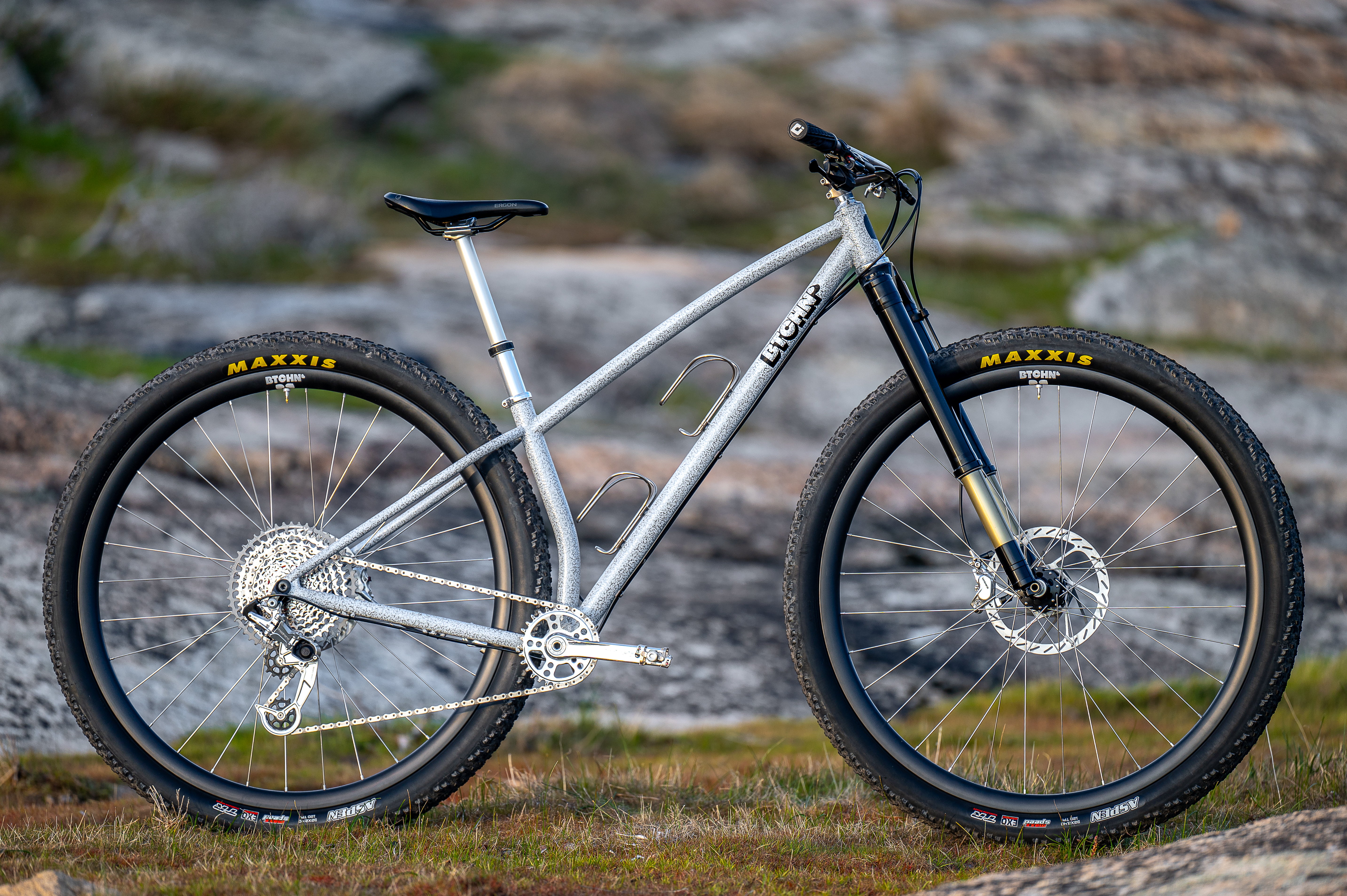
Over the last year or so, 32” wheels have been a common thread on many mountain bike media platforms, including Singletracks. While this larger wheel size initially seemed like a unique one-off on equally unique bikes at trade shows, it now seems to have filtered into the industry’s bloodstream.
And while we’re seeing changes in mountain bike geometry and suspension tech begin to level out, it seems that 32” bikes could shake things up again. But, do the pros of 32” wheels outweigh the cons? And is this latest transition going to be like the shift to 29” wheels in the 2010s?
Performance advantages of 32″ wheels
Bigger wheels are known to roll faster owing to increased momentum and larger contact patch with the ground. “It rolls faster. It definitely rolls faster,” Vassago Bikes owner Tom Ament told Singletracks recently. “And it seems like you can push a little bigger gear” thanks to the increased efficiency. In fact this is why cross-country racers first gravitated toward 29er wheels in the early 2000s and why some are experimenting with 32″ wheels today.
Joe McEwan, founder of Starling Cycles, has been riding around on his Big Bird for the last several months, noting the differences with a 32” front wheel. According to McEwan, the increased roll-over performance of the 32” wheel is noticeable. But, McEwan said, it is marginal gains, at best.
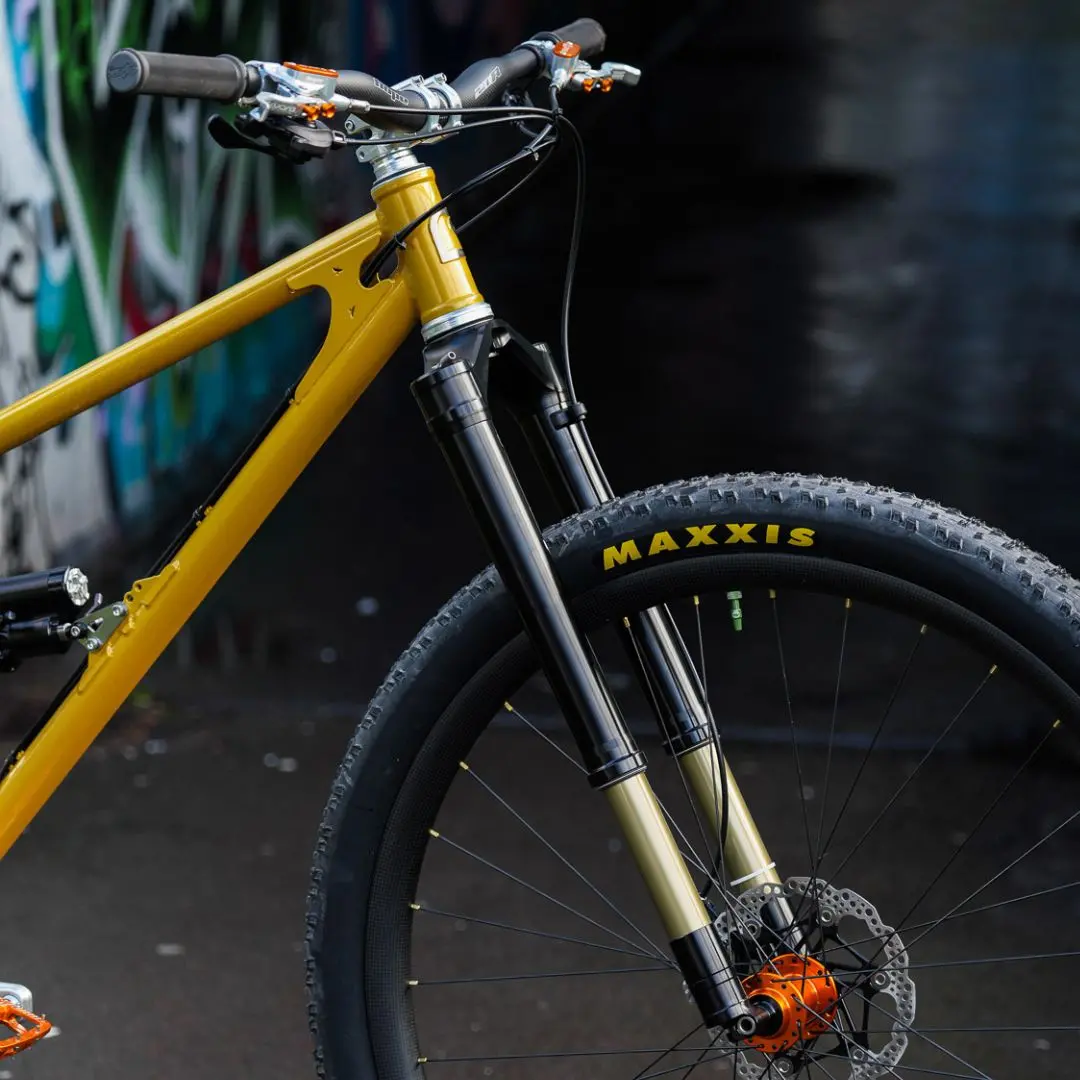
“It’s a little change. And, I think this is the problem, isn’t it? Because racing is always used as an example, and then they blow up the importance of marginal gains, but they don’t matter for everybody else,” McEwan explained.
At the highest XC race levels, McEwan can understand the benefits of 32” wheels. But for the weekend trail ride with your mates, you’ll see more impressive gains by not being hungover or stopping at the “loo” before a ride.
What McEwan really pointed out was the 32” wheel’s gyroscopic stability. He explained that the bigger wheels track very well, staying incredibly planted to the ground and providing good traction.
“I mean, the thing is fast,” Ament said. “When I went from 26 to 29 you know how, like when you accelerate on a 29 versus a 26 they just felt slower, but they weren’t. This doesn’t feel — you don’t get those feelings on this. It’s really nice. It’s a really nice wheel size.”
Larger, 32-inch diameter wheels are less likely than smaller wheels to get hung up on rocks and roots, or sucked into holes in the trail. Ament notes that today’s wide, large-diameter, high-volume tires like the 32×2.4″ Maxxis Aspen help to “smooth things out a little bit more.”
Finally, for exceptionally tall riders, 32ers can offer a better, more proportional bike fit.
But there are disadvantages to 32″ mountain bike wheels
However, that planted feeling comes at the price of cornering. The bigger wheels track well while going straight, but are quite a bit to manage in the turns. And while you might get used to this, physics don’t change: bigger wheels will have a larger turning radius.
Another disadvantage, at least currently, is that buyers have limited choices when it comes to bikes and components, and prices are high. Though we are beginning to see more brands building 32” bikes, a common thread is that 32” components are incredibly hard to find.
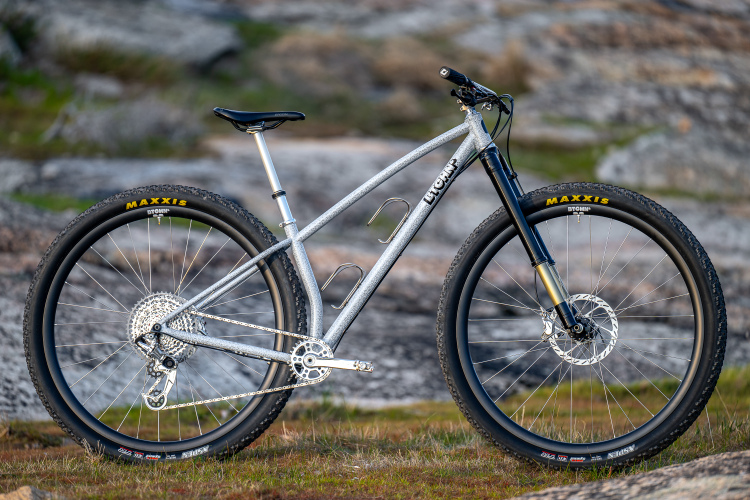
Rare components equal expensive components. Starling’s Big Bird, a 32/29 mullet bike based on the Mega Murmur, certainly isn’t cheap. For those willing to fork over the dough, the handmade frame, special fork, wheels, and tires will set them back over $7,000.
And, along with 32” bikes being a more expensive endeavor, the bikes are also heavier. Simply put, bigger means more material, and that equates to higher weights.
Bike fit is another challenge when it comes to 32er mountain bikes. In a conversation, Vassago’s Tom Ament told Singletracks’ Editor-in-Chief, Jeff Barber, the difficulty of building 32” bikes for smaller riders. Ament explained that one of the key geometry aspects of building a bike around 32” wheels was keeping the bottom bracket relatively low, around what it would be on a 29er. With the extra bottom bracket drop and larger wheel size, there is no room at all to get behind the saddle on smaller frames.
Ament also mentioned that the front of the bike has to be significantly taller, making it relatively unwieldy for shorter riders. To remedy this, a rather drastic negative drop stem can be used, but it will still leave them with a particularly tall front end.
Will this be like the shift to 29ers from 26″ wheels?
If you rode mountain bikes (or were even born) in the 2000s, you likely remember seeing 29” wheels rolling at your local trailhead for the first time, back when 26″ wheels were the standard. Truth be told, 29” wheels were around even before that. In the late 90s, frame builders like Gary Fisher were toying with larger 700c road hoops to see how they’d fare on the trails.
In the early 2000s, Fisher was one of the first to bring the bigger wheel size to production. Back then, 29- wheels were almost exclusively reserved for XC riding and racing. In fact, the UCI officially approved the larger wheel size in 1999, when they updated their rules, although “700c,” the more common term at the time, was used.
Throughout the 2000s we saw more XC bikes adopt the larger wheel size. As we entered the late 2000s, and especially into the 2010s, 29” wheels became the norm on nearly all XC bikes, and more trail bikes. Then they moved into the gravity realm.
27.5″ wheels came, and mostly went
Tweener, 27.5″ wheels offered a good “balance” between 26” and 29” wheels. Riders still had some of the agility they loved from the smaller, 26” wheel size, but with the added rollover and control of the larger size.
But, for whatever reason (we’ll let you tell us in the comments), 27.5 was short-lived, remaining now mostly as a rowdy rear-wheel option. Clearly, 29 has taken over the industry.
In some cases, the transition to 32” wheels is feeling similar to the change to 29”. Sam Alison, founder of Singular Cycles, writes on the design similarities between frames for 29” and 32” wheeled bikes. Alison found that key geometry aspects, such as chainstay length and bottom bracket height, were concerns when designing frames for both wheel sizes, despite the two timelines being decades apart.
However, adopting a 32” wheel presents unique challenges that the 29” transition simply didn’t have.
The transition to 29” wheels was gradual, with over a decade from their introduction to the size becoming the norm. The reality is, 29” wheels were already becoming standard on XC bikes long before they made their way onto our daily drivers. And when they did, the necessary components were already there: tires, forks, wheels, etc.
During this time, many companies were also still working with aluminum. It is much simpler and cheaper to rework a metal frame to accommodate larger wheels than to commission new carbon molds. This is why all the current 32” frames are from smaller, boutique frame builders, crafting from aluminum or steel.
Simply put, as we transitioned from 26” to 29” wheels, 29” wheels were already widespread, albeit on the XC side. While brands like DirtySixer toyed with 32” wheels a decade ago, those were one-off projects. At this point, today, the 32” infrastructure simply isn’t in place at scale like it was when 29” bikes went mainstream.
For riders who do decide to switch from 29″ to 32″ wheels, Ament says the difference doesn’t feel as big as it did from 26″ to 29″ wheels. “I thought the jump from 26 to 29 was pretty drastic. It felt, it felt way different. But from the 29 to the 32 it’s not that big a jump.”
32ers are unlikely to unseat 29ers, but there is demand for them
When asked if 32″ wheels might one day rival 29ers, DirtySixer founder David Folch said he didn’t think so. “It’s not about replacing 29 or signing the death of 26. I’m totally against that idea. I still believe that all wheel sizes have a usage, depending on the rider’s height, depending on what you need from your bike.”
“The 32 is just going to be an additional solution for people that are interested, and that are maybe over 5’8″, 5’9″, and are curious enough,” he said.
Ultimately, McEwan doesn’t see 32” wheels as being particularly good for the industry. He acknowledges that larger riders need larger bikes, but feels that can be accomplished with 29” wheels. The major rub with very large frames, even on 29” wheels, is that they look funny. According to McEwan, the most significant thing 32” wheels will do is make the largest frames look more proportionate.
And, if the industry goes that way, he fears it will make an already expensive sport even more out of reach.
“You’re not going to be able to upgrade a 29 to a 32,” McEwan said. “You’re going to have to buy a whole new bike. And all that means is–I’m being very cynical about this–you’re just making people spend more money. You’re making the sport less attainable. You’re making the sport worse.”
So, why build the Big Bird? Simply put, McEwan can. Starling is a small operation that hand-makes frames and is in the perfect position to try.
And, since mountain bikers love shiny and new things, McEwan also knows he’ll sell more than a few.



0 Comments