singletracks is mountain biking
Sign In | Create Your Account | Site Map | Help  


Dakine Sentry Jersey and Sentinel Glove Review

Thursday, November 3rd, 2011

Sentry Jersey

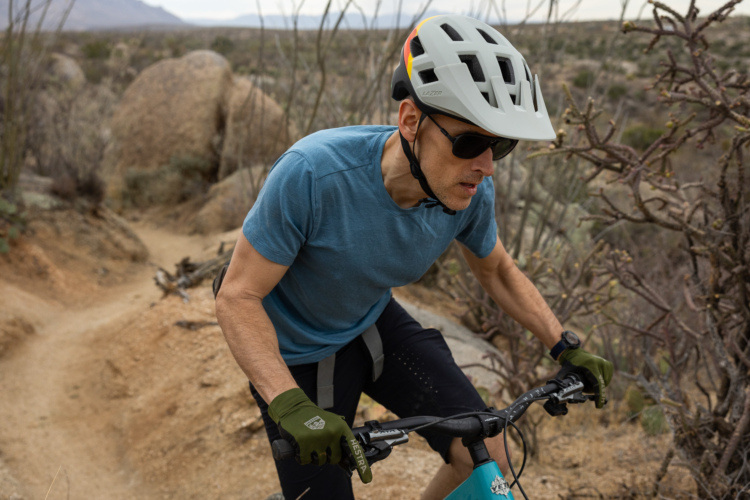
The Sentry Jersey from Dakine is a baggy t-shirt-style jersey designed for downhill mountain bikers. It features a very roomy design to accommodate bulky pads and body armor underneath. Special features include mesh panels that run down the side for excellent ventilation, an anti-bacterial fabric treatment, an eyewear chamois located on the left interior sideseam, and eye-catching sleeve graphics.

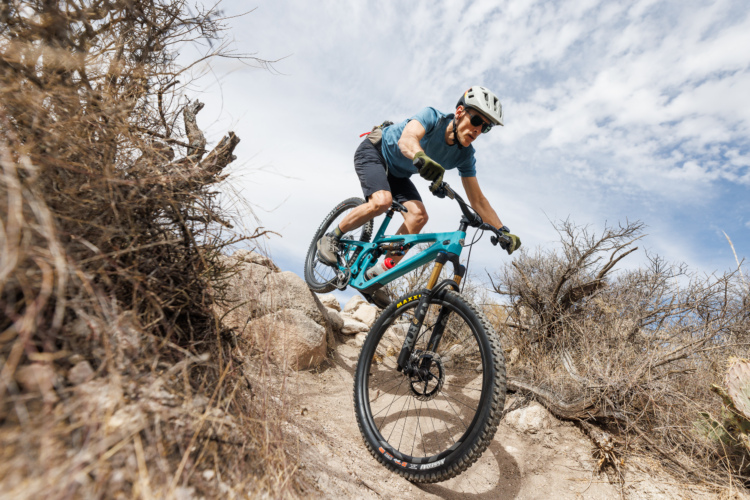
Wearing the Dakine Sentry jersey, Sentinel gloves, and Syncline shorts.

Based on my personal experience with the Sentry, this jersey breathes very well even with serious body armor on thanks to the mesh side panels and lightweight fabric. I was actually surprised at how light this jersey is, and yet somehow it still feels durable enough for shredding. It’s lightweight which makes it comfortable on a cross-country or all-mountain ride, but it does feel pretty baggy without body armor. No worries – this jersey is meant for the chairlift!

Downhilling at Crested Butte Mountain Resort in the Dakine Sentry, Sentinel, and Syncline.

I really like the subdued graphics on the Sentry – to me they’re understated but stylish, not bright and obnoxious like many DH jerseys I’ve seen. The Sentry is available in black, burgundy, and concrete (tested).

The Sentry offers an excellent blend of comfort, style, and performance. And for only $50, it’s hard to go wrong!

Sentinel Glove

Dakine’s Sentinel full-finger glove features padding on the knuckles for plenty of protection, an adjustable velcro closure, and a D30 flexible palm that features synthetic suede and a one-piece seamless construction. The two brake fingers on each hand feature silicon grip for maximum control.

The seamless palm construction completely eliminates any possible pressure points. However, the stiff d3o padding can definitely take its toll if your hands aren’t up to the challenge. The first several days I used these gloves I developed some serious blisters, but after a couple of months of use those blisters have transformed into durable callouses, and I can ride for hours without a problem. I have noticed that the uniform padding gives me more control on the trail – there’s nothing to dull the feedback from the front end, providing a very snappy, precise feel.

Despite being full-finger gloves, the Sentinels feature excellent venting and are comfortable even on cross-country rides in 80 degree heat. If the temps get much warmer than 80, though, I’ll probably be reaching for a fingerless glove.

The knuckle armor is respectably burly and has saved my knuckles from several trees that were way too close for comfort!

The only possible negative that I have to mention from my test is that the silicon grip at the ends of the index and middle fingers has started to peel away. At present, there is only about 50% of the original grip left.

The Sentinel is available in black (tested) and white.

MSRP: $40.

Many thanks to Dakine for sending out the Sentry and Sentinel for review!

Two MTB Trails, One Day: Enjoying my Fall Break

Tuesday, October 25th, 2011

My college gives us one day off for “Fall Break.” I’m not sure how a 3-day weekend qualifies for a vacation, but apparently it does! I decided to make the most of this precious time, so I hit the road and drove over to Ellijay, Georgia to investigate a couple of trails I’d never ridden before.

Ridgeway

First on my list was the Ridgeway Loop. I had heard that the hills were short, very steep and anaerobic, and that the trail didn’t receive much traffic… these reviews were dead on.

This photo is very characteristic of the entire trail.

This is definitely an old-school trail design that sends the singletrack straight up and straight down all the hills. Still, in spite of the design flaws, most of the climbs are manageable due to their short overall length; going anaerobic can be tough, but it can be done for a short time.

As for the condition of the singletrack itself, the trail doesn’t seem to receive much traffic at all. There were sticks, branches, and leaf litter on the main tread for miles. It was hard to tell, but it looked like the brush on the sides of the trail had recently been mowed down by a brush hog, and some of that debris fell on the singletrack as well. As a result, it might possibly receive more traffic than it appears to, but from one ride it was very difficult to tell.

Of course, the entire trail wasn’t actual singletrack… some rather lengthy sections were old doubletrack forest roads, and one section ran through what looked and felt like a tilled-up field, but there were a couple of singletrack jewels thrown in, too.

Hands down, the best section of trail was the last mile that drops down from the paved road junction before the turn off to the mountain bike parking and runs directly to the parking lot. This mile featured a modern trail design, and it looked like it had been cut more recently than the rest of the trail. However, it didn’t ride with the feel of a brand-new trail, so it’s difficult to say when they put this section in. Hopefully there is more of this in store for the rest of the trail!

When I dropped out into the parking lot after finishing with this swoopy delight, I had to ride back up the pavement and drop in again!

Taken on the best section of singletrack.

Downhill Trail

I had heard rumors of a downhill trail here at Ridgeway, so I packed my downhill rig, just in case. As my downhill bike isn’t in the best condition at the moment, I didn’t spend a lot of time trying to find the downhill course. I figured that if I saw the trail on my cross-country ride, then I’d go and check it out. Well, I didn’t see it, but when I got home and looked at the reviews, I realized that I should have read GoldenGoose’s review before I left, as the downhill trail apparently doesn’t actually touch any of the cross-country trails, but is very close to the parking lot.

Perhaps that’s another reason to go back and visit, but I do need to do some maintenance on my DH sled before I return!

Woodring Branch: Amadahy Trail

After spending too much time riding and hiking around in circles at Ridgeway, I finally made it to Woodring Branch to check out the Amadahy Trail.

Both of these trails are on the shores of Carter’s Lake, but they couldn’t be more different! While Ridgeway was steep, old-school, and anaerobic, Amadahy was very flat, easy, and flowed like a water slide!

The singletrack featured a beautiful bench-cut design that circles a large knob right on the shore of Carter’s Lake. The tread was mostly smooth with a light gravelly feel and is very fast, but there were a couple of entertaining sections of rocks and roots to break up the action.

While Ridgeway only provided views of Carter’s Lake, if you took a detour off the main trail, Amadahy follows the shore of the lake for about two thirds of its length. There are stunning views of the blue waters around every turn, with many opportunities for gorgeous photos.

At only 3.5 miles long, I just had to do two laps on this trail. Even then, 7 miles didn’t feel like enough. This is a wonderful little gold nugget of a trail, but it certainly isn’t a gold mine. If you live relatively close and want to check this place out, I highly recommend it, but there’s just not enough trail to make me drive an hour each way to get here again.

Your Turn: Have you ridden a new trail recently? Which one was it?

Dakine Sequence Pack and Blitz Jacket Review

Thursday, October 20th, 2011

You’re probably thinking – a pack and a jacket, in one review? Well, why not?

Dakine, in case you haven’t checked them out yet, is a big manufacturer of quality gear for mountain biking and other action sports. Not only do they produce great packs and luggage, but they also offer an extensive line of clothing for both men and women.

Sequence Pack

Having really stepped up my camera gear kit, I needed something just as serious to keep it all safe when I ride to take my pics. Now, seeing that most of my riding is on the slopes as of late (DH is just too much fun), and a fall could really ruin my day (not to mention my equipment), I needed something with a bit more padding than my old setup. The Sequence pack is just the ticket.

This mid-priced bag has enough room to carry all my camera gear, laptop, and more. The padded block allows you to carry your camera body and a barrage of lenses but you can also remove the padded camera block and configure it to exactly match the gear you’re hauling.

I set up my bag so that the camera body and other small parts sit in their own section, while each lens is cradled in its own padded cube. My flash, charger, and extra battery sit in another padded section which protects all the gear, keeping it from bouncing around. The great thing about the padded block is that it has full-length velcro so that you can set the bag up virtually any way you want.  The actual Sequence bag holds my laptop, mouse, power supply, pens, notepad, and technical manuals in the zip flap. The main flap also has room for a 15″ laptop and two small organization mesh zips to hold other stuff (ID, credentials, snacks, and the like).

Up top there is a zip pouch that holds the deploy-able rain cover. I also use this pouch to store my Blitz jacket. Two side pockets can hold water bottles or, when zipped open, a tripod. A big plus to the pack is the robust waist and shoulder straps which rivals the best hydration packs for comfort. In the waist strap there is even extra padding for the small of the back.

Using the Sequence for every bike trip and hiking situation I could muster, I have to say that I love this pack. I was a bit nervous when I first started carrying the big kit (what I call all my gear), but once I got used to the extra weight I was fine on all but the craziest of slopes. Not only does it keep my 15+ pounds of photo and computer gear safe (weight weenies are cringing right now), but when riding to spots on the slopes I appreciate the stability of the pack. Yes, the amount of gear I carry is a bit extreme, and most people may not take that much with them. My point in bringing this up is how much gear you can carry and still keep everything safe.

When things got a bit wet, all of my gear stayed nice and dry, thanks to the full construction of 420D Nylon and the easy-to-deploy rain cover (I still sprayed Scotchguard on the cover for added protection). On long trips, I doubled the space and packed my clothing in the main 33 liter compartment, while still carrying the padded camera gear along.

Blitz Jacket

The Blitz jacket is another super product from Dakine. Coming into the fall season, this is a must-have item here in Ontario and especially in BC, where we get a lot of rain during the fall. Packing water resistant gear is a must, and the Blitz is a great jacket. Constructed with a nylon outer shell and a polyester liner, this jacket is breathable too. It also stuffs in a pack easily.

The fit on the Blitz is roomy which is great if you’re wearing armor. If you usually ride without body protection, go one size smaller than you usually wear. This jacket holds up well to washing (I wash using cold water only).

The Blitz features two front zips with pockets and vents (all in one) and one left breast pocket. The full-length front zip is weatherproof, and there is a rear vent to help regulate body temperature. One of the Blitz’s coolest features is that the hood can easily accommodate a helmet or can be pulled closed (with the draw strings). The cuffs are adjustable with a very nice velcro arrangement which keeps the long sleeves from sliding up. The Blitz is not cut like a typical cycling jacket with the raised front and lowered rear waistline. Instead, this jacket features a regular cut, making it far more versatile since I can use it both on and off the bike. The waist does have a drawstring to allow you to tighten up if necessary.

The Blitz is rugged enough to be used as an outer layer even if you’re on a freeride rig and the durable shell can take abrasion from those close encounters with trees and bushes. The jacket also does a great job of keeping the wind out. This time of year when the weather can (and does) change quickly I keep the Blitz handy all the time. The jacket can get a bit too warm at times, especially if you’re in a high humidity situation. But seeing that fall is here with lower temps and humidity, the Blitz makes perfect sense.

The Sequence Pack runs $205 MSRP and the Blitz Jacket is offered at $170 MSRP. The Sequence pack comes only in black while the Blitz is available in Charcoal (pictured) or a style called “Phantom” which is a dark, textured color.

Thanks to Dakine for sending these items up for a review. Check out Dakine’s website for more great MTB gear.

Light & Motion Seca 800 Review

Wednesday, October 12th, 2011

I probably mountain bike at night more than most folks – usually once a week year ’round, including the summer. One thing I’ve found is that nothing takes the fun out of a night ride more than having a bad light. A proper mountain bike light should be durable and reliable while offering proper illumination on the trail, allowing you to ride the same way you ride during the day. The Light & Motion Seca 800 does all of the above better than any light I’ve owned.

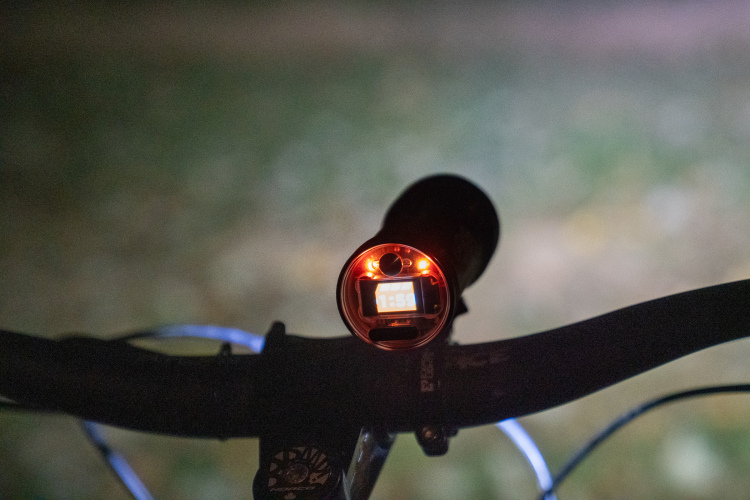
So let’s start with the stats. On paper the Seca 800 features 6 LEDs pumping out 800 lumens for 2 hours and the whole package (battery and head unit) weighs in at 341 grams. In the real world the numbers turn out even better – I got at least 2:15 run-time on high at 328 grams. There are settings for low, medium, high, and flash mode; charging time is about 2.5 hours. Viewed from the side the Seca 800 looks like a bank of stadium lights torching the singletrack.

On the trail the first thing mountain bikers will notice about any lamp is the beam pattern and projection. Light & Motion likes to point out that lumen count is just one factor in determining a light’s effectiveness; the pattern the light forms is almost equally as important. And this is where the difference between the Seca 800 and a single bulb and reflector unit is readily apparent. The Seca 800 beam is hotspot-free and works equally well mounted on the bars or the helmet.

That last bit is a big deal (to me anyway). A bright single bulb light works OK as a helmet lamp because you can turn your head to point the light where it’s needed at any given time. But oftentimes that means making unnatural movements or worse, taking your eyes off the line in front of you when you can least afford to do so. Mounting the Seca 800 on the bars also places the weight of the light and battery on your bike rather than on your helmet or in your jersey pocket.

Even mounted on the bars and without a supplementary helmet lamp, the Seca 800 does a great job illuminating short drops and low hanging tree branches, better than any other light system I’ve used. On the trails I typically ride I’ve found I can get away with keeping the light set on low or medium for most of the ride, though I suppose if I was a faster rider I’d need to ramp up to high more often.

The included bar / helmet mount clamping system is really simple and effective – just pull the rubber strap tight and hook it over the plastic pin. Once the strap is in place it doesn’t move; in fact it’s so stubborn that whenever I need to angle the light up or down slightly I have the release the strap – it’s that tight.

Light & Motion uses robust cable connectors that create serious suction to keep everything connected during the ride. There’s nothing worse than having a cable snagged and suddenly being left in the dark. In more than 2 months of riding with the Seca 800 I haven’t had a cable jiggle loose or get disconnected.

The Seca 800 features an intelligent power management system that warns you when you’re running low on battery power. In my tests, after about 2 hours, 15 minutes on high the lamp dimmed a little. According to the manual, the green LED on the power button should start blinking at this point but mine never did (this isn’t really helpful anyway if the light is on your helmet). After the initial dimming I got more than an hour and fifteen minutes (!) of additional run-time on high, though at a slightly lower light output level. With just a few minutes of run-time remaining, the Seca dropped the light output again and flashed the main lamps. At this point the green LED on the power button should also flash rapidly. With such a conservative warning system, I never worried about being caught out in the dark by surprise.

High, medium, and low settings simulated using Adobe Lightroom software. Can’t see much difference? You get the same effect on the trail at night – switching from high to medium doesn’t change the beam pattern, just the intensity (and even that’s subtle as you toggle from high to medium to low).

I love the sleek headlamp design and even the battery is well thought out with a groove on one of its three sides to fit snugly against a frame tube or stem. The power button could use a little work in my opinion – it’s hard to find, especially with a gloved hand and it’s also hard to tell when you’ve pressed it since the button “click” isn’t very positive. A rubberized button might be just the trick here so the texture stands out from the smooth metal and plastic surface on top of the lamp.

If you’re looking to extend your mountain bike season with a new light this fall, don’t let lumen counts and battery life numbers blind you to what’s really important: performance on the trail. The Light & Motion Seca 800 ($499 MSRP, $129 for an extra battery) is easily the best light system I’ve owned and offers reliable, effective illumination in a variety of terrain. Don’t get caught out in the dark this fall!

Manitou Revox Pro MTB Shock Review

Monday, October 10th, 2011

I’ve had the pleasure of testing quite a few mountain bike shocks back-to-back this season, including the new Revox Pro from Manitou. The Revox has gone through a few cosmetic changes and internal tweaks recently. On the surface the new Revox definitely looks much more polished compared to what it looked like a few years back.

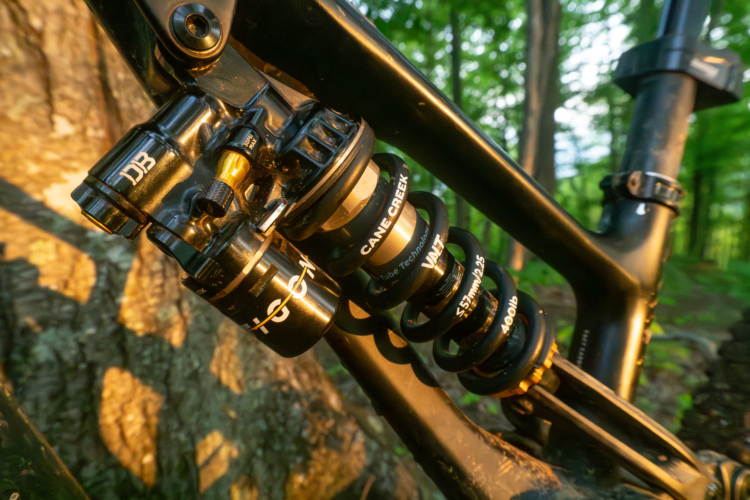
The Revox Pro is Manitou’s top-level rear shock and is best matched with the Dorado (or any other dual-crown fork). Coming in at about 450 grams without spring (depending on length), the Revox Pro is ready to rock. With a battery of adjustments (HSC, LHS, rebound, pre-load, and no-tool volume control) this shock can be tuned for anything you can dish out. To ensure that last statement holds true, a 14 mm hard-anodized damper shaft has been incorporated to keep things under control. Cosmetic changes to the anodizing and a new black damper body give the shock a fresh new look.

A shock with this many adjustments takes a bit of care to set up. Doing so correctly produces a rear shock that really shines and keeps you under control. When setting up the Revox, it’s a good idea to write down all the changes that you make. The detents are a bit soft, so recording adjustments as turns from full open / closed works best. Selecting the spring rate (usually manufacturers give you a good idea here) is a start. Consulting Banshee, for example, informed me that I needed a 400lb/inch spring for the correct rate to go along with the Revox. You can tell if you’re right when it comes time to setting up the sag. Usually you only need about 2 turns from initial contact of the spring to the spring seat collars. I wanted 35% sag, so from an eye-to-eye of 240 mm I wanted a compressed eye-to-eye of 213 mm. I tweaked the collar a half turn more, and I was there.

Once that was done, I was off to the slopes for some testing!

Below is a setup sheet:

After the sag, I set rebound, starting closer to the middle of the range and backing it off until I got a wheel that returned fairly quickly but not so quickly as to buck me off the back of the bike. Now I tend to run the shock at 8 clicks from full CCW. It gives me a live feeling in the back without pushing me too far forward.

The next two adjustments are the low speed compression and then the high speed. So again, I set the LSC at half-way and I went and did a few rides. It took a bit to figure out that the LSC was perfect the first time out. I was playing around with both compressions until I found that the mid level, 1.5 turns, was the perfect amount to give me active compression when hitting bumps, but still hard enough for pedaling.

Getting the high speed set was a bit easier. Starting at just over the mid-way point, I went mostly down from there, finding that once the HSC was set to 10 clicks, which is just a bit below the mid-point, I was happy to play with the bottom-out adjustment. Bottom-out was moved to position three with 160 psi in it (10 over stock fill).

After spending some time playing around with the Revox Pro at Seven Springs, Blue Mountain, and Horseshoe Valley, I can say it works perfectly! The Revox never faded, leaked, or had any other defect. I had superior control over the rear of my bike. Over gnarly rock gardens or boosting tables or even hitting 12ft drops to g-outs to step ups, the Revox did an excellent job. A good upgrade would be a Ti spring (hopefully for next season).

The only issues I had were that the LSC detents didn’t click well and it was a bit hard to repeat settings. The small red knob was also difficult to adjust with gloves. The Rebound knob did detent well enough, but it was a bit stiff. If Manitou works out these minor kinks they will have a flawless shock.  Get one of these for your bike for $400 MSRP (springs and hardware extra from $17.00 to $25.00).

Thanks to the folks at Manitou for sending down the Revox Pro for a review.

Dakine Syncline MTB Short Review

Thursday, October 6th, 2011

The Dakine Syncline features an “all-mountain fit” with a 14.5″ inseam. It has a conveniently removable Italian-made Comp chamois, ventilated mesh lining, zippered hand pockets and leg vents, a heavyweight rib knit back stretch panel, side waist tab adjustments, polyester birdseye waistband, and a crotch gusset for an increased range of motion.

But what does all of that even mean? Nothing if it doesn’t translate into a comfortable ride out on the trail.

Out on the Trail in the Syncline

I first tested the Syncline shorts during a long day of shredding the Evolution Bike Park at Crested Butte Mountain Resort. The baggy fit easily accommodated some beefy knee pads without any catching or binding. Thanks to the removable chamois, I think you could easily wear a hip and tail bone protector under these shorts and still feel very comfortable (although I haven’t tried them with one yet). The exterior of the Syncline short is much heavier and tougher than a cross-country short (as you’d expect) since it’s built to survive a few tumbles off the bike now and again without getting shredded to pieces. I’ll admit I took a couple of spills, and the Syncline shorts thought nothing of them.

When is a pair of downhill shorts just another pair of shorts… and when is it something more?

Obviously, the Syncline is designed for the downhill aficionado, and with all of these DH-specific features and its durable build, it excels in this category.

I was surprised to discover that the Syncline performs well in a number of other applications, too.

Cross-country

Despite the fact that these shorts hit below the knee, they ride very well even on cross country rides. I guess the “all-mountain fit” lives up to its name, by keeping them from catching on the knee or saddle. There were several chilly, early-morning rides in Crested Butte when I threw the Syncline on for a little extra warmth, and they were both comfortable and toasty! Obviously, because of the heavy, durable exterior they wouldn’t be ideal for hot summertime rides, but as the temps continue to cool here in North Georgia I am looking forward to many fall rides in the Synclines,

Commuting

The cooler fall temperatures have also convinced me to start commuting to school again. As a result, my Syncline shorts have been seeing significant use as a pair of commuter shorts. They’re the perfect mix between bicycle comfort and classroom style. I don’t have to  destroy my taint on the uphill slog to campus, and I don’t have to pack an extra pair of shorts to change into before class. Dakine’s Phantom pattern (tested) is low-key enough to not draw any weird stares from my fellow English students. Want to sport a different style? The Synclines are available in 5 different colors.

Bottom Line

From the big hit bike to the carbon hardtail to the commuter, the Syncline shorts provide stellar performance and classy style!

MSRP: $135.

Many thanks to Dakine for providing the Syncline shorts for review.

Life Cycles Mountain Bike Video

Wednesday, October 5th, 2011

There has never really been a mountain bike movie like this before. And it may be a long time before anyone else can capture a wisp of the feeling Life Cycles has captured. Derek Frankowski and Ryan Gibb, the creators of this masterpiece, have my respect.

Life Cycles exhibits a paradigm shift in the way mountain bike movies are made. Every scene offers an explosion of color, a lack of color, a thought provoking idea, and then it’s visually stunning again. The cinematography is truly awesome.

But that’s not all that Life Cycles is about. Depending upon your stage in life and what experiences you have had, you relate to the movie in different ways. Growing up around bikes my entire life, I totally get the story–almost as if the movie was playing what someone had read in my mind.

After watching it, all of a sudden a few doors in my mind opened up. Things from the past that were buried under cobwebs and day-to-day life started to emerge again–a purer way of thinking. Getting back to the day when things were simpler, less tech-oriented. As of late, people (myself included) are/were all about the latest and greatest, all about what’s new, what new technology we’re exploiting. It gets to the point where you’re not satisfied unless you have the latest and greatest between your legs when you’re riding… like the lack of a boostvalve or tapered bore piston is going to diminish your ride for whatever reason.

Well, Life Cycles brings you back. Remember that time when you first learned to jump as a kid? That moment when your bike left the earth behind for the first time, that first fleeting second off that rickety soap-box-and-plank jump? Remember that? How about those tracks you left behind in the black earth of the berm you just railed. Other words like “ebb” and “flow” come to mind as well.

Life Cycles provides new ways of looking at that trail: who created it and what they were thinking when they cut the path. Look at the care that was taken to not disturb most of the landscape so that they and you could enjoy the countryside. Appreciate the immensity of the outdoors and some of the epic visages that await you.

All this lies in store for you when you watch Life Cycles. The list of featured riders is impressive as well. Icons in their own niches of riding styles are here: riders like Hunter, McCaul, and Semenuk, to name just a few, will blow you away. Just seeing how big they are and at the same time how small we all are as we ride along the landscape before us is almost indescribable.

Check out Life Cycles: get yourself a copy. It sells for about $35.50 for your Blu-ray player, or you can download it on iTunes for less than $10. Either way, you’re getting something special.

Official Trailer

(here’s the link for those who can’t see the embedded video above)

If you have already watched Life Cycles, what are your thoughts?

Dakine Nomad Hydration Pack Review

Monday, October 3rd, 2011

If any one hydration pack can function as a jack-of-all-trades and still do every single job superbly, the Dakine Nomad is it.

Epic all-day trail ride in the backcountry? Check.

A day at the bike park? Check.

Sessioning a remote DH line? Check.

Short after work spin on the singletrack? Why not?

Dakine has thoughtfully engineered the Nomad to appeal to all sorts of riders from cross country to downhill. In order to appeal to all of those demographics, they incorporated a carrier for a full-face helmet that can also function as an XC helmet carrier with space for extra layers or even your shoes on the way to the trail. Armor carriers hang below the pack, but stay tucked out of sight if you don’t want to use them. A full 100 ounce bladder ensures you won’t get dehydrated on an epic trek and 1100 cubic inches of space guarantee you have plenty of room for those extra layers and emergency supplies. Finally, a mere 2 pound dry weight makes this pack perfectly fine for a quick after-work pedal, even if you don’t need all of the water and cargo space.

Out on the Trail

It’s so nice to use a pack that just plain works and doesn’t require any fiddling or excessive experimentation to figure out where to put everything. The internal organizer pockets are zippered to keep all of the little tools and parts that you need to carry separate, and specially-sized sleeves are already in place to hold both a mini pump and a spare tube. A fleece-lined sunglasses pouch is located safely on top of everything else for when the sun starts going down, and an mp3 holder sits just inside the top of the main storage compartment.

Dakine is serious about usability and design, and they naturally gave the reservoir a dedicated compartment separate from the main storage compartment. One of the greatest features that this pack offers is a stiff back panel with vented ridges that both eliminate barreling from the reservoir and promote airflow to keep your sweaty back as cool as possible. One added bonus that I noticed during a day in the bike park with the Nomad is that the stiff back panel and ridges seem to lock onto your back if you’re wearing a spine protector. The ridges are perfectly placed on either side of the spine protector, allowing the pack to stay firmly in place even if you’re busting through nasty rock gardens or launching booters!

For those epic cross country rides, the Nomad features the same swiss-cheese ventilation pattern on both the shoulder straps and the hip pads. While it’s difficult to quantify, I think this ventilation system significantly reduces perspiration.

But what if you don’t want to wear a waist belt? Well, the belt on the Nomad is removable, allowing it to ride much more comfortably when nearly empty.

Water Reservoir

I think I can safely say that out of every pack I’ve ever used, the Nomad is my favorite. Why does it stand out above the rest? Well, for all of the reasons listed above, for starters.

But in addition, the Nomad features the coolest and most intelligently designed reservoir on the market: Hydrapak’s Reversible Reservoir.

I’ve already blogged in detail about Hydrapak’s intelligent reservoir design, so I’ll just give you the Spark Notes this time around:

  • Durable
  • Quick disconnect hose
  • Strong fold-top closure
  • Completely reversible allowing it to dry quickly, be cleaned easily, and generally eliminate the build up of nast’.

Final Thoughts

All of these smart features allow this pack to function well for every type of rider, and with the best reservoir on the market, the Nomad is a winner. Despite the fact that it is on the large end of the hydration pack spectrum, the expertly designed back panel and straps help the Nomad ride almost as comfortably as a much, much smaller pack. Even though my test is done, I’m not sure I want to switch back to a smaller pack: the extra storage room is always appreciated!

All of my other packs are either gathering dust somewhere in the bottom of my closet or are being used as mere book bags for school. The Nomad is now my hydration pack of choice.

MSRP: $100.

Many thanks to Dakine for providing the Nomad for review!

Schwalbe Big Betty and Muddy Mary MTB Tire Review

Thursday, September 29th, 2011

Nearly all of my MTB wheelsets are UST so I’ve been searching for good downhill tires I can run tubeless. Recently the good folks at Schwalbe sent over Big Betty and Muddy Mary tires to put to the test. In the past I’ve had great results with the Fat Alberts and Wicked Wills, so I was pretty stoked to give these two tires a shot. I chose the Muddy Mary and the Big Betty based on the terrain I typically ride: granite, shale, hardpack (and I do mean hard pack), and sometimes mud that just won’t dry up.

The Big Betty and Muddy Mary both come in a few flavors. I am writing about the Evolution line which is a folding, tubeless, TrailStar version. It’s a mouthful for sure but these days tires are offered at many price points and configurations, making them more accessible and versatile for the rider. Both the Big Betty and Muddy Mary tubeless tires come in at 1100 grams each (XC riders, pick your jaws up off the floor). These tires are a bit heavy but for what they’re designed for and considering you don’t need a tube, the weight isn’t too bad (DH tubes are approximate 200 grams each).

Both tires feature single-ply construction with a thread density of 67 EPI (ends per inch). The Snakeskin sidewall protection is essentially fabric which offers about the same amount of protection as rubber. The tire carcasses along with the tread are designed to prevent side pinch punctures for more safety and stability. Limited Slip Technology (L.S.T.) is also a cool feature: it’s a special rubber compound that reduces the chances of the tire slipping on the rim (helpful if your tire  is a bit too low on pressure). The TrailStar compound is a blend of rubbers with an easy rolling base layer and a medium soft center compound followed by a soft center compound. Schwalbe also offers a softer compound mix called the VertStar which offers a super soft center and side rubbers but those are for DH competition.

The Big Betty 26×2.40 is a true high volume 2.4 inch wide tire. It’s designed for the drier side of things and offers great grip on a variety of terrain like rock, shale, and hard pack. Stability is decent on looser soil as well. I found that I could achieve high levels of braking force with these tires which made me feel comfortable diving into turns. Speaking of turns, the Big Betty transitions well from upright to pitched positions with no squirming in between. This is a great feature for riders who are getting comfortable at riding higher speeds on the slopes.

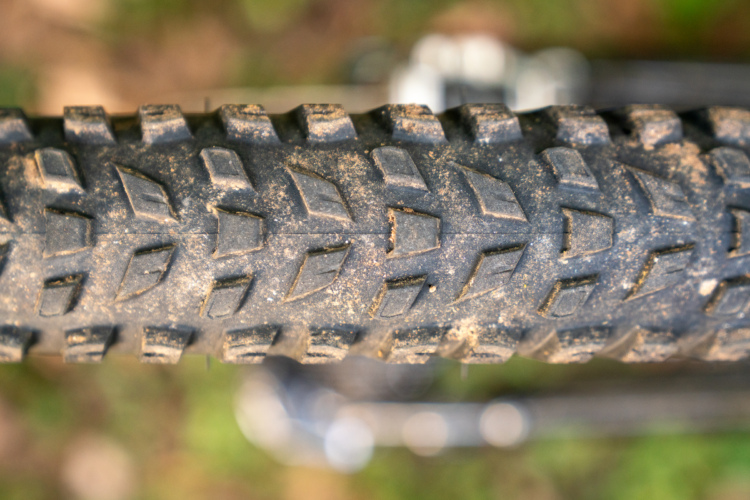
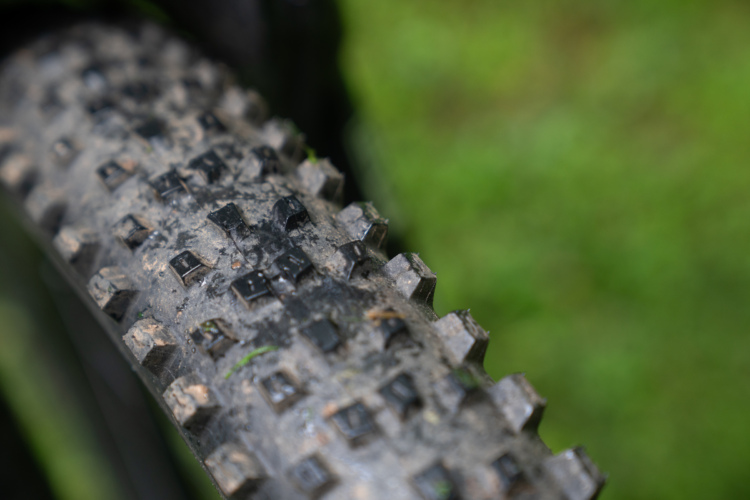
The twin row of sequenced vertical/horizontal ramped and sipped blocks along with a hollow square block does a good job keeping vibrations at bay away while offering high traction. The double row of cornering blocks excel at keeping you on line when pitched. Overall the design of the tire is somewhat tight so mud shedding is not as great as other tires out there.

The Muddy Mary 26×2.35 is another high-volume tire and is actually a bit bigger than 2.35 inches – it’s closer to 2.4 inches. This tire has its pattern arranged more openly with each center block sipped horizontally and the cornering blocks sipped vertically. The open tread pattern allows for good mud and debris shedding.

The Muddy Mary features an alternating wide block and single square block across the center along with a single flanking transitional square knob and aggressive cornering knobs. Due to the very square pattern, these tires don’t roll as well as the Big Betty but offer more grip on a wide range of terrain, including soft loamy terrain.

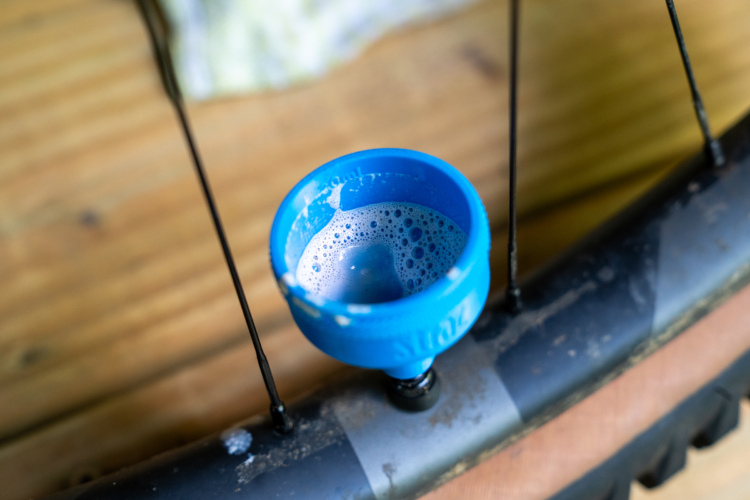
Installation was a snap for both tires on Mavic Deemax Ultimate and Easton Havoc wheels. Both wheels are UST and the tires went on easily with a floor pump and single tire iron. I like to thoroughly lubricate the sidewalls of the tire with soap (diluted dish soap works), and then pump them up to about 35 PSI to let the beads seat properly before I drop the tires down to 25/27 PSI (F/R) which is my running pressure.

How did these tires fair? I found I really liked the Big Betty tires and got used to them right away. You could almost say these were my go-to tire when I was packing my gear. I felt comfortable pitching the bike into corners and braking with confidence. However, the TrailStar compounds on both tires started to show signs of wear after nine full days of riding the slopes hard. The sharp knobs began to tear at their edges, mostly due to the hard braking that was needed to slow down my FR and DH rigs on the slate and hardpack surfaces. The high-speed berms at Blue Mountain are nearly as hard as concrete (talk about packed dirt) and many of the technical areas are on slate. So the amount of abrasion I put these tires through is perhaps more than some will experience.

The Muddy Marys worked nearly as well but I found they were best when used the day after a rainfall when the terrain was moist and the rocks were wet. The Muddy Marys offer a good speed-for-traction tradeoff – it certainly took a bit more effort to get them moving. But once they were heading down the slopes, these tires gripped well. Pitching the Muddy Marys into corners was fun, though I did note a touch of squirm on some occasions (on the harder terrain) but nothing like a Maxxis Ardent (another tire I enjoy). The tread on these tires held out a bit better than the Big Bettys, perhaps due to the fact there was less friction on the tire in the softer soil.

Check out the Schwalbe Big Betty ($90 MSRP) and Muddy Mary ($96 MSRP) tires for DH and FR mountain biking.

I would like to thank Schwalbe for sending down the tires for review.

Spy Optic Quanta Sunglasses Review

Monday, September 26th, 2011

The Quanta sunglasses from Spy Optic are constructed from solid materials and sport a number of features that any mountain biker can appreciate. Plus, unlike a lot of other mountain bike gear, you can actually wear your sunglasses when you’re not on the trail.

Although the Quanta sunglasses aren’t designed specifically for mountain biking (it’s just one of many intended uses), clearly the designers had riders like me in mind. My favorite feature has to be the (patented) Scoop Venting System that reduces fogging when you’re huffing and puffing. Looking closely at the glasses you can actually see the air channels on either side of the glasses that direct airflow toward your face. Now I love a good climb on the bike plus I sweat a lot so fogging lenses is a constant problem for me. The Quantas didn’t fog as much as other glasses I’ve worn though they did still need a good inside wipe every now and then (hey, nobody’s perfect!).

The temple tips on the Quanta sunglasses are some of the grippiest I’ve seen which means they won’t slip when you’re bombing down chunky trails. Of course the tradeoff is they don’t slip on and off smoothly so I have to remind myself to spread the temples to avoid yanking my hair out. The nose pads appear to be made from the same rubbery material for good measure.

The Quantas offer great coverage and protection on the trail and fit closely on my face. My sunglasses feature bronze lenses (there are several other choices including polarized versions based on the colorway you choose) which have worked well in most light conditions I’ve encountered on the mountain bike trail. Of course at dawn and dusk you’ll want to stash these shades but even on fully overcast days the lenses aren’t overly dark.

Spy Optic has a lot to say about the durability of these sunglasses and although I didn’t have a chance to put those claims to the test, I can say the Quantas feel solid and durable. Spy claims the lenses are impact resistant and are “virtually unbreakable” which is reassuring when floating through tight, branchy singletrack. The lenses are also anti-scratch and are meant to repel water/dust/oil. In my experience they do stay clean longer than some other sunglasses I own, perhaps thanks to these “anti” treatments. My pair weighs just under 1 ounce.
Styling is a very subjective part of choosing a pair of sunglasses – everyone has their own idea about what makes a cool set of shades. Clearly trends are important (oversized glasses still seem to rule) but beyond that it’s up to the wearer. I’m not sure if the Quanta styling completely suits me – I usually prefer more rounded frames – but it’s tough to argue with performance. Fortunately Spy offers dozens of styles which makes it easy to find the right glasses to fit your face.

At $99.95 MSRP, the Spy Optics Quanta sunglasses are a great pair of mid-price shades that any mountain biker can appreciate. And with pro riders like Sam Hill and Mike Montgomery repping Spy this year, it’s easy to see the company is dedicated to supporting the ride!

Thanks to the folks at Spy Optic for providing the Quantas for review.

Giant Anthem X FS 29er Review

Thursday, September 15th, 2011
Branding is a powerful thing. Most of us don’t want to admit it or perhaps we’re not even aware of it but when it comes to mountain bikes, something as simple as a name can influence our opinion about a bike. Admittedly my perception of Giant mountain bikes has been that they’re heavy and clunky (don’t ask me where I got this idea – I own a carbon Giant road bike that I really like). So coming into my test ride of the Giant Anthem X 29er I assumed the bike would be a beast on the trail (and not in a good way). And once again I was wrong.

The Anthem X is a full suspension 29er with 100mm of travel front and rear and a full aluminum frame. The SRAM X0 build that I rode was lightweight and seemed to be almost on par with the carbon 29ers I rode during the day.  The stealthy paint job and muted components scream “surgical strike.”

Climbing up the road to the start of the demo course was a breeze but otherwise unremarkable. In fact I could have done the same climb on my hardtail 29er and wouldn’t have felt much difference. The suspension was responsive through dips and transitions but where it really shined compared to other FS 29ers I tested was on the short, steep stingers along the course at Bootleg Canyon. Even slightly out of the saddle on those short climbs the Anthem X delivered without feeling overly twitchy on the descents.

Just one year ago I couldn’t name a single FS 29er that I enjoyed riding but for 2012 companies like Giant seem to have found the sweet spot with XC-style bikes like the Anthem X.  Models are priced at around $3,800 MSRP from your local Giant dealer. This is a fun bike to ride and one that won’t leave you completely worn out at the end of an epic day on the trail.

Trek Rumblefish FS 29er Review

Wednesday, September 14th, 2011

The Trek Rumblefish is a beautiful mountain bike with clean lines, modern hydroformed tubing, asymmetrical chainstays, and hot graphics that I had to ride during my time at Interbike. Like the other Gary Fisher 29er descendents, the Rumblefish has a reputation for being a solid big wheel bike with excellent handling characteristics.

The 2012 Rumblefish is currently spec’d with 110mm of rear travel and a 120mm travel fork which is a bit unconventional – most manufacturers prefer to match front and rear travel numbers. The rep I spoke with admitted the set-up wasn’t ideal and that the frame designers were still trying to make the geometry work (early adopters beware!).

Even with just 110mm of rear travel, Trek classifies the Rumblefish as a Trail bike which is traditionally 5-inch (120-140mm) travel territory. Of course some will argue that a 29er effectively rides like a longer travel bike than one with 26-inch wheels, making it difficult to pinpoint equivalent ranges of travel for big wheel bikes (XC vs. Trail vs. AM, etc.). Anyway, enough with semantics and classifications – I wanted to see how the Rumblefish handled itself on the trail.

On the climbs the Rumblefish definitely felt dialed in and efficient. While other companies are turning to carbon frames to moderate the 29er weight penalty, the Rumblefish is actually quite light despite its fully-suspended aluminum frame. On the descents the Rumblefish was agile and responsive and I had a hard time finding fault with the mismatched front and rear travel. This bike, like most of the other FS 29ers I rode, was a lot of fun on the trail and the geometry felt just right to me.

Still, I never got the feeling that this bike was more of a “Trail” bike than any of the other 29ers I rode at Outdoor Demo. Just about the only thing that screamed Trail to me about the Rumblefish was the wide, 2.4″ Bontrager tires on the demo model. If you ask me the Rumblefish (starting around $2,400 MSRP) rides like a fast, fun big-wheel XC bike in the same way as the Giant Anthem X does. It will  definitely be interesting to see how the frame and geometry on the Rumblefish evolves over time!

Update: The Trek website is now showing the 2012 Rumblefish comes with 120mm of travel front and rear (thanks Neil!). The rep we spoke with at Interbike apparently didn’t have the latest information – either way, the bike rode well!


Site Map | Advertise | Partners | Contact Us | Terms | Privacy
Campground Reviews | Hiking Trails | Trail Running | Skiing / Snow Sports | Mountain Biking
Copyright 2012 Blue Spruce Ventures LLC | Atlanta, GA
singletracks.com is yet another slick Review App