

This time of year really messes with my mountain bike mojo. Yes its cold, but the mountain bike industry makes all sorts of doodads that allow tough guys and girls to keep riding in damn near any conditions, no matter how sack-shrinkingly cold it gets. If I really need to get out and ride Ill do it, enjoy it, then go back inside and warm up with a slanket, a flagon of grogg, and a very high thermostat. But the real bummer of this time of year is how it follows the roughest day of my mountain bike year: Daylight Savings. Whoever thought of falling back should be dipped in Power Goo and thrown to the roadies.
The changing of the clocks is the twist of the knife at the end of the long, slow dwindling of the evening sunlight. Memories of warm nights leisurely shredding your local singletrack, unhurried and enjoyable, fade away and you find yourself frantically calculating if you can get your gear together and to the trailhead in time to get a good ride in before the sun retreats below the treeline. But theres a weapon that modern technology has provided us: the battery-powered trail light. Helmet or handlebar mounted (or both), they can kick out enough candelas to rail full speed down that descent as if it were high noon in August. Just bring your credit card, because bright, high quality gear usually comes at a dear price.
But wait! Enter: the MagicShine. Modern. Attractive. Bright. And at 10 Lumens per dollar it’s cheap. (If youre looking for another adjective, youre a greedy bastard). For comparison, lights from Cygolite, NiteRider, and Lupine fall somewhere between 2.5 and 5 lumens per dollar. But remember the old bike maker’s mantra: “Lightweight, durable, inexpensive. Pick two.” In the case of the MagicShine, as in all of life, there are compromises.
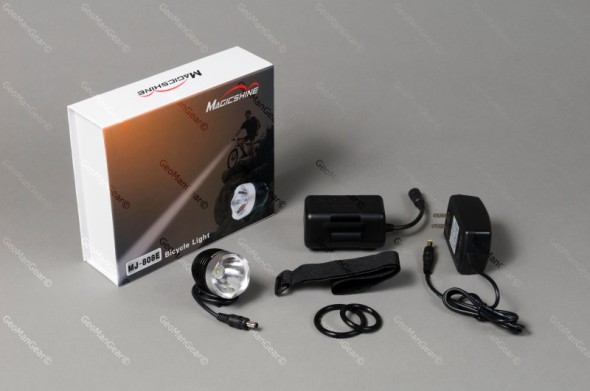
First Ill heap praise on this little fella. Its bright. 1000 lumens, 2+ hours on high no problem. It’s feature rich. High, medium, low settings with a battery life LED indicator in the translucent power switch. Recent improvements to the battery case are great: now you get a weather tight, compact package that can be connected via integral Velcro strap to all sorts of tubes. Stupid simple light mounting. One beefy O ring to wrap around almost all diameter bars, the helmet mount piece (not included but available as an accessory), or whatever else your twisted little imagination can come up with. If thats not enough, it ships with a spare ring.
So, how’s it work?
This thing beats back the shadows. On one of my first nocturnal excursions with the MagicShine I was accompanied by a Big Time parts & accessory manager in the bike biz. He, the guy with every hookup and bro deal there is to be had, compared our lights and admitted the MS was The Bomb. Well, yeah. And on top of all those lumens it was a third the price of his kit. Less weight too. As Gob Bluth would say: COME ON. Hang on, theres a BUT
As we stated earlier, you get lightweight, rugged and inexpensive – but you can only pick two.
A) This one clocks in at 312 grams for the light and battery. Compared to some other systems that claim to put out a similar number of lumens, the MagicShine is right in the ballpark. And for some perspective on how lightweight serious lighting has gotten, thats about the same as 4.6 Clif bars, or a can of post ride Oskar Blues Dales Pale Ale, the single greatest beer to enjoy after a good ride. Says me.
B) Way affordable. $99 bucks gets you a legit-looking presentation box with weatherproof battery, wall charger that charges said battery in around 4 hours, light head, 2 sizes of O ring mounts, and an extension cable for using in your hydration pack (or fanny pack if youre Napolean Dynamite).

C) Rugged: ahhhh, hold on a second. Ill be the first to admit I use gear in a less-than-dainty manner. In my mind it should work in the toughest conditions or its a waste of my effort carrying the thing out into the woods in the first place. Maybe you also have packing neuroses as I do, but after agonizing over each tool, spare tube, extra layer, etc. (and the decision about whether the grams are worth lugging up the hills), I expect that if I brought it its ready in every contingency. If its going to fail, better to do it on my local trails where I can limp home instead of scuttling the trip Ive planned for 6 months.
Anyway, where was I? Oh, the delicate electrical connections of the MagicShine. I used it on a handful of 0Dark thirty road rides and night MTB rides, took it on one motorcycle camping weekend, and then two weeks into commuting on my new cross bike in my new wintry corner of the world it started to cut out while riding. Not the sort of thing you want becoming a habit when youre bombing full daytime speed down your favorite descent in the pitch black of night. Granted, Ive traveled with the light kicking around on my carry-on bag, it has gotten its share of bumps and cable tugs, but felt like a brief life of reliability for my high output buddy.
Still, I think the fact that I promptly bought a replacement speaks to how much I like the MagicShine. For the money it still is at the top of my packing list when Im planning any night ops on two wheels.




7 Comments
Jan 2, 2012
Nice review- I haven't jumped into the light market yet, have the basic small Cat Eye that works well for as little as I use one. This light however seems like it would be right up my alley. I have promised myself to be somewhere a bit more hospitable next winter so will be cruising the light market for sure.
thanks Luke.
Jan 2, 2012
When it comes to design tradeoffs, seems like bike lights are a textbook case. Want more run time? You're gonna need a bigger (heavier) battery. Want a brighter bulb? Same deal, plus your run time will decrease. And in both cases, you're gonna need to pony up more cash.
Good news though: December 22 was the shortest day of the year so every day brings more daylight!
Jan 3, 2012
Jan 3, 2012
I haven't had any durability issues but I'm pretty careful with my gear. Luckily replacement lightheads are too pricey. Most of the cost is for the battery.
Jan 2, 2012
Jan 3, 2012
Jan 2, 2012