singletracks is mountain biking
Sign In | Create Your Account | Site Map | Help  


How to Convert Your Mountain Bike to a Singlespeed

Monday, August 8th, 2011

Hopefully my recent post, One Is Enough, convinced some of you to give singlespeed mountain biking a try.  The nice thing about singlespeeding is you may be able to do it for cheap by converting a bike you already own for less than $30!   You could spend a lot more, but the basic conversion will get you rolling with only one gear and is perfect if you just want to try singlespeeding out.  Converting an old bike to SS is also a great way to breathe new life into it and finally get it out of the garage and onto the trails again.

After riding my SS to help with the One Is Enough article, BrianW decided to convert his old 1991 Trek 830 to a SS.  We did just the basic conversion on his bike, and that’s what this article will focus on.  Future upgrades are included at the end however if you want to do a proper full-on, bomb-proof conversion.


Yep, you can even convert a full suspension bike to SS – you just need a special tensioner.  I used the Yess ETR-V to convert my Anthem for my first taste of SS riding.  I liked it so much I eventually built up a dedicated 29er SS hardtail and retired the Anthem.

Parts You’ll Need

Spacer kit – get one that includes lots of different spacer sizes to fine tune the rear cog position to achieve a really straight chain line.  Some cheaper kits include only two spacers – I don’t recommend these.

Rear cog – if your hub has a steel freehub body (common on most lower end bikes), a cheap stamped cog will work, but if your hub has an aluminum freehub body you should get a dedicated SS cog with a wider base to prevent gouging the freehub body.

Tensioner – this will keep the chain nice and tight and keep it from falling off.  There is a slight chance you wont need it, but very very slight.  Go ahead and pick one up – you can always take it back if it turns out you don’t need it.

Chain – most SS rear cogs will not fit 9spd chains so you’ll need either a SS chain or an 8spd chain.  If you’re converting an older bike it may already have an 8spd chain on it so feel free to reuse that chain on your SS set up as long as it isn’t too worn.

Several companies offer SS conversion kits that include the spacers, cog, and tensioner which is easier and cheaper than buying the parts separately.


BrainW purchased an Origin8 SS conversion kit that included multiple spacers, two cogs, and a tensioner.

Quick note on gearing:  The gear ratio/combo you use is dependent on your fitness level and where you live. Someone in Denver, CO probably needs an easier gear than someone in Savannah, GA.  Ask around your area for recommendations.

Tools You’ll Need

Performing the conversion takes limited mechanical knowledge and only a few bicycle-specific tools.  These are tools every cyclist should own anyway as they’re required for basic maintenance/parts swapping.  This project is a good excuse to get the tools if you don’t already own them!

  • Chain whip and lockring tool – used to remove the cassette from the rear wheel.
  • Chain tool – you’ll need to shorten the chain to the correct size.
  • Big adjustable wrench – used to turn the lockring tool.
  • Various allen wrenches – used to remove the rear derailleur and shifters, install the tensioner, etc.

Step 1 – No More Shifty Bits

This is pretty basic so I’m not going to go into too much detail.  Just remove all of the parts you’ll no longer need:

  • chain
  • front derailleur
  • rear derailleur
  • front shifter
  • rear shifter
  • all shift cables and housing


Won’t need any of this crap any more.

Step 2 – Rear Cog Install and Alignment

Remove the rear wheel from the frame and the cassette from the hub.  Use the chain whip to hold the cassette in place and the lockring tool and adjustable wrench to remove the lock ring.  Once the cassette is off, it’s time to put the rear cog on and get your chain line straight.  You’ll want to use the spacer kit to get the rear cog aligned with the middle ring on the cranks – it’ll take a few tries to get it right.

Put the cog and spacers on the wheel where you think it might be close but don’t tighten the lockring down too tight.  Put the wheel into the frame and lay the chain across the cog and chainring.  Is it straight?  Probably not.  Remove the rear wheel, and move the cog/spacers around to get closer.  Repeat as necessary and once you’re happy with it, tighten the lockring down.  You probably can’t get it 100% perfect, but get as close as possible.  A straight chain will run smoother, wear much slower, and is less likely to come off the chainring.


Nice straight chain line.

Tip:  It’s hard to tell if the chain is straight just by eyeballing it.  None of the frame tubes will be parallel to the chain so it makes it hard to visualize.  Here’s what I do:  place a straight edge (I use a level) on the chainrings extending back towards the rear wheel.  If the chain is straight, it will stay the same distance from the straight edge all the way back.


A straight edge makes it easy to tell if your chain line is good or not.

Step 3 – Chain Length and Tensioner Install

We’re almost done!  Now it’s time to shorten the chain to the correct length.  Without the tensioner on the bike, wrap the chain around the middle chainring and rear cog.  Figure out where you need to remove the excess chain – you want the chain as short as possible – then put the remaining chain back together.  Chances are the chain will be a little too long and you’ll have some slack but that’s what the tensioner is for.  If you get lucky, the gear combo and chainstay length will work out perfectly and you wont need the tensioner.  But, this is rare.


The chain didn’t quite line up perfectly on BrianW’s bike so we had to use a tensioner.  When you shorten the chain be sure take it apart at the correct place, so you have a pair of outer links on one end and inner links on the other – can’t connect two sets of outer links!

Installing the tensioner is easiest if you remove the pulley wheel so you don’t have to fight the chain.  The tensioner should have a spring peg near the derailleur hanger mount – that peg should sit in the ‘hook’ of the derailleur hanger.  The pulley wheel is usually adjustable so you can set it up to match your chainline.


Looking through the wheel, you can see the spring peg sitting in the derailleur hanger hook.

Some tensioners are designed to push the chain down, some are designed to push the chain up, and some can work either way.  A tensioner that pushes up on the chain is desirable because it causes the chain to wrap around the rear cog better, so there’s more teeth engaging the chain and less chance of slip or dropping the chain.  However, a decent tensioner that pushes down on the chain will work okay too.


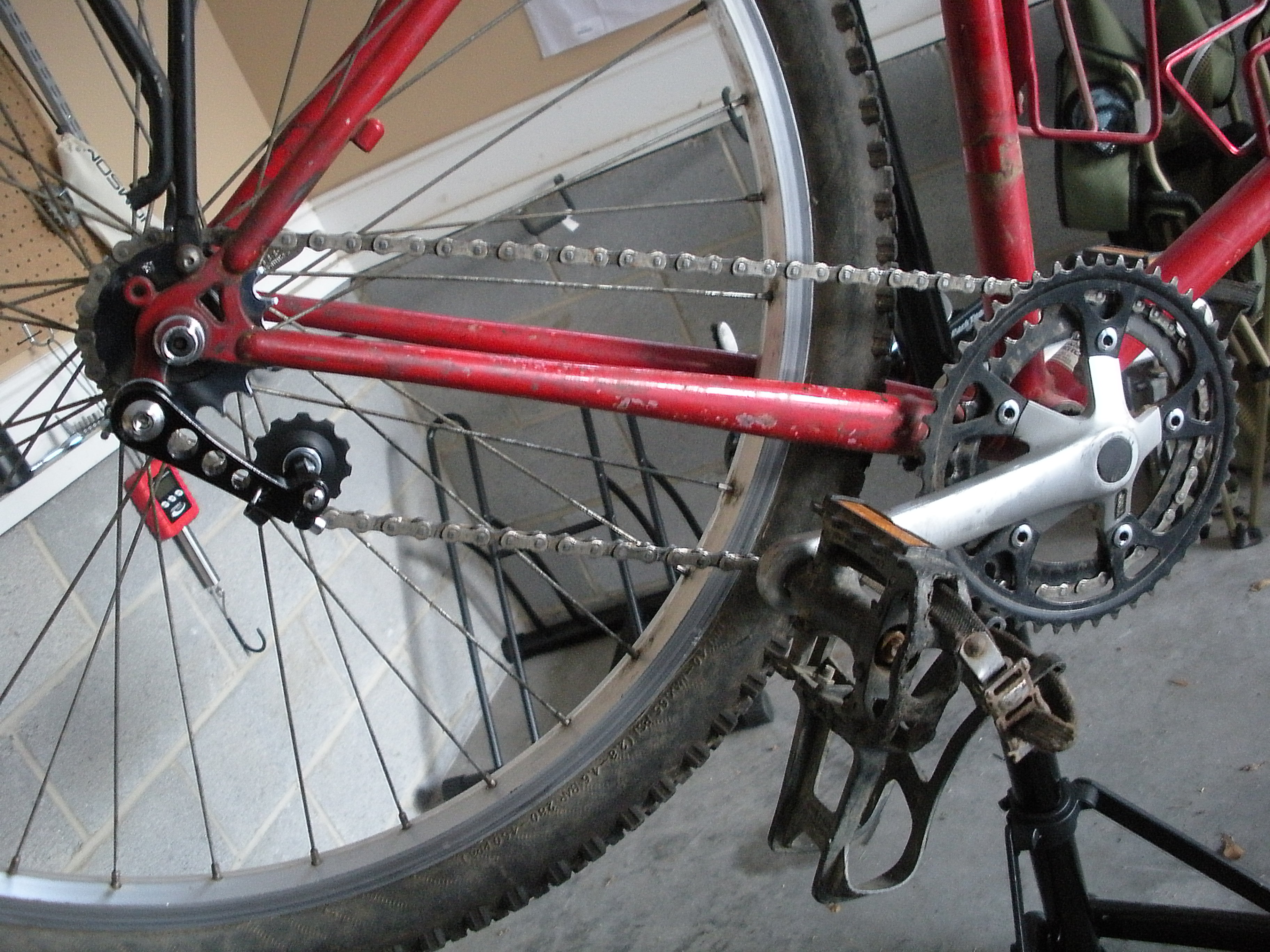
The Origin8 tensioner pushes down on the chain.  This bike is ready to ride!

Okay, you’re done!  Go ride and enjoy the simplicity of singlespeeding.

Go All Out

There are a few additional upgrades you can do to make your SS set-up better for long term use.

SS chainring – A dedicated SS chainring will not have any shift pins/ramps and will have taller and wider teeth than a ring designed for shifting.  The taller/wider teeth are stronger and engage the chain better for reduced chance of slipping and dropping the chain.

Wider SS cog – conversion kits all come with rear cogs that are stamped out of a flat piece of steel.  They are thin and under high load they can gouge into the cassette body on your hub, especially if it is a lightweight aluminum body.  True SS cogs are machined out of a large piece of metal and have a wider base to spread out the load to prevent messing up your expensive hubs.

SS chainring bolts – these shorter bolts will let you remove the big ring from your crank.  Less weight, more ground clearance, and no exposed teeth to cut into your leg in a crash.  And it looks nice and clean.


BrainW’s old bike is now ready to hit the trails once again!

One is Enough: Why You Should Give Singlespeed Mountain Biking a Chance

Thursday, July 28th, 2011

Do you remember the first time you saw someone riding a singlespeed (SS) mountain bike?  I bet your first thought was “what do they think they’re doing out here without any gears?  Don’t they know they have to ride up hills?”  I also bet you were immensely confused when they rode away from you on a climb – I know I was!  After my first SS encounter I walked away with the conclusion that you must have to be a beast to ride a SS MTB – I mean, it’s gotta be really hard, right?  I’m going to let you in on a secret:  singlespeeding isn’t nearly as difficult as you think.  Heck, I rode almost exclusively on a SS for over a year, and trust me – I’m not that strong.

I wanted to do a post that might convince some of you to give singlespeeding a try for yourselves.  There are already tons of blog and forum posts on the interweb about the benefits of SSing (light, simple, quiet, builds strength, etc.) so I decided to do something a little different.  I lent my 29er singlespeed to five non-singlespeed riding buddies to get their thoughts.  These guys and gal are normal riders, they’re not slow, but not that fast either.  They might do a race or two every year for fun, but they primarily ride because they enjoy it.  That’s what it’s all about after all!


My bike, a Vassago Jabberwocky.  25.16lbs of steel-framed, one-geared, big-wheeled goodness.  And yeah, it’s got a bell. 

Rider #1 – BrianW

STATS Age: 40 | Years Riding: 19 | My Bike:  Giant Yukon (hardtail, 26″ wheels, aluminum frame)

Thoughts on the singlespeed:

Within the first 2 minutes on the Keg Creek trail I was reaching for phantom shifters. The one thing that I noticed and could get used to was how quiet a singlespeed is. Just the tires on the dirt. Never knew how noisy the derailleurs were. Also seemed like as soon as I pushed down on the pedal there was power, no delay at all.

I was worried about two climbs: the first one, going up Boulder Creek, was a lot easier than I expected. On the steep rooty climb just after the “Bed Rock” crossing I managed to go up half way before losing momentum and walking the last portion. To be honest though, I struggle up this one even with a geared bike. Long ascents were not as bad – I got off the saddle a bit more than I normally would. Overall the climbs were not as bad as I thought they would be. I am also certain that given a few weeks on a singlespeed that the climbs would be a non-issue. It did seem that you needed to go a certain speed or cadence or else you might be walking.

The downside that I noticed was on long downhills – I wanted to put it into a higher gear to get more speed. Eventually I overcame this by picking up the cadence.  I also rode a section of paved road from Keg to Bartram (in Wildwood) to see how I would like it. Again I was reaching for phantom shifters. And again I had to overcome by picking up the cadence. I believe over time these problems would be non-issues.

Overall I did not miss the gears and the quietness of a singlespeed trumped the few times I really wished I had them.


Less (complexity, noise, weight, parts, maintenance) is more (fun).

Rider #2:  David K.

STATS – Age:  43 | Years Riding:  3.5 | My Bike:  ’09 Cannondale Rize Carbon 1 (carbon/aluminum framed 5″ travel full suspension bike, carbon Lefty fork, 26″ wheels)

The ride: Rode at FATS – Skinny (ccw) -> Brown Wave (ccw) -> Great Wall (cw)
20.2 miles. 1:58 riding time (surprisingly, not slower than on my geared FS bike)
Met Paul F. in parking lot and we decided to ride together. He rode behind. I always ride faster/push a little harder with someone behind me. I rode every hill without stopping; even the 2-mile climb out of Great Wall (cw).

The experience:

  • Several new variables with this bike: single speed, 29er, hard tail.
  • Frame might be too big, stem too long, and seat too far back. Overall though, it wasn’t a bad fit.
  • Never stood and pedaled so much out of the saddle (i.e., climbing). On geared bike, I just sit and spin most/all hills.
  • Quiet. Although, not due to lack of gears but the lack of chain slap (I could hear the chain slapping on Paul’s bike).
  • Going up hills was not nearly as punishing as I feared (I was very surprised). However, not sure if it was the SS, 29er wheels, or the knowledge that if I didn’t get enough speed or pound hard enough I would get stuck? Knowing that there isn’t an easier gear available is a great motivator for hills.
  • I’m not that fast downhill so needing/wanting a higher gear wasn’t an issue for me.
  • It’s hard to qualify but, once rolling, there seemed to be more power to the wheels (lack of RD?) and more momentum when coasting (29er tires?).
  • Actually, I think some climbs might have been easier than on my geared FS bike.
  • I tried to shift with the dingle bell a few times (subconscious thumb movement).
  • Riding a single speed/hard tail probably makes you a better/stronger rider: standing and pedaling out of saddle, focusing on technique during turns or watching the trail ahead to maintain speed/momentum.
  • Here is a shocker: If I had extra money, I would think about getting a SS 29er. Mostly as a “penance” bike for the day after a bad ride or when I bag a ride due to laziness. No cheating hills with a single speed.
  • Won’t give up my geared FS bike, but I can see where a SS might be nice to have for more variety (i.e., switching up trails and bikes) or for training.
  • A few times (long, slight uphill grade, seated) getting the bike rolling faster felt like moving a ton of bricks (might be that my legs were getting tired).
  • Most of the time though, once the bike was rolling, it kept rolling.
  • Really impressed at how (relatively) painless it was to stand and pedal those hills. I wouldn’t have guessed.
  • My casual observations have been that most folks start off with a hard tail, move to a full suspension and, if they’ve caught the fever, eventually get a singlespeed.  Never thought of myself progressing to the third stage but this ride has me thinking.


No shifters makes for a simple, clean, uncluttered cockpit.

Rider #3:  Tom Z.

STATS – Age:  44 | Years Riding:  10 | My Bike:  2001 Gary Fisher Tassajara  (hardtail, 26″ wheels, steel frame)

I don’t know why I was so surprised at how much I enjoyed my trial singlespeed ride.  After all, I spent the first 13 – 14 years of my life riding a singlespeed bike.  And we rode everywhere then – through woods, fields, in the clay pit behind my house.  Gears were something your mom had on her bike – a 3-speed cruiser.  You were a sissy if you had a 10-speed (which the rest of us were secretly envious of).

So I chose the Turkey Creek Trail to ride as it is representative of 75 – 80% of the riding I do.  It really didn’t take long to get accustomed to not having shifters.  Maybe because I have been struggling with rear derailleur issues for so long, but it felt very liberating to ride without gears.  The ride was definitely quieter.  Yes, I had to come out of the saddle a few times more that I normally would have.  I didn’t realize how dependent I had become on a geared bike – down shifting out of habit in the face of an obstacle rather than powering over or up it.  The trail was very trashy from recent storms – a lot of trees and limbs down to climb over and around.  Despite that, I thought my ride time was pretty good – 55 minutes in (7 miles) and about 5 minutes less out.  On this trail, I found myself wanting a higher gear more often than a lower one.  If I was slower than normal, I think it was on the flat and downhill sections when I normally would have pushed into a higher gear.

The bottom line is, now that I have a new geared bike (3 x 10), I convinced myself to convert my old bike to SS.  I’m looking forward to riding it on some more challenging trails.  Maybe my opinions will change when I have to do more climbing.  Hopefully I will get stronger.


Trent rode the SS with platform pedals.  Photo:  Trent S.

Rider #4:  Trent S.

STATS – Age: 34 | Years Riding: 10+ | My Bike:  2011 Specialized Camber Elite 29er (full suspension 29er)

First impressions @ Skinny – like most of the trails at FATS, Skinny starts with a long section of downhill and very, very quickly (within 50 yards of the parking lot) I ran out of spinning speed.  I love going fast, so not being able to do so under my own pedal-power was frustrating at first.  I caught myself trying to pedal a few times where I clearly couldn’t match my rolling speed.  After I accepted the fact that gravity and a light touch on the brakes would dictate my top speed, I got into it.

The first thing I noticed was that instead of barreling down the trail like I do on my 29er FS and grabbing handfuls of brakes moments before potential disasters at big hits or sharper-than-expected turns, I was rolling at a more leisurely speed and found myself enjoying setting up jumps and smoothly carving through corners.  Sure the overall pace of the ride was slower, but it ended up being more enjoyable.  Later in the ride, I also seemed to have more energy than normal.  It could be attributable to knowing I needed to beat the rain back to the Jeep, but I like to think that it was due to the single speed.  Normally I like rolling along in the big ring, pushing hard gears.  With the single speed, I had no choice but to enjoy the ride at a more leisurely pace and it saved my legs for the uphill battle back to the parking lot.  Normally at that point, my quads are starting to feel it and there are a few hills I dread.  Now, even though I was climbing in a tougher gear than I’d normally try to attempt, I had some reserves that pushed me through the steep spots.

I was riding platform pedals again.  If the Jabberwockey’s geometry were a little different, it’d be a lot like riding my old BMX through the woods.

@ Canal trail – Again, a single speed is best in the woods.  It felt really slow riding through the neighborhood on the way to the trail.  Reminds me of when I was a kid riding a BMX.  The easiest thing to do is stand up, pedal as fast as you can for a few moments, then cruuuuise….and repeat.  Once on the canal trail…well, I was concentrating more on getting back to the house in time for Stacey to pick me up for our trip to Beaufort to really notice many differences…except a whole new respect for single speed riders who fly through the woods.  Don’t know how they do it.  There are so many spots on the trail where you could really pick up some speed, but I didn’t manage to do that.  Maybe I’ll try again with clipless pedals.

Bottom line – I’d love to have one.  As a second bike.

Rider #5:  Stacey W.

STATS: Age:  30 | Years Riding:  2.5 | My Bike:  Giant XTC2 (hardtail, 26″ wheels, aluminum frame)

The advantage of riding the single speed on a trail that I’m familiar with allowed me to anticipate and better prepare for the climbs.  For instance, when a tight turn came just before a climb (knowing I couldn’t drop it down a gear to make the climb easier), I didn’t wimp out by squeezing the brakes.  I kept all the momentum I could, went wider and leaned harder into the turns, which is what I should be doing anyway!  It’s good “basic training” and brought me back to the fundamentals of riding (momentum, shifting weight etc).

The workout was more intense and I enjoyed the exertion I felt afterwards. I’d love to have a single speed for a second bike! ;)


Stacey enjoying the ride to the trail.  Photo:  Trent S.

Told You So!

As you can see, everyone enjoyed riding the singlespeed, even if they didn’t think they would.  The proof is in the pudding they say, so here’s my proof:  BrianW, David, Tom, and maybe even Trent are all converting their old bikes to singlespeeds.

Keep an eye on the Singletracks blog – soon I’ll have a Tech How-To post showing you how to convert your own bike to a singlespeed!  It’s a cheap way to try SSing without buying a whole new bike, it’s easy, and it is a great way to get your old bike out of the garage and back on the trails again.

Thanks to Brian, David, Tom, Trent, and Stacey for trying the bike and taking the time to write up their thoughts on it.

What do YOU think about SS MTBing?  Ever tried it?  Tell us what you think in the comments section.

Mountain Bike News: Easton Seatpost Recall, Croc Trophy Stage Race, and More

Monday, November 1st, 2010

Four mountain bike news items to start off the week:

Easton Seatpost Recall

Easton is recalling approximately 200 EC90 Zero seatposts manufactured in 2010. The Consumer Product Safety Commission says the carbon top clamp on the seatpost assembly can crack which, as you can imagine, would really suck for the rider. The release we read made it sound like the seatposts may have been included on some Turner and Ibis bikes so if you bought one of those bikes this year, check your post and the Easton website to see if yours is affected.

Although no injuries have been reported, consumers should immediately stop riding the bicycles and contact any authorized Easton Sports (dealer) for a free replacement top seat clamp.

Croc Trophy Race Wraps up “World’s Hardest” MTB Competition

photos courtesy crocodile-trophy.com.

To be more specific, race organizers claim the Croc Trophy is “the world’s hardest longest hottest and most adventures (sic) MTB race in the world” and this year’s competition just wrapped up a few days ago at the northeastern tip of Australia. Apparently the course takes riders into the Australian Outback and some daily stages are nearly 100 miles long. Just to finish all 10 stages of the Croc Trophy takes serious stamina – congrats to this year’s winner Urs Huber who finished 5 minutes ahead of second place finisher Bart Brentjens and 40 minutes ahead of third place finisher Mike Mulkens. Now’s the time to start training for next year’s epic!

Singlespeed World Champs Recap

We wrote about the Singlespeed MTB World Championships a couple weeks ago ahead of the competition in New Zealand and today we discovered ESPN.com’s entertaining take on the event. My favorite quotes from the article:

“If you are riding really, really fast but don’t want a tattoo, then don’t win the race. The winner will be tattooed at the finish line so decide before you start if you want a tattoo or not.”

If “The Dude” from “The Big Lebowski” was into mountain biking instead of bowling he would have been a singlespeeder.

I think this is one of those things I gotta experience for myself at some point – sounds like a blast! Though I guess that means I’ll need to shed some gears first…

Loch Raven Reservoir Cracking Down on Mountain Bikers

Mountain bikers in Baltimore have been enjoying the 30+ miles of trails around Loch Raven Reservoir for years but lately rangers have been issuing $100 citations for things like night riding (read the recent trail reviews for more examples). According to this article, land managers are becoming concerned about erosion issues affecting water quality and it seems mountain bikers are an easy target. Specifically new “unofficial” trails are popping up and land managers want it stopped – though hikers are just as likely to create unauthorized “social” trails as bikers. Keep an eye on this issue as local club MORE works with reservoir managers to resolve the situation…

Singlespeed MTB Championships in New Zealand This Weekend

Friday, October 22nd, 2010

photo by Alan Ofsoski, fotoengineers.com

The Singlespeed Mountain Bike World Championships are being held in Rotorua, New Zealand this weekend and there are over 1,000 riders from 30 countries registered for the main event. The course covers about 40 km through Whakarewarewa Forest starting at the Waipa MTB park and promises to be challenging, even by World Championship standards.

According to this article, some of the riders plan to wear costumes during the race – and not because it’s almost Halloween (do they even know what Halloween is in New Zealand?). One rider explained it this way:

I guess you can call it the punk of mountainbiking – back when it all got started not too many people were interested in singlespeed but now like punk it has become fashionable. It’s all about having fun – getting dressed up, having a few beers and racing just for the hell of it.

This year’s course offers a shortcut available to riders who chug a beer before hitting the alternate which sounds like a no-brainer to me. Perhaps the coolest part of the Singlespeed World Championships is the prize: the top male and female finishers get a tattoo! The Rainbow jersey is temporary but the Singlespeed World Championship honors are permanent!

And for those of you who are into the Gates Carbon Drive thing, Gates rider Jake Kirkpatrick took 3rd in the singlespeed division of the Whaka 100, a 100km endurance race that kicked off the overall Rotorua Bike Festival this week. Jake rode a fully rigid Black Sheep titanium bike with the new Gates Center Track carbon belt which seems like a pretty solid endorsement.

Lots of other cool stuff is happening around the race this weekend – if you can make it to Rotorua definitely send us a report!

Fixed gear mountain bikes

Friday, January 16th, 2009

Photo by Leif Borgeson, 63xc.com.

Here’s something you don’t see every day at your local mountain bike trailhead: a fixed gear mountain bike. Not to be confused with a singlespeed mountain bike, a fixed gear bike has just one gear but unlike traditional singlespeed bikes it lacks a freewheel hub. This means there’s no coasting on a fixed gear bike – if the bike is moving, you’re pedaling which can get a little tricky out on the trail (watch the embeded video below to see what I mean).


Joe rides fixie through rocky trail section from ricky d on Vimeo.

I’ve been doing a little research on fixed gear mountain bikes and not surprisingly there aren’t many folks out there rocking the fixie on the mountain bike trail. Fixed gear bikes are becoming more popular with the on-road commuting set but even learning to ride a fixie on the road can take weeks. The singlespeed sage himself, Sheldon Brown, had this to say about fixed gear mountain bikes:

Fixed gear is not ideal for all circumstances, however. A fixed gear is not well suited for seriously hilly terrain, and, more importantly, is not good for technical mountain biking. A mountain biker in difficult terrain must be able to control when each pedal is down, to avoid striking a pedal on rocks, logs or other obstructions. Similarly, jumping over obstacles is much more difficult on a fixed gear. If your single gear is low enough for off-road climbing, it will be too low to spin on the descents.

That being said, Sheldon inspired quite a few riders to build up their own fixed gear mountain bikes using the detailed instructions available on his website (including this guy and this guy).

So why would anyone ever want to build up and ride a fixed-gear mountain bike on the trail? Fans of the fixie will tell you the riding experience is more pure and the feeling of a connection with the bike is unmatched. There’s a ton of experimentation happening in the MTB world these days with new wheel sizes (29er, 650b), unusual gearing choices (single speed, 1×9), and retro tech (coaster brakes, rigid forks) so it’s really no surprise that some are attempting to bring the fixed gear to mountain biking. To me this is a really exciting time and I’m stoked to see which MTB innovations (or retrovations, if that’s a word) end up sticking in the long term.

If you’ve got a fixed gear mountain bike we’d love to hear about it – send us pics or post a comment!

Via CycleSnack.


Site Map | Advertise | Partners | Contact Us | Terms | Privacy
Campground Reviews | Hiking Trails | Trail Running | Skiing / Snow Sports | Mountain Biking
Copyright 2012 Blue Spruce Ventures LLC | Atlanta, GA
singletracks.com is yet another slick Review App