singletracks is mountain biking
Sign In | Create Your Account | Site Map | Help  


Mountain Bike Build: A Legend is Born

Wednesday, November 17th, 2010

Ohhh yeah! Finally, after what seemed like ages of waiting, my Banshee Legend II is ready to ride – and this past weekend I got to break it in. After the final parts arrived on Wednesday while I was work, I spent the evening getting everything cut, measured, installed, and torqued in place (more on that in a few).

A project bike like the Banshee Legend II is not something you can slap together and hope for the best. It’s important to look at what you’re going to be doing with a bike like this before you even spec the first part. Flying over rock gardens, drops, step ups, and almost anything else, you gotta make sure the bike (and you!) survive.

Just after arriving home from Interbike back in September, I was stoked to unbox the Banshee Legend II frame. At that point I already had some of the major components handy so I got most of the bike assembled. I installed a Cane Creek XXc headset and moved my Dorado fork over to the new rig. With a frame that’s worth a lot of $$, you may want to get a pro to do this part of the build, or at least invest in a headset press. I added an Answer DH direct-mount stem and my favorite handlebars, the Answer 780 DH, which pretty much completed the front end.

For stopping power I installed a set of Formula ONE brakes and the like-new Havoc DH wheel set I had on hand from last year (gotta hand it to Easton for building such a great set of wheels).

Then, a few weeks back a nice box of components arrived at my doorstep from SRAM with X.O shifting and the new Descendant crank (same one Peaty rides with). Now some may wonder why I decided to put a 10-speed drivetrain on a DH bike (many riders may argue a 9 or even 6 speed cassette is good enough). Three reasons: I’m not interested in butchering a cassette just to get a six-speed drivetrain, 10-speed spacing is tighter so shifting speed increases, and, perhaps most importantly, I’m no pro so I need a few extra gears when I actually have to pedal on the flats. :)

After another long night of installation and getting all the gears perfect and shifting amazingly on the stand, I had to wait on a rear shock and possibly a matching front fork. Well just last week a rather large box arrived, once again from SRAM. I got everything I needed to finish up the Legend plus two other bikes I’m building for next season (get ready for some interesting reviews and great products). This delivery added the new Vivid Air RC2, the BoXXer WC, and the new Code brakes. So yup, I had work to do. Off with the Dorado and on with the BoXXer as well as installing the Vivid and the new Codes. Looking at the bike I realized that this is turning out to be an almost all-SRAM DH bike.

Finishing off the bike with pedals, grips, saddle, and seatpost, I was still a few hours away from completion. Getting the cable and hose lengths just right is important and shouldn’t be rushed. After all, perfection is in the details so I ended up using Gore cables (love those so much!) for the rear derailleur to make sure the shifting is as smooth as possible. In fact these cables from Gore are a bit different from previous versions; unfortunately I can’t tell you how yet (they’re still top-secret). Anyhow, I also spent some time bleeding the Codes after I shortened the hoses; now I was ready for testing!

This weekend I took the Legend II to a local area where I could do some DH pre-testing (rock gardens, step downs, jumps, gaps and table tops abound). After a few runs I realized many of the components need a break-in period before they’re operating at full performance. Needless to say I still had a blast and I can’t wait to get more serious test rides in on my project bike.

I am very greatful to everyone who helped make this bike happen. Folks like Tyler Morland (Avid, Rockshox) Morgan Meredith (SRAM), Jay MacNeil (Banshee), Lois Mabon (Gore), Richard Travis (Manitou), Tom Porter (Answer), Christoph Vogl (Formula), Toby Henderson from THE, and Mark Reidy who reps Easton.

Stay tuned for more reviews on these great products and hopefully some more great AM-DH reviews on other items not yet installed!

Cheers

Selle Italia SL Troy Lee Designs “Pistone Bone” Saddle Review

Wednesday, June 16th, 2010

tld1

Here is some bling for those who like to stand out from the crowd. Troy Lee Designs (TLD) has been working with Selle Italia for the past few years, bringing us some fresh new looks to the otherwise boring black mountain bike saddle. This year, Selle Italia and TLD bring us the 25th anniversary”Pistone Bone” ($132 MSRP) to set the brave apart from the humdrum.

The SL TLD Pistone Bone is light enough for any type of riding at 230 grams but is still strong enough for extreme freeriding. The saddle’s backbone features 7mm diameter rails made from manganese and cromoly. To make sure the saddle isn’t too unforgiving, the shell features a mix of approximately 30% carbon composite / 70% ‘fiber glass’ matrix that “gives” in the bumps rather than staying bone-shatteringly rigid.

tld2

Underneath the super cool Lorica covered saddle, the padding molds itself to your behind over time, making for a perfect custom fit. I can easily see myself taking this seat off my FR bike and switching it over to my trail bike just because of that feature. Speaking of cool coverings, check out the graphics on this saddle. Totally awesome, totally Troy Lee. Selle Italia’s website has more great looking saddles in the TLD series of saddles including some like the SLR T1 that are almost too nice to ride.

tld3

On the trails (and on my trail bike), the SL Pistone Bone took just a short while to get used to because it’s a little different from my current saddle. In the end, the saddle did end up molding to my butt and with the 131mm wide base and 275mm length I found it just right. I set the saddle up parallel to the ground, making sure there was no pressure on the front end. The width was just perfect for me and felt fine without the hot spots that some saddles can create, especially in situations where pelvis spacing is way off. I could easily do 2 to 4hour rides on the Pistone Bone with little reservation.

On the FR bike there is not a lot of sitting but a saddle really can take a beating. Going off jumps and landing, the saddle gets banged around when your body weight bears down on it all at once. Some saddles can’t take that kind of abuse and tend to have their rails bend like a wet noodle. The SL thankfully did not. The covering even seemed to hold up pretty well to some of that abuse with minor scuffing along the sides (which only slightly detracts from the cool looks).

Overall, the Selle Italia / TLD Pistone Bone is a cool saddle with great looks and a comfortable feel. Light weight and strength blend together on this saddle for a smooth and comfortable yet bad-ass ride.

I would like to thank the folks from Selle Italia for providing this saddle for review.

Selle Italia SLR T1 Saddle Review

Tuesday, January 12th, 2010

slrt11

Here is some stylish bling from Italy for your AM / DH rig. Let’s face it, some of the best things come from Italy like cars, motorcycles, shoes, and yes, bike saddles. Unlike many minimalistic saddles, the 225g Selle Italia SLR T1 ($192 MSRP) is a balance of strength and comfort in a lightweight package. The T1 is a saddle that can soften the blow of rough trails while standing up to the abuse ride after ride.

The seat rails on the SLR T1 are made from Vanox, a combination of  Vanadium and Titanium which is actually lighter than Titanium alone. Even though the rails are only 7mm in diameter I found them to be very durable. Despite many jumps and drops they stayed straight and didn’t creak or groan during the abuse.

The beautiful and flawless Lorica cover (black or white) not only looks great but will maintain that sleek look for a very long time. Lorica is a high abrasion resistant material and the strategically placed Kevlar side reinforcements will keep this saddle from unraveling itself when you tank the bike.

Stripping away the great looks of the saddle we get into the feel of the ride. Gel placed in different thicknesses and densities under the skin of the Lorica allows the folks at Selle Italia to pinpoint comfort without unnecessarily increasing weight. Selle Italia’s gel is one of the lightest out there right now and this stuff absorbs impact 40% better than other saddle gels. After a little while in this saddle the gel will mold itself to your unique shape, further improving the feel and comfort of the ride.

slrt2

The T1 is 131mm across and 275mm in length which is pretty similar in shape to other MTB saddles within ± a  few millimeters. For my size and hip width this saddle fit extremely well – just as good as my WTB Devo. Unlike the Devo, the SLR T1 feels a bit softer and although I personally prefer a firm saddle, the T1 was nice as well, especially when riding hard and hitting roots and logs.  Compared to this saddle’s cousin, the SLR XC, the tip of the SLR T1 is a bit more blunt with extra padding, great for when you have the bike on an extreme angle and you’re putting weight on the nose.

For the money the SLR T1 may not be for everyone but it’s tough to put a price on comfort. At the end of the day there are few saddles out there that match the quality of workmanship and good looks of the T1 and it shows. It’s a good idea to test ride any saddle before you buy but if it fits, the SLR T1 is a high performance saddle that will go the distance for miles to come.

Thanks to the folks at Selle Italia and ProNet for the saddle for review.

Selle Italia SLR XC Gel Flow Saddle Review

Wednesday, December 30th, 2009

selle_italia_slr_xc1_profil

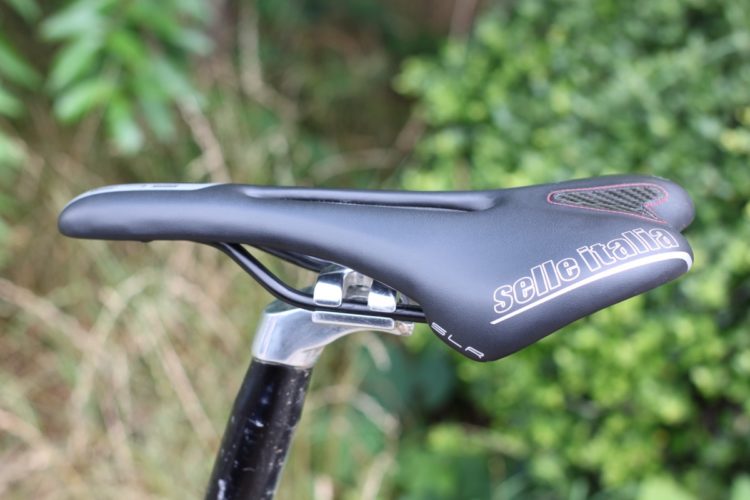
Selecting the perfect mountain bike saddle usually involves balancing the trade-off between comfort and weight. Super lightweight saddles often feel worse than metal folding chairs while really comfy seats are generally wide, bulky, and heavy. Fortunately Selle Italia has hit upon a winning design that carefully balances comfort and weight in the SLR XC Gel Flow.

Weight and Durability

Selle Italia claims the SLR line is the best selling high-end saddle in the world and there’s an SLR model for just about every style and budget you can imagine. While all the SLR saddles are rated for road and off road use, only the XC and XC Gel Flow are designed specifically for off road and free riding. At just 170g, the XC Gel Flow is the lightest MTB-specific saddle I know of and 30% lighter than my previous saddle thanks to the Vanox rails, lightweight silicon gel, and carbon composite shell.

The SLR XC Gel Flow is ultra durable and is, in fact, bullet proof, thanks to kevlar reinforcement. The saddle cover is made from something Selle Italia calls “Lorica” which is abrasion resistant and mud tends to slide right off the shiny, slick surface. Despite the slick surface, the saddle feels grippy under standard nylon/poly bike shorts. Unfortunately the middle and edges of the saddle don’t use the same material so mud and dirt stick in these areas (though grip is still excellent).

Style

Just looking at the profile of the SLR XC Gel Flow might make your cheeks sore but looks can often be deceiving. The SLR XC Gel Flow cuts a low profile and is fairly narrow (131mm) which gives it a super aerodynamic shape perfect for racing. The narrow tail also makes it easier to remount the saddle after behind-the-seatpost descents. I chose the white version because white bike components automatically make you 10% faster – or at least that’s what I heard :)

selle_italia_slr_xc2_top

Comfort and Performance

The saddle is one of the main contact points between rider and mountain bike which makes comfort a top priority. If you’re looking for a magical saddle that won’t leave you a little sore after a 50-mile epic, I hate to break it to you but there’s no such thing. The SLR XC Gel Flow does incorporate some features to at least make epic XC rides more bearable like a center cut-out to reduce pressure points (and also weight) plus increased gel thickness around the cut-out itself. On 20+ mile rides I’ve had no issues with soreness, though your mileage may vary and will depend on your chamois choice as well.

The nose on the SLR XC Gel Flow is elongated (275mm) which adds to this saddle’s race cred. Transitioning from out-of-the-saddle climbs, the long nose made the saddle easy to find and also makes for a convenient shoulder mount during hike-a-bike sections.

The Vanox tube rails felt super solid throughout my testing and didn’t creak or groan once despite some serious saddle time. Vanox is actually a steel alloy which means these rails flex a little more than aluminum or even some carbon rail set-ups. The upside? A little added protection for your tush on rocky trails.

Overall the Selle Italia SLR XC Gel Flow Saddle is a race-ready, lightweight, and high performance saddle that doesn’t skimp too much on comfort. It’s honestly hard to find fault with a best-selling design like the SLR – give it a try and see for yourself!

Thanks to Selle Italia for proving this saddle for review.


Site Map | Advertise | Partners | Contact Us | Terms | Privacy
Campground Reviews | Hiking Trails | Trail Running | Skiing / Snow Sports | Mountain Biking
Copyright 2012 Blue Spruce Ventures LLC | Atlanta, GA
singletracks.com is yet another slick Review App