singletracks is mountain biking
Sign In | Create Your Account | Site Map | Help  


Dakine Sequence Pack and Blitz Jacket Review

Thursday, October 20th, 2011

You’re probably thinking – a pack and a jacket, in one review? Well, why not?

Dakine, in case you haven’t checked them out yet, is a big manufacturer of quality gear for mountain biking and other action sports. Not only do they produce great packs and luggage, but they also offer an extensive line of clothing for both men and women.

Sequence Pack

Having really stepped up my camera gear kit, I needed something just as serious to keep it all safe when I ride to take my pics. Now, seeing that most of my riding is on the slopes as of late (DH is just too much fun), and a fall could really ruin my day (not to mention my equipment), I needed something with a bit more padding than my old setup. The Sequence pack is just the ticket.

This mid-priced bag has enough room to carry all my camera gear, laptop, and more. The padded block allows you to carry your camera body and a barrage of lenses but you can also remove the padded camera block and configure it to exactly match the gear you’re hauling.

I set up my bag so that the camera body and other small parts sit in their own section, while each lens is cradled in its own padded cube. My flash, charger, and extra battery sit in another padded section which protects all the gear, keeping it from bouncing around. The great thing about the padded block is that it has full-length velcro so that you can set the bag up virtually any way you want.  The actual Sequence bag holds my laptop, mouse, power supply, pens, notepad, and technical manuals in the zip flap. The main flap also has room for a 15″ laptop and two small organization mesh zips to hold other stuff (ID, credentials, snacks, and the like).

Up top there is a zip pouch that holds the deploy-able rain cover. I also use this pouch to store my Blitz jacket. Two side pockets can hold water bottles or, when zipped open, a tripod. A big plus to the pack is the robust waist and shoulder straps which rivals the best hydration packs for comfort. In the waist strap there is even extra padding for the small of the back.

Using the Sequence for every bike trip and hiking situation I could muster, I have to say that I love this pack. I was a bit nervous when I first started carrying the big kit (what I call all my gear), but once I got used to the extra weight I was fine on all but the craziest of slopes. Not only does it keep my 15+ pounds of photo and computer gear safe (weight weenies are cringing right now), but when riding to spots on the slopes I appreciate the stability of the pack. Yes, the amount of gear I carry is a bit extreme, and most people may not take that much with them. My point in bringing this up is how much gear you can carry and still keep everything safe.

When things got a bit wet, all of my gear stayed nice and dry, thanks to the full construction of 420D Nylon and the easy-to-deploy rain cover (I still sprayed Scotchguard on the cover for added protection). On long trips, I doubled the space and packed my clothing in the main 33 liter compartment, while still carrying the padded camera gear along.

Blitz Jacket

The Blitz jacket is another super product from Dakine. Coming into the fall season, this is a must-have item here in Ontario and especially in BC, where we get a lot of rain during the fall. Packing water resistant gear is a must, and the Blitz is a great jacket. Constructed with a nylon outer shell and a polyester liner, this jacket is breathable too. It also stuffs in a pack easily.

The fit on the Blitz is roomy which is great if you’re wearing armor. If you usually ride without body protection, go one size smaller than you usually wear. This jacket holds up well to washing (I wash using cold water only).

The Blitz features two front zips with pockets and vents (all in one) and one left breast pocket. The full-length front zip is weatherproof, and there is a rear vent to help regulate body temperature. One of the Blitz’s coolest features is that the hood can easily accommodate a helmet or can be pulled closed (with the draw strings). The cuffs are adjustable with a very nice velcro arrangement which keeps the long sleeves from sliding up. The Blitz is not cut like a typical cycling jacket with the raised front and lowered rear waistline. Instead, this jacket features a regular cut, making it far more versatile since I can use it both on and off the bike. The waist does have a drawstring to allow you to tighten up if necessary.

The Blitz is rugged enough to be used as an outer layer even if you’re on a freeride rig and the durable shell can take abrasion from those close encounters with trees and bushes. The jacket also does a great job of keeping the wind out. This time of year when the weather can (and does) change quickly I keep the Blitz handy all the time. The jacket can get a bit too warm at times, especially if you’re in a high humidity situation. But seeing that fall is here with lower temps and humidity, the Blitz makes perfect sense.

The Sequence Pack runs $205 MSRP and the Blitz Jacket is offered at $170 MSRP. The Sequence pack comes only in black while the Blitz is available in Charcoal (pictured) or a style called “Phantom” which is a dark, textured color.

Thanks to Dakine for sending these items up for a review. Check out Dakine’s website for more great MTB gear.

Dakine Nomad Hydration Pack Review

Monday, October 3rd, 2011

If any one hydration pack can function as a jack-of-all-trades and still do every single job superbly, the Dakine Nomad is it.

Epic all-day trail ride in the backcountry? Check.

A day at the bike park? Check.

Sessioning a remote DH line? Check.

Short after work spin on the singletrack? Why not?

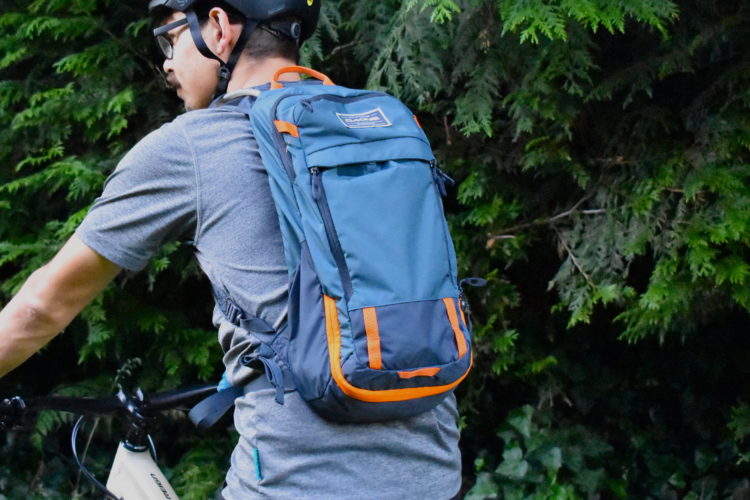
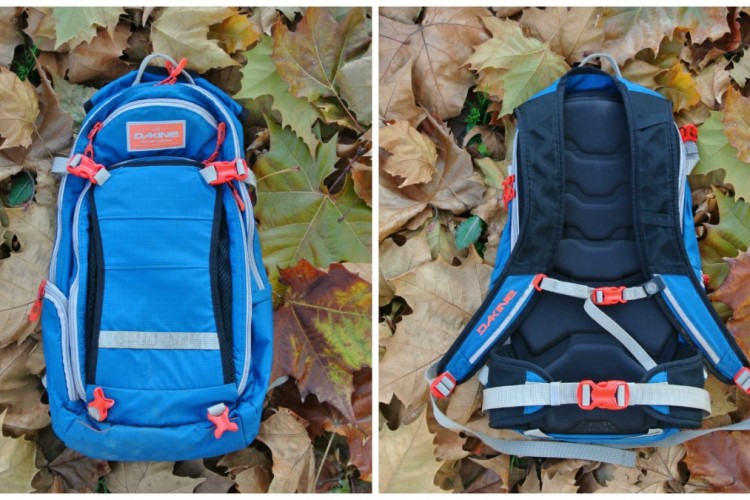
Dakine has thoughtfully engineered the Nomad to appeal to all sorts of riders from cross country to downhill. In order to appeal to all of those demographics, they incorporated a carrier for a full-face helmet that can also function as an XC helmet carrier with space for extra layers or even your shoes on the way to the trail. Armor carriers hang below the pack, but stay tucked out of sight if you don’t want to use them. A full 100 ounce bladder ensures you won’t get dehydrated on an epic trek and 1100 cubic inches of space guarantee you have plenty of room for those extra layers and emergency supplies. Finally, a mere 2 pound dry weight makes this pack perfectly fine for a quick after-work pedal, even if you don’t need all of the water and cargo space.

Out on the Trail

It’s so nice to use a pack that just plain works and doesn’t require any fiddling or excessive experimentation to figure out where to put everything. The internal organizer pockets are zippered to keep all of the little tools and parts that you need to carry separate, and specially-sized sleeves are already in place to hold both a mini pump and a spare tube. A fleece-lined sunglasses pouch is located safely on top of everything else for when the sun starts going down, and an mp3 holder sits just inside the top of the main storage compartment.

Dakine is serious about usability and design, and they naturally gave the reservoir a dedicated compartment separate from the main storage compartment. One of the greatest features that this pack offers is a stiff back panel with vented ridges that both eliminate barreling from the reservoir and promote airflow to keep your sweaty back as cool as possible. One added bonus that I noticed during a day in the bike park with the Nomad is that the stiff back panel and ridges seem to lock onto your back if you’re wearing a spine protector. The ridges are perfectly placed on either side of the spine protector, allowing the pack to stay firmly in place even if you’re busting through nasty rock gardens or launching booters!

For those epic cross country rides, the Nomad features the same swiss-cheese ventilation pattern on both the shoulder straps and the hip pads. While it’s difficult to quantify, I think this ventilation system significantly reduces perspiration.

But what if you don’t want to wear a waist belt? Well, the belt on the Nomad is removable, allowing it to ride much more comfortably when nearly empty.

Water Reservoir

I think I can safely say that out of every pack I’ve ever used, the Nomad is my favorite. Why does it stand out above the rest? Well, for all of the reasons listed above, for starters.

But in addition, the Nomad features the coolest and most intelligently designed reservoir on the market: Hydrapak’s Reversible Reservoir.

I’ve already blogged in detail about Hydrapak’s intelligent reservoir design, so I’ll just give you the Spark Notes this time around:

  • Durable
  • Quick disconnect hose
  • Strong fold-top closure
  • Completely reversible allowing it to dry quickly, be cleaned easily, and generally eliminate the build up of nast’.

Final Thoughts

All of these smart features allow this pack to function well for every type of rider, and with the best reservoir on the market, the Nomad is a winner. Despite the fact that it is on the large end of the hydration pack spectrum, the expertly designed back panel and straps help the Nomad ride almost as comfortably as a much, much smaller pack. Even though my test is done, I’m not sure I want to switch back to a smaller pack: the extra storage room is always appreciated!

All of my other packs are either gathering dust somewhere in the bottom of my closet or are being used as mere book bags for school. The Nomad is now my hydration pack of choice.

MSRP: $100.

Many thanks to Dakine for providing the Nomad for review!

Hydrapak Selva Review

Thursday, July 7th, 2011

My first real exposure to Hydrapak’s products was this year at the Sea Otter Classic in Monterey, California. They had a unique booth set up with a game of bean bag toss, known to many as corn hole, with free gear as a prize for making it in the hole on your first shot. I didn’t make it in, but I still got a water bottle as a consolation prize.

Ok, maybe that’s not really all that unique, is it? Well, if it had just been a game of corn hole, maybe not, but the “bean bags” were actual 1 liter Hydrapak reservoirs filled with water. There were bags of water flying all across the field, bouncing off of the boards and the ground, and you know what?

None of them broke. None of them even leaked. That’s how good Hydrapak’s technology is.

Special Features

The Selva hydration pack that Hydrapak sent me to review has 250 cubic inches of storage and a 70 oz. / 2 L. reservoir.

It has several intuitive features, not the least of which is the magnetic mouth piece attachment. When I first noticed this, I thought it was one of the coolest things I had ever seen! With other packs, making sure that my mouth piece was in the right spot was always a challenge, and putting it back after taking a drink always seemed to be a hassle, especially if it’s all you can do to keep up with the wheel in front of you. This movable magnetic attachment makes it an absolute cinch!

But of course, as I mentioned above, it’s the technology of the reservoir itself that is truly remarkable.

For starters, we were able to use the reservoirs as bean bags because the hose can be completely detached from a full bladder without having it run everywhere, thanks to a unique valve system at the bottom. This makes it easy to drain the hose and keeps everything secure and leak free when it’s re-attached.

After the hose is detached, the reservoir can be turned completely inside-out for easy drying and cleaning. This feature is courtesy of the wide fold-top closure. To close the top, just push the two hard ends together, fold them over, and slide the locking mechanism on top.

Once the bladder is ready to go, it hangs from a hook in the main pouch to keep things evenly distributed inside the pack. On the trail, the bite valve rotates to allow full flow or you can lock it out to keep it from dripping.

Here’s a quick video clip from Hydrapak illustrating how easy it is to fill and clean the reservoir:

Real Life Performance

This is all well and good in theory, but how does the Selva perform out on the trail? The Answer: Even better!

Most of the time, it takes me a little while to get used to a new pack. With the Selva, I only had to loosen up the straps and adjust them to my liking and after the initial 30 seconds it took me to get set up, I’ve just been able to forget it! The Selva is easily one of the most comfortable packs I’ve worn.

With 250 cubic inches of storage, it has enough room to fit emergency tools, a pump, tube, and a few extras, but probably not any extra clothes. It’s a pretty low-weight, low-profile pack that is perfect if you want to forget that you’re carrying gear. It’s intended for serious mountain bike use, and rides so snugly that even in the rough stuff it stays in place and doesn’t distract by bouncing all over the place. Several packs I have used in the past would be fine on the climbs, but when it came to launching off of drops on the downhills, they would fly up and hit me in the back of the head. Thankfully, the Selva stays exactly where it’s supposed to be: in the middle of my back.

Obviously, at this size it isn’t intended for epic-length rides, but Hydrapak has several other offerings with more water and gear storage for when you want to put in those really long mile

As for the hose routing, I’d like to thank the commentators for pointing out the correct route. When I first got the pack, I felt around on the inside of the straps but couldn’t seem to find my way through. After looking at it again, when coming from the inside of the pack you just have to be careful to take the upper route so you end up on the outside instead of inside the strap. Or, thanks to Hydrapak’s ingenious valving technology, you could route the hose backwards through the gray flap and connect it to the reservoir once it’s on the inside. Again, thanks to the anonymous commentator for pointing that out!

Bottom Line

Looking for a hydration pack for your everyday mountain bike rides that is easy to clean, rides firmly on your back, and has a ton of small features that make it easy to use? Check out the Hydrapak Selva for $74.99!

Thank you to Hydrapak for creating such innovative products, and for providing one of them for review!

MTB Hydration Pack Buyer’s Guide

Friday, June 24th, 2011

Like many great outdoor products, hydration packs were first developed for the military and later modified for civilian use. While there are several brands and a number of different models on the market today, the basic functionality is to carry gear and liquid, and to provide a means of drinking without stopping what you’re doing. Here are some pointers to help you select the pack that fits for your mountain biking needs.

Photo: Osprey.com

Water Capacity

Most packs on the market seem to have settled on two standard capacity offerings: 70oz and 100oz. When choosing the capacity that is right for you, consider how much water you like to drink, the length of your average ride and whether your bike frame has room for bottle cages. If you live in a hot or dry climate and like to do 3+ hour weekend rides, go for the 100oz. If you tend to do shorter, early morning or after work rides, 70oz is probably fine.

Cargo Room

Carrying water is only half of the equation; most riders will also want to be able to carry stuff along the trail. The singletracks forum has numerous threads about what to carry, but the basics include a multi-tool, flat tire repair kit, snacks, first-aid stuff and maybe a jacket or other clothing. Packs come in all sizes from ones that will hold just a granola bar and car keys, all the way up to packs like the massive 1,159 cubic inch Camelbak HAWG. Again, what you like to carry determines how much cargo space you need. Light and fast racers will tend to prefer the minimalist designs, whereas photographers and those who frequently go on epic rides with uncertain weather conditions will want to go with a much larger volume pack. When selecting the right pack for your gear carrying needs, lay out everything you already carry, or would like to, and take a picture of it. Bring the picture to the store so that you can remember it all, and maybe even grab some of those same items at the store and see if they fit in the packs you’re considering.

Features

With capacities being a fairly standard metric, most manufacturers try to differentiate their products by offering a variety of innovative features. For example, the FuL Cargo pack has a retractable helmet storage net, Osprey models have a nifty magnetic bite valve holder, and CamelBaks have arguably the best valve system with easy to find replacement parts. Other features include dedicated cell phone / mp3 player pockets, mini-pump sleeves, and even chain saw loops.

Photo: ful.com

Fit

All of the above is a non-issue if the pack doesn’t fit comfortably. Just like “regular” backpacks, each manufacturer has their own take on strap, suspension, and back panel design, and of course no two people are shaped alike. Once you have narrowed down the capacity and feature set you want, find a corresponding model from each of the available brands. Put some stuff in them to simulate a full load and wear them around the store for a bit. Pay attention to any pressure points or anything that doesn’t feel right. If it’s uncomfortable now, it will totally suck on the trail!

Recommendations

Racing: Some hardcore racers still do the bottle cage / seat bag thing, but hydration packs are starting to catch on, especially in the ultra-endurance segment. The Camelbak Fairfax and Osprey Raptor 6 are both small, light, and will keep you hydrated without slowing you down or throwing you off balance.

World Travelers: If you spend a lot of time away from home, Camelbak is your best bet. Every podunk sporting goods store in the country seems to have Camelbak bite valves and other replacement parts. This could make the difference between dropping $6 – $10 to fix your  pack or $50 – $100 to replace it.

Multisport: If you want just one pack for mountain biking and other, non-MTB activities like bike commuting or school, check out something like the Cargo from FuL or BC2 from Ergon. Both of these have well thought out organization features to help keep all of your various doodads neatly stowed.

Pack Rats: If you need to carry a LOT of gear, check out the larger Osprey models like the Verve 13 or Raptor 18. Osprey is first and foremost a backpack company and they do an amazing job of making a big load feel small by incorporating features like load lifter and compression straps into their hydration pack models. The Camelbak HAWG can also swallow a ton of gear and has a 100oz water capacity.

Whether you you are considering your first hydration pack or are looking to replace that worn out one you’ve had for years, the quality and selection available today is better than ever. Hopefully this guide will help you sift through all the models and features and lead you to that perfect pack for mountain biking!

FuL Cargo Hydration Pack Review

Monday, March 21st, 2011

There’s no denying that Camelbak is the established leader in the hydration pack market. As such, any newcomer gets the benefit of learning from their past mistakes, but they also face the challenge of creating something truly innovative, without stepping on any patents.

While I was waiting for my FuL hydration pack to arrive, I perused their website and found that they tend to cater to the college and hipster demographics with a myriad of messenger bags and “book bag” type backpacks. Based on what I saw, I was genuinely curious to see what their take on an outdoor-oriented hydration pack would look like. When I opened the box, I was immediately impressed by how light the pack is and how well constructed it feels.

Before coming to market, FuL had originally dubbed this pack the “Multisport” and with its feature set, it is easy to see why. It has a multitude of pockets, all with bidirectional zippers with tabs that feel both substantial and durable. Inside there seems to be a dedicated place for everything. It has a crampon patch on the back, as well as side pockets for securing trekking poles. It even features an ice axe loop!

When placed next to my Camelbak Rogue, the FuL Cargo pack doesn’t appear to be much bigger, but when I transferred over all of the items I normally carry on rides, it swallowed everything, and still seemed empty. I stuffed in an extra jacket, and it still had room. Gloves and heart rate monitor strap…no problem. Then I found the expansion zipper that makes the whole cargo area 2 inches bigger….and I was able to stuff my whole Camelbak into it! And just when I thought it wouldn’t hold any more, I found a small zipper near the bottom that releases a large mesh pouch with hooks on it that attaches to eyelets near the top and provides storage for your helmet when it isn’t being worn. Since I also use the pack for commuting to work, convenient helmet storage is a huge bonus!

Like most hydration packs, the 70oz bladder must be removed in order to fill it. Instead of a screw on cap, however, the entire top opens for filling, and then folds over and is secured by a sliding clip that locks into place with two tabs. This setup makes it easy to stuff the bladder full of ice, or fill it in a hurry from just about any type of water source. With the top properly closed, I have experienced no leakage. Inside the pack, the compartment that holds the bladder is insulated to help keep things cool.

When I put the pack on, it took less than a minute to get it adjusted for a perfect fit. The shoulder straps are luxuriously wide and the sternum strap is identical to what you would find on a high-end day pack. It boasts real compression straps and channeled back padding that allows more cooling air flow than I have experienced with any other pack I have ever worn.

On the trail, the the Cargo rides close and does not flop around, even when fully loaded. The side and sternum straps can be easily adjusted while riding, but in actuality, once they are set, there is very little need to mess with them. I have noticed with this pack that the shoulder straps don’t constrict blood flow to my arms. It turns out this is an issue with my Camelbak, and it has been causing numbness in my hands this whole time….go figure. (It only took two pairs of gloves and three sets of grips to figure this out!)

As awesome as this pack is, it’s not perfect and my biggest gripe is the bite valve. The valve requires a push/pull motion to open and close it, and when I first tried it the water flow was pathetic. I emailed customer service at FuL to see about getting a replacement, and they actually directed me to make sure to bite as close to the end of the mouth piece as possible. (There’s actually a visible indentation indicating where to bite it) This did the trick and even though it still doesn’t gush like the patented Camelbak valve, it is acceptable. Honestly though, I’m not accustomed to putting that much though into getting a mouthful of H20, but once you get used to it, it’s okay.

It is clear that FuL has done their homework and pulled from their experience designing packs for a variety of different uses. The Cargo is a well thought out and expertly-constructed hydration pack with options that make it equally useful for biking, hiking, rock climbing, or even ice climbing. After several weeks of using it, I’m still discovering new features (like the Chapstick pouch inside the shoulder strap) and it has become my daily use pack for both commuting and mountain biking.

If you’re on a budget or if you want one hydration pack for several different sports, for $69 MSRP you can’t go wrong with the FuL Cargo.

Thanks to the folks at FuL for providing the Cargo for review.

Topeak Air BackPack 2Core Review

Tuesday, December 28th, 2010

Topeak Air BackPack

The Air BackPack 2Core from Topeak is a curiously awesome hydration pack. It’s small in form, but packs tons of gear among its cleverly hidden pockets. It’s quite light at 645g yet  it’s still loaded to the brim with technical features. Among conventional hydration packs, the AirBackPack is like an enigma, wrapped inside a kite, wrapped again inside a stealth bomber. This is the back pack that Bruce Wayne would use on weekends. For short, I call it the “Bat” Pack.

In terms of standard features, the Air BackPack 2Corerates an A+. This pack comes with all the normal things such as a 1.5L hydration core, sealed zippers, rain cover, helmet holder, mp3 pouch, reflective strips, utility clips, a stuff sack, and pockets and even more pockets. I won’t go into the details or performance of those things, because they’re not particularly interesting and they all worked as expected.

Now here is where things get exciting. The central concept behind the Air BackPack is the “air mesh” frame built into the pack. Instead of the usual foam padding and rigid support frame, this pack uses an inflatable grid for the back area and the hip straps. Included with the pack is a tiny little hand pump that allows you to inflate the back air mesh and the hip air mesh separately to your own preference. By adjusting the pressure in each of the air compartments, you can fine-tune how the pack fits you. The air padding provides structure for the pack but it also distributes the load evenly across your body, making for an incredibly comfortable fit.

The other really cool thing about the Air BatPack is the “core” concept that makes storage somewhat modular. Inside the the long zipper that goes straight down the middle is the bag’s main storage compartment, which contains a few small internal pockets, the mp3 pocket, and the “gear core.” The gear core has six or eight little pockets that would be good for tools, parts, food and other stuff that is smaller than your hand. The best part, though, is that the gear core can be unclipped and completely removed from the inside of the bag, clearing up space for other stuff or just lightening the load when you don’t need it. Now this might not seem all that revolutionary, but this really blew my mind when I thought about how easy this makes it to use the bag across multiple activities. I could hit the snowy trails in the morning, take out the gear core full of food and tools, fill the bag full of books and take it to school, add a different gear core full of waxes and hand warmers, and then take the bag skiing in the afternoon. Sure, you could go through the process of packing, unpacking, and repacking all of your crap, but the core concept makes life a whole lot easier.

There are few, if any, outstanding deficiencies in this product. Still, I do have issues with a few things. First, I’m not a big fan of the bite valve on the drinking hose…it’s just not that great. Secondly, I don’t particularly like the use of some of the hook-and-loop straps, which tend to get mudded and mangled easily. I’m also on the fence about the lightweight 210 denier nylon because I just don’t know if it will stand up to extreme use. Finally, there’s a rubbery patch on the front of the (extremely comfortable) shoulder straps that makes me unnecessarily hot and sweaty at the front of my shoulders. Despite all that, the general quality of design and construction makes this one of the nicest packs I’ve ever used.

The Air BackPack is an aerodynamic, lightweight, form-fitting pack meant for cycling, but it is versatile enough to serve you well in other outdoor activities. This pack’s clever technical features make access to your gear quick and easy. Furthermore, the Air BackPack’s gimmick-free innovation provides a comfortable fit that can be infinitely adjusted to suit any rider.

Thanks to Topeak for providing us with the Air BackPack 2Core for review. For more information and details check out Topeak’s website.

New Camelbak Antidote Reservoir & Octane LR

Friday, September 24th, 2010

Every year I’m excited to visit the Camelbak booth because it seems like there’s always something new and this year was no exception. The Camelbak hydration system has been around for more than 20 years but it’s been a while since the venerable blue bladder has seen a major update. Camelbak’s newest bladder, the Antidote, improves on the design in a number of ways.

The oversized screw cap that Camelbak introduced with the Omega reservoir several years ago was a big improvement over the smaller inlet but for many it was prone to leakage if not tightened properly. The new cap tightens with just a quarter turn, much like the gas cap on your car for a leak-proof seal every time. Camelbak claims the new cap is also 20% lighter and even lower profile than the previous version. The icing on the cake: built-in, retractable dryer arms attached to the cap.

A new quick-link system makes it a cinch to remove the hose from the bladder for cleaning and installing accessories (like an inline water filter called the Fresh™ – wonder if it filters out the taste of plastic?). But the feature I’m most excited about – and which seems so simple it’s hard to believe no one thought of this before – is the addition of a stabilizing baffle within the reservoir itself. The baffle serves to stabilize the water and minimize sloshing while making the bladder itself flatter and therefore easier to pack. In the photo above you can see the baffle – the line running down the center of the bladder – is pretty much as simple as it gets.

Camelbak has also improved packs like the Lobo by adding easy access to the fill cap so you don’t have to take the entire bladder out every time you refill. Freeride packs have been redesigned as well with hot graphics, cool colors, and refined pockets and straps (top photo).

Some riders still prefer frame-mounted water bottles to heavy, awkward hydration packs so the company is working on better methods of distributing water weight to improve comfort and stability. The Octane LR pack (above) wraps an Antidote reservoir around the waist and lower lumbar which places water weight closer to the hips where it’s much more stable for XC and all-mountain riding. I got a chance to put on a fully loaded Octane LR pack and it felt surprisingly natural, almost like I wasn’t wearing a hydration pack at all.

This year Camelbak has gone way beyond adding more pockets and new color choices to their packs by rethinking and refining the core hydration bladder at the heart of their products. Look for the new Antidote and Octane LR bladders to make appearances in the full line over the next year. If dehydration is what ails you, Camelbak has the Antidote.

Osprey Raptor 6 Hydration Pack Review

Tuesday, March 23rd, 2010

osprey_raptor1

The Osprey Raptor 6 is a hydration pack with wings – or at least it feels that way. This sleek pack swallows 2L of water and a surprising amount of gear without harshing your ride. In fact it might just be the most comfortable hydration pack we’ve ever tested.

Osprey has made a name for itself over the years for producing high quality packs for multi-day hiking and camping trips and that experience shows in the Raptor 6, one of the first bike-specific packs from the company. Osprey spent 3 years and rolled through 100 prototypes before releasing the 2010 Raptor series. The hydration pack is covered in a reflective, rip-stop material with mesh venting in the back to keep you cool on hot rides. Stretchy material on the waist straps provides additional comfort while the same material is used on the outside front pocket for expandable storage. The strapping system is intuitive and makes it quick and easy to get a customized fit.

inside_pockets

The Raptor 6 features one main zippered compartment with 3 internal sleeve pockets that make organizing your gear a cinch. Some packs we’ve tested don’t include any internal pockets which leads to a mess of gear inside while others have so many pockets we’re left scratching our heads as to what to put where. The Raptor 6 also features a zippered pouch on top that’s perfect for goggs or sunglasses plus a “LidLock” for attaching your vented MTB helmet. There’s even a dedicated strap on the back for your blinky night light!

lid_lock

The Raptor 6 includes a Nalgene HydraForm reservoir that mates snugly with Osprey’s HydraLock system. The HydraLock frame basically uses pressure to increase fluid flow, adds stability, and keeps a full hydration bladder from encroaching on precious gear space. And it works.

reservoir

Clearly a lot of thought has gone into the Nalgene reservoir as well. The HydraForm reservoir features a wide mouth inlet, perfect for filling with ice cubes and convenient for cleaning and drying after the ride. There’s also a hard plastic spine that makes it easy to slide a full bladder into the pack – with other packs this can be like trying to shove an oyster into a coin slot. The bite valve on the Nalgene is “always on” and is perfectly round so you don’t have to think to drink. The icing on the cake is a magnet on the bite valve that keeps it secured to the chest strap.

bite_valve

Flying the trails

One of the reasons I really wanted to try the Raptor 6 is I’ve been getting a lot of crap on the trail about my huge hydration pack. Sure it can hold a ton of stuff but it’s also bulky and seems to get snagged by tree branches more often than I’d like. By comparison the Raptor 6 keeps my center of gravity closer to my back and hips and hasn’t snagged on a tree once. Osprey claims this pack can also be used for trail running, a claim we’re eager to put to the test soon.

There are always trade-offs when designing high performance mountain bike gear and clearly a smaller pack will be more comfortable than one designed to haul a ton of gear. However, I was surprised at all the stuff I could fit into the sleek Raptor 6: a DSLR camera + two lenses, 70 ounces of water, an extra 29er tube, Blackburn Mammoth pump, tire irons, multi-tool, and car keys. Plus there was still room for my blinky light, an extra helmet (!), and a lightweight rain jacket using the outer pockets and straps. With all that gear the pack felt balanced and comfortable, even after hours in the saddle.

osprey_raptor_back

The hard plastic in the HydraForm reservoir can feel uncomfortable if your pack isn’t adjusted correctly or if your jersey has a zipper in the wrong place. On a recent ride I felt something hard poking my back and initially thought I had the reservoir inserted incorrectly but it turned out to be a zipper pull on my jacket. Luckily a quick adjustment to my jacket and the Raptor shoulder straps relieved the pressure. My only other complaint is that the stretchy sternum strap tends to work itself loose during long rides. A quick one-handed tug gets things back in place but it can be annoying when you’re bombing a slope.

Mountain biking isn’t a fashion show

It’s true but if mountain biking were a fashion show, you wouldn’t be too out of place wearing the Raptor 6 on your back. This pack is Colorado sporty and the color choices (sand gold, spruce green, and silt grey) are fresh and outdoorsy. Reflective graphics give the illusion of giant osprey wings on the hip belt and I’m pretty sure they make me ride faster.

If you’re into flowing with the trail without carrying a lot of extra bulk and weight, check out the Raptor 6 from Osprey. It’s one of the best designed packs we’ve tried and is a steal at less than 80 bucks MSRP. Grab one and fly away!

Thanks to the guys and gals at Osprey for providing the Raptor 6 for review.

New Stuff From Hydrapak For 2010

Tuesday, September 29th, 2009

picture-383

For those who are looking for an affordable hydration pack that doesn’t suck, take a peek at what Hydrapak has to offer. I spoke with Dax Kelm at Interbike and he showed me some of the new and improved hydration packs. The pic above shows the redesigned Laguna which is now even more comfortable. The Laguna features a 100 oz bladder, a new 45 degree angled surge valve, and a cool new clip called the Quantum which prevents your hose from flopping around after you have taken in water. The Laguna is also expandable when you need it, growing from 500 to 850 cubic inches of storage.

picture-384picture-385

Hydrapak also revamped the Big Sur with a new back panel for improved ventilation and an intelligent layout of the gear compartments including a tool pouch accessible from the bottom of the pack.

The Morro is an interesting new pack (unfortunately I forgot to take a photo) with 800 cubic inches of storage designed for those long day rides. This pack has a 100 oz bladder and rip stop materials to tie the whole thing together.

Hydrapak has also expanded a little product that I personally use and love called the Softflask. The Softflask is basically a refillable reservoir to hold your favorite energy gel and it’s made from the same material as the larger bladders in the Hydrapaks. With the Softflask you can save money on bulk gel purchases and help the environment by not generating any more trash from your wrappers.

More cool stuff at hydrapak.com.

Very Cool Stuff From Camelbak

Thursday, September 24th, 2009

camelbak_flow_meter_1

When you think of Camelbak, you might not necessarily think of innovation. Sure, every year Camelbak gives us new pack colors and more pockets but many of the best selling packs have been around for years. In 2010 however, Camelbak is stepping on the gas and cranking the innovation to 10!

Digital flow meters. One of the biggest complaints Camelbak users have lodged over the years is that it’s tough to know how much water is left inside the hidden reservoir. The Camelbak Flow Meter, which can be attached to any existing Camelbak hose system, solves the problem and gives you an avalanche of data and display options to maximize your hydration awareness. Just enter the amount of water in your reservoir and your weight and the Flow Meter will tell you how much water you’ve consumed, how much you have left, and if you’re over- or under-hydrating yourself. It even flashes a warning when you have less than 10 ounces left – time to turn around or refill!

camelbak_flow_meter_2

Quick connect hoses. Cleaning out a Camelbak bladder is just about as fun as a root canal and fortunately the oversized fill cap has gone a long way toward making this less painful. This year, new quick connect hoses allow you to drain your Camelbak bladder more easily and make gunk removal a cinch.

camelbak_1

New freeride packs. Camelbak has put a ton of thought into designing a new line of freeride/downhill packs that have some pretty cool features. Aside from straps for cinching body armor and an oversized pouch for carrying a full face helmet, the top of the line pack (the Don) features a see-through pouch for a lift pass and a spot on the shoulder straps for ipod ear buds. The reservoir holds 100 oz. which is perfect for all day sessions at the mountain.

Other cool stuff. Though not necessarily MTB-specific, Camelbak is introducing cycling jerseys with integrated hydration and a water bottle that claims to keep liquids cold 4-times longer than a standard water bottle – without adding weight or reducing capacity! We’ll keep you posted to see how this new tech finds its way into mountain-specific products.

What to pack for an epic MTB ride

Tuesday, January 27th, 2009

I like to be prepared for anything on the trail from bike and body breakdowns to hunger meltdowns and over the years I’ve come up with a list of items to handle almost any emergency. As a rule of thumb I try to “expect the unexpected” and pack my trail bag accordingly. Here are my tips.

The first thing you need to be prepared for an epic ride is a backpack or a hydration pack that has room for carrying what you need. If you look at cycling-specific hydration packs regardless of brand they all do a pretty good job at carrying water and stuff so it’s important to find the most comfortable pack that’s the right size. I purchased the Camelbak Octane 14+ since it has a 100oz bladder, a comfortable strapping system that’s both secure and non-restrictive, and an expandable zipper system that effectively doubles the storage capacity on demand.

Once you’ve settled on a pack, it’s time to fill it up. First and foremost you should pack a comprehensive first aid kit – one that contains everything you need to take care of most major abrasions you may get. Inside my kit I have bug spray, alcohol pads and sanitized hand wipes (both for cleaning any wounds), 4 x 5 prep pads, 2 x 2 prep pads, band aids (assorted sizes), Advil extra strength, compression bandages, thread and needle (sterilized in bag), Polysporin, Benedril (poison ivy cream), a hot/cold pad (to reduce swelling), steri-strips 2nd skin patches (holds cuts closed like stitches), a very sharp diving knife with serrated edge, a sling, and splints. Now this is a worst-case-scenario first aid kit and works great if you know how to use it but for some folks it may be overkill.

In terms of trail tools I recommend a good quality multi-tool that includes a chain rivet tool. If you have special wheels like Mavic’s Crossmax carry the tools that are used to adjust the wheel and true them as well. A good quality pump for tires is a must and if you have full suspension bike you may want to bring the shock pump as well (for them pesky stuck down situations). I also like to bring spare parts like SRAM power links, derailleur cable, and a spare derailleur hanger. Tire irons and patches and/or tubes are a good idea, and if you have tubeless tires a spare 2 ounces of Stan’s and a tire inflator to blasts the beads in place could come in handy on the trail.

Extra items that you will want to consider are a spare pair of gloves in case the ones you are wearing get wet and a water resistant jacket that will keep you warm when the weather doesn’t cooperate.  A high power tail light that clips to the bag is a good idea in case you’re caught in the dark and need to be seen.  Your wallet, cell phone and car keys are good to have as well – never leave home without ‘em!

Now that we have medical and mechanical emergencies covered it’s important to talk about food. I like to carry fresh fruit on long rides which I like to consume first since fruits tend to get bruised easily on rocky trails. I also carry a variety of snack bars (taste them before you go off the deep end and buy a box) and gel for fast energy. Another good thing I like to carry is a bag of trail mix (that’s what it’s made for after all!). More important than any snacks, make sure your Camelbak has enough water for your ride. I have found 100oz it usually good for about 4 hours and if I think I’ll need more water I carry a 500ml bottle in my Camelbak as well.

One final note about packing for your epic ride: bring whatever you like on your ride but always pack out what you pack in (wrappers, etc.) Keep a small bag so that you can toss the wrappers in without messing the inside of your hydration pack. If I have extra room in my pack I’ll stop to pick up small trash I find on the trail as well.

Packing for an epic ride takes just a little planning but pays off big time in the event of a trail emergency!

Camelbak L.U.X.E. review

Monday, January 12th, 2009

“Shrink it and pink it” used to be the standard in women’s specific mountain bike products. But the Camelbak L.U.X.E. is hardly a shrunken version of the popular M.U.L.E. hydration pack: with the same 100 oz bladder and same 600 cubic inch capacity this is a pack for the woman that rides IN FRONT of the big boys. As for the pink, well, my L.U.X.E. is crushed violet, or purple, which happens to be my favorite color!

I’m typically a minimalist when it comes to riding–risking walking out of a trail because I’ve left behind tubes and mini pumps for fear of being weighed down by extra stuff. The L.U.X.E. can carry a lot in its five compartments (not including the separate bladder compartment) so now I can easily take along a pump, extra tube, a few tools, food and much more. There’s a nice organizer pocket with a key holder that is perfect for small items like gu, energy bars, or your cell phone. The small lined pocket is great for keeping scratches off your camera or ipod.

The Camelbak L.U.X.E. has waaay more capacity than my previous pack (a Camelbak Classic) and even with the 100 oz bladder completely full of water, the L.U.X.E. did not feel any heavier while riding. The handy adjustable waist and sternum straps helped keep the pack stay put without even the slightest jostling over technical rocky sections. The back of the pack has six strategically positioned pads for a comfy fit and to provide areas of ventiliation. On short or long mountain bike rides, you’ll hardly notice it’s there.

Overall, I felt really confident and comfortable riding with the L.U.X.E strapped on my back. This women’s pack is not too bulky despite its huge capacity. There is more than enough room for storing bike accessories or stuffing in clothing. Plus, the 100 oz of water will definitely be useful on hot, humid summer rides here in the south. The only problem I have encountered so far is that one of the zipper pulls broke off, but luckily there are two zippers so I can still access that compartment. I plan to take my L.U.X.E. on all my mountain biking adventures – who says it’s just the boy scouts who need to always be prepared?


Site Map | Advertise | Partners | Contact Us | Terms | Privacy
Campground Reviews | Hiking Trails | Trail Running | Skiing / Snow Sports | Mountain Biking
Copyright 2012 Blue Spruce Ventures LLC | Atlanta, GA
singletracks.com is yet another slick Review App