singletracks is mountain biking
Sign In | Create Your Account | Site Map | Help  


cSixx 150gm Carbon Chain Tensioner

Thursday, December 22nd, 2011

I’ve been playing around with a cool new chain retention device from cSixx for a while now. cSixx (pronounced simply as “six”) hails from South Africa, and they presently offer two chain retention devices: the 150gm and the lighter weight 110gl. I had the pleasure of testing the full-on race version, the 150gm.

Specs

The cSixx 150gm really does weigh in at the advertised 150 grams, thanks to a mixture of weaved carbon and a section of kevlar/carbon mix at the bash area. All the fasteners are aluminum for further weight reduction, with the exception of the three bolts which hold the 150gm to the ISCG05 tabs on the bike. The guide comes with an adapter for ISCG, just in case your ride doesn’t have tabs.

Installation

Installation of the 150gm requires you to remove the cranks which is just about the hardest part of the installation. If you need to install the adapter, then you also have to remove one of the spacers and swap it with the adapter. Other than that, the installation instructions are very clear, with a mix of simple instructions and great illustrations. Once the guard is in, install the cranks and follow up by double checking that the pulley lines up with your chain (using the supplied washers). Afterwards, the taco and idler pulley should be set to your correct chain ring tooth count (32-42). Finally, thread the chain through and you are set.

The Test

I ran the 150gm for about three months on trails all over the region. This guide has taken a good amount of hits: everything from larger logs to the rocks of the Frankenstein trail at Seven Springs (which are mainly large boulders). Needless to say, the 150gm survived with minimal surface damage thanks to the reinforced Kevlar section. There were no other problems, either.

I did notice that I had some chain rub on the taco portion, and that it was just a bit too narrow. To remedy that issue, I ended up placing a 1mm washer behind the outer plate and the rubber spacer that goes to the inner plate. That helped reduce the rub that happened when the rear cassette was on the 11T cog. One great thing about the 150gm is it wasn’t affected by dry lube like some other brands.

For the entire duration that I had the tensioner installed on my Banshee Legend, it had no dropped chains or any other issues.

The cSixx retails for about $200. Contact cSixx for further details and to find distributors.

A quick thanks to the folks at cSixx for sending down the 150gm for review.

WickWerks Chainring Review

Monday, August 17th, 2009

picture-261

“One ring to control them all…” Well three rings to control them all actually. Chris Wickliffe, the man behind WickWerks, was kind enough to send me a set of chainrings (MSRP $139.50) to see how his cogs operate compared to my current setup. I was promised great results and right off the bat he said not to baby the shift which naturally piqued my curiosity.

One of the unique things about the WickWerk rings (44, 32, and 22T) is that they are only ramped – 11 ramps on the big ring, 8 on the middle. The teeth on the rings are machined in a series of four, having their profiles adjusted to accommodate shifting. The added stiffing ridge and hogged out sections save weight (3 rings @ 136grams) while keeping strength high (made from 7075 T6 aluminum).

picture-262

Out of the package the very first thing you need to do is read the installation instructions. WickWerks supplies spacers for 2006+ XTR units but if you’re running a different crank configuration you’ll want to measure the spacing on your older unit beforehand to see if you need the spacers. Once I removed my old rings (which required removing the drive side crank arm), I installed the new WickWerks rings. My crank is a Raceface Deus and I stuggled just a bit with installation since the WickWerks rings are machined to very tight tolerances and fit super tightly. Now may be a good time to consider a new chain and perhaps a new cassette as well, especially if your drive train has many miles on it.

Once installed (about 30min), I hit the trails and noticed a difference right away. On the up shifts my drivetrain took half the amount of time it usually takes to get the chain up and on the next gear. Under power and doing the same shift was faster than my original rings but not quite as fast as it was under lower power. Shifting worked equally well on the down shift and I never encountered a dropped chain or a smashed drop in shifting that can happen with other chainring systems. I also noticed that overall the drivetrain was quieter too – perfect for sneaking up on slower riders. :)

For those who are looking to replace their rings or want a higher performance front drivetrain setup I would recommend taking a look at what WickWerks has to offer. At $139.50 for all three these rings aren’t über expensive – just a few dollars more than RaceFace and Blackspire and way cheaper than Shimano ($117 just for the large ring). WickWerks chain rings offer solid trail performance at a reasonable price.

Bike Part Jewelry from Designs by Jodey

Friday, July 24th, 2009

mtb-bracelet-casual

I’ve always been proud to show off my wounds and scars from mountain bike crashes, but there is actually a much easier way to show off my love for the sport. Bike part jewelry is a really unique way to take a little bit of your mountain bike with you (literally) anywhere you choose to wear it and it makes for a great gift too.

I was super excited to see the wide variety of handcrafted jewelry designs that Designs by Jodey has created from bike parts.  Jodey, a mountain biker herself,  makes bracelets, necklaces, earrings, bookmarks, and keychains out of new and used bike parts.  It was hard to decide on just one piece but I finally chose a custom sized Double Row Chain Link Bracelet.  The chain link is such a classic and obvious representation of a bicycle part – I didn’t want anyone to mistake this as just another ordinary bracelet.

mtb-bracelet

When I read that Jodey used worn bicycle parts for her jewelry, I was a little skeptical.  I wondered if I was going to end up with dirt and grease rubbing off on my wrists or clothes.  On the contrary, the silver chain link plates in my bracelet are clean and shiny! The cool thing is I can tell they aren’t new due to the characteristic scratches and friction marks. Sometimes I like to imagine the killer trails this chain saw in its former life – if only chain link plates could talk.

The bracelet also uses black bike chain rollers in between the chain link plates.  I really like the contrast of the black and silver which makes each part stand out and together, well, it just works.  The toggle clasp is a complementary gunmetal color and makes getting the bracelet on and off easy with your single opposing hand.

mtb-bracelet-bike

The fact that this bracelet has a really simple and unique design using recycled bike chains make this one of my favorite everyday pieces to wear.  I got complements the first time I wore this bracelet to work and I’m proud to wear it most casual Fridays. It also goes great with the little black dress ;-)

Just like the little black dress, every girl that rides mountain bikes needs bike part jewelry.  You can order the jewelry on Jodey’s website, www.designsbyjodey.com.  And guys, when you’re buying bike jewelry for your lady friends you can also check out men’s bike part necklaces and bracelets for yourself too!

How to fix or replace your MTB chain

Monday, January 12th, 2009

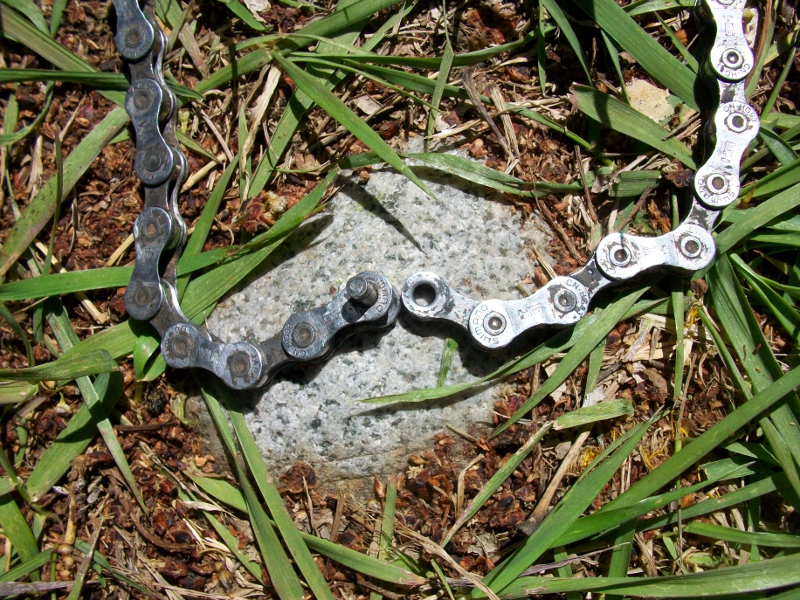
To replace a mountain bike chain, you’ll need a chain-tool. Some chain-tools have removable bits that are different sizes for different link-pins. Most mountain bike chains have the same link-pin size, so do not be concerned if your tool only has one bit. The Park Chain-tool is a good choice, as it has a large handle and two chain-placement channels.

First, clean any excess dirt or grease off your chain. Do this by holding a rag lightly moistened with chain-degreaser around the chain, beneath the bottom-bracket. Work the chain through your degreaser rag by backpedaling, and make sure you grip the rag lightly.

After you’ve degreased & cleaned the chain, it is now easy to see the pins on your chain. Work around the chain, looking for the “Connector Pin” that some chains have. This pin will appear different than the rest, and will not have “peening” around the head. On some chains (Shimano), the pins are peened, which flares the head of the pin, adding extra strength to the chain. With Shimano chains, a pin which is pressed out will sheer off the peening, which weakens the chain. These pins with sheered-off peening must be replaced with “connector pins”.

Connector pins are long, with a tapered end & a peened end. After inserting the connector pin fully into the chain link, the tapered end is broken off.

When selecting a pin to press out, do not select either a connector pin, or the pin next to it on the same link!

On other chains (SRAM), look for a “Master” or “Quick Link”. This is a section of chain that is slotted, allowing you to separate the chain by sliding the links together. Reassembly is the reverse.

Place the chain inside the channel on your chain tool, making sure it’s fully seated inside the cradle.

Then turn the press handle clockwise, until the removal bit contacts the pin. Make sure the bit is on the center of the pin; then continue, pressing the pin fully through the link and out the other side.

Now that the chain is separated, and replacing the chain is the reverse, except for a few steps. Make sure that the chain is routed correctly through the rear derailleur pulleys, and through the front derailleur as well.
If the chain had peened pins, the “connector” pins are used at this point to rejoin the chain. Slide the connector pin into the chain, tapered end first. After the peened end is even with the other pins on the adjacent links, break off the tapered side with a pair of pliers.

On a “master” linked chain, grasp the two ends of the chain and hook them back together with the sliding links.

Run the chain through several cycles, looking for stiff links. If one is located, observe the link pins for uneven protrusion. If it is the pin which was just replaced, use the chain tool to evenly seat the pin so that it is the same as it’s neighbors. Chain link failure is often the result of protruding pins or bent plates.


Site Map | Advertise | Partners | Contact Us | Terms | Privacy
Campground Reviews | Hiking Trails | Trail Running | Skiing / Snow Sports | Mountain Biking
Copyright 2012 Blue Spruce Ventures LLC | Atlanta, GA
singletracks.com is yet another slick Review App