singletracks is mountain biking
Sign In | Create Your Account | Site Map | Help  


How to Set Up a Home Bike Shop For Every Space and Budget

Wednesday, December 7th, 2011

Setting up a home bike shop makes it easy to perform basic maintenance on your bike.  Having the right setup even makes working on your bike, dare I say, enjoyable.  Of course, you may not have the space to dedicate to a full-fledged shop, but there are still options.  I’ve been there myself – I started riding when I lived in a 600 square foot  apartment on the 3rd floor of the building and space was at a premium!  There’s also the fact that some bike tools are expensive, and you may not want to spend a lot of money on tools you’ll only use once a year.  So here are a few different set-ups and some additional tips for setting up a shop to work with whatever space and budget constraints you might have.

The “Just the Essentials” Set Up

You need very few tools to do basic maintenance on your bike: adjusting shifting, installing a new chain or shift cables, adjusting fit and control positions, changing tires, etc.  An allen wrench set, adjustable wrench, pliers, chain tool, floor pump, and tire levers will take care of most needs.  A small toolbox will easily swallow all of that, is nice and portable, and doesn’t take up much space.  Also, tackle boxes work really well and are often cheaper than proper tool boxes.


My old “shop”.  Not much to it, but it got me by for a few years.

The 95% Set Up

A few additional tools will take care of 95% of the work you might do on your bike.  Some bike-specific tools like cone wrenches, bottom bracket wrenches, cassette lock ring sockets, and a chain whip will take care of almost everything your bike could need, including swapping entire drivetrains, changing fluid in suspension components, hub overhauls, etc.

My garage.  I can do most of the work on my bikes, but there’s still a few things (like installing headsets) I take them to the LBS for.

The “Better Than Most Real Bike Shops” Set Up

Some folks are dedicated enough to go all out, and set up an at home shop that rivals most actual bike shops.  They have all the tools, even the ones very rarely used.  They can build a complete bike with no trouble, everything from facing headtubes and installing headsets, pressing bearings into suspension linkages, building wheels, and trimming brake hoses to fit – they can do it all.  This isn’t the sort of shop you put together in a weekend – it’s something a person builds up over the years.  A shop like this is kind of like a boat or a pool – you may not have the budget/space/desire to have your own, but it’s good to have a friend who does! :D

Singletracks member azdrawdy has one of the nicest home shops I’ve seen.

A Few Other Tips

A proper work stand will make your life much easier when working on your bike, especially anything related to drivetain work.  However, work stands do take up a lot of space, and they’re certainly not cheap.  If you’re handy you could always build your own and if space is at a premium, look into the various folding models that are on the market.  If cost is an issue, you could use a storage stand (like one of these two I reviewed recently).  You can also just flip the bike upside down on the seat and bars.

Peg boards (or nails in the wall) are a great way to keep tools organized and have easy access at the same time.

Keeping your shop organized is important.  Whether your shop consists of a single tool box or an entire garage or basement, every tool should have a place, and you need to always put it back in its place.  That way you spend your time using the tools instead of looking for them.  Using a peg board to hang up your most often used tools is a good way to keep them both organized and readily available.  When it comes to buying tools, remember: they’re an investment, so buy the quality stuff so you only have to buy it once.  Quality tools will last you a lifetime, and it’s cheaper in the long run!  Many tool manufacturers sell kits that come with a bunch of different bike-specific tools.  These kits are a good option and although they are not cheap, they’re generally cheaper than buying each tool individually.  Most come with a nice case to keep everything organized and easily portable so you can take them with you on your next mountain bike trip.  You can check out all the tool reviews here on Singletracks to make sure you’re buying good quality gear.

azdrawdy has pretty much every tool that might be needed, and his work bench is highly organized.

What kind of home shop do you have?  Tell us about it in the comments below and include a link to a photo if you’ve got one.

Feedback Sports Alpine Digital Scale Review

Thursday, May 27th, 2010

scale_close

How much does your bike weigh? It’s a question I’ve had for a long time and as a self-confessed weight weenie it’s an important one to ask. For XC racers especially, shaving extra weight off equipment is essential to remaining competitive. The Alpine Digital Scale from Feedback Sports is a great tool for everyone from the gram counter to the project bike tinkerer thanks to its high performance, rugged, and simple-to-use design.

If you were able to answer the question I posed at the beginning of this article, you probably said something like your bike weighs “around 27 pounds.” My 29er mountain bike, on the other hand, weighs 24.88 pounds in its current configuration. The Alpine Digital Scale is accurate to within 0.02 pounds (± 10 grams) so you can see how every zip tie, bolt, and chunk of dried mud affects the weight of your rig. And while most component upgrades will list an official weight on their packaging, it can be tough to understand the full weight impact of things like cables and adapters (not to mention the fact that official weights rarely add up).

At the end of August I’m riding a hut-to-hut trip from Durango to Moab where I’ll need to carry a week’s worth of gear on my bike and the Alpine Digital Scale is my go-to planning tool. The hook scale makes it easy to weigh everything from wheels to packs so I can balance pannier bags and understand the implications of adding just one more short sleeve jersey to my load. You can also use the Alpine Digital Scale to weigh your hydration pack for sag calculation just like the pros do.

scale_bike

The Alpine Digital Scale can be hung from a ceiling hook or event clamped into a standard work stand thanks to its patented design. A vinyl coated hook ensures your fancy rig doesn’t slip during weigh in and the whole thing is wrapped in a rugged plastic shell that can take all kinds of shop abuse (and the 1-year warranty doesn’t hurt either). With a 55 lb. capacity, this scale can weigh all but the burliest of DH rigs with ease.

scale_workstand

Perhaps one of the best features of this scale is its lack of features, specifically those that would make the thing overly complicated. Just three buttons here: on/off, zero, and mode (choose from metric or standard units). The scale is battery operated so you can use it anywhere, from home to the shop to the trailhead. No more arguing with your compadres about who’s bike is the heaviest – break out the scale and compare!

Anyone who is serious about building and maintaining an efficient mountain bike should take a look at the Alpine Digital Scale. It’s easy to use, rugged and versatile, and ultra-accurate. You know what they say – if you can’t measure it, you can’t manage it!

Thanks to the folks at Feedback Sports for providing the Alpine Digital Scale for review.

New Toys From Hayes for Your Stroker Brakes

Thursday, November 12th, 2009

picture-62picture-63

Holidays are just around the corner and Hayes has introduced some new products for use with their MTB braking systems. Check these out: the new Pro Bleed kit, the Stroker tool kit, and my personal favorite, the brake pad spacer called the Feel ‘r Gage. Each item is sold individually and certainly won’t break the bank. In fact, these tools can help you save in the long run by avoiding costly repairs due to poor maintenance. I have personally used and found each of these items very useful, particularly the Feel ‘r Gage. I cannot say how much time that tool alone has saved me since I started using it.

The Pro-Bleed kit (PN # 98-23572, $30 MSRP) is the most comprehensive kit out there that is made for Hayes brakes. It covers all models that Hayes has made over the years and all the adapters and hoses are included. Once assembled all you need to do is select the correct fitting for your brake lever and you’re good to go. Brake fluid is included along with two bottles which allow you to do the job drip free.

Next up is the Stroker tool kit (PN# 98-23971, $39 MSRP). This kit is only for the Stroker Aces, but will make the job of rebuilding the brakes a non-issue. All the tools as well as instructions are included in this pouched kit. The kit contains the piston bore tools as well as the multi-function piston alignment tool plus spare seals.

Finally, check out the pad/rotor alignment tool called the Feel ‘r Gage (PN# 98-23972, $15 MSRP) which is super easy to use and gives you perfect alignment every time. The Feel ‘r Gage is designed so that you can insert the steel shims on either side of the disk to get the correct pad spacing as well as make sure the caliper is parallel with the rotor. The Feel ‘r Gage also can be used as a pad spreader.

Coming up shortly, a video on rebuilding a Stroker Ace caliper using all these tools.

Thanks to the folks at Hayes for providing these products for review.

MTB Repair Tools for the DIY Rider

Thursday, April 30th, 2009

picture-50

There usually comes a time when a mountain biker decides to repair some of his or her own equipment. In this day and age, doing the job yourself is not only cheaper but also prepares you for trailside repairs and prolongs the life of your gear. While I’m not suggesting putting your LBS service department out of business, home repairs can help you save some dough so you can buy more stuff (like new cycling shoes or hydraulic brakes). Changing a flat tire yourself saves $7 and doing a simple tune-up on your own can save you $25-60 – that’s money you can put right back into your rig!

In this article I will go over the function of major tools that you need to tune up your bike. I will also mention a few tools for those who are interested in doing more advanced work.

For most repairs you can assemble a simple set of tools.

* A good work stand to hold your bike when doing repairs. Pick a stand that can be collapsed and portable so you can take it with you. Three-leg (tripod) stands work best and offer the most stable platform at home or outdoors. Topeak, Ultimate, and Park have many bike work stands to choose from.

picture-52* Allen wrench 2, 3, 4, 5, 6, 8, 10mm used for removing most of your components; you can either use T-handle or standard L-shaped wrenches. T-handle wrenches tend to generate more torque with less stress on your hands. L-shaped Allen wrenches can generate a bit too much force when holding the long end if you’re not careful.

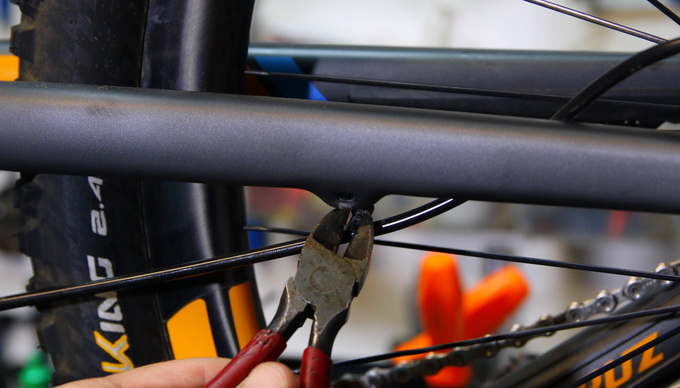
* Side cutters used for cutting brake and inner shifting cables. I recommend purchasing one at least 6 inches long.

* Cable housing cutter used to cut brake and shifting cable outer housing.  The Park Tools cable cutter works great.

* Cone wrenches 14, 15, 16, 17, 18, 19mm used for adjusting wheel bearings and hard to reach or slim areas. To save yourself some money get only the ones you need. For adjusting wheel bearings sometimes you need two sets of cone wrenches.

* Pedal wrench for removing pedals. A good quality pedal wrench is slightly offset to prevent your hands from striking the crank.

* Headset wrenches used for those who have older style threaded steering tubes 32, 36, 40mm.

* Bottom bracket wrench. You can purchase a bottom bracket wrench that matches your bottom bracket or purchase one in a socket drive form.

* Phillips #2 and #1 screwdrivers used for adjusting the derailleur stops on your derailleurs. You probably already have these laying around your house.

* Standard (flathead) screwdrivers with 7/16 and 3/8 wide blades for adjusting derailleurs.

* Crank and crankbolt extractor – be sure to get the one that matches your type of crank. For X-drive bottom brackets all you need is an 8 or 10mm Allen key.

* T25 torx drive used to remove disk brake bolts. Get the T-handle version since it gives you more torque to break free those stubborn bolts.

* Don’t forget the cleaning products which should include a good quality bike wash for breaking down dirt without attacking painted surfaces. A de-greaser to remove gunk off your chain. Chain lube (choose the one that closely matches your terrain: wet, dry, epic, etc.). Grease (Phil Wood, Permatex Ceramic lube or similar) used for re-packing bearings, headsets, for inside seat posts (** DO NOT apply grease in carbon frame sets**)

For wheel service and wheel building including freehub service (advanced)

picture-51

* Wheel truing stand. A simple one will work just fine but the more complex units have self centering features.

* Truing wrenches which come in four sizes and are color coded. Bring your wheel to the store to match up the sizes with your spokes.

* Tire Iron used to help remove the tire from the rim. Purchase a set of three (** Use caution on wheelsets that are tubeless as some levers may damage the rim strips**).

* Cone wrenches which are thinner than normal wrenches and allow you to fit them in the sides of the wheel to adjust your bearings.

* Freehub lock ring tools or freewheel removal tool. Bring in your rear wheel to match up  the tool if you’re not sure which to purchase. This tool is a must if you intend to replace broken spokes on the drive side of your rear wheel

* Chain whip used to hold the gears in place while releasing your lock ring or freewheel.

* Chain pin tool. Necessary if you’re planning to remove a chain which does not have a “power link.”

*Chain cleaning device (not shown) used to house a cleaning solution and a convenient way to degrease your chain.

* Toothbrush or similar bristle tool to clean freehub gears.

* Various lubes for wheel bearings and special lube for the freehub.

* Wheel building book or guide.

* Any tools specific to your wheels. Mavic, for example, makes a special spoke wrench and tools for servicing their wheels.

For finishing up your work and final assembly or specialty tools.

picture-53* Allen socket set 2, 3, 4, 5, 6, 8, 10mm for use with your torque wrench for final assembly and proper torque settings.

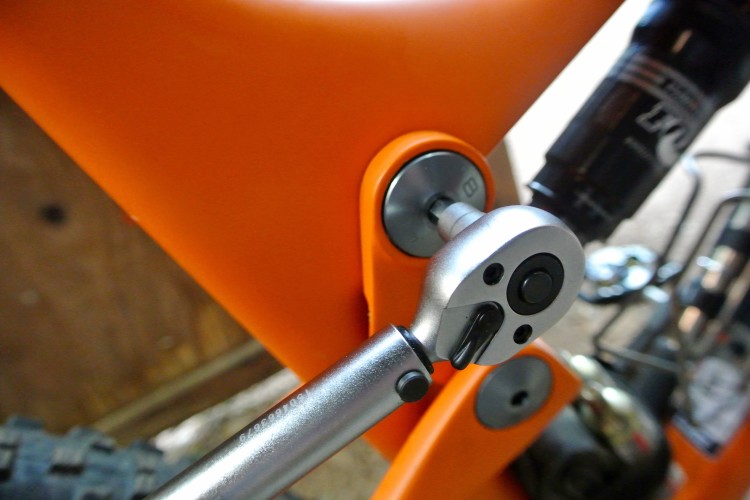
* 1/4″ Torque wrench used for setting low torque values on brakes, shifters, derailleurs, stems, seatposts, seatpost clamps, and everything else. Especially important if you use Carbon components.

* 3/8″ Torque wrench used for setting high values of torque (200 in/lbs+) mainly used for pedals and crank arms.

* Fine screwdrivers used for opening shifting pods and exchanging cables or for internal components in shocks.

* Shock pump. Only necessary if you have an air fork or rear shock.

* 6, 7, 8, and 10mm sockets may be needed for torque settings on various components.

* Threadlocking compound (permanent and low strength). Your need for this stuff will depend on the type of terrain you ride.

* Special sockets or tools for specific tasks such as bleeding brakes, fork internal repairs, suspension tools, sag setting devices, star nut tools, etc. Hang on to tools like small bottles or syringes, picks, swabs, old tooth brushes and the such.

Tool kit recommendations

Most DIY bike mechanics will want to gradually build up an arsenal of tools as repairs come up but for those looking to jump right in there are a few pre-assembled kits available. If you’re market for a basic set-up the Park Tools SK-1 Home Mechanic Starter Kit is a decent option. An even better value with more tools is the Sette Torx ST-37 Tool Kit (on sale at Pricepoint for $140) or the Filzer BFTB Tool Box II.

This list of tools may grow over time with your experience beyond what is presented here, but then again it may not which is fine. This list is only a guide to help those of you who are thinking about repairing your bike and are not sure which tools to get or why you need them.

One final very special tool – information. Get your hand on as many guides and manufacturer-specific installation instructions and have them at the ready when its time to fix your rig. Nothing beats first-hand info.

Cheers.

Simple Strap Replaces Your MTB Seatpost Bag

Monday, March 30th, 2009

simple-strap-mtb

We don’t typically blog about MTB products unless we’ve had a chance to try them for ourselves, mainly because it’s a waste of time to regurgitate specs sheets you can read online. But the Simple Strap is different – it’s so simple it probably doesn’t even have a spec sheet!

The Simple Strap has everything we look for in a MTB product – it’s lightweight, multi-functional, and simple. Designed to take the place of those goofy under-seat tool bags, the Simple Strap securely straps stuff like extra tubes, tire levers, and mini pumps to your seat post. No more rattling down the trail like a box of rocks – your stuff is tight and easily accessible (great for racing).

What I really like about the Simple Strap concept is that it’s so versatile. Over on the byeKyle website there’s a post about using the Simple Strap to MacGuyver a broken chainring and the possible uses are pretty much endless. I actually use a similar piece of stretchy velcro (boot blousers from my military days) to wrap my pants leg for commuting. No more frayed cuffs for me!

Simple Strap comes in multiple colors and is available for purchase online for just $6.99; at that price it probably makes sense to get at least two. The inventor, a mountain biker named Kyle, claims the Simple Strap has been tested in races and 100-mile rides so it seems to have a good track record. Always cool to see grassroots innovation in the MTB world…

What to pack for an epic MTB ride

Tuesday, January 27th, 2009

I like to be prepared for anything on the trail from bike and body breakdowns to hunger meltdowns and over the years I’ve come up with a list of items to handle almost any emergency. As a rule of thumb I try to “expect the unexpected” and pack my trail bag accordingly. Here are my tips.

The first thing you need to be prepared for an epic ride is a backpack or a hydration pack that has room for carrying what you need. If you look at cycling-specific hydration packs regardless of brand they all do a pretty good job at carrying water and stuff so it’s important to find the most comfortable pack that’s the right size. I purchased the Camelbak Octane 14+ since it has a 100oz bladder, a comfortable strapping system that’s both secure and non-restrictive, and an expandable zipper system that effectively doubles the storage capacity on demand.

Once you’ve settled on a pack, it’s time to fill it up. First and foremost you should pack a comprehensive first aid kit – one that contains everything you need to take care of most major abrasions you may get. Inside my kit I have bug spray, alcohol pads and sanitized hand wipes (both for cleaning any wounds), 4 x 5 prep pads, 2 x 2 prep pads, band aids (assorted sizes), Advil extra strength, compression bandages, thread and needle (sterilized in bag), Polysporin, Benedril (poison ivy cream), a hot/cold pad (to reduce swelling), steri-strips 2nd skin patches (holds cuts closed like stitches), a very sharp diving knife with serrated edge, a sling, and splints. Now this is a worst-case-scenario first aid kit and works great if you know how to use it but for some folks it may be overkill.

In terms of trail tools I recommend a good quality multi-tool that includes a chain rivet tool. If you have special wheels like Mavic’s Crossmax carry the tools that are used to adjust the wheel and true them as well. A good quality pump for tires is a must and if you have full suspension bike you may want to bring the shock pump as well (for them pesky stuck down situations). I also like to bring spare parts like SRAM power links, derailleur cable, and a spare derailleur hanger. Tire irons and patches and/or tubes are a good idea, and if you have tubeless tires a spare 2 ounces of Stan’s and a tire inflator to blasts the beads in place could come in handy on the trail.

Extra items that you will want to consider are a spare pair of gloves in case the ones you are wearing get wet and a water resistant jacket that will keep you warm when the weather doesn’t cooperate.  A high power tail light that clips to the bag is a good idea in case you’re caught in the dark and need to be seen.  Your wallet, cell phone and car keys are good to have as well – never leave home without ‘em!

Now that we have medical and mechanical emergencies covered it’s important to talk about food. I like to carry fresh fruit on long rides which I like to consume first since fruits tend to get bruised easily on rocky trails. I also carry a variety of snack bars (taste them before you go off the deep end and buy a box) and gel for fast energy. Another good thing I like to carry is a bag of trail mix (that’s what it’s made for after all!). More important than any snacks, make sure your Camelbak has enough water for your ride. I have found 100oz it usually good for about 4 hours and if I think I’ll need more water I carry a 500ml bottle in my Camelbak as well.

One final note about packing for your epic ride: bring whatever you like on your ride but always pack out what you pack in (wrappers, etc.) Keep a small bag so that you can toss the wrappers in without messing the inside of your hydration pack. If I have extra room in my pack I’ll stop to pick up small trash I find on the trail as well.

Packing for an epic ride takes just a little planning but pays off big time in the event of a trail emergency!


Site Map | Advertise | Partners | Contact Us | Terms | Privacy
Campground Reviews | Hiking Trails | Trail Running | Skiing / Snow Sports | Mountain Biking
Copyright 2012 Blue Spruce Ventures LLC | Atlanta, GA
singletracks.com is yet another slick Review App