singletracks is mountain biking
Sign In | Create Your Account | Site Map | Help  


Mountain Bike Trail Maintenance 101

Tuesday, January 24th, 2012

We’ve seen a recent surge of interest in trail building here on Singletracks and we just started a new forum for discussions about building mountain bike trails. But building the trail is only half of the equation; maintaining the trails is a long-term task that will never completely go away.

I’ve been dedicating more of my time lately to volunteering during trail work parties at my local trails. This blog post tells the story of our most recent work party, but also explains the why and the how behind basic trail maintenance.

De-berming and Nicking

We spent four hours on a Saturday morning (1/7/12) working on de-berming and nicking the Jake-to-Bull connector trail out at Bull Mountain which runs from the lower Jake Mountain parking lot to the upper Bull Mountain lot. Our main focus was the first section, which drops down from the Jake Mountain lot to USFS road 28-1. In my opinion, the entire Jake-to-Bull connector is (or was) one of the worst-draining sections of trail in the entire trail system, so our focus here was well-deserved, and really, long overdue!

The basic design premise behind a bench-cut singletrack trail is that you want the water to flow off the trail/across the trail instead of following the trail down the mountain. There are various techniques you can use to make this happen, but the most important is to make sure that the trail is out-sloped.

Due to heavy use (or a haphazard initial build), the center of this trail tends to pack down more than the outside, creating an outer berm that holds the water on the trail. Our job was to de-berm the worst sections of the trail and to “nick” the low points by building drainage channels off of the side so that the lowest spots at the bottom and tops of the hills can drain properly.

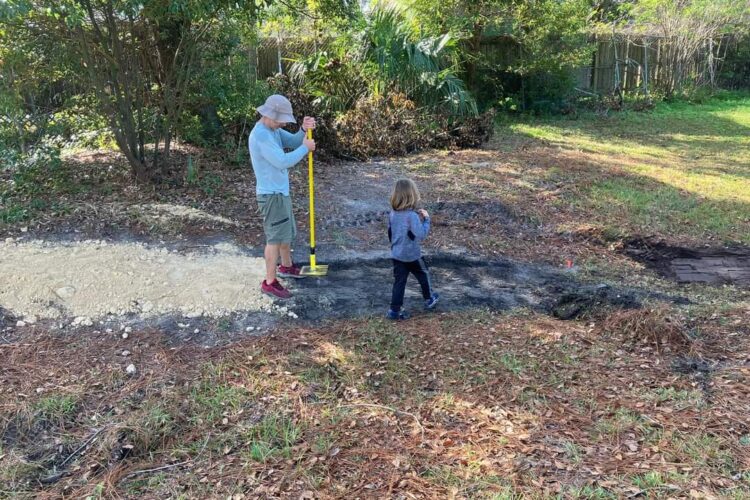
De-bermed section of trail.

The tools of choice for this work are a pulaski and a McLeod. The pulaski is used for the main grunt work of chipping down the hardened outer berm and digging the nick in. But a pulaski isn’t capable of finishing the job. After the main digging is done, the McLeod comes out and is used to pull all the loosened dirt and other debris downhill, away from the trail. Generally, after pulling the loosened dirt away we’ll notice that the outer berm is still somewhat present, and then it’s back to the pulaski.

Pulaski, foreground. McLeod, background.

It can take a lot of switching back and forth between tools or people and a lot of time to satisfactorily de-berm and nick a low spot in the trail. Of course, you can do a quick once over… but if you don’t put in adequate time to do the job properly, it will either not make any difference at all, or the small drainages that you’ve made will fill right up in a few months. The best plan: do it right the first time so you won’t have to be back for another decade or so!

De-berming of a low spot, before and after:

Note: the low spot pictured above was rather minor compared to some of the muck holes we tackled that day!

The final test to determine whether or not the de-berming or nick will succeed at diverting the water off the trail requires a very specialized tool: a soccer ball.

Yes, a soccer ball. The ball is rolled down the trail and supposedly simulates the action of water with relative accuracy. If the ball rolls off the trail at your newly constructed nick or newly removed berm, then good: mission accomplished! If not, it’s back to the pulaski until it does.

Dave Muse testing the trail with the soccer ball.

Get Involved

With these trail design philosophies, tools, and techniques at your disposal, you are ready to start giving your trails the TLC they deserve! Before you head out and start moving dirt, though, make sure you have permission to perform the maintenance, and make sure you are working in line with the general philosophy of the trail system. For instance, out here in the National Forest we aren’t allowed to just go out and put tools to trail old day we please. We have to arrange pre-scheduled work days, document all the hours we work, sign waivers, and follow quirky safety procedures such as wearing helmets while we dig.

If you are interested in helping maintain your local trails, one of the best things you can do is become a member of your local trail advocacy group (check out this list of mountain bike clubs and organizations). They will probably have tools you can use, instruction and guidance on where and how to maintain the trails, and it’s a great way to meet like-minded riders, too! And if you aren’t convinced that you should help out yet, here are 7 Reasons to Start Doing Trail Work.

Get Digging!

Your turn: Are you involved in maintaining your local mountain bike trails?

Leave No Trace Mountain Biking

Wednesday, September 28th, 2011

“What does mountain biking mean to you?”

This question is posed all the time in forums, blogs, videos, and magazines. It can be a tough question to answer because there are so many things that make mountain biking such a rewarding lifestyle. I know that for me, and for many of you, one of the most rewarding aspects of mountain biking is getting to enjoy some of the wilder, more unsullied places on the planet. There is something peaceful and pure in nature that speaks to us, that calms the spirit.

That blissful escape from the urban world is destroyed when you reach a scenic overlook only to find someone’s garbage lying on the ground.

Sometimes I hate people. This trail-side trash heap totally ruins the scenic beauty of this spot. Green Mountain, Blue Ridge, Georgia.

For me, this picture represents the beauty and grandeur of nature that I head out on the trail to find. Trail 401, Crested Butte, Colorado.

We can all help protect the majestic beauty of the mountains, forests, meadows, and deserts that we ride in by choosing to Leave No Trace.

LNT Mountain Biking

There are seven main principles of Leave No Trace outdoor ethics. In addition to just listing the main principles, I’ll add some of my thoughts on how it can be specifically applied to mountain biking:

1. “Plan Ahead and Prepare”

This is a good rule for any trip into the forest. Know where you’re going, what the area will be like, and pack everything you think you’ll need.

2. “Travel and Camp on Durable Surfaces”

This is very important for mountain bikers! Ever heard the saying: “Keep singletrack single”? The trail is meant to be followed. If you don’t have the skills to ride a particular section of trail, don’t blaze your own trail around it. If you do it, someone else will follow your tire marks. Riding off the established trail accelerates erosion and degrades the purity of the singletrack experience.

Please, if you can’t handle the difficulty of a specific section of trail, just get off and walk.

3. “Dispose of Waste Properly”

Pack it in, pack it out. One of the things that inspired me to write this post in the first place was finding trash all over my local trail system after a recent race. Does it really take you that long to put your half-eaten gel packet back in your pocket? And if you can pack in an extra tube for when you get a flat tire, why can’t you pack your flat tube back out with you?

I picked up all of this trash in less than a quarter of a mile. Perhaps the water bottle was more “lost” instead of “tossed,” but the tube and sweat rag are unacceptable.

For other sorts of waste in the backcountry, I refer you to these directives from LNT.org:

  • “Deposit solid human waste in catholes dug 6 to 8 inches deep at least 200 feet from water, camp, and trails. Cover and disguise the cathole when finished.”
  • “Pack out toilet paper and hygiene products.”
  • “To wash yourself or your dishes, carry water 200 feet away from streams or lakes and use small amounts of biodegradable soap. Scatter strained dishwater.”

4. “Leave What You Find”

If you want to take something from a natural environment, please just take a picture. Leave whatever you’re photographing there for everyone else to enjoy too!

5. “Minimize Campfire Impacts”

This really only applies to mountain bikers who are bikepacking, but please try to use preexisting fire rings.

6. “Respect Wildlife”

These ideas really apply to everyone at all times, including mountain bikers.

7. “Be Considerate of Other Visitors”

This is especially important for the mountain biking community. Learning to yield the trail properly to other users goes a long way towards amiable interactions with other user groups and trail access in the future. In case you aren’t aware, the technical rules of yielding are as follows:

  • Hikers yield to horses.
  • Mountain bikers yield to horses.
  • Mountain bikers yield to hikers.
  • The downhill rider yields to the uphill rider.

As we’ve discussed in a recent forum thread, this last one doesn’t always make the most sense. But when in doubt, stick to these guidelines, and it can help alleviate stress for everyone.

It Only Takes One

It only takes one person to ruin the purity of nature for everyone else by leaving trash on the ground, carving their initials in a tree, or spreading dirty toilet paper across the forest floor.

On the other hand, sometimes it only takes one person to pick that piece of trash up to restore the woods to its former natural glory.

Don’t be the first person… be the second.

What are your thoughts on Leave No Trace MTB ethics?

Fresh Dirt: Paynes Creek, GA Ride Report

Tuesday, July 12th, 2011

Whoops!

Not as in “whoops, I dropped the hamburger on the ground,” but whoops as in “YEE-HAW!”

The new mountain bike trail at Paynes Creek is absolutely chock-full of whoop-te-dos! They vary in size from small to massive, but all of them are easy to negotiate, making this a very beginner-friendly trail. However, if you are an advanced rider (or just have an extra-large dose of crazy), you can blast through many of these whoops at high speed, airing off of the top of one and landing on the transition into the next. The landings added to the thrilling g-forces at the bottom of the U’s are sure to put your rear suspension to the test, despite the almost complete lack of rocks and roots on this trail.

And of course, being the great journalist that I am, I totally forget to take a picture of a single whoop. Sure, it might have had something to do with how much fun I was having riding them!

While the gorgeous flow of this trail encourages you to drop the hammer and rail through everything, make sure you don’t get complacent: some of the biggest whoops right at the beginning of the trail (on a counter-clockwise day) will throw you into the air and have you landing on a loose off-camber corner above the water!

And while you might also think that this trail is totally flat because it’s in Northeast Georgia and lies right next to a lake, a couple of the switchbacked climbs may throw a series of tough punches to your gut.

Whether you are a beginner trying singletrack for the first time, someone just looking for pretty views of the lake, or an advanced rider ready to drop the hammer, the 7-mile long Paynes Creek trail has plenty of awesome to go around!

History

At this moment, Paynes Creek is about as new of a trail as you’ll ever ride, having just opened at the end of April (2011). This is the first true singletrack mountain bike trail in this section of Northeast Georgia and helps fill in a large gap in the map. Paynes Creek was designed and built through the cooperation of the US Army Corps of Engineers, the crew behind the epic trail design of FATS, the Southern Off-Road Bicycle Association (SORBA), people like you who were willing to volunteer, and even Singletracks.com.

So what are you waiting for? Plan your trip to Paynes Creek today!

My Top Five: The Best Mountain Bike Trails in the CSRA

Thursday, May 26th, 2011

I’m proud to call the the Central Savannah River Area, or CSRA, my home.  The CSRA is the the area surrounding Augusta, GA and North Augusta, SC and it’s home to some of the best, least-expected mountain biking in the southeast.  I say least expected because we don’t have any mountains here.  We’ve got hills, but no mountains.  But boy oh boy do we have trails, about 150 miles of them actually, with more in the works.  We have many of these trails because of the local MTB club, SORBA-CSRA.  SORBA-CSRA has done such a good job in this area that in 2010 IMBA held their biannual World Summit here.  So if you’re looking for a place to take a spring MTB trip, give the CSRA a look.  In this blog post you’ll find my five favorite trails in the area, in no particular order.

FATS: Forks Area Trail System (SC)

FATS, located in the Sumter National Forest in South Carolina, is the crown jewel of the CSRA mountain bike scene, and the only IMBA Epic in South Carolina.  It’s 37 miles of fast, swoopy, roller coaster like purpose built mountain bike trails.  There are six individual loops, each with a slightly different feel and the trails will satisfy both beginners and experienced riders alike.  There is very little technical terrain at FATS so anyone can ride here and likely clean every inch of trail.  What makes this trail fun is the speed – it’s easy to get, and easy to keep.  But you do have to be careful with all that speed: there’s a bunch whoop-de-doos that will throw you over the handlebars if you’re not careful.


Riders cruising through some whoop-de-doos on the Deep Step loop at FATS

Mistletoe State Park (GA)

Mistletoe is the anti-FATS.  It’s the most technical trail in the CSRA.  The trail was not built for mountain biking, even though bikes are allowed now.  There are lots of creek crossings – some are easy, some are not.  There’s some rocks, and some steep climbs.  The trails can be a little confusing your first time out so I suggest looking for a local to show you around.  The Rock Dam and Cliatt Creek Nature Trail are the most popular rides, and most locals link them together to form a loop around 6.5 miles long, with a lot of climbing for this area.  Mistletoe is the western most portion of the big Thurmond Epic route.


One of the deeper creek crossings at Mistletoe State Park

Modoc (aka Stevens Creek) (SC)

Modoc is another technical trail, for the CSRA at least.  Located in Sumter National Forest, the Modoc trail roughly follows Steven’s Creek and has some nice scenic views.  Several ditch and creek crossings keep you on your toes on this 6-mile out and back trail.  Between the technical bits Modoc is pretty fast and smooth.  There is plenty of really nice bench cut singletrack that has been in place for decades and it’s a lot of fun to ride.  Locals link Modoc to the Turkey and Wine Creek trails for longer routes.


Only 1/4 mile from the parking lot is one of Modoc’s most memorable creek crossings.  Photo: brianW

Bartram (GA)

The Bartram trail is one of the least technical trails in the area, but it’s also one of the longest.  The trail is an out and back stretching from the West Dam Recreational Area west all the way to Washington Road, and it’s 22.5 miles one way!  The trail runs right through the Petersburg Campground, making Petersburg a great place to stay if you’re planning a visit to the CSRA to ride.

East of Petersburg is known as “old Bartram” to the locals and it is the least challenging side.  It is very flat, smooth, and very fast if you want it to be; a great place to take the kids riding.  West of Petersburg, or “new Bartram” is a little tougher, with some climbing, whoop-de-doos, and a few technical challenges.  The entire trail hugs the shores of Lake Thurmond and has lots of nice views.  Bartram is the biggest chunk of the Thurmond Epic route.


There’s something special about lakeside singletrack.  Photo: brianW

Canal Trail (GA)

This is probably going to a controversial pick as a Top Five trail but hey, it’s my list and I love the canal trail!  It’s a very short 2.8 mile loop inside the city limits of Augusta.  This is the only trail in the area that’s within easy riding distance from a large population area.  It sits on a small piece of land between the Savannah River and the Augusta Canal.  To make the best use of the land the trail is very tight and twisty, making it a great place to work on your cornering skills.  There aren’t any big climbs, but there are a few short steep rooty grunts that can test your skills.  It’s a little trail, but it is big on fun!


That’s me, playing hookie from work and enjoying the canal trail on a sunny Friday afternoon in the spring.  Don’t tell my boss.

My Top Five: The Best Mountain Bike Trails in Western North Carolina

Monday, May 16th, 2011

Trying to pick the 5 “best” mountain bike trails in Western North Carolina (WNC) is kind of like trying to pick the 5 best $5,000 mountain bikes. They’re all amazing, but they’re all just a little bit different. So while I’m picking these trails because I think they’re really great and may in fact be the best, I’m also choosing these specific trails in an effort to portray the incredible diversity of the mountain biking opportunities available in WNC.

5. Sugar Mountain

Sugar Mountain

Photo Credit: Goo. Rider: Unknown.

If you are coming from the south in an effort to find lift-serviced downhill mountain biking, Sugar Mountain is the first spot that you’ll find. While the resort doesn’t offer an expansive trail network or a jump park, it does have one full top-to-bottom trail packed with more rocks, roots, drops, steeps, and more rocks than you can shake a broken derailleur at! During my first visit to Sugar Mountain, I rode the trails non-stop for the entire 5 or 6 hours that the lift ran. While the trails may be few, the ones they do have are seriously fun! If you live north of North Carolina, though, there are probably some much better options available within a reasonable distance. But for those of us in the South, Sugar Mountain is a great asset.

4. Bent Creek

Bent Creek

Photo Credit: ositoking.

I have not yet ridden this trail, but based on all the information I’ve gleaned from guidebooks, the listing here on Singletracks, and friends of mine that live in Asheville just a stone’s throw from the trailhead, Bent Creek is worth a trip! Based on my conversations with locals, the trails are apparently much, much tamer than the trails in Pisgah proper, and are even less technical than those found in Dupont. However, that doesn’t detract from the beauty of this trail system as a whole. There are climbs and descents to be found all over the place, and by all accounts the trails are well-built and narrow.

Bent Creek is designed as a tightly wound “trail system” with concentric loops, making it easy to do anything from a short 5-mile ride to a pieced-together all-day epic. Either way, you’re rarely far from the trailhead. For some people, this could be a welcome relief from the epic-quality singletrack in the rest of Pisgah National Forest that seems to take you deep into the heart of nowhere, completely removed from the constraints of civilization… and the safety of it. Riding a trail system such as Bent Creek requires much less overall commitment. Add in the benefits of a lake and campground and you have a classic mountain biking destination fit for you and the buddies, or you and the family.

3. Tsali

Tsali Singletrack

Photo Credit: Goo.

View of Fontana Lake

Photo Credit: Goo.

According to mtbikewnc.com, “The popular Tsali Recreation Area has long been a top destination for mountain biking in Western North Carolina, and even the entire eastern US. Containing nearly 40 miles of trails in a system with four excellent loops, it has been rated as one of the top 10 places to ride in the USA.” Historically, Tsali has been one of the great mountain bike destinations of the Southeast. I have spoken with several Georgia locals who can remember back to a time when mountain biking in the state was sparse, and that if a rider wanted to find true singletrack they would have to make the pilgrimage up to Tsali. Thankfully that is no longer the case, but Tsali continues to be a classic destination for mountain bikers from all over the Southeast, and from all over the nation.

Tsali’s popularity is due to the incredible undulating flow of its smooth trails, and the breathtaking views that it provides of Fontana Lake from several different vantage points. In many ways, Tsali is the antithesis to almost all of the other trails in Western North Carolina. Pisgah, Dupont, and many other areas are renowned for the technical challenge found within their forested borders. Tsali’s trails are renowned for exactly the opposite!

2. Black Mountain

Black Mountain

Photo Credit: Goo.

As Timm Muth, the author of the North Carolina Falcon guide book, says, “Simply put, this is one of the top three descents in (Pisgah National Forest). It should be on the “A” list for any rider who requires an enormous dose of heartbreak, challenge, and adrenaline.” I know Timm personally, and he has done every single ride in his guide book, so I’ll take his word for it!

Black Mountain is full of quintessential Pisgah singletrack: incredibly steep climbs filled with drops, roots, and rocks like you’d never believe, followed by descents that are just as steep and just as gnarly. Black Mountain is no exception to this rule, and it is an intense 10-mile ride! Starting at ground zero, the trail climbs up and over Hickory Knob, back down the other side a bit, and then rockets straight into the sky to the top of Black Mountain. At the top, turn around, drop your saddle, and bomb back down! Highlights include tons of drops, crazy gnar, jumps, and 8-foot tall berms.

If you’ve been looking at this list closely, you’ve noticed that Black Mountain is the only trail listed that resides in the Pisgah National Forest (barring the Bent Creek trail system). There are literally hundreds of miles of trail in Pisgah, and if you took almost any one of them and placed it in one of the nearby states, it would make a top 5 list such as this with ease. As you can imagine, picking out the “best trail” is difficult at best and arbitrary at worst; in any case I think Black Mountain does a good job of standing as a representative of the entire forest!

1. Dupont State Forest

Dupont State Forest

Photo Credit: Goo.

Putting “Dupont State Forest” in first place is a little bit of a cheap shot, as there are over 80 miles of trails available in the forest. The various trails contain steep slickrock, flowy singletrack in the trees, scenic waterfalls, jumps, rocky technical sections, steep climbs, rhododendron tunnels, and more. I have not explored every single one of the trails yet, but so far the trail combination that includes the most slickrock is easily my favorite. In fact, it may be one of the best trails I’ve ever ridden… ever. This East Coast slickrock experience is not to be missed!

Have you ridden in WNC? What’s your favorite trail?

My Top Five: Best Mountain Bike Trails in the North Georgia Mountains

Thursday, April 21st, 2011

Before I met my wife, the entire state of Georgia rarely crossed my mind. I knew nothing about it, except for its geographic location and the fact that it was one of the 13 original colonies. Moving to Georgia never occurred to me as a possible course for my life… not even in my wildest dreams!

As you might imagine, I had never thought about the prospect of mountain biking in this state either. Sure, I had heard of the legendary riding in North Carolina and West Virginia, but Georgia? C’mon now.

Having lived here for more than 2 years now I can personally attest to the fact that life will take you places that you’ve never dreamed you would go, and that Georgia is a mountain biking hotbed. Specifically, North Georgia is the place to be. While the bottom three-quarters of the state are really quite flat, the upper quarter bordering North Carolina and Tennessee contains legitimate mountains… and legitimate mountain bike trails. Add in a mostly year-round riding season and active trail clubs and you have a formula for great mountain biking.

Pinhoti Trail, Dalton / Ellijay

The Pinhoti trail is a massive, mostly singletrack trail that stretches from the upper reaches of North-Central Georgia all the way down to Central Alabama. The trail is 330 miles in length, and Georgia contains 164 of those miles. Unlike many trails of this scale in the eastern US, most of the Pinhoti trail in Georgia is open to mountain bikes.

As you might expect, IMBA (the International Mountain Bicycling Association) recently bestowed the venerable title of “Epic” to the Pinhoti. The word is out, and everyone knows what an extraordinary ride this is.

Due to its length, it would be nearly impossible to write a concise review of the entire Pinhoti trail. Some of the sections further to the south and west near Dalton are considered to be some of the most technical mountain biking in the state. The sections near Ellijay are beautifully-constructed, narrow singletrack and unlike the sections around Dalton, they are relatively smooth and fast.

If there’s one thing that you can be sure of when riding the Pinhoti, it’s that you’ll definitely be doing a lot of climbing and a lot of descending… and you’ll probably love every minute of it!

Bear Creek, Ellijay

Bear Creek

It doesn’t seem fair that Ellijay should have so many incredible trails in such a relatively small area… but they do. Another classic ride, the Bear Creek trail intersects the Pinhoti trail here (mentioned above).

The Bear Creek trail lies in a gorgeous section of the Chattahoochee National Forest and many different factors contribute its scenic nature: Bear Creek tumbling alongside the trail, the mighty Gennett Poplar, and the scenic overlook of the Cohuttas found at the top of the trail.

Not only is this ride stunningly beautiful, but the trail is a blast to pedal on as well. This is a simple out-and-back, with the singletrack climbing steadily for 5 miles. Then at the top, you get to turn around and bomb back down. The descent back down Bear Creek is fast, amazingly flowy, and best of all it is uninterrupted. Continuous downhills of this length are pretty rare here in North Georgia!

Stanley Gap, Blue Ridge

Stanley Gap

While this is just one trail in the Aska Trail System, Stanley Gap is definitely the crown jewel of the Blue Ridge area. Best ridden as an out-and-back, the trail climbs steeply from the Deep Gap parking lot all the way up to the high point, and then descends back down a little ways to Stanley Gap.

After turning around and climbing back up that shorter section, the main downhill back down to the start is your true reward… and it is to die for! The speeds you can achieve dropping down this steep, steep section of trail can honestly be scary: make sure you either bring the balls or the skills to deal with the tight trees, big rocks, and sudden turns whipping past at mach 5!

Bull Mountain, Dahlonega

Bull Mountain

Since this trail is practically in my backyard, there is a special place in my heart reserved for the Bull Mountain trail and the surrounding trail system.

Admittedly, the standard 11-mile Bull Mountain loop isn’t the best singletrack ride in the world. Much of the climbing takes place on old roads and doubletrack. However, the descent back down more than makes up for it! Expect rocks, rocks, and more rocks, high speeds, rhododendron tunnels, and the need to pick bugs out of your teeth after grinning all the way down.

In my opinion, two of the greatest things about the Bull Mountain loop are the large amount of elevation gain (and loss), and the remote feeling in the outer reaches of the loop. Up on the high Bare Hare trail, I always feel as if I am totally removed from civilization. It’s just me, my bike, and the mountain peaks!

I recommend adding in this approach trail to turn it into a 17 mile lariat.

Stonewall Falls, Clayton

Stonewall FallsStonewall Falls is one of the only legitimate singletrack mountain bike trails in the northeastern corner of the state, and it is definitely worth a little bit of a drive to reach it. This 11+ mile loop is a challenging ride that will at least stretch you physically if it doesn’t test your bike handling skills.

In short, this trail never feels like it is on flat land. It is either climbing a hill or descending the other side. There is no break, there is no respite: your heart will be going the entire time!

In the end, the descents, narrow singletrack, and beautiful forests make all of the pain worthwhile. As a grand finale, Stonewall Falls sits at the very end of the loop, signaling the end of your ride from far off with its roaring water: a fitting end to a mountain bike trail in Georgia.

I’ve done enough writing, now it is time to hear from you: Have you ridden in North Georgia? What’s your favorite trail?

If you haven’t been here, what is your favorite trail where you live?

Singletracks Trail Work Day @ Lake Hartwell (GA): Sat. April 23, 2011

Monday, April 18th, 2011

This Saturday I’ll be heading to Lake Hartwell on the Georgia/South Carolina border to help with the trail work day at Paynes Creek, soon to be SORBA’s newest mountain bike trail. Assuming all goes well and plenty of volunteers show up this weekend, the official grand opening is scheduled for the following weekend, April 29.

This is a great opportunity to volunteer for a number of reasons:

  1. Helping build new trails is exciting and it’s a chance to preview the course before it’s officially open!
  2. Trail work days are a great chance to meet other mountain bikers.
  3. Singletracks is giving away free trail membership certificates ($19.99 value) to EVERYONE who works this Saturday.
  4. The weather is going to be fantastic and any excuse to spend time outside is a good one.
  5. There’s a free lunch for the volunteers.
  6. It’s a good chance to learn trail building techniques from the pros while getting a “hands on” application of best practices.
  7. Giving back to the trails always feels good and if you ride often it’s the right thing to do. If you’ve never volunteered before, this is your chance!

Full details are available here and on the SORBA calendar. See you Saturday!

IMBA Southern Regional MTB Summit: Summary

Monday, April 18th, 2011

This is my third and final post covering the first ever Southern Mountain Bike Summit.  In case you missed the first two posts, part one can be found here and part two can be found here.

The Take Away

I’ve been involved in MTB advocacy on the local level pretty much since I started riding a few years ago so I know that a lot of work goes on behind the scenes and that mountain biking is a lot more than just riding your bike in the woods.  But I didn’t realize just how much work happens, and how hard people have fought for access to land and trails.  It was really cool hearing the success stories from the people largely responsible for those successes.  All great trails take a lot of work, and a lot of time, to become reality.  Take the Coldwater Mountain project for example – people have been working on that for over a decade and not even a single foot of trail has been built yet!!


Some of the people responsible for the summit, from left to right: Karen Into (President, Pisgah Area SORBA), Liz McNamara (Vice President, Upstate SORBA), Tom Soret (IMBA Southeastern Regional Director), Robin Allen (SORBA Communications Director), and Walt Bready (SORBA Promotions Director)

Several presenters gave some really interesting statistics that local clubs can use as ammunition when fighting for access.  Here are a few examples:

  • Over 50% of children in the US are obese
  • There are 1.5 times more mountain bikers than golfers in the US
  • 1 in 5 Americans over the age of 16 ride a mountain bike
  • Mountain bikers have 30% more voting power than voters aged 65 and above
  • For every $1 spent on trails, $4 is saved on medical expenses
  • 55% of trail users exercise more than before they had access to trails
  • More useful statistics can be found from the Outdoor Industry Foundation and the Rails and Trails Conservancy

If you’re not involved in advocacy on at least some level you should be!  Trails don’t build or maintain themselves you know. :)   Head over to the IMBA website to find out if there’s an IMBA club near you, or how to start one if there isn’t a club in your area.  And if you’re not already a member of either a local club or IMBA, what are you waiting for?  A basic membership with IMBA is only $30 - it’s the least you can do to give back to the sport you love so much.

Ride Report: Black Mountain

After the final session on Friday afternoon everyone headed over to Poppie’s Market and Cafe.  From there we rode 2.3 miles on a scenic greenway trail, and then split into three groups.  There was a 4-mile ride for the beginners, the intermediate ride was 4.3 miles, and the expert ride was 9.3 miles.  I did the expert ride, and we rode an old Pisgah classic: Black Mountain.  After we split off from the intermediate ride we regrouped at some horse stables before starting the big gravel road climb up Clawhammer Rd to get to the trail.  Todd Branham, owner of Blue Ridge Adventures, was our ride leader, and he told us “You’re about to do most of your climbing right here.  Once you get over this steep pitch the rest is easy.  This will gain about 1200 ft in 3 miles.”   He wasn’t kidding, we were about to go up, up, and away!

Lucky for me, a friend let me borrow his Yeti 575 for the weekend.  On this climb I was extremely thankful for gears!  Even with the lowest gear ratio I can set up on my singlespeed I’d have been walking that whole climb.  It was steep, and it never seemed to end.  I got dropped pretty quickly by all the locals and people used to doing those big climbs.  Thankfully, I wasn’t the slowest person – several others were way behind me.

After the first few miles of stupid-steep climbing the road leveled out some.  We kept going up for a few more miles but it was a much more mellow grade.  One of the redeeming values of the climb is the great view on the way up.  Once we got to the top of the road there was a little more climbing to do, but now on technical singletrack.  I walked it all.  I probably could have ridden it, but I was exhausted after more than an hour of climbing and once the people in front of me stalled and stopped, so did I.  After a minute or so of walking we were at the top – it’s all downhill from here!


Photo: Goo

The downhill was intense.  The top section was steep, with tons of roots, rocks, and water bars.  Drop after drop after drop.  I stopped after a few minutes and lowered the seat on the Yeti.  The rest of the downhill was a lot more fun without the seat in the way.  Part of the way down the trail changes from steep and technical to mellow and fast.  Big sight lines and huge 6 ft tall berms meant you could stay off the brakes and absolutely fly!  This is mountain biking at its finest.

At the bottom we regrouped and then rode back to Poppie’s on the greenway.  At Poppies there was something mountain bikers love, maybe even more than trails: good food!  I got a bison burger and downed it faster than I knew I even could.  It was the perfect way to end a great ride.

The End

This wraps up my coverage of the first ever Southern Mountain Bike Summit.  I hope you enjoyed it, and I hope it encourages you to get involved with your local club, and to attend events like this.  It’s pretty cool being in the same room as all the people responsible for the great riding spots in your part of the country, hearing how they made it happen, and how you can do the same in your town.

Big “Thank You!” and “Job Well Done!” to all the organizers and presenters.  Everything went off without a hitch, and all of the presentations were really well done.


Regrouping at the bottom of the downhill.  Everyone had a great time.

IMBA Southern Regional MTB Summit: Day 2

Friday, April 8th, 2011

This is the second part of my coverage on the Southern Mountain Bike Summit that was held in Brevard, NC recently.  In case you missed it, find the first part here.  Okay, let’s get on with it.

Building Partnerships to Get Things Done

Day two started with a really good presentation by Sig Hutchinson, the president of TORC and owner of Sig Hutchinson Communications.  Sig knows how to get things done.  He is a mover and shaker in his community in Raleigh, NC where he is largely responsible for raising $140 million for open space preservation, parks, and an incredible greenway system that links several communities and parks together in Wake County.  The system currently has about 70 miles, and there’s another 40ish currently under construction.  Who wouldn’t want something like that in their town!?

Sig’s presentation focused on how to deal with people to build partnerships.  As volunteer groups, most MTB clubs are very willing to ask for things such as donations, land to build trails on, access to existing trails, etc.  But we don’t always think of ways to give back to the people that help make those things happen.  Sig talked a lot about how people are under appreciated.  So when we work with someone, we need to give them credit for what they do to help us.  Get the media involved, send out press releases, let people know about the good work that person did.  They’ll be a lot more willing to help you again later if you do.


People slowly filing into the room Saturday morning.  Half an hour later the room was packed out.

Working With the USDA Forest Service

This was another panel session where several people gave short presentations.  One thing I quickly learned is we actually have some good cycling advocates who work for the Forestry Service. One of the speakers, Jim Schmid is a Trails Manager for the Forestry Service who was a mountain biker before mountain biking even existed.  Back in the 70′s he didn’t own a car so he biked everywhere and he was the first person in his town to buy one of the 1982 Specialized Stumpjumpers (the first widely available mass-produced MTBs) and he’s even cycle toured around Europe.  He is a true bicycle fanatic – and it’s great to have people like him working on the inside with us.

The big take-away from this session was that the Forestry Service is a multi-management agency.  They have a lot to deal with, including: conservation, restoration, timber, fire management, recreation, and wildlife just to name a few.  So again, patience when working with them is important.  Things take time, and we need to realize that.  Even when they get behind a project 100%, it will not happen quickly.  And they do like working with volunteer groups such as mountain bike clubs; without us working with them there would be a whole lot less trails for us to enjoy.  The southern region of the Forestry Service has over 10,800 miles of trails!  Without volunteers to help maintain them that number would be much, much smaller because the Forestry Service simply doesn’t have the budget or manpower to do it themselves.

Creating Great Trails and Communities

This session focused on why we need trails in our communities.  Trails offer a lot of benefits to communities aside from being a place to have fun.  They’re cheaper than other recreational facilities, they preserve wildlife habitats, they can revitalize derelict property, and they can be an economic boom to communities that embrace them.  Trails also get people exercising and create healthy lifestyles.  One statistic given was that 55% of trail users exercise more than before they had access to trails.  In other words, trails get people off the couch and outside getting healthy.  This presentation also gave tips on how to turn your trails into a destination trail system – somewhere people will travel to from far and wide to ride.  The speakers offered tips on what the trails should offer, the types of lodging trail users will need, and even how to advertise and market your trails.

IMBA Club Care

The final session of the summit was another Trail Care Crew presentation – how to build a sustainable mountain bike club.  And once again, Steve and Morgan did a great job with this presentation.  They gave advice, learned from successful clubs around the country, on how to increase membership, organize meetings, and avoid volunteer burnout.  They also explained why clubs should put on events, and how different events work better to reach certain goals.  For example, hosting a skills clinic would not be a good fundraiser, but it would be good at building a riding community and growing club membership.


The Trail Care Crew spent some time with Upstate SORBA before the summit.  Photo: Upstate SORBA.

Up Next

That wraps up my coverage of the learning sessions.  As you’ve seen, there was a LOT of information thrown at us in those two days.  Find out if a regional summit is coming to a town near you, and if so, go check it out!  There is a ton of knowledge to gain at these summits and it will only benefit your local club and riding scene if some of your folks can attend.

In my third and final post on the Southern MTB Summit I’m going to present my big take-away, the overall impression I was left with at the end of the summit.  There will also be a ride report from Friday afternoon’s ride – these things aren’t all work you know!

IMBA Southern Regional MTB Summit: Day 1

Tuesday, March 29th, 2011

This year IMBA is hosting half a dozen regional summits across the US and I got a chance to attend the the Southern Mountain Bike Summit in Brevard, NC this past weekend.  The conference was hosted by IMBA-SORBA and the Pisgah Area and Upstate SORBA chapters.  The summit brought industry leaders, professional trail builders, local club members, and land managers together for two days of seminars covering a wide range of advocacy topics.  Yours truly was there, and it was great!  All of the speakers were really good, and I learned a lot.  There was a ton of information thrown at us in those two days – I took over 11 pages of notes!  We got to do a little bit of riding as well on Friday afternoon, a classic Pisgah ride, but the planned Saturday and Sunday rides were rained out.

This was the first regional summit IMBA is holding in 2011; there will be five others this year in other parts of the country.  Going forward SORBA plans to host one of these summits every two years opposite the biennial IMBA World Summit.  If there’s a conference scheduled for your area I highly recommend you check it out – there’s a wealth of knowledge to gain and you’ll meet some very cool people and have a lot of fun.

I’ll be breaking down my coverage of the summit into three parts.  This is the first part, and it will cover the seminars on day one.  Part two will cover day two, and part three will be my take-away from the summit and a ride report from Friday afternoon’s ride.


Tom Soret, IMBA’s Southern Regional Director

Opening Remarks:  Krista Rettig

Krista is a great advocate for cycling and she’s very energetic and passionate about all types of cycling.  She’s a former mountain bike racer and longtime employee at Trek.  She is currently serving as the Director of Advocacy and Government Affairs for Trek so her talk focused on the importance of cycling in modern society (all forms, not just mountain biking) and how advocacy groups can approach local governments to get projects going.  She emphasized the use of statistics and hard data to convince people, specifically politicians and government employees, of the value of cycling infrastructure, be it a paved greenway or a gnarly singletrack trail.  She also gave advice for local clubs and talked about how Trek is doing their part.  Did you know that for every full suspension mountain bike Trek sells they will donate $10 to IMBA, and some of their dealers will match that?  Next time you’re shopping for a Trek, ask your local shop if they participate in that program, and if they don’t, try and get them to sign up!

Subaru/IMBA Trail Care Crew: Land Manager Training

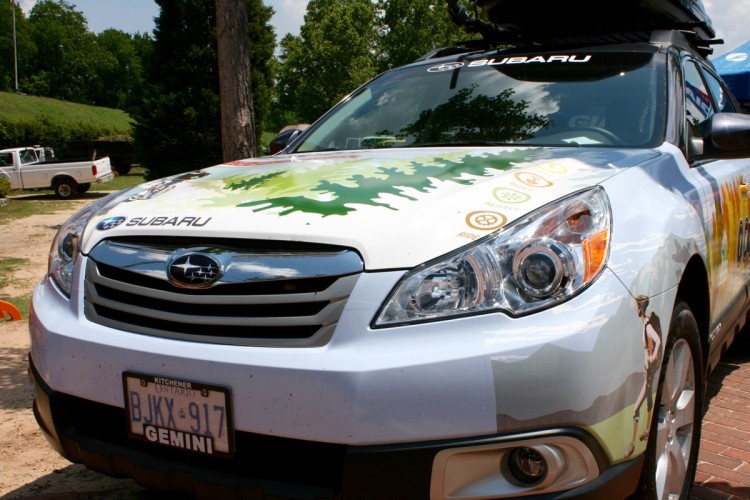
The Subaru/IMBA Trail Care Crew is a free resource for IMBA clubs all over the country.  There are two crews that travel around the country 10 months out of the year teaching clubs and land managers how to build, maintain, and manage sustainable mountain bike trails.  The program was started in 1997 and has been, and continues to be, fully funded by Subaru, one of IMBA’s long time supporters.  Subaru covers ALL costs associated with the trail care crews – gas, food, lodging, salaries, everything.  None of your IMBA membership dollars go toward the Trail Care Crews – it’s a FREE program for IMBA.  Subaru also offers discounts on new cars for IMBA members as well.  That’s pretty cool for a car company to support mountain biking in such a huge way and for so long!

The crew that visited us was the husband and wife duo Steve and Morgan Lommele.  Their presentation was fantastic!  This particular talk was aimed at educating land managers about mountain biking: what we want in a trail, what we don’t want, and how we’ll help them maintain it.  The presentation covered the economic and social benefits of trails, sustainable trail building theory and practices, how to design for specific user groups (MTB, equestrian, hiking), and how to use positive control points and how to avoid negative control points.

Again, the Trail Care Crews are a FREE resource for your local IMBA affiliated club.  Ask them to come teach your group some things and they probably will!  Check out the Trail Care Crew website for more details.

Connecting With Agency Land Managers

This session had several short presentations made by land managers followed by a Q&A session.  The panel of land managers represented a wide range of agencies from all levels: federal (USFS), State (NC DNR), and County (Forsyth County, GA).  They gave us the inside scoop on what they, as managers, are looking for in a partnership with a volunteer club, and what we should expect from them.  They also explained some of the restrictions they have and why things take so long sometimes – usually due to laws they must follow or simply bad timing.  One of the big points we need to remember is that land managers are busy, they have a lot on their plates, and we need to be patient with them.

Success Stories

Three success stories were presented by the folks involved in making them happen.  These stories showed what great things can be accomplished when a MTB club partners with a land management agency and the two work together for a common goal.  The timelines for these stories also illustrate the importance of patience!

Itusi Trail System – Lake Norman State Park, NC

  • Project began in 2001, initially using volunteers to hand build the trails
  • There are now five loops, for a total of 17.5 miles of singletrack
  • The park did not spend any money on the construction of the trail
  • The trails are directional to avoid user conflict, hikers and bikers travel in opposite directions.  The direction is changed every year
  • Maintained by the Tarheel Trailblazers

Santos – Ocala, FL

  • Partnership between the Ocala Mountain Bike Association and the State of Florida Office of Greenways and Trails
  • 84 miles of singletrack!!!
  • Freeride park, skills park, 2 pumptracks, and 3 dirt jump lines
  • Trails constructed alongside the 110 mile long Marjorie Harris Carr Cross Florida Greenway
  • Uses old limestone quarries for technical terrain
  • Designated as an IMBA Epic Ride and a Ride Center
  • 5 trailheads provide easy access

Coldwater Mountain – Anniston, AL

  • This project is 11 years in the making, and construction is FINALLY about to start.  Remember that patience thing I mentioned earlier?
  • Partnership between the Northeast Alabama Bicycle Association and Forever Wild
  • Will contain somewhere around 50-60 miles of purpose built mountain bike trails
  • Stacked loop system will have a little something for everyone, including TWO gravity zones!
  • The entire area will be MTB and hiking/running specific – no horses, hunting, or motorized use
  • Trail construction should start this year

Photo courtesy IMBA.

Up Next

Day two included sessions on how to build partnerships, working with the USDA Forestry Service, how to create a great riding community, and how to grow your local MTB club. Stay tuned!

New Bike Trails at Paynes Creek on Lake Hartwell (GA) Opening in April – With Your Help

Thursday, March 17th, 2011

photos courtesy recreation.gov

SORBA is working with the US Corps of Engineers to open a brand new 6.7-mile mountain bike trail loop in the Paynes Creek recreation area on Lake Hartwell on the GA/SC border off I-85. Professional trailbuilders have already cut the rough trails (the same crew that built FATS) and SORBA is organizing two work days to get the finishing touches complete in time for an April 29 grand opening!

Singletracks is all about new mountain bike trails and so we’re offering free trail memberships ($19.99 value) to everyone who volunteers on the April 23 trail work day. There’s also a trail work day this Saturday for those who can’t make it April 23 and it looks like the weather should be amazing!

Paynes Creek offers camping and access to beautiful Lake Hartwell which means this new trail system should become an instant classic. The topography in the area is rolling and although I haven’t seen the site yet, I predict these trails will be both fast and family-friendly.

Details, including links to directions and start times can be found on this forum thread. Check in and let us know if you can make it!

Southern Mountain Bike Summit in Brevard, NC March 25-27

Wednesday, February 23rd, 2011

I plan on attending the first ever Southern Mountain Bike Summit will be held in Brevard, NC March 25-27.  The SMBS will bring riders, land managers, industry leaders, and politicians together to “teach, learn, meet, greet, ride, and grow the sport of mountain biking in the Southeast.”

The summit will have sessions about a wide range of topics, including some specifically for land managers.  The topics include:

-Leadership Training
-Working with the USDA Forest Service
-Creating Great Trails and Trail Communities
-National Mountain Bike Patrol Training
-Growing Healthy Chapters and Clubs
-Success Stories: Model Trail Systems in the South

There will also be a movie screening, silent auction, the SORBA Board of Directors meeting, and awards for volunteers.  And of course, there will be riding!  Friday the ride will leave from Poppies Gourmet Farmers Market, Saturday’s ride will be somewhere in Pisgah National Forest (home to some of the gnarliest singletrack in the country), and Sunday’s rides will be at DuPont State Forest (home to the most slickrock riding this side of Moab).  There will also be bike demos available for Sunday.

I’m stoked for the summit and will post a summary afterward.  It’ll be a good chance to learn some new things about advocacy, and it’ll be my first time riding Pisgah and DuPont.

Head over the Pisgah Area SORBA webpage for more details and registration information.  At only $65 for the whole weekend registration is very reasonable and one and two day passes are also available.  The price does go up if you register after March 10th, so sign up early!


Site Map | Advertise | Partners | Contact Us | Terms | Privacy
Campground Reviews | Hiking Trails | Trail Running | Skiing / Snow Sports | Mountain Biking
Copyright 2012 Blue Spruce Ventures LLC | Atlanta, GA
singletracks.com is yet another slick Review App