singletracks is mountain biking
Sign In | Create Your Account | Site Map | Help  


Louis Garneau T-Flex 300 “Macked Out” MTB Shoe Review

Wednesday, February 8th, 2012

Fresh out of the oven, the latest hotness from Louis Garneau.

The latest T-Flex 300 mountain bike shoe from Louis Garneau is the shoe Xzibit would build if his TV show were called “Pimp My MTB Shoe.” It’s the shoe with features you never thought to ask for while delivering on the features you can’t live without. In short, it’s completely a macked-out MTB shoe.

If you’ve owned more than a few pairs of mountain bike shoes over the years, you know the most crucial part of the shoe is the ratchet strap. I won’t buy an XC-style shoe without one because without it, the shoe feels loose and disconnected on the bike. The ratcheting buckle on the T-Flex 300 is simple to operate in both directions: pull up on the black tab to tighten or the red tab to loosen. I was able to get a nice, tight fit out of the straps without any sign of the ratchets pulling out.

Most ratchets work fine out of the box but eventually the plastic teeth will get worn either through use or damage (like when a vine grabs your strap and yanks as you speed by).  Fortunately the T-Flex 300 has been updated with improved ratchet reinforcement and Louis Garneau even includes two extra ratchet straps in the box. Swapping the straps out is a cinch – just push.

Like most high end cycling shoes these days, the Louis Garneau T-Flex shoes are heat moldable, allowing you to get a custom fit now matter how weird your foot shape is. The included instructions walk you through the process, though they recommend setting your oven to 150-degrees and mine won’t go below 170. Not to worry – my shoes came out just fine with no incidental melting. Just remember to remove the ratchet straps first and you’ll be okay.

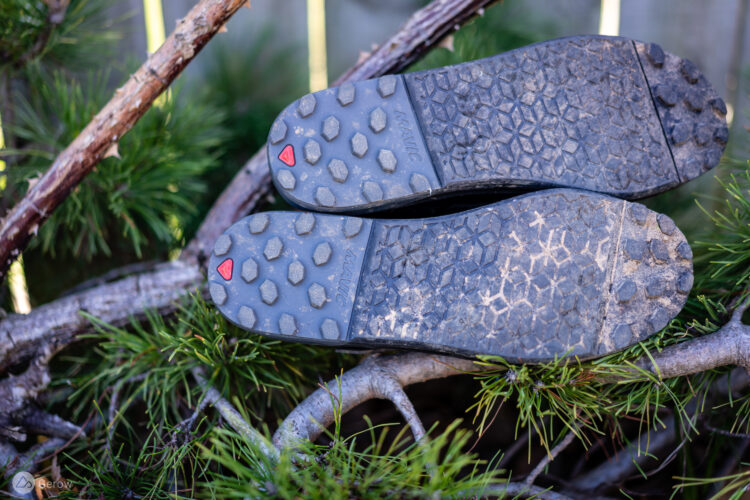
The forefoot tread on the T-Flex 300 is what I’d call semi-aggressive with nice deep tread and included (but optional) crampons. The rear tread doesn’t have a ton of surface area which kept me on my toes for the most part. Still, the rear tread spacing allows the shoe to really dig in deep for the most extreme hike-a-bike situations.

Ok, so replaceable ratchets, heat molding, and aggressive tread are all pretty standard features on most high-end MTB shoes. Now this is the part of the show where Xzibit takes over…

Louis Garneau added a removeable carbon plate they call the Air Power Blade to the T-Flex 300′s outsole that serves two purposes. Attached, it stiffens the sole and prevents air infiltration, keeping your feet warm on cold rides. Removed, the shoe is ventilated from underneath, keeping your feet cooler and drier in the summer. Inside the shoe you can see a mesh screen covering the vent holes on the bottom of the shoe and aside from keeping your feet well ventilated, this also serves to drain your shoe quickly after a deep stream crossing.

Of course that works both ways. In my tests I was shocked at how quickly my feet got wet on stream crossings even with the Air Power Blade in place. Other shoes I’ve tested do a better job at keeping feet dry in shallow waters. Once the T-Flex 300 soles get wet, your feet are sure to get wet too.

Louise Garneau includes two sets of Ergo Air insoles with the T-Flex 300s: Hot Stuff and Cool Stuff. I used the CoolMax-covered Cool Stuff inserts on my first ride before realizing I needed to switch to the Hot Stuff. What a difference! The Cool Stuff insert is light and breezy, even with the Air Power Blade attached. The hot stuff kept the bottoms of my feet much warmer and limited the airflow from the sole.

Speaking of air flow, the T-Flex 300s have great ventilation on top too. The mesh upper is lightweight and comfortable, reinforced by the varnished microfiber leather for added strength and protection. For cold weather riding I invested in a set of shoe covers to cut down on the topside draft but in the summer these shoes should be pure bliss.

One of my favorite T-Flex 300 features is actually the heel padding on the inside of the shoe. The padding is covered with a fine, silvery mesh-like material that’s both soft and grippy, almost like fine sandpaper. That extra bit of grip prevents heel slip while padding the heel from uncomfortable rubbing. And thanks to the heat-moldable material on the outside of the shoe, the heel conforms nicely to the shape of my foot. I also love the loops inside the shoe’s tongue, perfect for hanging the shoes to dry after a wet ride.

I’ve been wearing these shoes on the trail since the beginning of the year and I have to say they’re pretty awesome. I only have two complaints: One, while white highlights on MTB gear is trendy right now, I don’t think shoes are a good place for it. The white highlights even extend to the tread which turned brown on the first day out and has stayed brown ever since. If LG wanted me to wear black shoes with brown highlights they should’ve just made them brown to begin with. :)

Two sets of insoles, 2 replacement straps, crampons & tool, plus the bag – all included.

Second, while heat-moldable, the T-Flex 300s felt a bit narrow out of the box. Granted, I have EE-width feet but other heat-moldable shoes I’ve tested felt slightly roomier in the forefoot to start. The good news is the shoes seemed to stretch pretty quickly and I’ve found if I leave a little slack in the lower velcro strap they’re not uncomfortable.

The T-Flex 300 is a fully featured mountain bike shoe designed for year-round comfort and performance. With the included replacement straps and insoles, these shoes should last even the most aggressive XC rider season after season.

The Louis Garneau T-Flex 300 is priced at $199 MSRP. Thanks to Louis Garneau for providing these shoes for review.

Mavic Alpine XL Mountain Bike Shoe Review

Thursday, August 25th, 2011

Not too long ago I reviewed the Mavic Razor MTB shoe which is perfect for those who are into XC riding and want a durable, race-ready shoe without spending a lot of coin. For those who are looking for something a bit more rugged yet comfortable, the new Alpine XL is just the ticket.

The Alpine XL fills the space between shoes that can be worn all day and those that work well for clipless or flat pedal biking. These shoes offer a host of cool features including a neoprene ankle guard (perfect for that added protection from nasty elements that will be encountered on the trail) and a flap that covers the very effective lace-pull system.

The EVA tongue is meshed for breathe-ability and maximum comfort while providing a measure of support and protection. To keep your foot in place and to increase lace tension, an extra strap up top keeps you foot firmly in the heel cup during the ride. The uppers are constructed from synthetic leather for longer life with added mesh for flexibility at strategic points along the shoes for just enough give. The heel sports integrated reflective material for safety at night and the foot bed uses Mavic’s Ergo fit pre-shaped insole which is vented and treated with Agion (a silver based antimicrobial treatment) to help control moisture and odor.

The sole of the Alpine XL is all business with a full rubber pattern from front to back, which works well in all conditions. The space for the SPD-compatible cleat is near perfect with no issues fitting Shimano or Crank Brother (Time) cleats. The sole, unlike some race oriented shoes, has decent give for when you need to hike a bike or just walk into a store to grab that Monster energy drink. My two shoes plus cleats came in at 993 grams (Time cleats) which is pretty good considering I wear a size 46.

The fit on the Mavics is a bit on the tight side at first so I recommend trying before buying on this one. I don’t recommend ordering these shoes online unless you have tried a set first. The toe box is roomy enough for my fat toes and on the trails and slopes (I mostly used the Alpine XL on my bigger bikes) I really loved how these felt. With no hot spots on my feet due to uneven pressure, the shoes were comfortable on the bike. The mid height arch worked well for my slightly flat feet – the added support there was nice. I also liked the feel of the heel cup and toe box.

Riding on harsh trails and slopes I had more than one occasion to bash a rock or two with my feet. The added protection on the toe box was welcomed and did a good job at keeping my toes in tact. The sole on the Alpine XL shoe has no spikes (fine by me) so walking is not an issue with them and the 5mm of tread works well on most surfaces (mud, not so much). The neoprene does a fine job at keeping most debris out of the shoe and also means you have to pull on it a bit to get your foot in there in the first place.

If you’re looking for an everyday mountain biking shoe in the $120 – $160 range the Mavic Alpine XL is a good pair to to consider.

I would like to thank the folks at Mavic for sending these down for a review.

Mission Workshop: DZR District Shoe and Rambler Backpack

Thursday, July 21st, 2011

During the summer months I have a lot of free time which allows me the pleasure of kicking it a bit more often and taking leisurely rides here and there. Sometimes I just don’t want to bust out my full kit and shoes to go for a ride in town. For these types of rides I love to carry around the camera, laptop and other gear but a regular hydration pack isn’t big enough; I need something that’s larger, water resistant, and expandable. It turns out Mission Workshop has some pretty cool gear for just what I am looking to do (or for commuting if that’s your thing). Today I’ll be reviewing the DZR District shoe and the “Made in the USA” Rambler expandable cargo pack.

The DZR District shoes are SPD-compatible (time, CB, Shimano) but most importantly, they’re comfortable. Even with the recessed SPD cleat installed I found walking around comfortable without compromise. The secret is the reinforced area where the cleat is attached which balances stiffness, power transfer (on the bike), and comfort.

Up top there’s a mix of durable canvas and leather with a neat reflective strip integrated into the design on the side along with a highly reflective logo on the heel of the shoe cup. This shoe has a fairly roomy fit (which I love) yet still close fitting enough that you can unclip easily without tearing off your shoe. In the box you also get a set of plugs in case you decide to take your cleats off the shoe and want the plate covered up.

I’ve found myself wearing the DZRs a lot recently as my “go to” shoe for nearly everything I do (except when I decide to hit the DH trails). But for hopping on my bike and heading to the coffee shop or gearing up for an urban assault, these shoes are perfect!

A while back I was hemming and hawing about finding a daypack I could use to carry a bunch of stuff like my camera gear, lunch, and water along for errands and leisurely rides around town. Now the Rambler is not a true camera bag (no segmented padding) but it serves my needs nicely for now (all my lenses have their own padded bags anyway).

The Rambler backpack features a cavernous, weatherproof main compartment that can transform from a 1350 cubic inch pack to an unzipped 2700 cubic inch monster. The uninterrupted main compartment, even when zipped down, easily fits my camera body, telephoto lens, books, and other supporting gear (laptop) when I am on the trails or in the city taking pics. Unzipped I have enough room for other clothing plus snacks (my favorite PB&J sandwiches).

The pack features two other slim sleeves – one right at your back and the other on the front of the bag. Both sleeves could be used to fit a thin laptop in a pinch. On the very outside of the bag there is a smaller zipped compartment for keys, wallet or your breath mints. The opening flap can be used as either a “roll-top” or in a traditional “flap-down” configuration.

The overall construction is a mix of durable weather proof materials (except the expandable fold), with collapsed dimensions of 13″x 19″ x 5″. A carbon fiber frame adds support and the urethane-coated zippers should last a long time. The main straps are padded and about 2.5″ wide with an adjustable-height sternum strap. An optional waist belt is a good addition if your gonna get aggressive on your bike as it adds a measure of stability to the whole system.

I used the Rambler as my commuter / carry a ton of stuff pack. This is not a true hydration pack as it is a bit too heavy and does not breathe that well. But if you’re a person who commutes to work this may be a great solution for carrying an entire change of clothes, a laptop, and a lunch on your bike.

I typically rolled with the Rambler in the zipped up, 1350 cubic inch configuration and looped my tripod on the outside when I was in the city taking pics and stuff. On one occasion while shopping I even fit my heavy Kryptonite lock in one of the sleeves and did some shopping with my DJ bike with no worries about the added weight from the lock.

As you can see from the photos, this is a very rectangular bag which makes it ideal for carting stuff like books and boxy items. The only problem I found is when I carried a bunch of small things they tended to fall to the bottom of the pack which required me to dig to find them again. Perhaps a few small elastic sleeves would really make the main compartment that much more useful. All in all this is a decent pack for those who are riding hard on the urban scene. Heck I even found myself using this bag on the slopes to carry my gear in for some photos of the DH riders on the trail.

Check out the Mission Workshop website – you might be surprised at what else is out there for bikers other than spandex and polyester! The DZR District shoes are available for $85 MSRP and the Rambler Backpack goes for $239.

Thanks to the folks at Mission for sending the gear for review.

Xpedo Hurtle 12 Pedal and MXS Mountain Bike Shoe

Thursday, November 4th, 2010

Over the last few months I have been rocking a few different sets of flat pedals on my mountain bike but here’s one that sets itself apart: the Xpedo XMX12AC Hurtle (for simplicity I’ll call it the Hurtle 12). This Hurtle 12 is similar in construction to the Face Off 17 pedal that I reviewed a few months back and shares the same chromoly axle with a single DU bushing and bearing. Constructed out of 6061 AL, the Hurtle 12 weighs in at 370 grams, 10 grams less than the Face Off 17. Unlike other pedals, the Hurtle 12 has its spindle completely protected in the middle which helps with sealing and durability.

The Hurtle is pretty thin at 13mm (not including the pin height) which is just enough spindle diameter to keep the grease inside. The actual body is an extrusion which is then machined to its final shape. Look carefully and you will see the slight concave shape which is designed to match the shape of a typical flat shoe.

Out of the box you also get replacement pins and a wrench that allows you to easily replace broken pins. The Hurtle pedals comes in black, grey, red, pink, green, and gold – pretty much all the colors you’d need to match any bike.

On the trail the Hurtle 12s offer the largest and most solid platform of all the Xpedo pedals I’ve tried. Placing my foot down on the pedal feels about as secure as locking in with a pair of SPD clips. Yep, that secure. The square platform has 8 pins placed strategically so that my forefoot gripped extremely well with just enough grip at the back of the pedal to allow a bit of foot roll for times when I pitched the bike sideways.

Having these on my FR bike for the test and riding through all kinds of terrain I had no issues with rocks or contamination. The pedals still spin great with zero signs of grittiness or play. I did manage to scrape them up a bit, but other than that, they stayed straight. I would even recommend the Hurtle 12 pedals for AM / DH use; I found they boosted my confidence level a bit, knowing that if a foot came off I would find that pedal quickly enough.

Xpedo MXS Shoe

The MXS is the only flat sole mountain bike shoe that Xpedo sells and I’m happy to report they work well enough and felt fairly comfortable. I have a wide foot so the roomy toe box on the MXS was a welcome feature. The MXS shoes grip will on most pedals, offer decent heel and ankle support, and feature a foot bed with a bit of flex.

Overall the MXS shoes tend to work better as a dirt jump (DJ) shoe than a more aggressive DH shoe. I noticed the low rise cut on the outside of the shoe allowed my ankles to roll at times which isn’t ideal for DH riding. On the other hand, the ability to roll to the outside of the shoe worked well for the bike park. The inside ankle cut is best described as a mid-rise and it covers the ankle for both protection and support.

The uppers on the MXS shoe are synthetic leather and mesh for a good balance between durability and breathe-ability.

Taking the shoes out on my FR rig at the slopes I didn’t feel as confident as I would have liked. I found when the shoes got a little dirty on the soles they started to slip a bit too much. The lack of outer ankle support also contributed to some issues when sailing through rock gardens.

For DJ riding I can definitely recommend the MXS shoe – it’s stiffer and more durable than your Nikes. However, for DH mountain biking I would say go for something else – though let’s see what the future brings for this shoe.

In case you’re wondering, the Xpedo Hurtle 12 pedals retail for $75 and the MXS shoes will set you back around $55. Check out the Xpedo website for these and other great products.

I would like to thank Xpedo for providing the Hurtle XMX12AC pedals and the MXS shoe for review.

Five Ten Karver MTB Shoe Review

Thursday, October 21st, 2010

I’m just gonna come out and say it: Five Ten shoes are to the gravity rider like cleats are to XC racers. If you ask almost any rider on the slopes what shoes they wear (or want to wear) they will tell you Five Tens.

Five Ten didn’t actually start off in the bike market – in fact they started off way back in 1986, producing high-friction footwear for climbing. Charles Cole, the company’s founder, came up with a grippy rubber compound that produced high friction yet held up for climb after climb. To make a long story short, the company rolled out Steath rubber outsoles to all their shoes and eventually found their way into the freeride/DH scene. For the MTB market, the Five Ten line of shoes represents a tough, durable set of kicks with crazy good traction on the pedals.

The Five Ten Karver shoe is built for the really rough stuff that you encounter on the trail – bumps, logs, and of course jumps. Compared to other flat shoes I own I have to say I feel the safest in these. For starters the toe box on the Karvers feel secure with zero flex. I’ve pinched my foot between a rock and the pedal more than once so I really love the added protection I get with the Karvers. Speaking of pedaling I also appreciate the amount of power I can transfer via the fairly stiff sole. I even found I could get a bit of a pull up on the pedals thanks to the super grippy outsole.

The Karvers shine brightest on the drops and jumps. The shoes feel fantastic, keeping my feet on the pedals all the time. Even on the rough terrain like rock gardens where a foot can get tossed off the bike, the level of grip on these shoes helps me grab control of the pedal that much quicker. The Karvers feature just the right amount of padding to keep my foot secure and comfortable through the full range of motion.

The two best features of the Karvers have to be the flap that covers the shoe laces and the support cup around the ankle. I just love the feel of having my ankle held in place and my feet doubly covered to prevent unfortunate incidents with trees and rocks. The Karver can be had for about $115 and you can get them either online at Five Ten or at your favorite retailer.

I would like to thank the folks at FiveTen for providing the Karvers for review. Hopefully I’ll get you a few more reviews in the near future with the new Cyclone and Maltese Falcon shoes from Interbike. Check out the Five Ten website for more rad MTB shoes.

Mavic Hoops, Computes, and Boots at Interbike

Thursday, October 14th, 2010

Mavic is one name that doesn’t need an introduction. The yellow Deemax rims sport an iconic look that, unless you’re totally new to the sport, you know right away is a Mavic. The company has actually been in business since 1889 and the name Mavic is actually an acronym – Manufacture d’Articles Vélocipédiques Idoux et Chanel (translation: manufacturers of articles for bicycles from Idoux and Chanel).

For 2011 Mavic is keeping most of the MTB wheelsets the same but did improve the mid-level Crosstrail Disk wheels, making them lighter and stiffer and adding a host of features. Mavic is also bringing back the Crossride UB/Disc wheelset which is a good replacement wheelset for those who are ready to swap out their OEM hoops. The Crossrides are compatible with either disk or v-brakes and perform well at a budget-friendly price.

Beyond wheels, Mavic is serious about electronics and showed off a revamped Wintech Wireless USB cycling computer that can be hooked up to your PC for serious data crunching. The large display makes it easy to see key stats at a glance plus, with the power to customize the data fields, you can view various sensor outputs (power, heart rate, etc.) on a single screen.

I also got the chance to preview Mavic’s expanded shoe and clothing lineup at Interbike. With the help of parent company Solomon (also a huge name in Alpine skiing / sports wear), Mavic has put considerable resources into creating high quality footwear for 2011 and beyond.  Both trek7k and I were impressed with the quality and weight of the various shoes in the line up. With high-end racing XC shoes in the upper $300-range (the yellow Fury above) down to shoes in the $120-range (more my speed), Mavic has a ton of options to choose from (plus three colors of each model). I was really impressed with their new AM shoes (the white ones pictured above) – great ankle support, hidden laces to prevent brush snags, and a decent tread design for hike-a-bike.  Definitely explore the Mavic website yourself and see what else they have for 2011!

Meet the KEEN Coronado Cruiser Shoe

Tuesday, January 26th, 2010

keen2

Hi folks, here’s another cool product from KEEN geared toward mountain bikers: The Coronado Cruiser ($80 MSRP). Although it’s not really a technical riding shoe, this is one of  those products that is great to just kick around in. As its name implies, this shoe is for cruising (stylin’ while ridin’) and it kinda brings me back to the days before complicated, high tech bike equipment.

The Coronado Cruiser combines breathable canvas, soft leather, and recycled rubber to make a relaxed summer shoe. The sole is made up of two different compounds: the outer sole is harder, longer-wearing, and non-marking while the inner sole hides a panel of soft rubber under the ball of the foot to help your foot grip the pedals.

One of the coolest things about the Coronado shoes is that they’re made from recycled materials. With an eye toward the environment, Keen has chosen to use recycled rubber in the soles and recycled aluminum in the hardware. Even the packaging material is recycled. How’s that for corporate responsibility?

keen3

Taking these to the street on both my mountain and DJ bikes I found these shoes to be pretty grippy on flat pedals. Now these are not a shoe to hit the slopes with, but on those lazy days when you’re just riding around for fun, these fit the bill nicely. Still, there’s a bit of added room in the protected toe box and the area under foot is reinforced for stiffness which translates into greater pedaling efficiency.

Check out KEEN and their expanded Spring/Summer 2010 Pedal Shoe Collection. These shoes meet the basic needs of cyclists with stylish, comfortable shoes, socks, and bags that are ready to roll. The Pedal Collection includes KEEN cycling favorites, as well new styles that will enhance the biking lifestyle and should be available in stores now.

Features

- 3/4 length plate for increased energy return and support
- Non-marking rubber outsole
- Soft rubber forefoot pod for pedal grip
- Vulcanized eco-friendly construction

Thanks to the folks at KEEN for providing the Coronado Cruiser shoe for review.

Gore-Tex R&D: My Visit to Gore Part II

Friday, November 13th, 2009

Last week I wrote about some of the technology behind the Gore-Tex membrane and how Gore works closely with brands like the North Face and Pearl Izumi to produce super high quality gear. This week I thought I’d talk about the testing process Gore uses on everything from jackets to footwear to gloves and some of the new developments we can expect to see in the future.

gore_3

Fabric Testing

In order for Gore-Tex to “guarantee to keep you dry,” they need to test every new garment design before it goes into production. At Gore they use some fancy scientific tests like the “sweating hot plate” and water pressure testing but in the end a good garment design will be all about comfort. To that end, they have a few tests to mimic real world conditions with real human test subjects.

gore_2

The comfort chamber: This should probably be renamed to the dis-comfort chamber since it’s basically just a small room where the temperature can be set from -20° F to 120° F. The comfort chamber also features fans to add in wind chill to see how stuff like Gore-Tex snowboard jackets will perform on windy ski hills.

gore_rain_room

The rain room: This room is appropriately named and is the place where Gore tests all their rain gear (like Gore Bike Wear jackets). Rain falls from the ceiling in a fairly natural pattern and there are even nozzles pointing up from the floor to simulate rain coming off a wet bike or motorcycle tire.

gore_1

The wash room: Ok, so this test doesn’t involve human subjects like the other two but it turns out continuous washing is the best analog the Gore engineers could find to normal wear and tear experienced in the field. I’m told there are more than 200 washers in the room and they’ve all been rigged to run continuously, often for hundreds of hours at a time.

gore_4

Gore also tests footwear by flexing shoes over and over in a water bath to see how many flexes it takes before water penetrates the toe box. I saw a set of Pearl Izumi kicks in the testing lab and apparently if a shoe doesn’t pass this test, it’s back to the drawing board before the shoe can be manufactured.

Coming soon?

Gore-Tex fabric technology has been around for a long time (30+ years) so it’s interesting to see where Gore might be heading in the future. Back in September element22 and I sat down with a Gore rep at Interbike to preview the Fusion jacket which makes use of “comfort mapping” technology introduced in 2005. Basically the idea is that different parts of an athlete’s body have different insulation and ventilation needs. The kidneys, for example, like to be kept warm (no kidding).

gore_bike_wear_comfort_mapp

The inside of the Gore Bike Wear Fusion jacket where the colors show various comfort mapping zones

Gore has also developed a new type of waterproof apparel enclosure called “Lockout” that they’re using on a motorcycle jacket which basically looks like a zip lock bag with a slider. Could we see this concept migrate to Gore Bike Wear in the future? I’m guessing yes (just as soon as they improve it – getting it to work properly is a little tricky).

I’m still testing my Gore Bike Wear Alp X II jacket so stay tuned for the official review.

MTB Shoes & Pedals From Time

Wednesday, September 23rd, 2009

time_1

This morning element22 and I got a chance to speak with the folks at Time and saw some pretty cool mountain bike shoes and pedals.

time_2

The MXS Carbon shoe features a thermoformable external membrane that allows you to get a custom fit for your foot shape. The cool thing? You can mold the shoe yourself at home using a hair dryer! We’re told the toe box is a touch wider and taller than a typical MTB shoe which is good news for my 2E brothers and sisters.

time_3

The Titan Carbon pedal is super lightweight and offers 5 degrees of angular float plus 5mm of lateral float. With a titanium axle and carbon reinforced body these pedals tip the scales at just 290 grams per pair. The pedals claim to be “self-cleaning” so mud jamming shouldn’t be an issue, though the real test is to see how they perform in tacky Georgia red clay.

time_4

For the freeride/DH crowd, Time offers the Z pedal, a lightweight platform pedal with a steel axle and aluminum body. Just like the Titan Carbon you get 5 degrees of angular float and the same self-cleaning design. At 530 grams per pair these pedals feel much lighter than they look.

Mountain bikers may not be super familiar with Time but these pedals and shoes are definitely worth a look as a lightweight, high performance alternative to the SPD/Crankbrothers duopoly.

Shimano M310 Shoe Review

Tuesday, June 2nd, 2009

picture-21

Shimano has just released an improved model of their M300 shoe, which is now called the M310. For those of who haven’t seen or considered these shoes, you may very well be impressed. With an updated moldable upper, an improved carbon fiber midsole, and two colors to choose from (basic black or bling bling silver with red highlights), the M310s are a solid choice for the trail.
If you’re looking for comfort, light weight, and performance in a MTB shoe, listen up. The Shimano M310s are labeled as elite competition shoes and that’s because they are some of the most comfortable, precise shoes you can purchase. Don’t let the pro-level designation scare you off – even regular Joes deserve a great pair of MTB shoes!

A bit about the M310s from the Shimano website:

  • Moldable upper forms to foot for a precise custom fit
  • Modable insole forms to foot for a precise fit with anti-bacterium treatment
  • Full-length stiff carbon fiber mid-sole with dual injection polyamide-polyurethane outer transfers your energy straight to the pedals, and allows compliance and grip for hike sections
  • Composite toe spikes increases traction in sand or loose dirt
  • Asymmetric buckle & dual off-set straps securely holds foot and allows subtle adjustments. Off-set straps prevent pressure points
  • Durable synthetic leather upper provides foot protection and excellent durability
  • Anti-slip heel lining knitted with metal fiber prevents heel lift
  • Available in E-width for wide feet

After purchasing the M310s from my LBS (Cyclepath North York), I made an appointment at Sporting Life where they have Shimano-specific equipment to heat-mold the shoes. With the help of the store manager Keith, the  shoes were ready to go in less than an hour. One word of advice: due to the fact that these shoes work best after a custom fitting, I strongly recommend getting these shoes at a retailer that has the equipment on site. Not all shops carry the equipment and some will charge for this feature if you have not purchased the shoes from them so if you purchase these shoes online, expect to pay up to $50.00 for the service (which takes a good three quarters of an hour – make an appointment).

I HIGHLY recommend having these shoes molded to your foot  – it makes a night and day difference and is well worth the cash. Hitting the trails with the M310s I noticed right away that my feet didn’t move in the shoes and there were no pressure points anywhere on my foot. With the new shoes my pedaling felt more efficient since my foot wasn’t moving around inside the shoe at all. I did, however, have to increase my pedals spring tension because I noticed my foot started sliding around the pedal a bit more. Going for a few long rides I expected the shoe to stretch out or change how it felt but that didn’t seem to happen – the fit was constant after hours of riding. The soles on the M310s are pretty basic and provide just moderate traction on the dirt. If you need something with a bit more bite you may want to look elsewhere – consider the Shimano M230 which is partially moldable but has more of a tread pattern.

picture-42

Overall these shoes are super comfortable, fit great, and are light and breathable. The downside is the M310s are a bit overpriced and you have to lay out additional cash to get the shoe fit just right. I’ll also be keeping my eye on the minimal rear sole tread which may need replacing in the near future (I’ll keep you posted).

Cheers.


Site Map | Advertise | Partners | Contact Us | Terms | Privacy
Campground Reviews | Hiking Trails | Trail Running | Skiing / Snow Sports | Mountain Biking
Copyright 2012 Blue Spruce Ventures LLC | Atlanta, GA
singletracks.com is yet another slick Review App