singletracks is mountain biking
Sign In | Create Your Account | Site Map | Help  


Manitou Revox Pro MTB Shock Review

Monday, October 10th, 2011

I’ve had the pleasure of testing quite a few mountain bike shocks back-to-back this season, including the new Revox Pro from Manitou. The Revox has gone through a few cosmetic changes and internal tweaks recently. On the surface the new Revox definitely looks much more polished compared to what it looked like a few years back.

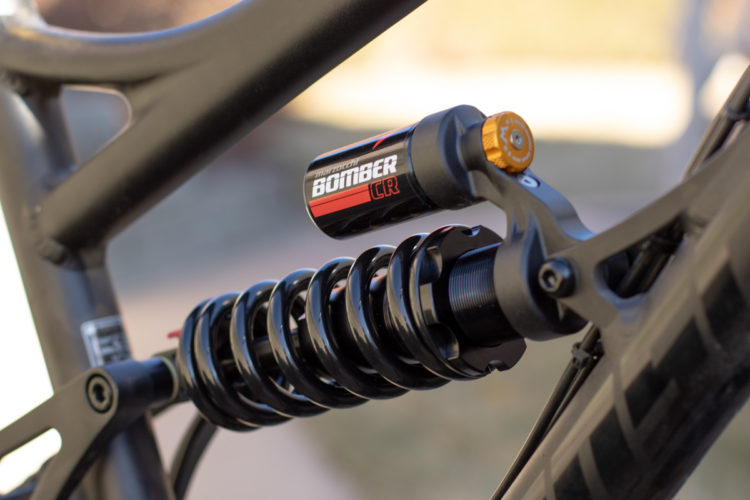
The Revox Pro is Manitou’s top-level rear shock and is best matched with the Dorado (or any other dual-crown fork). Coming in at about 450 grams without spring (depending on length), the Revox Pro is ready to rock. With a battery of adjustments (HSC, LHS, rebound, pre-load, and no-tool volume control) this shock can be tuned for anything you can dish out. To ensure that last statement holds true, a 14 mm hard-anodized damper shaft has been incorporated to keep things under control. Cosmetic changes to the anodizing and a new black damper body give the shock a fresh new look.

A shock with this many adjustments takes a bit of care to set up. Doing so correctly produces a rear shock that really shines and keeps you under control. When setting up the Revox, it’s a good idea to write down all the changes that you make. The detents are a bit soft, so recording adjustments as turns from full open / closed works best. Selecting the spring rate (usually manufacturers give you a good idea here) is a start. Consulting Banshee, for example, informed me that I needed a 400lb/inch spring for the correct rate to go along with the Revox. You can tell if you’re right when it comes time to setting up the sag. Usually you only need about 2 turns from initial contact of the spring to the spring seat collars. I wanted 35% sag, so from an eye-to-eye of 240 mm I wanted a compressed eye-to-eye of 213 mm. I tweaked the collar a half turn more, and I was there.

Once that was done, I was off to the slopes for some testing!

Below is a setup sheet:

After the sag, I set rebound, starting closer to the middle of the range and backing it off until I got a wheel that returned fairly quickly but not so quickly as to buck me off the back of the bike. Now I tend to run the shock at 8 clicks from full CCW. It gives me a live feeling in the back without pushing me too far forward.

The next two adjustments are the low speed compression and then the high speed. So again, I set the LSC at half-way and I went and did a few rides. It took a bit to figure out that the LSC was perfect the first time out. I was playing around with both compressions until I found that the mid level, 1.5 turns, was the perfect amount to give me active compression when hitting bumps, but still hard enough for pedaling.

Getting the high speed set was a bit easier. Starting at just over the mid-way point, I went mostly down from there, finding that once the HSC was set to 10 clicks, which is just a bit below the mid-point, I was happy to play with the bottom-out adjustment. Bottom-out was moved to position three with 160 psi in it (10 over stock fill).

After spending some time playing around with the Revox Pro at Seven Springs, Blue Mountain, and Horseshoe Valley, I can say it works perfectly! The Revox never faded, leaked, or had any other defect. I had superior control over the rear of my bike. Over gnarly rock gardens or boosting tables or even hitting 12ft drops to g-outs to step ups, the Revox did an excellent job. A good upgrade would be a Ti spring (hopefully for next season).

The only issues I had were that the LSC detents didn’t click well and it was a bit hard to repeat settings. The small red knob was also difficult to adjust with gloves. The Rebound knob did detent well enough, but it was a bit stiff. If Manitou works out these minor kinks they will have a flawless shock.  Get one of these for your bike for $400 MSRP (springs and hardware extra from $17.00 to $25.00).

Thanks to the folks at Manitou for sending down the Revox Pro for a review.

Fox DHX RC4 Mountain Bike Shock Review

Thursday, July 14th, 2011

For gravity-oriented mountain bikers, the Fox DHX RC4 should already be familiar. But if you’re just starting to get serious about DH mountain biking, read on to learn about this essential upgrade.

The DHX is your top level rear shock from Fox with more features than you can shake a stick at. For the techie rider you’ll love playing with this unit to get it to do exactly what you want. With 15 rebound settings, 18 low speed compression settings, and 12 high speed compression settings (plus 4 turns of bottom out control), this shock is all business.

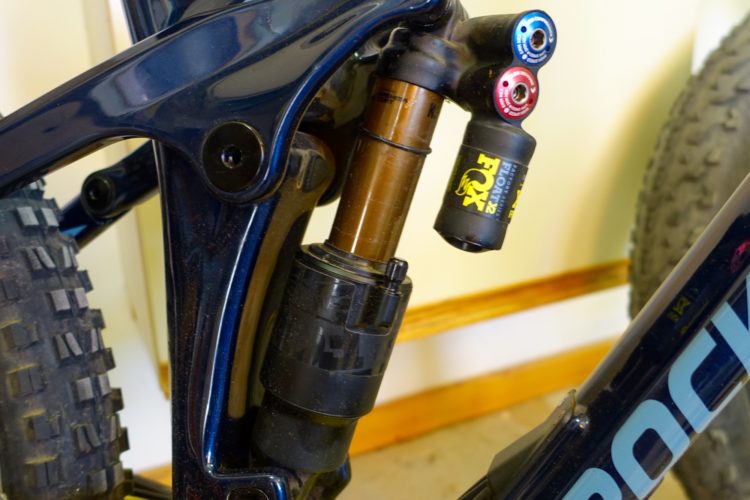
The Fox DHX RC4 is a high performance, racing-oriented rear shock designed to give you complete freedom to set up and control your rear wheel. Fox spent a ton of time dialing the shock in and incorporating their Boost Valve technology and the latest Boost Valve implementation features speed-sensitive dampening control over the last third of the shock travel. This means the shaft speed of the shock determines the amount of dampening you get as you approach the end of the shock travel. So those big drops and rock gardens that are your nemesis now become non-issues. Working in parallel with the Boost Valve are the two compression circuits (high and low speed) and the rebound circuit, providing precise control over the rear end of your bike.

With all those potential adjustments, setting up the RC4 takes a bit of time (it gets easier the more you do it). You’ll want to make sure you have a reference spring rate before you get started – check with Fox or your frame manufacturer if you’re not sure. My Opus Nelson with 7 inches of wheel travel and a shock travel of 2.75 inches has a leverage ratio of approximately 2.54. So being 200lbs with gear and knowing I gotta stop that mass in about 2.3 inches (to prevent excessive bottoming) plus the fact that my previous spring felt a bit too soft, I went with a 450lb spring (200lb x 2.3″= 460lb/inch approximately). With this spring I use very little pre-load which is a good thing. I opted for the titanium version to keep the weight down on my bike, though steel springs are much more affordable and cost about $30 each.

Once the spring was in and installed correctly (make sure the ends of the spring are seated on the lower retainer and not in the gap), I set the sag according to the table in the owner’s manual. From there I headed to the slopes at Blue Mountain and the flowy Haole trail with a 2.5mm and 3mm allen key for some fine tuning. I have a checklist I use for setting up my shocks starting with low speed compression, high speed compression, then rebound. After those are set I work on the extras like Boost Valve.

The Haole trail at Blue Mountain features sections of slow rises and falls as well as mildly rooted sections and a few small jump features. There are also some sweeping berms and switchbacks which are perfect for configuring low speed compression settings. So after a few runs I ended up going with 10 turns back from full +ve. After I was happy with that setting I concentrated on the high speed compression. Going to another slope with squared edged rocks and heavily rooted sections I sessioned Waterfall and O-chute (black diamond and double black diamond runs). This is a perfect workout for any shock and I ended up with a setting of  6 from full +ve. Finally I turned my attention to the rebound which I had been playing with throughout the day and finally settled on 8 from full +ve. Tweeking the Boost Valve to get just the right amount of rise on the spring rate I ended up with 1.5 turns back from full-in.

So how did the DHX RC4 do? Well, so far this is my favorite coil shock I’ve ridden. It’s very smooth and produces virtually zero sticktion. Plus I can feel everything on the slope with this shock.

At one point I did back-to-back runs with the RC4 installed on my FR bike and my DH bike and found this shock allowed my FR bike to give my DH bike a run for its money. Sure it would have been a better test to use identical bikes but knowing both bikes very well I could say that the traction off the back on my FR bike was superior. The RC4 produced smoother tracking in the rear end compared to the banging I felt on the other bike. I found I could really toss the bike deeper and faster into corners with the rear end hooking up nicely.

I would definitely recommend the DHX RC4 for anyone upgrading their rig or planning on stepping up their game on the race circuit. For $585 MSRP for the shock plus $30 for a steel spring you’re getting a world-class rear shock well worth the coin for your AM-DH rig.

I would like to thank the folks at FOX for sending up the 2011 DHX RC4 for review.

Diverse Suspension Dueler Rear Shock Review

Monday, June 21st, 2010

diverse2

While the big three shock manufacturers seem to have the lion’s share of the market these days, there are a few companies out there that are working really hard to make a name for themselves. One of those companies, Diverse, is making waves on the FR / DH scene with their new Dueler shock.  Diverse started off in 2002 making springs for motocross bikes and suspension tools and as MTB enthusiasts themselves, they moved into the MTB market in 2007 with a coil over shock and titanium springs (cha ching). After speaking with Fadi Ahad about Diverse, I really got the sense that he knows his stuff as well as his customers, giving them what they want at a price they can afford. This is accomplished via a direct sales approach which bypasses the distributor.

I received the 8.75″ x 2.75″  ( 220mm x 70mm) Dueler Shock ($339.99 MSRP)  in a neat box almost ready to go. Complete with a titanium spring (450 lb/in), all I needed to do was install a set of bushings for my frame set (standard RS or Fox hardware) and I was off. The Dueler comes preset at the factory with 120 psi in the bottom out control which can be adjusted simply by adding more pressure into the chamber with a high pressure pump. Pretty sexy I gotta say.

A good thing about this rear shock compared to others out there is the Dueler can be rebuilt by nearly any decent tech. Heavier riders may opt to change out the fluid but for the most part this shock comes ready to rock. The DH needle set installed on the Dueler I tested needs faster shaft speeds to work properly (more on that later) while the more user-friendly DH / AM needle set is now in production and comes standard on the new units.

Set-up and configuration

Now the difficult part. Setting up the Dueler can tricky depending on which setup you get. The Dueler version I tested features DH valving which requires hitting the slopes to get things set it up properly. The set-up sequence is critical: rebound first, followed by high speed compression (HSC), then low speed compression (LSC). After the shock speeds are set, you’re probably going to have to set sag by pre-loading the spring (if you got your spring rate right that would be about 4 turns pre-load). Check the old spring on your bike to get an idea of the spring rate you’re currently using; otherwise a rate change may be in order. If the stock spring rate on the Dueler isn’t right for you, you can choose one with a different spring rate for an additional $50.

diverse3

Starting with rebound, the shock should extend as quickly as possible without “bucking” the rider off the bike, yet not so slow that the shock “packs down” and doesn’t return in time to absorb the next bump (lost travel). If therebound rate is too fast, turn the knob clockwise to increase damping (slow rebound). Conversely, if the rebound rate is too slow, turn the knob counter-clockwise to decrease the damping (faster rebound). Rock gardens offer the best test to see whether rebound is dialed in correctly.

diverse4

Next up: high / low speed compression settings. Start off with both adjusters in the middle of the travel. Now find a few good drops where you will be riding that involve some serious damping. I chose a nice flowy section of trail with a gnarly rock garden followed by a G-out and then two good jumps and a drop down. While sessioning the section, I simply adjusted the HSC to prevent bone jarring landings. Here you’re looking for the shock to compress in a controlled state without being too stiff.

Once the HSC  was set, I started on another section of the slope with some serious bermed corners – perfect for setting up the LSC. Here I was looking for the bike to enter corners, pitch, and come out without feeling wallowy in between. In other words, a crisp and fast reaction out of turns but not so fast that the bike would start to shimmy. It took a bit of work but a few clicks from the middle to the “+ve” side and I was there.

diverse5

Trail performance

Hitting the trails with my Opus Nelson1, I found the Dueler worked equally well with both single crown and dual crown set-ups. With just a bit of tuning the Dueler was clearly most effective when traveling fast over terrain rather than slow. Considering that the Dueler valving was tested by a bunch of DH racers, I can tell the speeds those guys run at compared to my speed is a good bit higher.

I got a chance to test the Dueler on nearly every trail surface you can think of – rock gardens, loamy flat corners, berms, drop downs, table tops and double jumps – and I can say that they Dueler matched up great with the Melson and worked very well on all those surfaces. I especially found that the control of the compression circuits felt spot on when hitting kicker-style jumps to a drop down. I also noticed very quick compression ramp-up which decelerated the bike almost instantly without the harshness of the impact traveling through my wrists like some shocks I’ve tested. Now on the really slow technical stuff you may find on some FR runs, the Dueler felt a bit soft. Most of the softness can be tuned out but it takes a bit of time fiddling with the HSC and LSC once again.

The Diverse Dueler is a competition-ready shock that’s more than capable of taking on anything you can toss at it. With its high quality build, light weight, and durable toughness, this is a shock that just works great. At well under $400 you get all this plus a Ti spring to boot (to keep the weight down, just 410 grams compared to 600 grams plus for other steel sprung rear shocks). Contact your LBS or Diverse to get the shock configured just the way you want it.

ADJUSTMENTS:
- High Speed Compression
- Low Speed Compression
- Rebound
- Spring Preload
- Bottom-Out (Air Pressure)

FEATURES:
- TITANIUM SPRING
- PRC, Progressive Ramp Control (Reservoir Volume)
Standard on 9.5×3.0 and 10.5×3.5 Dueler PRC Models

Thanks to the folks at Diverse for providing the Dueler for testing and OPUS for a great test bike for review.

2009 Manitou ISX-6 Review

Thursday, September 3rd, 2009

picture-269

Not only does Manitou make a decent MTB fork, but you have to check out Manitou’s line-up of ISX dampers. I was lucky enough to get my hands on an ISX-6 and I must say it shows some promise to be a great damper. Out of the box it has all the things I need and want in a damper and none of the things I don’t need – kinda like it was custom made for me! Anyhow, the Manitou ISX-6 (MSRP $609) is made for those who fall into the all-mountain to gravity range of riders where weight is not too much of an issue (my 190 x 50mm unit weighs 418grams with spacers). Even at that weight it’s still as light if not lighter than some of its direct competitors.

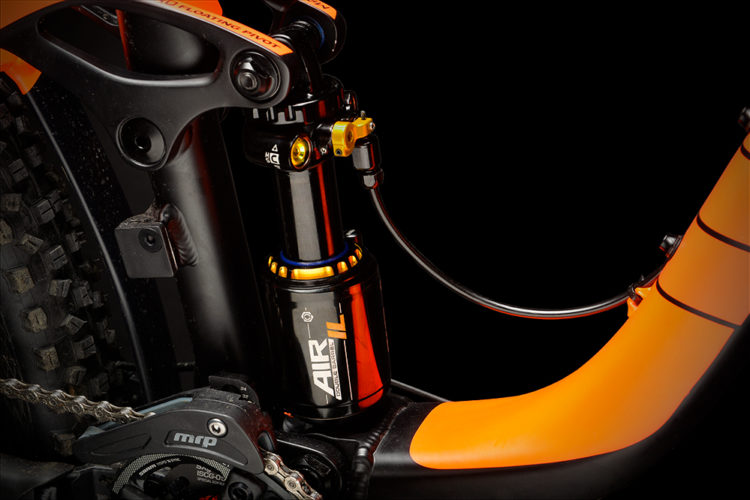
The Manitou ISX-6 rear shock comes with independent high and low speed compression dampening adjustments, rebound adjustment, volume control (which controls spring rate near the end of travel), and spring rate (air pressure). These are all the controls you need for everything from stuttery, rutted, rocky trails to big drops that would normally cause your bike’s rear end to bottom out.

picture-275

Installing this unit on the bike really should be done by a person who knows what they are doing, mainly because you need to know which adapters are required for your bike (all shocks are sold without adapters). Once you or your mechanic install the correct mounting hardware, you’re ready to get busy setting up the damper.

First things first: set the sag by following the instructions supplied with the shock. The instructions are very specific and require you to set the shock by adding air into the reservoir first (red cap). Pump that side up to at least 150psi to start. Next, make sure the high and low speed circuits are fully open as you add air into the main chamber. Adjust sag by adding or taking away pressure from the main air spring (black cap). Although this part sounds complicated, Manitou includes a handy measurement chart for dialing sag in exactly. Serious riders know that sag measurement is critical for optimizing travel path and positioning and once you have it dialed in correctly, it’s nirvana.

After setting the sag I worked on adjusting compression. To be honest I found the compression settings a bit difficult – I ended up with the high speed compression (black knob) 3 clicks from full on and then fiddled with the low speed compression (red knob) only. My goal in setting high speed compression is to find the point where coming off a drop won’t cause the wheel to blow through its travel too quickly. For the low speed compression setting, I found the point where there was as little pedal bob as possible when sitting and pedaling.

Once the compression was set, I worked on rebound (blue knob) to find the point where bumps don’t buck me off the saddle. During ride one I played with the rebound – two clicks +/- here and there – until I found the perfect setting. With the ISX-6 dialed in I could launch off drops with a controlled compression and even return without overshooting or bouncing too much.

The final control is the volume control which controls the shock at the end of its stroke. There are four settings and I ended up at the 3rd setting which ramps up spring rate for the 6+ foot drops I was taking.

On the trails I felt confident with the ISX-6 controlling the rear suspension. I found on fast descents and hitting multiple roots and drops that the rear end of the bike was far more stable than with my previous shock.

At this point I’d like to pause and offer a brief physics lesson. If you consider the saddle as a level or a gauge of how your bike is tracking, when the saddle goes up on a bump this means the suspension is working but not fast enough (my old shock did this). The transfer of energy is not complete and the wheel is following the disturbance and forcing the bike to move instead than the shock. This can also be an indicator that you are near the limit of the shock’s travel.

With the ISX-6 I noticed far less bike movement and the saddle was more stable than with my previous set-up. This made a big difference in the overall ride quality for me – more plush, yet fully under control without that wallowy feeling.

picture-242

Taking the ISX-6 to the limit, I hit a few of my favorite rock garden waterfalls. These sections are 50 foot long steep descents of just rock and trees where you have to change direction at least 4 times as you thread yourself between some large trunks. This can be a daunting task, but with the help of superb ISX-6 enabled tracking in the rear it was a piece of cake with tons of control. These sections are great at measuring wheel control and the ISX-6 passed with flying colors!

All in all, the ISX-6 is a decent shock with great small and large bump compliance. It’s light enough for long leg trail bikes and tough enough to take bigger hits and thread rough terrain.  Many thanks to the folks at Manitou for tuning tips to unlock this shock’s potential!

Cheers.


Site Map | Advertise | Partners | Contact Us | Terms | Privacy
Campground Reviews | Hiking Trails | Trail Running | Skiing / Snow Sports | Mountain Biking
Copyright 2012 Blue Spruce Ventures LLC | Atlanta, GA
singletracks.com is yet another slick Review App