singletracks is mountain biking
Sign In | Create Your Account | Site Map | Help  


IMBA Names 2010 Epic Trail Systems

Wednesday, November 3rd, 2010

Yesterday IMBA released its 2010 list of Epic mountain bike trails and the six selections represent a diverse group of trails scattered across the US. The organization claims the trails on this year’s list “provide something for everyone” and we have to agree there’s a lot of variety represented.

photo by Terry_Tiessen

Black Rock (Falls City, OR) Trails for all skill levels, including some with amazing wooden freeride structures like the one shown above.

Fresno-Saucedo Loop (Big Bend Ranch State Park, TX) Miles and miles of trails and old 4×4 roads to explore in the area! Looking at the photos you might think these trails were located somewhere like Fruita or the desert outside Las Vegas.

MoCo Loop (Montgomery County, MD) Forty miles of trails connecting 9 (!) county parks. Plans include a connection to the 180-mile C&O canal path. Can you say bikepacking?

photo by bluejudad

Hurricane Cliffs (Hurricane, UT) This Epic route includes the JEM trail, Hurricane Rim trail, and Gould and Gould Rim trails. The Hurricane Cliffs route also hosts the 25 Hours of Frog Hollow race each year.

photo by trek7k

Oak Mountain State Park (Birmingham, AL) Of the six inductees, Oak Mountain State Park is the only trail I’ve actually ridden (yet). The park features great trails with decent climbs and a dedicated club maintaining the singletrack year round. Look for even more trails – for 30 total miles – to be added in the coming years.

photo by drdiederich

Rock Lake (Cable, WI) Thirty miles of singletrack in the Chequamegon-Nicolet National Forest.

Add these and other IMBA Epics to your singletracks trail wishlist to explore in 2011!

Lake Placid Elementary School Adding Mountain Bike Program

Monday, October 18th, 2010

Just as high school mountain biking leagues are gearing up across the country, an elementary school in Lake Placid, NY will become one of the first to offer a mountain bike program for 3rd through 5th graders. The school’s PE teacher, Matt Young, has been working with others to write up grant proposals and create an MTB curriculum in time for a spring launch.

The school will purchase 21 bikes from Rocky Mountain Bicycles and local bike shops are offering discounted helmets and safety equipment for the program. The class will last 3 weeks and will take advantage of the beginner mountain bike trails around the Lake Placid area.

By now we all know the benefits to mountain biking: it’s good exercise, it teaches confidence, and it’s a great way to stay fit and active. With programs like this and IMBA’s “Take a Kid Mountain Biking Day,” the sport should continue to grow and become even more accessible. Who knows, maybe this elementary school program will inspire kids to get their parents into mountain biking!

IMBA Epic Nominations Now Open

Friday, August 20th, 2010

copper_harbor

IMBA Epic Copper Harbor Trails. Photo posted by copperhippie.

The International Mountain Bike Association is gearing up to pick its 2010 class of “Epic” mountain bike trails and anyone can submit their nomination online. If you’ve ever wondered how IMBA chooses its “Epics”, here’s a little peek into the selection criteria from IMBA Communications Director Mark Eller:

Many Epics are remote backcountry journeys that feature adventurous riding and incredible vistas. We also spotlight riding opportunities that break the mold and deliver innovative solutions, like Ray’s Indoor Bike Park. The essential components of great trails include engaged land managers, skilled trailbuilders, community involvement and dedicated volunteers, so many Epics feature engaging backstories that highlight these elements.

The nomination form is fairly lengthy and asks for some pretty specific information so it’s a good idea to do your homework before submitting a recommendation. On average about 5 Epics are added to the list each year so competition is sure to be stiff!

Now that we have a little more info on how trails become IMBA Epics, the question is: Can a trail lose its Epic status due to a lack of attention from local clubs, trailbuilders, and riders? If so I may have a nomination right here in Georgia…

Illegal Mountain Bike Trails

Wednesday, June 2nd, 2010

illegal_trail1

The phrase “illegal mountain bike trail” conjures up different emotions depending on who you talk to. To some it’s an adrenaline-filled dare; to others it’s forbidden fruit not to be touched; to still others, it’s a guilty pleasure. To non-mountain-bikers, it’s a rule they expect to be strictly enforced. But what are illegal mountain bike trails really?

Land managers tend to refer to these types of trails in a number of ways, though rarely as illegal per se; instead they call them: unauthorized, user-generated, social trails, or non-system trails. User-generated trails have existed since well before the days of mountain bikes and hikers are just as guilty (if not more so) for creating many of the social trails that exist today in local, state, and federal parks.

Recreational ecologists and others who study trail systems have come to the conclusion that if official trails don’t take users where they want to go, unofficial trails will pop up to fill the void. This means, for example, that if a trail takes the scenic route to the banks of the river, hikers and bikers will find a more direct route to get there. And if there’s a sweet boulder in the middle of the forest, mountain bikers will beat a path to shred it.

To give you an idea of the scale of the problem, in California alone, officials estimate there are more than 13,000 miles of non-system trails located on state and federal lands. Many of these trails are unsustainable from an environmental perspective and can be dangerous as well. The downside is that government agencies end up diverting funds from official trail building and maintenance projects to close and remediate the unofficial trails that spring up. Some agencies have had success charging illegal trail builders with the huge costs of clean up – but that’s only if they’re able to catch the culprits in the act.

In certain instances, social trails can become official trails which tends to send a mixed message to unauthorized trail builders. This can happen due to the ongoing failure of signage and trail closures or an eventual recognition that users prefer the unofficial routes over the official ones. Of course this is pretty rare and can take years – and in the meantime the risk of fines and other punishment is high.

Mountain biking was born out of a non-conformist culture so there’s always an undercurrent of flouting the rules in search of the best dirt. At the IMBA World Summit we heard about one community where bumper stickers were printed that said “Don’t be the Ranger’s Bitch – Ride Illegal Trails!” Clearly this doesn’t help open new trails to bikes any more than constructing unofficial trails does.

no_bikes1

The author around 1997. In my defense I was an idiot back then as the lack of helmet and sweaty cotton t-shirt attest. We didn’t actually ride this trail at Bull Mountain that day but thought at the time it would make a funny pic.

One more definition of an illegal mountain bike trail is any trail (official or otherwise) that is closed to bikes but open to other users (hikers, equestrians, etc.). IMBA’s conservative stance is that unless bikes are expressly allowed on a trail it should be considered closed to bikes (harsh). The fines and penalties for riding these trails can be just as nasty as if they were unofficial trails – just ask the Riding the Spine crew about mountain biking in the Grand Canyon. Suffice it to say if you’re not interested in being taken into custody by federal agents you may want to stick to the legal trails.

Illegal mountain bike trails will never completely disappear and it’s up to each individual to make responsible riding decisions for the greater good.  Know that if you commit the crime you gotta be prepared to do the time and be accountable to all the other mountain bikers who are affected by your actions.

IMBA’s Focus on Urban MTB Trail Systems

Friday, May 21st, 2010

pump_track

In 2007 IMBA rolled out an ambitious plan to create mountain bike “Ride Centers” all around the US and we were curious to hear the latest at the IMBA World Summit. IMBA executive director Mike Van Abel did mention the Ride Center initiative in his keynote presentation but only after speaking at length about the new(er) “Gateway Trail” model.

According to recently collected survey data, mountain bikers are looking for more trails closer to home (no surprise here). While Ride Centers are designed to be “destination trail systems,” they’re typically sited in rural areas where there’s plenty of land to support dozens of miles of singletrack. As such, most mountain bikers need to drive to get to the trails which can limit usage significantly.

Gateway Trails, on the other hand, are designed to be accessible to the widest audience possible, including kids who aren’t old enough to drive yet. The ideal Gateway Trail includes purpose-built singletrack for beginner and intermediate riders and often includes a pump track as well. Like gateway drugs, Gateway Trails are designed to get folks hooked on mountain biking so they’ll want to get their fix on more advanced, epic rides outside of town.

Lately I’ve found myself looking for ways to “ride to the ride” as often as possible and the Gateway Trails model scratches where I itch. Loading the car and fighting traffic after work is often a big hassle and can take some of the fun out of riding. For me, heading out the front door and warming up on the pavement is a welcome change and makes the well deserved singletrack seem that much sweeter.  If only there was more singletrack within say 10 miles of my house (any further than that and I might as well ride my road bike).

Riding to the ride is also great for the environment since it gets more of us out of our cars and onto our bikes. Even if you don’t care about the environmental stuff, consider this: some MTB trailheads are in danger because of crowded parking lots. Just this week we read about a trail system in Idaho where residents are blocking access to trails because they don’t like all the cars parked on the street.

One of the first Gateway Trails IMBA talked about is the Valmont Bike Park in Boulder, CO (IMBA’s backyard, natch). Urban trail systems like those in Richmond, VA are also getting a fresh look, as are projects like the I-5 Collonade trails in Seattle. And don’t forget about Highbridge Park in Manhattan (NYC) – the pump track and trails there are being used by kids who had never heard of mountain biking before.

While we were stoked to hear about the Ride Center focus back in 2007, we’re even more excited about Gateway Trails. Not only are they convenient for old timers, they also bring new riders into the sport and get more folks out of their cars. Talk to your local club about getting on the bandwagon and opening more singletrack in your city!

IMBA World Summit 2010: Day 1

Thursday, May 6th, 2010

I had hoped to “live blog” much of the IMBA Summit today and tomorrow but there’s just too much going on here (plus the internet connection is spotty). Anyway, I thought I’d share a couple pics from this afternoon with a promise for much more in depth coverage later (definitely early next week, hopefully earlier).

img_5552

IMBA Trail Care Crew, Canada. The guys and gals at IMBA Canada just took possession of this sweet ride within in the last week or so and managed to drive it down here to Augusta for the Summit. Look for the crew at Canadian trailheads this summer!

img_5550

Plenty of demo bikes to go around. Sessions start early (8am) but knock off at 3pm each day so everyone can hit the trail. The IMBA Epic Forks Area Trail System (FATS) is the main draw but there are half a dozen other trails to choose from as well. My plan is to hit the newest section of the Bartram Trail this afternoon, the Canal/Waterworks Trail and new pump track tomorrow, and FATS on Saturday. Niiiice.

MTB Trailbuilding Essentials: The Benchcut

Monday, April 5th, 2010

If you’ve been following the singletracks series on trailbuilding, you’ve read Trailbuilding: Work Smart Not Hard, Choosing Your Line Part 1 and Part 2, and Trailbuilding 101. Now you’re ready to put your knowledge to work and start building your trail! But how do you build a trail that is sustainable, fun to ride and maximizes flow? The answer: build a rolling contour benchcut trail.

img_2041

What is a Benchcut Trail?

Benchcutting is to trailbuilding what beer is to a Canadian: essential. Benchcutting is the fastest, easiest way to build a sustainable, low maintenance trail.

Benchcutting new trails is great because it allows for relatively easy removal of organic topsoil, provides good drainage, and makes the most out of elevation drops by traversing the hill rather than going straight up or down it. Trails that go straight up or down a hill will eventually become rutted out. Rutted trails are difficult and not fun to ride plus they’re environmentally unfriendly.

pbpic4125496_r

An integral part of building a benchcut trail is marking the new line. To mark out a benchcut trail, visualize the line and plant flags on the downhill side of the future trail. The trail can and will deviate slightly from the original flagging. For tips on how to choose your line, check out these articles: 1 and 2

How to Build a Benchcut Trail

A benchcut trail is created by removing material from a hillside and broadcasting it down slope. This removal of material is best done with a mattock, a Pulaski, a mini front-end loader, or a mini skid steer/earth mover. When built properly, a benchcut trail provides a stable surface allowing riders to traverse the hillside. It sounds straightforward but there are a number of elements that are necessary for the trail to ride and drain properly.

pbpic4125498r

Camber is defined as the angle of the trail perpendicular to riding direction. The camber is always sloped downhill to allow water to run across the trail rather than down it. Without the proper camber, water would channel down the trail, creating unwanted ruts. Rutting can also occur if the camber angle isn’t steep enough or the trail itself is too steep. IMBA recommends a maximum trail grade of 15 degrees. Of course this maximum grade isn’t always possible and will increase or decrease depending on the type of trail you’re building and the soil type. Loose, sandy soils erode more easily than clay based trails, so you’ll be able to create steeper, less cambered trails if you are working with clay soil.

Trail #305 photo posted by TMWJR777 on March 21, 2009.

"Trail #305" photo posted by TMWJR777 on March 21, 2009.

IMBA recommends “grade reversals” on benchcut trails to facilitate drainage and avoid channelling. Grade reversal is another way of saying a change in trail pitch from downhill to uphill or vice-versa. This works well because even if water does start to channel down the trail it will collect and drain at the lowest point, the point of grade reversal. The more grade reversals that a trail has, the better it will drain.

photo posted by Xerien  on June 28, 2009.

photo posted by Xerien on June 28, 2009.

Avoid building benchcut trails on extremely steep slopes. The amount of earth you need to remove from the hillside increases as steepness increases. If you remove too much earth, you can jeopardize slope stability and cause land slumps or even landslides. The slope stability depends on the number of trees and the type of soil on the hill. Hills with a low number of trees and clay soil are particularly susceptible to slumping, while hills with a high number of trees and sandy soil are not.

Marthas Grove Loop photo posted by Xerien on August 4, 2009.

"Martha's Grove Loop" photo posted by Xerien on August 4, 2009.

Once the new trail is cut, you need to finish it. Finishing involves removing roots, big rocks, organic material and loose soil. A McLeod is the best tool for finishing a benchcut trail because the rake end is used to remove sticks, roots, and rocks while the flat end is used to move loose soil and create proper camber. If you can’t find or afford a McLeod, make do with a rake and a hoe. After finishing a benchcut trail, you will have a smooth, flowy, rolling trail that will last for years.

What’s Next?

Now you know what a benchcut trail is, how to flag it out, and how to build it. To incorporate some serious speed and flow, you need to know how to build berms. Stay tuned because my next article will give you helpful berm building tips and quality photo examples.

About the Author

Kevin Johnstone is an avid mountain biker from Vancouver, Canada. He has been building trails across Canada for 4 years. He has worked with the worlds #1 bike park builder, Jay Hoots, to build a mountain bike park on the Sunshine Coast of British, Columbia, Canada. He spent 2 seasons improving the trails at Kelso Conservation Area in Milton and has a passion for building downhill-specific trails. Kevin can be reached via private message.

Kevin Johnstone and singletracks.com will not be held responsible for the consequences of illegal trailbuilding. Always get permission and build legally.

Mountain Biker Pushing Back on Bike Ban

Thursday, February 18th, 2010

bike_ban

photo: ANNIKA ENDERBORG, Manly Daily.

Here’s an example of what not to do if you want increased mountain bike trail access: get quoted in the local paper saying you’ll continue to ride trails closed to bikes. As if that’s not enough, get a photo of yourself inserted in the article so officials can ID you on the trail. That’s just what Australian Aaron Dunford has done and we’re anxious to see the results.

I suppose things are a bit different down under but here in the US, Dunford would probably be attacked by hikers first then cited for trespassing by local law enforcement. IMBA would issue a press release saying Dunford doesn’t represent mountain bikers everywhere (if they haven’t already) while going into major damage control mode. And this guy appears to work for a bike company!

We’re all for trail advocacy and standing up for our rights as mountain bikers but honestly there are a million better ways to do so. Gandhi demonstrated the power of the “sit -in” so why not organize mountain bikers to suit up and take a seat on the trail one weekend? Demonstrating the number of mountain bikers who want trail access while playing by the rules works more often than you might think…

MTB Trailbuilding How-To: Work Smart, Not Hard

Thursday, December 31st, 2009

If you’ve been following the Singletracks.com series on trailbuilding, you’ve read Choosing Your Line Part 1 and Part 2 and Trailbuilding 101. Congratulations, you’ve learned a lot about trailbuilding and you’re almost ready to head out and start digging. But you need something to dig with and some friendly people to help, right? Otherwise you’d just be that crazy guy digging alone in the woods with your hands. This article goes over the most useful trailbuilding tools and gives you strategies to expand your network of slave labor, er I mean friends.

img_0981r

Gather Tools and Building Supplies

mccloud_trailbuilding_tool

Always use the right tool for the job to increase efficiency and reduce the chance of injury. Here is a list of tools I often use; I’ll provide details about what tools are needed for specific tasks in future articles.

1. Spade
2. Square shovel
3. Buckets
4. Wheelbarrow
5. Cutting Mattock
6. Pulaski
7. Chainsaw with sharpening and filing tools
8. Hoe
9. Rake
10. McLeod (pictured above)
11. Axe
12. Hammer
13. Battery powered hammer drill with 3 batteries
14. Folding saw
15. Pruners
16. Gas powered trimmer
17. Dakine Trailbuilders Backpack

fire_2_001r

It’s always a good idea to use protective gear when building new trails. I wear long pants, 8” steel toed boots, safety glasses and gloves whenever I build because you never know when or where you’ll encounter a nasty thorny bush, poison ivy, poison oak or just plain crap falling on you.

Find Building Partners

Contact your riding buddies and let them know that you are building a new trail. In all likelihood they’ll be stoked and will want to help you build. Many hands make light work and it’s always good to have company on those long trail building days (plus there’s safety in numbers). Friends can also help you brainstorm new trail ideas too. Having others to bounce thoughts off of will help you decide which ideas to embrace and which to kick to the curb. Just make sure you bring along creative, positive helpers!

capturer

If you don’t know many people who ride, don’t worry! Just by getting out there building and riding you will meet people. Get the contact info of people you meet on rides and expand your network. Social networking sites like Facebook can help organize your contacts. Don’t be shy about talking to other riders on the trails. Mountain Biking is a sub-culture where the passion for riding breaks many social barriers and there’s always something to talk about when you’re with other mountain bikers. At the beginning of the season, I didn’t know most of the people I ride with and build with now. I regularly plan build and ride sessions through Facebook and expand my circle of friends nearly every time I ride. The Singletracks.com Facebook page might be a good place to start finding local mountain bikers in your area.

img_0988r

Friends help make trail building more fun and it’s up to you maintain the positive vibe. Keeping the conversation light and positive helps the time pass more quickly. Ideally you will establish a core group of friends that can bring their own tools and will help you build regularly. Be sure to clarify your plans for the trail and ask them to consult you before they make modifications to the plan. When people work on your trail they are investing time and effort so they should be likely come back to build or ride because they have invested “sweat equity”.

fire_2_007r

Call Before You Dig

The last thing you want is to cut through a fiber optic cable or be electrocuted while digging. You don’t know what lies underground until you call 811 (United States only) or your local “call before you dig” hotline. This is especially important if you live in an urban area.

What’s Next

Now you’ve learned to:

- Gather the Right Tools and Building Supplies
- Tell Your Riding Buddies What’s Up
- Expand Your Network
- Call Before You Dig

Now you’re ready to start learning how to build!

Stay tuned for the next article in the Singletracks.com series on trailbuilding. Next article will outline perhaps the most useful method of trailbuilding: benchcutting.

About the Author

Kevin Johnstone is an avid mountain biker from Ontario, Canada. He has been building trails across Canada for 4 years. He has worked with the worlds #1 bike park builder, Jay Hoots, to build a mountain bike park on the Sunshine Coast of British, Columbia, Canada. He spent 2 seasons improving the trails at Kelso Conservation Area in Milton. He is currently building downhill specific trails. Kevin can be reached by private message at Singletracks.com.

*Disclaimer*Kevin Johnstone and Singletracks.com will not be held responsible for the consequences of illegal trailbuilding. Always get permission and build legally.

MTB Trail Building How-To: Choosing Your Line Part 2

Thursday, December 24th, 2009

You’ve likely read Choosing Your Line Part 1 and Mountain Bike Trailbuild How-To. This article continues to detail the finer points of choosing your line. By the end of this article you should be able to flag out a flowy, well-drained trail with more natural features than Megan Fox.

Flow

Flow is the ability to carry momentum through an entire trail without having to brake or pedal excessively.

turn11turn2turn3

Ideally you want to pack as many features into your trail as you can while maintaining good flow. A trail with good flow will allow riders to maintain momentum from start to finish. The flowiest trails will not require riders to change speed drastically and allow riders to maintain momentum by avoiding long, steep uphills and extended straight sections. If you need to slow riders down, build a series of opposing turns.

img_2068r

Even slow speed trails can be flowy. The key is to decide what kind of trail you are trying to build and stick with that type. Trails can be fast with no steep hills or sharp turns, slow with steep and technical sections or in between. Avoid mixing high speed and low speed maneuvers on the same trail.

Build technical sections on a downhill slope to allow riders to maintain speed through features. One of the best ways to create flow is to include rolling uphills and downhills, or contours, throughout the trail. A rolling contour benchcut trail drains extremely well. More information about creating flow will be available in my next article, Benchcutting. It takes more thought and work to build a trail with flow but the final product is well worth it.

img_2040r

Choose Your Line

After you have familiarized yourself with the area on foot and identified some natural features you want to use, it’s time to choose your line. Again, include as many features as possible without disrupting flow. A trail that flows well and has fewer features is better than a trail packed with features but no flow.

img_2018r

Drainage

Route the trail along well drained areas. Avoid topographic low points, as these areas turn into speed sucking mud bogs. Muddy areas just get muddier and more rutted as more people ride through. Traversing a hillside is the best way to ensure that water flows off the trail, not down it. If the trail must be routed through a low lying or flat section, be prepared to dig drainage ditches.

snakes_ladders_002r

Ruts

Ruts are every rider’s enemy. Few things in mountain biking rob riders of control like a big, rocky rut. It’s our job as trailbuilders to know how to design trails that remain rut-free for years. The principle is simple: the steeper the trail, the more prone it will be to ruts. Avoid ruts by designing trails with frequent changes in pitch. Route a trail straight up or down a hill and ruts will appear faster than Tiger Woods can bed a cocktail waitress.

fire_004r

Walk it, Flag it

Walk a few different lines multiple times. This will allow you to decide which line will yield the best finished product. You will likely be spending 50-100+ hours building your new trail so choose your line wisely. Once I choose a line I usually walk it top to bottom 3 times to get a good idea of what the final product will be like. After choosing the line, insert flags into the ground to mark where the trail will go. Don’t stress about being exact with flag placement. The line (trail) often changes slightly during construction.

What’s Next

In this article you’ve learned about Flow and how to build trails with Flow. I’ve also outlined the following strategies:

- Walk the area
- Look for natural features
- Consider Drainage
- Design a Rut-Free Trail
- Envision the line
- Walk the line
- Flag the line

If you enjoyed this article, you’ll want to catch the next one in the Singletracks.com series on trailbuilding. The next article, entitled Trailbuilding: Work Smart, Not Hard, identifies the most useful trailbuilding tools and strategies to gain new building partners.

About the Author

Kevin Johnstone is an avid mountain biker from Ontario, Canada. He has been building trails across Canada for 4 years. He has worked with the worlds #1 bike park builder, Jay Hoots, to build a mountain bike park on the Sunshine Coast of British, Columbia, Canada. He spent 2 seasons improving the trails at Kelso Conservation Area in Milton. He is currently building downhill specific trails. Kevin can be reached by private message at Singletracks.com

*Disclaimer* Kevin Johnstone and Singletracks.com will not be held responsible for the consequences of illegal trailbuilding. Always get permission and build legally.

Mountain Bike Trailbuilding How-To

Tuesday, November 10th, 2009

btb_1

Before the Shovel: First Steps

As a trailbuilder with 4 years experience, I have worked on more than my fair share of mountain bike trails. I believe it’s every mountain biker’s responsibility to get involved with trailbuilding at some level plus it’s great exercise, you’ll meet cool people, and you’ll be giving back to the mountain bike community. Best of all you, and your friends get to ride your new creation! Getting involved with trailbuilding is easy if you look in the right places. I intend to show you the quickest and easiest way to start building the trail of your dreams. This article identifies the steps you need to take before you put a shovel in the ground.

Identify a Need

Chances are you have trail envy. You’ve seen or ridden trails far from home that you love, and you want to bring the best elements together into one super-trail close to home. Don’t be afraid to dream big when you picture the ideal trail. Grab a pen and paper and list all the features you’re looking for. Start with the genre of trail you want to build and then add more specifics. Here’s an example:

New Downhill Trail
-    Road to shuttle/ride/hike up
-    At least 500ft elevation drop
-    Flowy
-    Rock gardens
-    Lots of jumps: step down, step up and gap
-    Some berms
-    No uphill
-    Some pedalling
-    Some steep sections
-    Within 30 miles of home

These are just some examples of characteristics you might want in a trail. I will expand on definitions in article 2 entitled Choosing Your Line.

Now that you’ve identified the key features of your trail, contact people in your community with extensive knowledge of existing trails.

btb_2

Contact the Local Experts

In order to find an area to build trails, contact your local mountain bike club. If your town doesn’t have a mountain bike club, go to the local bike shop and find out who knows the trails best. Once you’ve found your local expert, tell him about your riding interests and what your area is lacking. Say that you would like to get involved and build a trail to suit the needs of yourself and other riders like you. This is a good way to find out if there are already trails in your area that meet your needs and can help identify areas that are good for building.

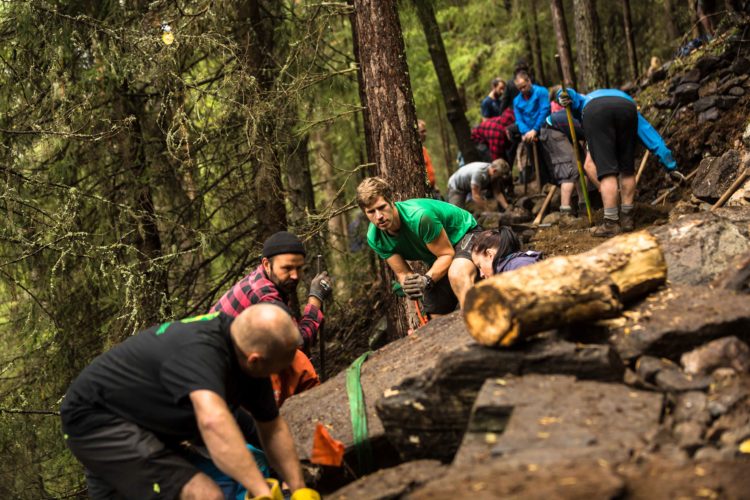
Be open to helping the club meet their existing trailbuilding goals, especially if you are a novice trailbuilder. Often mountain bike associations will host trail build days. Attending these build sessions will help you maintain a good relationship with your local club, meet other people with similar interests, and learn basic trailbuilding skills. If you’re unsure as to whether you are ready to build a whole new trail, sponsored trail build days will help you decide. Mountain bike associations appreciate suggestions for trail improvement. Maybe they will use one of your ideas in their next build day.

btb_3

Once you’ve attended some build days and improved your trailbuilding skills, ask your local association to give you some projects pertaining to your interests. Many mountain bike associations have long lists of trail maintenance jobs that need to be done as well as volunteer hours to fulfill. For many people, involvement in local build days is all the trailbuilding they want to do. For others, trailbuilding turns into a passion matched only by their enthusiasm for riding. These impassioned builders need a trail to call their own.

The desire to build trails comes from an unfulfilled need. Your local expert might not show any interest in pointing out areas on existing trails suitable for the modifications you have in mind. It is common for mountain bike clubs to hesitate in allowing trail features such as jumps, berms and steep sections, features that many riders enjoy. A good solution to this problem is to ask to build a new trail specific to the needs of riders like you. Now you must find a suitable place to build your dream trail.

Identify a Suitable Area to Build

First, ask your local mountain bike association if they can recommend an area to build in that will suit your needs. If there are trails in your area similar to the one you have envisioned, ask if you could build in the same area. This keeps trails centralized and allows others to more easily enjoy your work. If you don’t get an answer from one person, look for someone else who can help and be persistent. Ask your local mountain bike club, bike shop, riders and perhaps the best resource, other trailbuilders.

btb_4

It is very important that you don’t build a trail anywhere you don’t have permission to. This includes private land and protected areas. Unless I have permission from the land manager, I only build on crown land. Crown land is a Canadian term meaning “taxpayers land” owned by the government. Crown land is public land with certain laws governing its use. Find out where the government owned land is in your area by going to library or geography department of a university and looking at zoning maps. You will likely find a number crown land areas suitable for your new trail. (note: US laws are often more strict regarding public land uses) It is always a good idea to contact the crown land manager in your area before building. Crownland.org is an excellent resource if you live in Canada. Google maps is another good tool to use to identify forested areas and topography using the satellite and terrain tools. Remember, illegal building hurts our sport and can lead to jail time!

Now that you have identified one or more areas suitable for your new trail, it’s time to brush up on your trailbuilding knowledge.

Review IMBA Trailbuilding Strategies

IMBA has a number of books packed with useful trailbuilding strategies. These books will help you envision your new trail. It’s good to read this before you go scout out the area because you will have a better idea of what natural features to look for.

Now that you have one or more possible places for your new trail, it’s time to lace up the boots!

Stay tuned for my next article: Choosing Your Line.

About the Author
Kevin Johnstone is an avid mountain biker from Ontario, Canada. He has been building trails for 4 years across Canada. He has worked with the worlds #1 bike park builder, Jay Hoots, for a number a build sessions spanning 2 years. He spent 2 seasons improving the trails at Kelso conservation area in Milton. He is currently building downhill specific trails. Kevin can be reached via private message.

NC State Parks Bike Plan Review Through Oct. 31

Tuesday, October 27th, 2009

nc_state_park_mtb_trails

Itusi trail @ Lake Norman State Park – photo by EZ-E

IMBA is on the ball again, this time organizing mountain bikers to comment on the North Carolina State Parks Systemwide Plan. As always, IBMA has some talking points for comments that can be submitted via email or letter by October 31, 2009.

If you have ever ridden or plan to ride North Carolina, please take the time to send your comments in support of expanded and improved shared-used trails in our state parks.

Looking at the draft plan itself, there are some pretty encouraging words for mountain bikers in North Carolina. I’ve pasted the section on mountain bike trails below but the jist of it is that mountain bikers in NC are vocal and they want singletrack in Umstead State Park. The plan also gives kudos to MTB volunteer groups and points to the trails at Lake Norman State Park as a good model for future trail development. Check out the NC Division of Parks & Rec. website to see how you can submit your comments before the deadline.

From the 2009 Systemwide plan:

The largest number of responses on the survey from a recreation-specific user group was from mountain bikers. The survey found that while although only 39.3% people surveyed would ride mountain bikes in state parks, mountain bike trails were by far the most requested facility-type – with 19.9% of people surveyed choosing this facility as their highest priority to develop in state parks. The 2007 NSRE found that within the previous year, 15.7% of North Carolinians participated in mountain biking.

The comments on the survey from the mountain biking community were numerous. The major themes emerging from the comments were: more mountain biking trails are needed – particularly in areas near centers of population; the mountain biking community is sizeable and organized; mountain biking can be low impact use on properly designed trails; single-track trails on natural surfaces with a wide variety of trail types, difficulties, and length are preferred; and there are many groups such as: the Tarheel Trailblazers, Brushy Mountain Cyclists, Greensboro Fat Tire Society, Triangle Off-Road Cyclists, International Mountain Biking Association, and the Southern Off-Road Bicycle Association are available and willing to contribute financially and also through volunteer work to help design, build, and maintain mountain bike trails.

The vast majority of park-specific comments received from this user group were directed to William B. Umstead State Park where mountain bikers were unhappy with the wide gravel road experience and noted that new single-track trails (or conversion of existing trails) at the park were desired. Several mountain bikers applauded the division’s collaboration with the mountain biking community on the design and construction of the single-track trail network at Lake Norman State Park.


Site Map | Advertise | Partners | Contact Us | Terms | Privacy
Campground Reviews | Hiking Trails | Trail Running | Skiing / Snow Sports | Mountain Biking
Copyright 2012 Blue Spruce Ventures LLC | Atlanta, GA
singletracks.com is yet another slick Review App