singletracks is mountain biking
Sign In | Create Your Account | Site Map | Help  


MTB Drivetrains 101: What’s the Big Deal About 2×10?

Wednesday, December 21st, 2011

You have probably heard terms like 3×9, 2×10, or 1×9 thrown around in discussions about mountain bike gearing. In case you are not familiar with the jargon, here is a quick review.

When someone says 3×9 (pronounced “three by nine”) they are referring to the setup of the chain rings and cassette on their bike. The number 3 is how many chain rings they have on the front and 9 is the number of cogs on the cassette. Therefore a 1×9 would be 1 chain ring and a 9 speed cassette, etc. You get the idea.

A typical 3×9 crankset from RaceFace.

Additionally, chain rings and cassettes come in different sizes. Both are measured by the number of teeth they have, and if you’re mathematically inclined you can use this info, along with the wheel diameter and length of your crank arms, to calculate your total effective gear ratio. I am not mathematically inclined, so let’s just skip that part.

For years mountain bikes have employed a triple front chain ring and a 7, 8, or 9 speed cassette. This is a tried and true design and it gives you an extremely low granny gear for long, steep climbs, and a decent big ring for haulin’ the mail on flat or downhill sections.

However, there are some limitations to this setup.

Weight: Three chain rings weigh more than two … or one.

Clearance: When crossing logs, rocks, etc, the big ring can scrape, and bent or broken teeth are generally the result. (On the chain ring, not necessarily your teeth.)

Crossing Your Chain: This is discussed at length in this forum post but here are the cliff notes. Every rear derailleur has a range of gears that it can handle. It is usually expressed as a number of teeth, and on a typical 3×9 system it will be somewhat less than the difference between your largest chainring and smallest cog, or vice versa. Shifting into one of these extremes will result in poor pedaling efficiency and will accelerate wear on your chain and gears.

Derailleur Cage Length: The greater the difference between your large and small gears, the longer your derailleur cage needs to be to take up the chain slack. The longer the derailleur cage is, the more likely it is to get whacked on stuff.

One obvious solution is to just get rid of the big ring and maybe replace it with a bashguard. Many riders, especially here in Colorado, have done just that, leaving the small and middle rings. This is a workable solution, however without that big ring, long stints on the flats can be really tedious.

A ‘ghetto’ 2×9 setup with a bashguard installed.

So what is a modern mountain biker to do?

Enter the 2×10 setup!

But wait, isn’t that essentially what the bashguard setup is? 

Not exactly…

A typical 3×9 setup will have something like a 44t-32t-24t chain ring setup, (t = number of teeth) and an 11-34t cassette. There are some variations such as older 8 speed cassettes with 11-30t or 32t, and newer 10 speed cassettes with 11-36t. The latter is the norm on most 29ers.

So what those clever bike engineers have done is take the traditional triple chain ring and “split the difference” with a two ring setup. The current offerings from SRAM employ a 26t-39t setup, whereas Shimano has a 26t-38t or a 28t-40t.

Okay, I get the concept, but why do I care?

Admittedly, a 2×10 setup is the very definition of compromise, as there isn’t as big of a big ring and the granny gear is a little less granny and a little more gear, but there are some advantages.

Weight: Comparing otherwise identical Race Face Turbine crank sets, the double shaves 55 grams off the weight of the triple.

Clearance: While not as radical as the old school two ring setup, the new style 2 speed cranks are still smaller than the traditional big ring so it will scrape less (and yes, there are bashguards for a 39t big ring).

Crossing Your Chain: This is my favorite feature. On a 2×10 setup you can use all 10 gears with either chain ring; there is no chain crossing. On the trail this simplicity is awesome.

Derailleur Cage Length: Depending on your exact setup, you can most likely get away with a shorter, mid cage rear derailleur.

I recently made the switch from 3×9 to 2×10 and I am completely sold on the concept, however, it may not be for everyone. The slightly smaller big ring isn’t much of an issue, but out here in the mountains the lack of a true granny gear is very noticeable. I found myself needing to keep up a slightly higher cadence in order to avoid stalling out when climbing. It was brutal at first, but once I got used to it, I really liked it. And after a month or so, I found myself significantly faster on climbs.

There is nothing wrong with a traditional 3 chain ring approach or a homebrew 2x with a bashguard, but if you’re bored with your current setup and want to shave a little weight while losing some complexity, then you should definitely give 2×10 a try.

SRAM X0 2×10 MTB Drivetrain Review: Part I

Monday, February 21st, 2011

Almost every brand new mountain bike drivetrain I’ve ridden has been great: quiet operation, smooth shifting, and shiny parts – heck, even the lube on a new drivetrain smells great. But over time things usually start to go south – derailleurs wilt, cassettes choke on grime, and bottom brackets start to creak; cranks lose their teeth and chains start to kink. Regular maintenance can certainly delay the decay but the real key is to start with high performance design and quality parts that are built to last and can stand up to trail abuse. The SRAM X0 series takes this idea and rides with it to a whole new level.

I’ve been testing the new SRAM X0 2×10 drivetrain on my 29er over the last 6 months, quickly taking things from “factory fresh” to “well worn” and I’ve learned a lot about X0 and 2×10 along the way. Just this month I finished riding 29 trails in 29 days in some of the worst mountain bike conditions imaginable – snow, mud, ice, and rain – which was great for testing (though not always great for riding). Here’s what I found.

SRAM XX Cassette

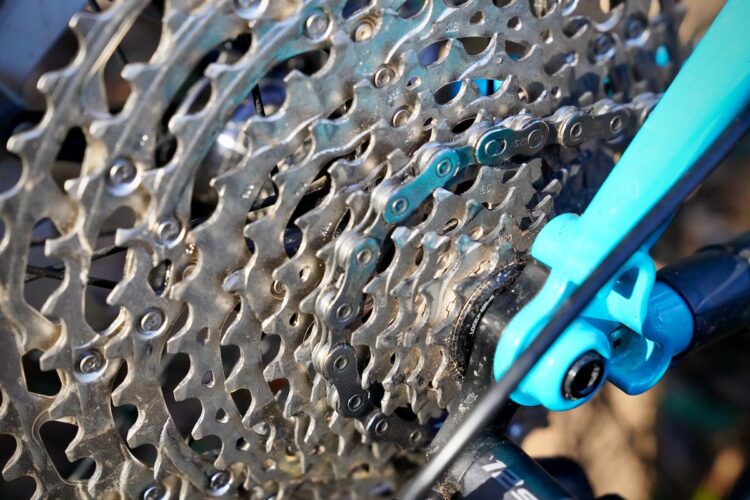
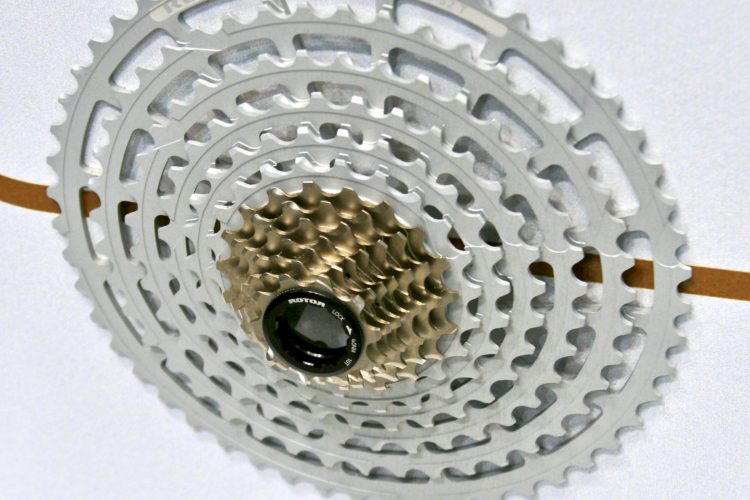
Yes, this is a review of the SRAM X0 drivetrain but at the time I received my parts the X0 cassette (XG 1080) was still in production so I got hooked up with the XG 1099 (score!). I know it’s been said before but the SRAM XX cassette is truly a work of art. According to SRAM, it takes 9 hours to cut the cassette out of a solid hunk of steel using fancy CNC machinery. The result is a one-piece design that’s been digitally optimized for maximum mud shedding, light weight, precision, and strength.

I opted for the 11-36 cassette (there’s also a more aggressive 11-32 version) which weighs 31 grams less than the already supermodel-thin X0 cassette. The final 11T ring is separate from the main cassette body as is the aluminum lock ring. Just like the X7, X9, and X0 cassettes, the XG 1099 features SRAM’s X-Glide technology which provides consistent shifting performance under a variety of conditions.

Installing and uninstalling the XX cassette has been a breeze. At this point I’ve used the cassette with 3 different wheel sets and I’ve cleaned/degreased it just as many times. It’s always a smooth fit and after a recent cleaning it still looked as good as new (the pic directly above is an “after” shot taken a few days ago; the pic at the top of the article was taken “before”).

It’s tough to talk about the performance of a single component in a mountain bike drivetrain, especially the cassette where the rear derailleur mostly runs the show. I can say my chain never slipped (not surprising) and that mud shedding is certainly above average. Leaves and various bits of crud did manage to find their way into the cassette voids over time but were easy enough to remove with running water and a toothpick.

GXP Team Bottom Bracket

The bottom bracket is sorta the unsung hero of any drivetrain but the GXP Team Bottom Bracket is hard to ignore. With sealed steel bearings and a tungsten finish, the GXP Bottom Bracket is built to keep water and crud out while maintaining a velvety smooth spin. Mine installed easily and I haven’t had to touch it since. Over the past six months I’ve been cranking the pedals pretty hard and the BB continues to whirl like new.

SRAM X0 Crankset

The X0 crankset is perhaps my favorite part of the whole drivetrain setup. With carbon crank arms and the simplicity of just two rings up front, the X0 really shines. I went with the 26-39 configuration but SRAM also offers a racy 28-42 2×10 option as well as a 3-ring 22-33-44 version (these options are also available in the X7 and X9 lines). Like the cassette, the crank rings are CNC-machined for sharp precision and a sexy look and feel.

Some riders may be wondering about the differences between X0 and X9 parts and the answer really depends on which component you’re talking about. The X0 crankset, for example, weighs in at 788 grams compared to the (aluminum) X9 at 881 grams (that’s almost 100 grams lighter for the math-challenged). It’s a pretty significant difference and in my opinion, worth the additional investment. If you do have to skimp somewhere, consider another area like the chain.

The biggest question most mountain bikers have about going 2×10 is whether they’ll miss the third chain ring. I personally love the simplicity of a 2-ring set-up and while some of the most extreme “granny gears” are missing, I found that I was quickly able to adapt. On the high end I only miss the additional gears when I’m riding flat stuff like fireroads or pavement (and I try to limit that as much as I can anyway!). A 2×10 drivetrain doesn’t quite offer the same range of gearing as a standard 3x system – but it gets close enough for any rider who appreciates things like simplicity and weight savings.

As with any long term relationship, mountain bikers tend to hurt the ones they love the most and unfortunately the X0 crankset has born the brunt of my trail abuse. During a nighttime time trial in Augusta one of my pedals worked itself loose and when I stepped on it coming out of a turn I stripped the last 2-3 pedal threads on the crank. The loose pedal had nothing to do with the crank itself – the pedal either wasn’t tightened properly or it seized in the cold temps – which made the damage all the more frustrating. Fortunately I was able to have the threads re-tapped and after a month of riding and hundreds of miles, everything is holding up well.

Coming off a 1×9 drivetrain, I also haven’t done a good job protecting my big ring from log hits. During a recent inspection I found one big ring tooth that was nearly completely gone and a few others that had been noticeably dulled. To be honest I haven’t noticed any performance issues associated with the loss but I’ll certainly be more careful and will do a better job removing grit from my chain after muddy rides to avoid further wear on the precision metal teeth.

SRAM PowerChain 1071

Some may be surprised to learn that standard 9spd chains won’t work well with a 2×10 drivetrain and it’s because the spacing on a 10spd cassette is slightly narrower. The PowerChain 1071 is actually part of the X7 group and the only difference between the 1071 and 1091R (the X0/XX chain) seems to be the “Lighting Holes” the 1091R features on outer links for additional weight savings. How much weight do the holes save? According to SRAM, about 2 grams (less than 1% of the total).

SRAM’s 10spd chains also feature the PowerLock connecting link that’s a little different from the PowerLink connection you’ll find on SRAM 9spd chains. PowerLock links can be installed without using a tool but unlike PowerLinks, they are not re-usable (the pins pop off when you use a standard chain removal tool). I haven’t had any issues with my chain over the past 500+ miles but I always carry a couple spare PowerLocks in my hydration pack just in case.

Despite the narrower chain gauge I haven’t noticed any unusual side-to-side flex during shifting nor have I experienced any sort of “chain stretch.” Keeping the chain clean and properly lubed seems to make all the difference in terms of quiet performance. The only thing I’ve noticed is that my rag catches slightly on the PowerLock link when I wipe off excess lube.

So that’s a lot to take in and I haven’t even talked about the shifters or derailleurs (coming up next). Look for part II of my review plus a review of SRAM’s sexy X0 hydraulic disc brakes.

Thanks to the folks at SRAM for providing these parts for testing and review.

How to replace a mountain bike cassette

Tuesday, January 13th, 2009

This article is a step-by-step procedure on replacing a mountain bike cassette & chain.

Featured parts used here are:

SRAM 8spd (11-32) cassette

SRAM 8spd Powerlink chain (top chain is old, bottom chain is new & longer)


Tools required for this job are:

Cassette lockring tool (SRAM cassettes are compatible with Shimano lockring tools)

Chain-whip tool

Adjustible Wrench (for use with Park Cassette lockring tool)

Torque Wrench (ft-lb/Newton Meters)

Chain Tool

First, either place the bike on a stand, or upside-down. Shift the rear derailleur to the highest gear (smallest cog). Remove the rear wheel from the bike. Remove the old chain utilizing a chain tool. After removing the old chain, use it to make sure the new chain has the correct number of links. If not, remove the extra links from the new chain.


Remove the quick-release skewer/axle from the rear wheel. Insert the cassette lockring tool into the splined lockring.

Now use the chain-whip tool to keep the cassette from spinning as the lockring is being loosened.

Once the lockring is removed, the first two cogs will come off separately. The cassette should then slide smoothly off the hub. If it doesnt, apply some quality degreaser into the spline area between the cassette & hub. Let it set for a while, and then try again. If it still refuses to come off; flip the wheel over and using a small hammer and 6″ wooden dowel, tap the cassette off the hub body.

Be sure to take this opportunity to clean the hub body. Apply a quality anti-seize compound to the hub splines.
Locate the indexing spline on the hub body, and then match it to the index slot on the new cassette. Usually this index spline is smaller/narrower than the others. Line up the splines and slide the new cassette onto the hub. Make sure the cassette is seated fully onto the hub body.

Then, place the two small cogs onto the hub, making sure they are seated properly against the new cassette. Finally, install the new cassette lockring, but do not tighten yet.

Take note of the torque markings on the lockring! Then use a torque wrench to tighten the lockring onto the cassette.

Spin the cassette by hand to ensure that it moves freely and does not wobble. Fit the new chain around the derailleur guide pullys and the smallest front chainring. Again using the chain tool, fasten the chain back together (if using a standard chain, SRAM Powerlink chains do not need a chain tool).
Reinstall the rear wheel back onto the bike, and the job is done!


Site Map | Advertise | Partners | Contact Us | Terms | Privacy
Campground Reviews | Hiking Trails | Trail Running | Skiing / Snow Sports | Mountain Biking
Copyright 2012 Blue Spruce Ventures LLC | Atlanta, GA
singletracks.com is yet another slick Review App