singletracks is mountain biking
Sign In | Create Your Account | Site Map | Help  


Upgrading Your MTB Suspension Fork

Tuesday, August 23rd, 2011

People frequently come to the Singletracks forums looking for guidance on mountain bike fork upgrades.

Will it fit my bike? Tapered headset? How much travel? Disc or V-brake compatible? QR, 15mm, 20mm thru-axle? How much should I spend? What brand? What on earth is a Terralogic?

These are all variables that can come up when selecting a replacement fork and this guide will attempt to make sense of it all.

Starting with what will fit on your bike is a great way to quickly narrow down the field. Here are several key measurements to consider.

Headset: there are basically three headsets commonly found on mountain bikes. Older bike models have what’s call a threaded headset with a ‘quill‘ type stem. A bike this old is not a good candidate for a fork upgrade, and a new bike would be a better investment. Among modern threadless headsets, there is the more common 1 1/8″ model, and the newer 1 1/2″ to 1 1/8″ tapered version. If you have a standard 1 1/8″ you cannot use a fork with a tapered steerer. If you have a tapered headset, you can use a fork with a standard steerer, via an adapter, but you will lose the extra stiffness for which the tapered setup was created.

Steerer length: Different bikes have different head tube lengths. If you get a fork that has had the steerer tube cut too short for your head tube, you are screwed. You can measure the outside length of your head tube as a shopping guide, or remove your current fork for a precise measurement. It’s ok to get one with a longer or even uncut steerer, as it is pretty easy to get it cut down to the right length.

Travel: Many people consider a fork upgrade because they want to increase their front travel. This is a very good idea, within reason. Bikes are designed with an overall geometry that takes the fork length and travel into account. Going too tall, say from 80mm to 140mm, will result in a bike that wanders while climbing, corners poorly, and just feels wrong overall. A good rule of thumb is to stick within 20-25 millimeters of what your bike came with. For example, I upgraded my Specialized Rockhopper from a stock 80mm fork to a 100mm replacement. I also upgraded my Giant Trance from 100mm to 120mm. In both cases the bikes continued to handle as designed, and I got the extra travel I wanted for my riding style. Whatever you do, just make sure it doesn’t end up looking like this:

Now that you’re looking at a bunch of forks that will fit your steed, it’s time to think about options.

Coil or Air: Once you get out of the entry level stuff, most modern forks are either coil sprung or have air chambers that act as a spring. Coils springs compress with a linear response, which makes them ideal for extremely long travel downhill forks. On the downside, coil forks are typically heavier, and they are more difficult to tune for individual rider weight. Air springs are generally lighter, and they are easily adjusted for different rider weights by changing the air pressure. But unlike a coil spring, air does not exhibit linear compression. When air is compressed, the spring rate increases and the fork essentially feels stiffer. A LOT of research and design has gone into mitigating this effect and modern air forks deal with it pretty well.

Rebound, Lockout, Compression, and Travel Adjustment: Rebound is an adjustment of how quickly the fork returns after it has been compressed. Rebound that is too fast can make the fork feel bouncy and harsh. If it is too slow, repeated bumps will make the fork “pack down” and eventually bottom out altogether. Adjustable rebound is a must-have feature.

A lockout adjustment allows the suspension fork to be set to a nearly rigid setting. This can be handy for long fireroad or paved sections. The adjuster for this is typically on the top of the fork leg or attached to a remote on the handlebars. This is also a pretty basic feature and if you’re upgrading, you should look for it (I have a remote lockout and I love it).

Forks that have a compression adjustment allow you to set a different spring rate for slow speed vs. high speed bumps. It can be a pain to get dialed in, but it makes for the ultimate in smooth riding when set up properly.

On some high end models the travel amount can be quickly changed with an external adjuster. This can help create the ultimate do-it-all bike by allowing you to drop the travel for XC and climbing, bring it up a bit for all day riding, or max it out for sustained downhill. This feature is awesome, but it comes with a high price tag.

Brakes: If you have, or intend to get, disc brakes, your new fork must have tabs for mounting the caliper. If you have and want to keep your V-brakes, you will need the posts for attaching those. For a while now forks have been shipping with both, but lately many models have dropped the V-brake posts altogether and are disc only.

Wheel Compatibility: This is fairly straightforward, but does bear keeping in mind while fork shopping. If you plan to keep your front wheel, make sure to get a fork with the matching axle configuration. If you’re upgrading the wheels and fork together, just pay attention to the specs of each.

Cost: A lot of research has gone into modern suspension forks, and it is reflected in the prices. It’s not hard to drop around $1,000 on a decent fork with the options mentioned above. If that is out of your price range, take a look at what you really need for options and then focus on the middle of the product lines from the major brands. A decent fork with air springs, rebound and lockout can be had in the $250 – $500 price range. These will be a bit heavier, and won’t have the coolest features like low-speed compression adjustment, remote lockout or adjustable travel, but they will work well and hopefully make a nice upgrade over the original you’re replacing. Another trick is to look on eBay or even at your LBS for a “new take-off” model. This is essentially a brand new fork that for whatever reason was swapped off of a new bike when the buyer took delivery. For example, my Fox F32 120 RL Remote retailed for about $900, but I got it as a new take-off for $300 from a bike shop!

Major Brands: Suspension fork manufacturers have  come and gone over the years. The major brands these days are Fox, Rockshox, Marzocchi, Manitou and Magura. Fox and Rockshox own most of the market due to the innovation of their designs and their build quality. Marzocchi builds excellent long travel models for downhill and freeride, but lately their low end models tend to be, well, low end. They also have a somewhat confusing model line-up where the same model name can have wildly different features and pricing. Manitou revamped their product line several years ago in order to simplify the available choices and incorporate updated designs and materials. They still don’t have the market share of Fox or Rockshox, but they’re a respectable brand that’s worth checking out. Magura manufactures XC, racing, and all mountain forks and is somewhat of a niche brand. They are well regarded among those who own them, and you can occasionally score a really good deal on a used one due to lack of brand recognition.

Terralogic: This is a suspension design originally developed jointly by Fox and Specialized that uses a special valve to detect what the trail surface is like and automatically lock out or open up as needed. Dgaddis recently tested one and you can read more about it here.

Hopefully this has given you some solid guidelines to help you decide what you need in an upgraded fork so you can zero in on the one that has the features you want at a price that fits your budget. Happy shopping!

MTB Hydration Pack Buyer’s Guide

Friday, June 24th, 2011

Like many great outdoor products, hydration packs were first developed for the military and later modified for civilian use. While there are several brands and a number of different models on the market today, the basic functionality is to carry gear and liquid, and to provide a means of drinking without stopping what you’re doing. Here are some pointers to help you select the pack that fits for your mountain biking needs.

Photo: Osprey.com

Water Capacity

Most packs on the market seem to have settled on two standard capacity offerings: 70oz and 100oz. When choosing the capacity that is right for you, consider how much water you like to drink, the length of your average ride and whether your bike frame has room for bottle cages. If you live in a hot or dry climate and like to do 3+ hour weekend rides, go for the 100oz. If you tend to do shorter, early morning or after work rides, 70oz is probably fine.

Cargo Room

Carrying water is only half of the equation; most riders will also want to be able to carry stuff along the trail. The singletracks forum has numerous threads about what to carry, but the basics include a multi-tool, flat tire repair kit, snacks, first-aid stuff and maybe a jacket or other clothing. Packs come in all sizes from ones that will hold just a granola bar and car keys, all the way up to packs like the massive 1,159 cubic inch Camelbak HAWG. Again, what you like to carry determines how much cargo space you need. Light and fast racers will tend to prefer the minimalist designs, whereas photographers and those who frequently go on epic rides with uncertain weather conditions will want to go with a much larger volume pack. When selecting the right pack for your gear carrying needs, lay out everything you already carry, or would like to, and take a picture of it. Bring the picture to the store so that you can remember it all, and maybe even grab some of those same items at the store and see if they fit in the packs you’re considering.

Features

With capacities being a fairly standard metric, most manufacturers try to differentiate their products by offering a variety of innovative features. For example, the FuL Cargo pack has a retractable helmet storage net, Osprey models have a nifty magnetic bite valve holder, and CamelBaks have arguably the best valve system with easy to find replacement parts. Other features include dedicated cell phone / mp3 player pockets, mini-pump sleeves, and even chain saw loops.

Photo: ful.com

Fit

All of the above is a non-issue if the pack doesn’t fit comfortably. Just like “regular” backpacks, each manufacturer has their own take on strap, suspension, and back panel design, and of course no two people are shaped alike. Once you have narrowed down the capacity and feature set you want, find a corresponding model from each of the available brands. Put some stuff in them to simulate a full load and wear them around the store for a bit. Pay attention to any pressure points or anything that doesn’t feel right. If it’s uncomfortable now, it will totally suck on the trail!

Recommendations

Racing: Some hardcore racers still do the bottle cage / seat bag thing, but hydration packs are starting to catch on, especially in the ultra-endurance segment. The Camelbak Fairfax and Osprey Raptor 6 are both small, light, and will keep you hydrated without slowing you down or throwing you off balance.

World Travelers: If you spend a lot of time away from home, Camelbak is your best bet. Every podunk sporting goods store in the country seems to have Camelbak bite valves and other replacement parts. This could make the difference between dropping $6 – $10 to fix your  pack or $50 – $100 to replace it.

Multisport: If you want just one pack for mountain biking and other, non-MTB activities like bike commuting or school, check out something like the Cargo from FuL or BC2 from Ergon. Both of these have well thought out organization features to help keep all of your various doodads neatly stowed.

Pack Rats: If you need to carry a LOT of gear, check out the larger Osprey models like the Verve 13 or Raptor 18. Osprey is first and foremost a backpack company and they do an amazing job of making a big load feel small by incorporating features like load lifter and compression straps into their hydration pack models. The Camelbak HAWG can also swallow a ton of gear and has a 100oz water capacity.

Whether you you are considering your first hydration pack or are looking to replace that worn out one you’ve had for years, the quality and selection available today is better than ever. Hopefully this guide will help you sift through all the models and features and lead you to that perfect pack for mountain biking!

Mountain Bike Helmet Camera Buyers Guide

Friday, January 7th, 2011

Helmet cameras for mountain biking are becoming more and more popular every year, thanks to declining costs, smaller form factors, and improved image quality. If you’re in the market for a helmet camera to film your MTB exploits, here’s what you need to know before you buy.

Image Quality: HD or SD?

These days most helmet cameras shoot HD video and there are two levels of HD – 720p and 1080p. If you’re planning on uploading most of your videos to the web, 720p is more than enough quality. Cameras that shoot in standard definition (SD) only are generally inexpensive but the image quality is often grainy, even before it’s posted online. Video quality is also affected by frame rates so look for cameras that shoot at least 30 fps at each resolution. 60 fps is even better and is ideal for capturing fast action (i.e. mountain biking).

Beyond video resolution (i.e. the # of pixels), white balance, colors, and light capture are also important. View as many videos as you can from each camera you’re considering and note how life-like the colors appear. Some cameras do better in bright, sunny conditions while others may “wash out” on blue sky days. Good cameras will adjust the image balance based on the light conditions (for transitioning from open areas to canopy-covered trails).

Many helmet cameras offer multiple shooting modes: SD, 720p, and/or 1080p. Lower image quality modes allow you to conserve memory (see next section).

Memory and Battery Life

Helmet camera manufacturers may brag about the amount of memory included in their cameras but don’t worry too much about this stat. Good cameras will include a memory card slot so you can buy an inexpensive, larger memory card if necessary (prices are falling all the time). Besides, the main constraint on filming is often battery life.

Batteries will either be built-in, rechargeable types or replaceable. There are pros and cons to each choice. Built-in batteries are convenient but once they run out on the trail, you’re done filming for the day. If your camera uses replaceable batteries, we strongly recommend packing extra batteries and springing for the more expensive lithium alkaline variety for maximum life.

Size Matters

Obviously helmet cameras need to be as portable as possible so look for small, compact units. Most helmet cameras are “one-piece” while others require the use of a cable/battery pack. Also consider the form factor of the camera itself: aerodynamic, “bullet-style” cameras tend to work well for mountain biking.

Mounting Options


Helmet cameras aren’t just for helmets and many manufacturers include additional mounting hardware in the box. Consider the type of helmet you’ll be wearing (vented vs. skate-style/full-face) and whether you’d like to experiment with different camera angles. Handlebar, wrist, chest, and frame mounts are also available, sometimes at an additional cost.

Camera Controls and Viewfinders

photo courtesy vio-pov.com.

Most helmet cameras keep their controls simple enough to operate with a gloved hand but it’s still a good idea to play around with the controls before you buy. Multiple buttons can be confusing, especially when the camera is on your head and you can’t see what you’re pressing. Some cameras offer remote control units, either included or sold separately.

Due to their small sizes, most helmet cameras don’t include an LCD viewfinder like you’d find on a regular digital camera. This can make it difficult to line up your shot and we’ve often returned home to find hours of footage of our handlebars. Some manufacturers have added laser sights to their cameras while others offer remote (either cabled or wireless) screens.

Lenses

The best helmet cameras have wide angle lenses to avoid the “tunnel vision” effect you’d get with a standard lens. Keep in mind that if the lens is “too wide,” you’ll get a fish eye effect (cool for some stuff, but annoying if that’s all you have). Lenses on consumer-level helmet cams are not typically replaceable so you’ll usually be stuck with whatever lens is included.

Audio Quality

Ever notice how most mountain bike videos posted online have a catchy song playing in the background? That’s because the audio quality sucks from most helmet cameras, though in defense of the cameras it’s really not their fault. Wind noise is tough to filter out and besides, the only other sounds on the trail are often bikes clanging, creaking, and squeaking or riders huffing and puffing. Occasionally you’ll catch a well timed comment or expletive but that’s about it. If audio quality is important to you, seek out sample videos posted online from each camera you’re considering.

Software

Most helmet cameras ship with video editing software which is generally mediocre at best so don’t make your decision based on the software included. Instead, plan to use inexpensive editing software like iMovie for Mac or Windows Movie Maker. These days, online video editing is becoming a viable option as well.

Other Considerations


Helmet cameras aren’t always the best way to capture action on the trail or at the slopes. While the first-person perspective is convenient to film, it can get stale after a while. Consider using small portable cameras like the Flip trail-side or even cell phones and digital cameras with built-in video capabilities. Splice your helmet camera footage with trail shots and you’re on your way to the film festival circuit!

Most helmet cameras also allow you to take digital still shots, though in our experience those features are seldom used. Some cameras allow you to take a timed series of pics which is good for taking trail pics without harshing your flow.

Recommendations

Keeping in mind that every helmet camera has its own set of pros and cons, the list below should be a good starting point for mountain bikers looking to go viral. Now that you know what to look for, you should be able to pick the best helmet camera for your style!

  • ContourHD: Simple bullet-style camera body, laser alignment, full HD, rechargeable battery, and microSD memory card slot for around $300. Contour also offers the ContourGPS that adds GPS data collection and Bluetooth.
  • GoPro HD Helmet Hero: Waterproof/shockproof casing, rechargeable batteries, and multiple mounts included. Two HD versions available – the $299 full HD and $179 HD Hero 960 which doesn’t shoot in 1080p.
  • Drift Innovation HD170: 1.5″ LCD viewfinder and remote control included. Rechargeable batteries, auto white balance, and 1080p. Drift also offers a less expensive SD version called the X170.
  • V.I.O. POV.HD: Professional level camera system ($599 MSRP) with remote and cabled battery pack/viewfinder. V.I.O. also offers less expensive, lower resolution versions with the same pro form factor.
  • Epic HD: Replaceable batteries and multiple mount options. The entry level Epic Action camera is available starting at $129 MSRP.

Read more in-depth helmet camera reviews from the singletracks crew and see which helmet cameras singletracks members like the best. And don’t forget to post your best videos to singletracks!

Mountain Bike Tire Buyers Guide

Wednesday, December 15th, 2010

When it comes to mountain bike tires, there are a ton of choices out there (there are nearly 300 different models listed on singletracks alone). But how to decide which tires are best? Luckily slapping new skins on your wheels is an easy upgrade – just follow these tips to find the right mountain bike tire to suit your riding style.

Wheel Size

This is probably a no-brainer for most folks but be sure you’re looking at tires that will actually fit your wheels. Mountain bike tire sizes typically look like this: 26×2.10 or 29×2.25 where the first number before the ‘x’ is the wheel diameter in inches. Most mountain bikes have 26-inch wheels; 29ers have 29-inch wheels. If you see a tire that’s labeled in centimeters (700×23 for example) it’s probably for road bikes.

Tire Width

The second number in the tire size mentioned above is the width of the tire (in inches). Values can range from as little as 1.5 to 2.6 on the high end. Essentially skinnier tires roll faster (lower resistance) but they aren’t good in loose conditions (think of a road bike here). Fatter tires handle well in loose conditions and can absorb big hits but they’re slower rolling. Keep in mind that some bike frames may encounter clearance issues with fat tires; check with your bike manufacturer to find the maximum tire size you can use. In general, XC tires will feature narrower widths while more aggressive Trail and DH tires will be wider.

Carcass and TPI

All bike tires feature a “carcass” of woven fibers that basically acts like a skeleton embedded into the rubber itself. This cloth carcass is often rated in terms of threads per inch or “TPI” (sorta like thread count in bedsheets). A high TPI tire (120 and up) will be more supple and lighter weight but this can leave the tire more prone to punctures and pinch flats. Low TPI tires (60 and below) are heavier and more durable but without the same ability to “give” based on the terrain.

In addition, Trail and DH tires may be armored and/or double-ply to increase durability.

Tread Pattern

If there’s both an art and science to creating the best mountain bike tire, tread pattern is definitely the “art” side of the equation. Intuitively it makes sense that long, pointy knobs will grip better than short, smooth knobs so the way a tire looks is important in making your selection. Also be sure to take note of knob spacing which can affect grip and mud shedding properties. Beyond that, tires are typically grouped into a few groups based on the tread pattern:

  • Low rolling resistance: This category can run the gamut from completely slick (for riding exclusively on the road) to semi-slick to XC-type tires. If you plan on riding off road, pay attention to the side knobs which will help with cornering.
  • Maximum grip: These tires may be marketed as “wet” or “loose” condition tires and work well for climbing and more aggressive downhill riding.
  • All ’rounders: You guessed it – these tires attempt to blend low rolling resistance with good gripping properties.

Center knobs are the workhorses on any MTB tire while the side knobs assist in cornering. Transition knobs affect handling as you move from cornering to straight-line riding.

Tire Compound

Unless you’re a materials scientist, understanding the various rubber compounds used in mountain bike tires isn’t necessary. Instead, keep this in mind:

  • Soft tire compounds are sticky and grippy but they wear our quickly.
  • Firm tire compounds wear more slowly but don’t grip as well.

These days, many mountain bike tires are “dual compound” and feature a softer compound on the side knobs for improved grip with a firmer compound on the center knobs for longer tire life. Race tires may feature a single soft compound with superior grip but are often “used up” after just a couple rides.

Tire Bead

The tire bead is basically the lipped edge of the tire that seats inside your rims. The man decision here is wire bead or kevlar (the same stuff that’s used in bullet-proof vests). Kevlar is lighter weight (Sheldon Brown says Kevlar saves about 50g per tire) but typically adds to the price of the tire. In addition, Kevlar tires are “foldable” and may be more difficult to mount than a wire bead tire.

Front vs. Rear and Forward vs. Backward

Some mountain bike tires are sold as front/rear specific while others are marketed as suitable for both front and rear. Some riders swear by riding matched pairs of tires while others choose two different tires for front and rear. For example, running a low rolling resistance tire up front with a grippy tire in back can improve climbing while reducing friction up front.

Most tires are uni-directional meaning you’ll need to pay attention to the way you mount them on your wheels to get maximum performance. Some tires, however, are bi-directional (reversible) and may even exhibit different characteristics depending on which direction they’re rolling.

Tubeless vs. Tubed

Some mountain bike tires are marketed as tubeless, tubeless-ready, or UST which means they can be used with a tubeless wheel set up. There are advantages and disadvantages to running tubeless so we recommend reading discussions like this one to decide which set-up is best for you. Many tires that are not explicitly marketed as tubeless-ready can be successfully used without tubes but may take a bit of trial and error.

Specialty Mountain Bike Tires

Mountain bike tires aren’t just for riding dirt – here are some specialty tires you might come across.

  • Studded tires: These tires have metal studs embedded in the knobs to improve grip in snowy and icy conditions.
  • Super fat tires: Bikes like the Surly Pugsley can take tires up to 3.7 inches wide which are great for riding on top of the snow.
  • Slicks: These tires are usually very narrow and offer zero knobs, perfect for cruising asphalt at high speeds.
  • DJ/Urban: 26-inch tires with characteristics that have been optimized for dirt jump, urban, and/or park riding.

Recommendations

As you can see there’s a lot to consider when choosing a mountain bike tire but don’t let this all info overwhelm you. Here’s a list of tires we recommend as good starting points no matter what kind of riding you’re into (the list is ordered randomly). Want more? Check out all the singletracks tire reviews or view the best mountain bike tires according to our members.

DH Tires: Not necessarily the best climbing tires. Instead, these skins are super durable and should corner well in extreme conditions.

Trail / AM Tires: Designed to be good “all around” tires for climbing, cornering, descending, and everything in between.

  • Maxxis Ardent: great for a variety of terrain including rocky, rooted trails.
  • Maxxis Ignitor: low rolling resistance, good multi-condition tire.
  • WTB WeirWolf: classic design with square edges for great braking performance.
  • Specialized Eskar: good all-in-one tire and a decent climber.
  • Kenda Nevegal: excellent on hardpack with extra bite for the climbs.

XC / Race Tires: Lightweight and typically fast rolling.

XC / Training Tires: Budget friendly tires that will last mile after mile.

Mountain Bike Light Buyers Guide

Tuesday, November 2nd, 2010

Just in time for the end of daylight savings and shorter trail days, we’ve put together a mountain bike light buyers guide. Mountain biking at night adds a new dimension to familiar trails and it’s a great way to extend your riding season; use this guide to find the best lights for you!

Trail speed and terrain considerations

Before you choose a light for mountain biking it’s important to consider the types of trails you’ll be riding at night and the speeds you expect to carry. For example, if the trails you’ll be riding are technical you’ll want a brighter light with better fill than if you’ll be riding wide dirt paths. And if you want to go fast you’ll need a light with more range (i.e. power) than if you expect to slow things down in the dark. Also keep in mind how often you’ll be night riding; if it’s only once or twice a month in the winter you may not want to sink a ton of money into a light system.

Where will you mount your light?

There are basically two choices here: bar mount and helmet mount.

A helmet mounted light tracks wherever you’re looking – around a switchback, at a rough patch of trail, etc. – which many riders prefer. The trade-off is that helmet lights generally aren’t as powerful as bar mounted lights due to weight considerations. Remember, with a helmet-mounted light you’ll need to strap the battery pack to the helmet itself or in a jersey pocket which can harsh your flow on the trail. Lights are typically mounted to a vented helmet using velcro or stretchy straps. Helmet mounted lights typically shine down on the trail more which is good at eliminating shadows but shortens the distance the light will carry forward.

Bar mounted lights are typically more powerful and tend to feature larger battery packs that are longer-lasting. Light mounting arrangements may vary and some are better than others at dealing with tapered bars and varied bar diameters (look for ones with rubber straps or a clamp with plenty of screw length). Batteries are usually mounted separately and most riders choose to place them under the stem or in the frame triangle below the top tube. Light at bar height will shine farther down the trail but will tend to produce more shadows in uneven terrain.

Many small- to medium-sized light kits include hardware for both helmet and bar mounting so you can see which one works best for you. Of course the best of both worlds is to ride with a combination of helmet and bar lights but for beginning night riders a medium-power helmet lamp is a good start.

Light emitters: LED or nuthin’


These days it’s hard to find major bike light manufacturers offering anything other than LED lamps and it’s no surprise: LED lights are reliable and super efficient. Stay away from lower priced halogen and HiD based systems – these lights suck battery life and produce a ton of excess heat.

To compare brightness between light systems, check the number of lumens (companies often claim competitors’ lumen counts are flawed but it’s still a good starting point). At a minimum you’ll want about 150 lumens to ride trails at night – and at that point you’ll be find yourself riding pretty slowly. :)

Beyond lumen counts, the actual beam pattern is important to consider. The simplest pattern is a round one (since LED bulbs are round) but much of that light is wasted on the edges of the trail. Some lights offer a round beam pattern with a center “hot spot” and a diffused outer halo that’s good at illuminating your peripheral vision while highlighting what’s ahead. A well thought out beam pattern on a bar mounted light system all but makes up for the fact that your light doesn’t follow your eyes like with a helmet-mounted system.

Most lights ship with multiple light modes (high, medium, low, strobe, etc.) and some even offer customizable light modes but in our experience there’s no need for more than one or two modes. High mode works best for most rides unless you need more run-time (more on that in the next section) while a strobe mode is mostly good for commuting and dusk rides where you’re more concerned about being seen than actually seeing the trail.

Batteries matter

The heart of any light system is the battery so it’s important to pay attention to quality and reliability. Most mid- to upper-level light systems include a rechargeable Li-ion battery while less expensive systems may ship with NiMh batteries. Charge times can vary widely (from as little as 2.5 hours to 10+ hours) so be sure to check – there’s nothing worse than forgetting to charge your light the day before a big ride. Be sure to follow the manufacturer’s charging instructions to maximize the life of your battery.

Longer battery life comes with a trade-off: batteries are heavier and more expensive. Look for run-times on high that are at least long enough for your typical ride (we look for 2 hours minimum). To compare systems it can be helpful to calculate a simple ratio of max lumens to run-time on high. For example, if a 300 lumen light gets 4 hours of run time (240 minutes), that’s 0.8 lumens per minute (this number doesn’t mean anything – it’s just for comparison). If another light’s ratio is 1 lumen per minute that means the second light is more efficent (holding other things like battery size/weight constant).

Because batteries will degrade over time and technology is changing rapidly we don’t recommend purchasing used bike lights unless you’re able to test and verify actual run-time yourself.

Tail lights

It’s always a good idea to bring along a blinking red tail light on any night ride, even if you don’t expect to encounter any cars. Choose a bright, inexpensive light that can be easily strapped onto a hydration pack or attached to your seatpost.

Recommendations (Updated November 2, 2011)

At this point we’ll offer some specific mountain bike light recommendations but remember to consider your budget and how you’ll be using the light to make the best choice. Products listed below are ordered by lumen count.

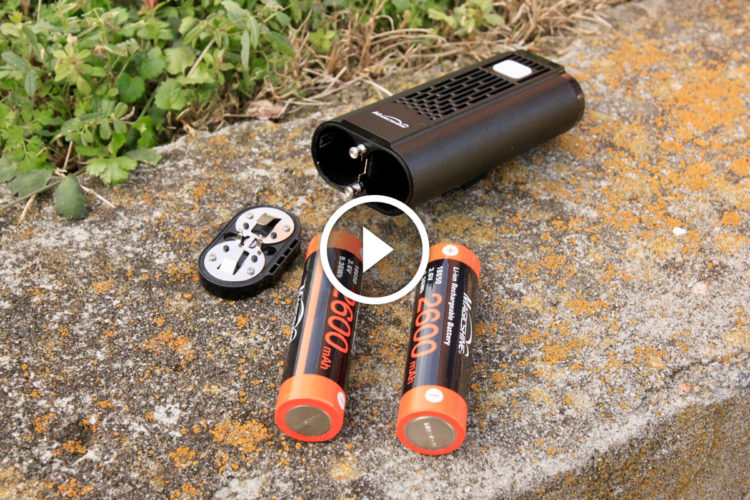
NiteRider MiNewt.600: This 600 lumen light is USB rechargeable and is a one-piece unit meaning there are no cords to get tangled on the trail. The smart charger juices the MiNewt in about 5.5 hours for 1.5 hours of run-time on high. Handlebar and helmet mounts are included and at $149 MSRP this simple little light is a great value.

Magicshine GMG Special 900: This simple light system pumps up the volume with 900 lumens of light and a battery that offers about 3 hours of run-time on high. At just $89 MSRP this is one of the best dollars-per-lumen values but because this system is fairly new to the market, the jury is still out on reliability. So far so good!

Light & Motion Seca 1400: The mack daddy of our recommendations, this light produces an astonishing 1400 lumens of light and weighs just 500 grams. You’ll get about 2.5 hours of battery life on high and you can mount this portable torch on your helmet or handlebars. The side-beam pattern is second to none but all this performance comes at a price ($699 MSRP). In our tests the Seca 800 works very well too and can be used comfortably as a bar-mounted light.

You can read in-depth reviews of even more bike light systems or read and compare mountain bike light reviews for these and dozens of other light systems on the market. See you on the trail!

How to Choose the Best Mountain Bike Pedals

Thursday, April 22nd, 2010

best_mtb_pedals

For our second mountain bike buyers guide, we’re gonna fill you in on some tips for choosing the best mountain bike pedals. Whether you’re a mountain bike beginner looking to upgrade your entry-level bike or an old pro looking for the best pedals for the money, we’ve got a recommendation for you.

Platform vs. Clipless Pedals

When choosing a mountain bike pedal, the first thing you’ll want to decide is if you want platform or clipless pedals (or a combo – more on that later). Most entry level mountain bikes come equipped with platform pedals made from either plastic or some type of metal. The main advantages of platform pedals are:

  1. You don’t need special shoes to use them. Any sturdy pair of shoes with a flat bottom will work.
  2. It’s easy to bail off the bike if necessary (great for beginners but also downhill/dirt jump/freeriders too).
  3. Entry level platform pedals are less expensive than entry level clipless pedals.

platform_pedal

Some platform pedals may also include straps for keeping your feet attached, though if you really want a solid foot-pedal connection you’ll want to investigate clipless pedals.

Clipless mountain bike pedal systems feature a special cleat that is attached to a mountain bike-specific shoe to give the rider a solid connection between foot and pedal. The rider clips into the pedal by stepping down and releases by twisting his heel to the side. It can take beginners a bit of practice to get used to clipless mountain bike pedals but the advantages are pretty clear:

  1. Improved pedal efficiency as energy is transferred throughout the pedal stroke.
  2. Improved handling on technical rides. Clipless pedals keep your feet attached to the bike on bumpy descents and make things like bunny hopping much easier.
  3. Decreased weight. Clipless pedals generally cut a much smaller footprint than platform pedals and can weigh half as much as a similar quality platform pedal.

atac_pedal

There are several competing standards in the clipless pedal market and cleats may not be compatible from one standard to another. Major clipless pedal standards include SPD, Time, and CrankBrothers, among others. At the moment SPD is the most widely used standard across many brands but unless you plan to share bikes or need to outfit multiple rigs, this may not be a very important consideration.

Combination mountain bike pedals combine the advantages of both pedal types: a wide platform plus a clipping mechanism. The main tradeoff in choosing a combo pedal is there is often a large weight penalty and the clips may be a bit more difficult to engage than on a clipless-only pedal. Still, for many riders the combo pedal is a great choice.

Other Pedal Factors to Consider

We’ve touched on many of these items already but no matter which type of pedal you’re looking for, you may want to consider these additional items.

  • Pedal weight. Manufacturers typically quote the weight for the pair of pedals and in most cases, lighter is better.
  • Mud shedding abilities. Look for open spaces in the pedals where mud can be pushed out when you place your feet on the pedals.
  • Adjustability. This is mostly important when looking at clipless pedals where you’ll want to consider things like pedal tension settings (the amount of force it takes to clip and unclip) and float (the degree to which you can rotate your foot when clipped in). Platform pedals may allow you to replace spike pins or even change up the colors on the pedal body. More adjustability is better.
  • Durability. It’s a good idea to choose a solid pedal with smooth bearings that won’t require a ton of maintenance. Great mountain bike pedals will stand up to the abuse of multiple rock strikes and scratches year after year.

MTB Pedal Recommendations

With all that in mind, here are the best mountain bike pedals as rated by singletracks members and our editors. We’ll update this list periodically to reflect the latest and greatest.

PLATFORM PEDALS

CLIPLESS PEDALS

  • CrankBrothers Eggbeater sl: Super lightweight and great mud shedding. Unfortunately these pedals are not adjustable.
  • Time ATAC Alium: Buttery smooth clip and release plus a highly durable pedal body.
  • Shimano M520: This pedal has been around forever, and for good reason. Great value.
  • Xpedo MF-6: Lightweight with a decent size pedal body and the smoothest bearings we’ve seen. Detailed review here.

COMBO PEDALS

  • Shimano M424: The top rated combo pedal according to singletracks members.
  • CrankBrothers Mallet m: Durable platform pedals with the ability to clip in when necessary. Only 464 grams/pair.
  • Time ATAC Z: These pedals can take a serious beating yet they’re buttery smooth clipping in and out.

Choosing the best mountain bike pedals isn’t rocket surgery, it just takes a little research. To view all the pedals singletracks members have rated, head over to the MTB pedal review pages where you can read detailed reviews, view pics, and even videos.

GPS Buyers Guide for Mountain Bikers

Friday, January 29th, 2010

gps_buyers_guide

There’s been a lot of discussion about GPS and mountain biking around here lately so we thought we’d put together our first ever Mountain Bikers’ Buyers Guide to help you make the right choice. Look for more buyers guides for other MTB products coming soon!

Basic Features Most GPS Devices Include

While there are a wide range of GPS choices available, most will at least include the basics:

  • USB connection: Older GPS units used serial connections but today’s devices include a way to connect to your PC or Mac.
  • Speed and distance tracking: Standard on 99.9% of GPS units.
  • Ability to mark points of interest: These are called waypoints and most devices give you a way to mark your current location and add a short title to help you remember what you marked.
  • Elevation tracking: GPS devices have varying degrees of accuracy around elevation/altitude readings but almost all are accurate enough for consumer use.
  • Path tracking: Most GPS devices are constantly marking where you are on screen so you can follow your path back to the start in case you get lost. This series of data points showing where you’ve been is called a “track.”
  • Basic navigation: At a minimum, most GPS devices will help you navigate (via straight line) from point A to point B.

Beyond the basics, you need to decide what you want to use your GPS for on the mountain bike trail.

Navigation or Fitness… or Both?

There are two main uses for GPS devices on the trail: navigation and fitness training. Of course many of us want a device that does both and that’s certainly possible – but it’s generally more expensive than a single-use device.

Navigation

If you want a GPS to use for trail navigation, you’ll want to choose one with a color screen, the ability to load detailed maps, and support for an external memory card. Keep in mind that detailed “basemaps” may or may not come pre-loaded with your GPS and can cost up to $100 each. Some manufacturers make a distinction between topographic and driving maps so if you want turn-by-turn directions like the ones you use in the car, make sure you get driving maps in addition to topo basemaps for the trails. Almost all basemaps show things like bodies of water, roadways, railroad tracks, cities/towns, and other landmarks which are useful for navigation.

Fitness

For workout and fitness level tracking, choose a GPS unit that can be paired with a heart rate monitor, power meter, etc. Also consider the included and compatible fitness training software for your GPS. There are plenty of fitness tracking websites that allow you to upload your GPS data directly via web browser for analysis.

Other considerations

Beyond general usage, consider other features you may find useful:

  • Battery type: Some devices include an integrated rechargeable battery while others require AA or AAA batteries that must be replaced.
  • Form factor and bike mounts: Larger units, like those designed for use in the car, can be mounted to bike handlebars but they’re often awkward. Scope out compatible bike mounts before you choose your GPS.
  • Other usage: If you’re into outdoor activities other than biking (say hiking or running), look for a device that can do double (or triple) duty. Just remember, cycling-specific GPS units perform better on the trail than multi-purpose devices.

Recommendations for Mountain Bikers

With all those considerations in mind, here’s a list of our top picks for mountain bike GPS devices in three categories: cheap and good, mid-range, and money is no object. Also be sure to read all the reviews here on singletracks to find out what mountain bikers are saying about other devices we didn’t include.

Cheap and Good GPS Devices for Biking

  • Garmin eTrex H: Does all the basics but doesn’t include navigation or fitness functions. No matter, it’s available for less than $100 and is the only GPS we used for years before upgrading.
  • Garmin Forerunner 205: This wrist-mounted fitness device is great for both biking and running. Consider getting a bike mount for the Forerunner since it tends to impede wrist motion on the bike. For heart rate monitor compatibility, you’ll need to spend a bit more for the Forerunner 305.
  • Garmin Edge 205: At $249 MSRP, this is the most expensive of the “cheap” devices but it’s also the best suited to mountain biking. Still, it doesn’t contain robust fitness or navigation features so you may find the need to upgrade sooner rather than later. Includes bike mount.

Mid-range GPS Devices for Biking

  • Garmin Edge 305: One step up from the Edge 205, this device adds support for a wireless heart rate monitor and other fitness tools. Bike mount included.
  • DeLorme PN-40: Available online for less than $300, the PN-40 includes a color screen and basemaps for navigation. It’s a little bulky on the handlebars but is a great choice for color navigation on a budget and does double duty as a great hiking GPS.
  • iPhone: We weren’t sure where to place this one but if you already have an iPhone you can get decent mapping apps for less than $10 each. Of course the iPhone is a bit more fragile than devices specifically made for outdoor activities and you may not have access to basemaps if you’re out of cell tower range.

Money Is No Object

  • Garmin Edge 705: If you have the coin to spend and are looking for a GPS to use primarily for biking, go for the Edge 705. This GPS does it all, from color screen navigation to wireless fitness tracking, all in a convenient and easy to use package for mountain or road biking.

Where to Shop for Mountain Bike GPS Devices

While more and more local bike shops are stocking GPS devices these days, you’ll generally find the best selection online at electronics retailers like Amazon.com. You’ll also get the best prices at Amazon, in some cases lower than what cycling retailers pay. Of course it’s always a good idea to support your LBS so check there first to see if they have what you need.

Summary

Choosing and buying a GPS for mountain biking takes a bit of research and planning but it’s well worth the effort. The right GPS can help you say on the trail, find the best singletrack, and elevate your training to the next level. Happy trails!


Site Map | Advertise | Partners | Contact Us | Terms | Privacy
Campground Reviews | Hiking Trails | Trail Running | Skiing / Snow Sports | Mountain Biking
Copyright 2012 Blue Spruce Ventures LLC | Atlanta, GA
singletracks.com is yet another slick Review App