singletracks is mountain biking
Sign In | Create Your Account | Site Map | Help  


2010 Fox 32 Float 150 FIT RLC Installation & Configuration

Wednesday, January 6th, 2010

Here’s a quick guide to installing (or not installing) the Fox 32 Float 150 FIT RLC fork and how to dial it in for max performance on the trail. If you’re looking for a review, check this out.

Installation Tips

Don’t plan on installing this fork yourself unless you have all the proper tools handy and are competent enough for the task. Just in case you’re wondering, you will need either a pipe cutter with a new blade on it or a steering tube cutter guide and a hack saw. You will also need a star nut installation tool. Having said that, once the steering tube and star nut are installed, the rest of the installation is actually easy.

You’ll want to make sure you have enough brake hose for full travel (though you can step the travel down to 130mm using the included spacers). Always follow the recommendations on the included interactive installation CD when mounting the wheel and setting up your quick release for the first time. Keep in mind that the QR should not brush up against the fork at all when the QR locks in place.

rlc3

Take your bike around a parking lot or on the street and jounce the fork for a while to get all the fluids in place. Let everything settle in for a bit before continuing onto bigger and gnarlier stuff. This is actually an important step and should never be skipped before setting op the fork, no matter how hard it may be to wait. :)

rlc1rlc2

Setup

The 32 Float 150 RLC has four settings: air pressure, rebound, low speed compression, and lock-out threshold. The first setting you’ll want to adjust is the air pressure and sag. To do this you should have ridden around a bit to get all the bushings well lubricated to make sure that nothing sticks. Dial all the settings to the lightest levels by backing out the knobs (counter-clockwise) on both the compression bezel and the rebound knob on the bottom of the fork leg. Once that is complete you can set the sag on the fork.

Get dressed up in your full cycling gear and weigh yourself in. Look up your weight on the chart in the owners manual to find the correct pressure setting and use the provided shock pump to pressurize. For example, at my weight (full in @200lbs), Fox recommends 95 psi for the correct amount of sag.

Setting compression and rebound along with lock-out settings are all about user preference and will vary from rider to rider and will depend on your terrain, riding style, and ability. Ultimately you want the fork to track the terrain without feeling like it wants to toss you off the bike. You also don’t want a fork that feels like it’s about to bottom out on moderate drops. I generally like to set rebound first, then compression.

You can get a good idea of the initial rebound setting while standing in one spot and jouncing the fork. Start turning the rebound dial clockwise a few clicks at a time, and test each change by opening your hands and pushing down hard on the bars. The rebounding fork should not push your hand off the bars when it returns; if it tosses your hands off, there is too little rebound. Now, go for a ride and pay attention to how the fork is returning. On multiple hits the fork should not pack down (that is, lose travel every hit). Once the rebound is set, it’s time to get the compression and lock-out dialed in.

Compression should be set on the fly, preferably on a section of trail that you know well. With the compression knob you want to add enough compression (clockwise) so that when you take a drop / bump you don’t blow through the entire travel. Instead, you want to have a controlled compression without hitting the bump stop. You can also use the lock-out feature as a higher-level compression setting when taking larger drops or as a way to improve efficiency when pedaling through flats and climbs.

The 2010 Fox 32 Float 150 FIT RLC offers a wide range of settings you can tweak to get the perfect ride. Experiment to find the settings that work best for you!

2010 Fox 32 Float 150 FIT RLC Review

Wednesday, January 6th, 2010

foxps4

2010 marks an exciting year for Fox Racing Shox with a ton of new and truly innovative products coming from Bob Fox’s team of engineers and factory test riders. Boost valve technology is now standard in the Float rear shock and there’s also a new DH-specific rear shock called the DHX RC4 that looks super promising. In addition, Fox has taken the hugely successful FIT damper technology from the DH and FR shocks and scaled it for 32mm XC and Trail forks for a new level of performance across the boards. Along with the new damper, the 32mm chassis is now compatible with QR15 thru-axle systems as well.

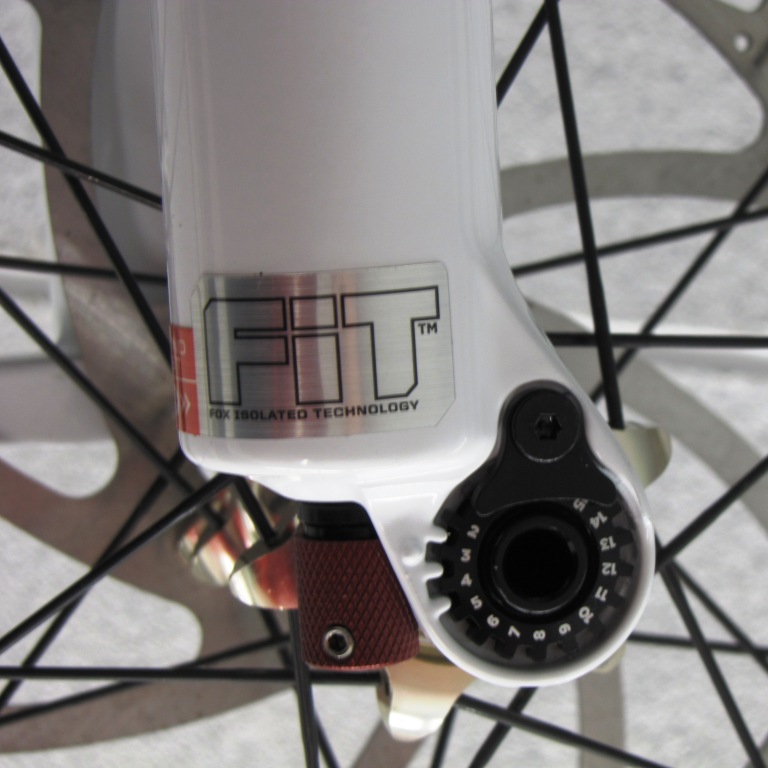
The 2010 Fox 32 Float 150 FIT RLC (MSRP $870) comes in at a feather light 3.88lbs with 150mm of travel (1 1/8 steering tube) compared to last year’s 140mm version at 3.97lbs. FIT stands for Fox Isolated Technology and the FIT damper basically reduces oil volume and weight by 71g. The damper also produces a reduction in un-sprung weight (weight not supported by the air spring) which ultimately increases tire-to-ground responsiveness and traction. Another major benefit of the FIT damper is the elimination of fluid aeration which translates into consistent damping, even over washboard trails. This is accomplished through a bladder that holds the fluid in a vacuum sealed, reduced volume chamber to prevent fluid from foaming up when traveling though the piston.

For those who might be skeptical about the QR15 thru-axle, it’s definitely time to reconsider. The QR15 was developed in collaboration with Shimano and the engineers optimized the design for weight, stiffness, and packaging for XC to light AM bikes. Bikes with the QR15 have 15% greater torsional fork stiffness with a full 25% gain in transverse shear. Ultimately this increases rider confidence and makes the fork a stronger, stiffer unit, with sixth-sense-like steering response.

On The Trails

Once everything was dialed in (see my article on Fox 32 Float 150 FIT RLC installation and set-up) I had some great opportunities to give this fork a workout with varied terrain from rollers and rooted terrain to fast, dry, hard pack on the Don trail network here in Ontario. To be honest I didn’t pay much attention to the fork for the first couple of hours of riding since most forks, including this one, need time to get broken in and to get all the seals set and working correctly. During my warm-up I found I needed to increase my initial compression and rebound settings.

After working the kinks out I really started paying attention to how the 32 Float 150 works. I have to say for a fork that has only 150mm of travel it rides like it has much more than that. The travel seemed especially long when the fork started hitting rougher, extended rooted surfaces where the 32 Float performed fantastically. Ultimately this fork seemed to perform nearly as well as the Fox 36 Talas despite the smaller diameter stanchions. This unit is a whole 1.1 lbs lighter than the 36 Talas and the narrower stanchions make this fork great for the aggressive trail rider who can make do with 10mm less travel.

Hitting 4-foot drops was nothing for this fork and it soaked up the drops as if they were sidewalk curbs. So with that bit of experience I started hitting bigger 6- and 7-foot set downs with smooth transitions with no worries and a big smile. I noticed that the harder the fork worked, the more comfortable it felt, much like the 36 Talas I reviewed not too long ago.

In the corners I definitely noticed a huge improvement over the 9mm wheel mount version that I tested last year. For starters I noticed my discs didn’t rub in berms and flat corners – the old version flexed enough that the hub would torque slightly and the disc would rub on my brake pad. Needless to say, the QR15 is well worth the upgrade by itself (that is if you have a QR15 wheelset or plan on getting one soon). The QR15 really did improve tracking on the trail and kept me pointed where I wanted to go.

If there were one thing I would improve on this fork it would be the compression dials and indicators. Unlike another fork I also ride often, the amount of difference from one click to the next on the 32 Float 150 FIT RLC is not as clearly defined which means it takes a bit of luck to find the right levels.

All in all, the Fox 150 FIT RLC is a great mountain bike fork. It tracks precisely, takes bumps, roots and drops with ease, and soaks up terrain like a mop. This fork may not be the lightest around but it is certainly very tough and responsive. I would definitely recommend the Fox 32 Float 150 FIT RLC to any of my long legged trail bike friends!

Performance Chart:

Tracking and steering 9
Rebound control 9
Compression control 8.5
Construction and quality 10
Trail worthy 1 For light XC, 10 For extreme FR/DH 7.5
Overall performance quality out of 10 9.0

Specs from FOX:

WEIGHT (15QR-includes axle)
3.88 lbs / 1.76 kg (1 1/8″ steerer)
3.85 lbs / 1.75 kg (1.5″ taper steerer)

TRAVEL
5.9 inches (150mm)fit1

ADJUSTMENTS
- Low speed compression- Lockout force adjust- Lever actuated lockout- Air spring pressure
- Rebound

DAMPER
NEW FIT

LOWER LEG
(post-style disc brake mounting only)
- 15QR thru-axle system

STEERER
Standard: 1 1/8″
Optional: 1.5″ Taper

SPRING
Air

FORK COLOR
White

INTENDED USE
XC, Trail, AM

Thanks to the folks at Fox for sending over the Fox 32 Float 150 FIT RLC for review.


Site Map | Advertise | Partners | Contact Us | Terms | Privacy
Campground Reviews | Hiking Trails | Trail Running | Skiing / Snow Sports | Mountain Biking
Copyright 2012 Blue Spruce Ventures LLC | Atlanta, GA
singletracks.com is yet another slick Review App